
English has many words that look almost identical but do not have the same place in modern writing.
Inclosed vs enclosed is a good example. Both spellings are connected to the same meaning, and both have appeared in English for a long time.
However, they are not equally common today.
For most modern writing, enclosed is the spelling you should choose.
It is the standard form used in everyday English, business writing, schoolwork, emails, letters, and professional documents.
Inclosed is a less common variant, and it may sound old-fashioned or appear in older texts.
Major dictionaries still record it as a variant of enclose, so calling it simply “wrong” would be misleading.
That small spelling difference can easily confuse English learners. You may see phrases such as “the documents enclosed with this letter,” and then come across an older text using “inclosed.”
Naturally, you may wonder whether one word has a different meaning.
The good news is that the basic difference is simple. Enclosed and inclosed come from the same verb idea: putting something inside, surrounding something, or closing something in.
Once you understand which form is preferred in modern English and why inclosed sometimes appears, the confusion becomes much easier to handle.
What Does “Inclosed” Mean?
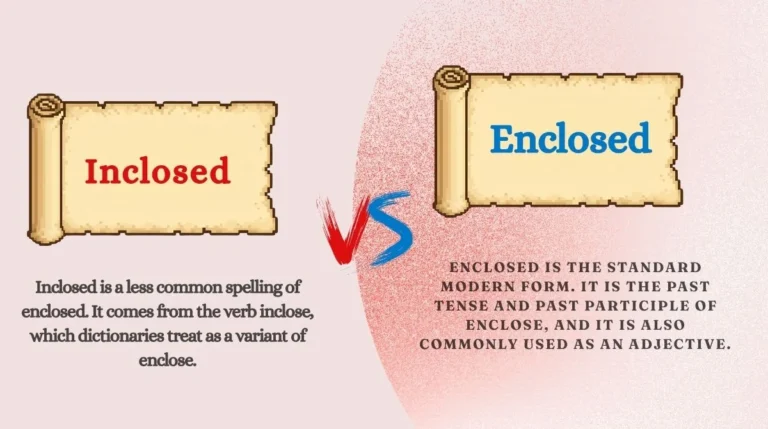
Inclosed is a less common spelling of enclosed. It comes from the verb inclose, which dictionaries treat as a variant of enclose. Merriam-Webster describes inclose as a less common variant, while Collins also calls it a less common spelling of enclose.
The meaning is therefore not very different. Inclosed can describe something that has been surrounded, shut in, contained, or placed inside an envelope or package.
For example:
- The garden was inclosed by a high wall.
- The letter inclosed a small photograph.
- The documents were inclosed in the package.
- The animals were inclosed within a secure area.
- A narrow fence inclosed the field.
- The note had been inclosed with the application.
- The old village was inclosed by stone walls.
- The payment was inclosed with the letter.
These examples show the same meanings that we normally express with enclosed.
Is “inclosed” grammatically correct?
Yes, but there is an important point to remember.
Inclosed is not a random spelling mistake. It is a recognized variant connected to inclose. Merriam-Webster lists inclose as a less common variant of enclose, and its entry for enclose notes that the forms can include enclosed / inclosed, enclosing / inclosing, and encloses / incloses.
So the problem is mainly one of modern usage, not basic grammar.
In present-day English, readers are far more accustomed to enclosed. That makes inclosed look unusual, old-fashioned, or connected with an older style of writing.
You may especially notice inclosed in older books, historical documents, or quotations from earlier English. The verb inclose has a long history as a spelling variant. Collins lists it as “a less common spelling of enclose,” while Wiktionary describes the spelling as archaic.
When might you see “inclosed”?
There are a few situations where inclosed can appear:
Older writing:
Writers in earlier periods sometimes used inclose and inclosed.
Historical quotations:
A modern writer may copy an old sentence exactly, including its original spelling.
Variant usage:
Some dictionaries still recognize the form, even though it is much less common.
Special or deliberately old-fashioned writing:
An author might use unusual spelling to create a historical feeling.
For normal school or business writing, however, choosing enclosed is much safer.
What Does “Enclosed” Mean?
Enclosed is the standard modern form. It is the past tense and past participle of enclose, and it is also commonly used as an adjective.
The verb enclose has several closely related meanings.
First, it can mean to surround something with a wall, fence, barrier, or another boundary.
For example:
The fence enclosed the garden.
Second, it can mean to place something inside an envelope, package, or similar container.
For example:
I enclosed the receipt with the letter.
Third, it can mean to contain something within a space.
For example:
The walls enclosed the courtyard.
Cambridge gives two especially useful meanings for enclosed: something can be surrounded by walls, objects, or structures, or it can be sent in the same envelope as a letter.
Example sentences with “enclosed”
Here are some natural examples:
- The house has an enclosed garden.
- Please read the enclosed instructions carefully.
- I have enclosed a copy of my passport.
- The playground is enclosed by a strong fence.
- The letter came with an enclosed form.
- The cat was kept in an enclosed area.
- Please find enclosed a copy of your invoice.
- The package contained an enclosed note.
Notice how natural the word feels in these sentences. It is used in everyday English, formal writing, business communication, and descriptions of places.
Oxford also gives examples such as “enclosed space,” “Please complete the enclosed application form,” and “Please find enclosed a copy of the requested information.”
“Enclosed” can be a verb or an adjective
This is an important grammar point.
As a verb, enclosed is the past tense or past participle of enclose:
She enclosed the documents in an envelope.
As an adjective, it describes something that is surrounded or included with another item:
Please read the enclosed document.
Another example:
The children played in an enclosed courtyard.
This is why learners may see the word used in several sentence patterns.
Difference Between Inclosed and Enclosed
The main difference is modern usage and spelling preference, rather than meaning.
Both forms are related to the verb enclose, but enclosed is the normal choice in present-day English. Inclosed is a less common variant and can sound old-fashioned. Merriam-Webster and Collins both recognize the relationship between the two forms.
Comparison table
| Point | Inclosed | Enclosed |
|---|---|---|
| Base verb | inclose | enclose |
| Basic meaning | surround, contain, put inside | surround, contain, put inside |
| Modern use | Uncommon | Very common |
| Standard choice today | Usually avoid | Yes |
| Formal writing | Can appear, but unusual | Preferred |
| Older texts | More likely | Also used |
| Adjective use | Yes, but uncommon | Very common |
| Past tense/past participle | inclosed | enclosed |
Usage difference
Imagine you are writing a business email:
Please find enclosed a copy of the contract.
This sounds normal and professional.
Now compare:
Please find inclosed a copy of the contract.
The second sentence can still be understood, and historical dictionary evidence recognizes inclosed as a variant. However, modern readers may find it strange because enclosed is the expected spelling.
Grammar logic
The grammar is actually easy.
With the modern verb enclose:
- Present: enclose
- Third-person singular: encloses
- Present participle: enclosing
- Past tense: enclosed
- Past participle: enclosed
With the variant verb inclose:
- Present: inclose
- Third-person singular: incloses
- Present participle: inclosing
- Past tense: inclosed
- Past participle: inclosed
Collins lists these variant forms directly.
So there is a complete verb pattern behind inclosed. The problem is not that the spelling breaks an English grammar rule. The issue is that enclose/enclosed has become the normal modern form.
Meaning comparison
There is essentially no important meaning difference in ordinary use.
Enclosed: surrounded or included inside something.
Inclosed: the same basic idea, but expressed through the less common spelling.
For learners, this is a useful rule:
Same basic meaning, different level of modern usage.
That is the key to this pair.
Grammar Rules You Must Remember
Rule 1: Use “enclosed” for normal modern English
When you are writing an email, school assignment, report, letter, application, or website content, enclosed is usually the best choice.
Please find enclosed the requested documents.
The garden is completely enclosed by a fence.
This matches the standard form shown by major learner dictionaries such as Cambridge and Oxford.
Rule 2: “Inclosed” is a recognized variant, not a different meaning
Do not think that inclosed refers to a special type of enclosure.
It does not normally have a separate everyday meaning. Dictionaries connect it directly to enclose.
The yard was inclosed by a wall.
This follows the same basic idea as:
The yard was enclosed by a wall.
Rule 3: Use “enclosed” in professional communication
Professional writing usually values clarity and familiar word forms.
That means this is the better choice:
I have enclosed my résumé with this email.
Rather than:
I have inclosed my résumé with this email.
The first version is immediately familiar to modern readers.
Rule 4: Do not confuse “enclosed” with “include”
Although the words are related in history and meaning, they are not interchangeable.
Enclose means to put something inside or surround it.
Include means to have something as part of a group or whole.
Compare:
I enclosed the receipt with the letter.
The price includes delivery.
You can enclose a document in an envelope, but you do not normally say you “include” it in an envelope when describing the physical act.
Common Mistakes Students Make
One common mistake is believing that inclosed and enclosed are completely different words.
They are not different in the way accept and except are different. They are variant forms connected to the same verb. The real issue is which one fits modern usage better.
Mistake 1: Using “inclosed” everywhere
A learner may find inclosed in an old dictionary or book and assume it is just as common as enclosed.
Better: Use enclosed in modern writing.
❌ Please find inclosed the documents.
✅ Please find enclosed the documents.
Mistake 2: Thinking “inclosed” is always wrong
This goes too far in the other direction.
Because dictionaries still recognize inclose as a variant, inclosed is not simply a meaningless spelling error.
A better explanation is:
Inclosed is valid as a variant, but enclosed is the normal modern form.
Mistake 3: Changing the meaning
Some students assume that inclosed means “inside” while enclosed means “surrounded.”
That distinction is not reliable. Both forms can be connected with surrounding something or putting something inside a parcel or envelope.
Mistake 4: Writing “inclose” because it looks logical
The spelling inclose may seem logical because something goes “in.” But English spelling is not always built from simple visual logic.
For current standard usage, enclose is the safer verb.
Easy correction tip
Whenever you are unsure, ask yourself:
“Would I normally see this spelling in a modern email, dictionary, schoolbook, or business letter?”
For enclosed, the answer is yes.
For inclosed, the answer is usually no.
That quick test can help you choose the modern form.
Easy Trick to Remember the Difference
Here is a simple memory trick:
ENclosed = ENvelopes
Think of the first two letters:
ENclosed → ENvelope
When you put a letter inside an envelope, it is enclosed.
The check is enclosed in the envelope.
This does not explain the complete history of the word, but it is a useful learner-friendly trick.
Another way to remember it is:
Modern English prefers ENclosed.
When you are writing for school, work, customers, or general readers, choose enclosed unless you have a special reason to preserve an older spelling.
Think of inclosed as a word you may recognize, but not one you usually need to use.
That difference matters. Good English is not only about knowing whether a form exists. It is also about knowing which form sounds natural to modern readers.
Daily Life Examples of “Enclosed”
Here are some everyday situations where enclosed sounds completely natural.
1. Sending an application
I have enclosed a copy of my passport with the application.
2. Sending a business letter
Please find enclosed the documents you requested.
This formal expression is well established in business English. Cambridge and Oxford both give examples of this type.
3. Talking about a garden
We have an enclosed garden at the back of the house.
4. Describing a playground
The children are playing in an enclosed playground.
5. Talking about an animal area
The rabbits are kept in an enclosed area.
6. Sending a card
I have enclosed a birthday card for your daughter.
7. Giving instructions
Please complete the enclosed form and return it by Friday.
8. Talking about a building
The shopping center has a large enclosed area for children.
9. Emailing documents
I have enclosed the revised report for your review.
10. Talking about a package
The instructions were enclosed inside the box.
These sentences show why enclosed is such a useful word. It works in homes, offices, schools, letters, emails, packages, buildings, and many other everyday settings.
Practice Section: Choose the Correct Word
Choose inclosed or enclosed in each sentence.
1.
Please find ________ a copy of the agreement.
2.
The garden was ________ by a tall wooden fence.
3.
The writer used the old spelling “________” in the historical document.
4.
I have ________ the receipt with my application.
5.
The children were playing in an ________ courtyard.
Answers
1. enclosed
2. enclosed
3. inclosed
4. enclosed
5. enclosed
The first, second, fourth, and fifth examples use the spelling that modern readers normally expect. The third deliberately refers to an older or variant spelling.
FAQs
What is the difference between inclosed and enclosed?
There is very little difference in basic meaning. Both are associated with the idea of surrounding, containing, or putting something inside. Enclosed is the normal modern spelling, while inclosed is a less common variant recorded by dictionaries.
Is “inclosed” a correct word?
Yes, inclosed is a recognized word form, but it is uncommon in modern English. Merriam-Webster lists inclose as a less common variant of enclose. For ordinary modern writing, enclosed is usually the better choice.
Is “enclosed” more correct than “inclosed”?
For modern standard English, enclosed is the preferred choice. However, that does not mean inclosed has no historical or dictionary status. It is a variant form rather than a completely unrelated or meaningless spelling.
Can we use “inclosed” in formal writing?
You can encounter it in formal or historical writing, but it is usually better to use enclosed in modern formal communication. In business letters, applications, reports, and emails, enclosed will look much more natural to today’s readers.
Is “please find enclosed” correct English?
Yes. “Please find enclosed…” is a standard formal expression, especially in letters and business communication. Oxford and Cambridge both provide examples of enclosed in this kind of sentence.
Do “inclose” and “enclose” have the same pronunciation?
They are pronounced essentially the same. The spelling changes, but the pronunciation does not give learners a useful way to tell them apart. That is another reason this pair can be confusing when you first encounter the written forms.
Conclusion
The difference between inclosed vs enclosed is much simpler than it first appears. Both spellings are connected to the same basic idea: surrounding something, containing something, or putting something inside an envelope or package.
The important point for modern English learners is usage. Enclosed is the standard, familiar, and widely preferred form today. It is the spelling you should normally use in emails, schoolwork, business letters, applications, reports, and everyday communication.
Inclosed is a recognized variant, but it is less common and may feel old-fashioned. Major dictionaries still record the relationship between inclose and enclose, so it is better to call it an uncommon variant than a simple spelling mistake.
The easiest rule to remember is this: when writing modern English, choose “enclosed.” The more you see the word in real sentences, the more natural that choice will become.

Evan Rellmont is a writer who turns thoughtful ideas into meaningful words, creating stories and reflections that connect, inspire, and leave a lasting impression.
2 thoughts on “Inclosed vs Enclosed: Which Spelling Is Correct in 2026?”