
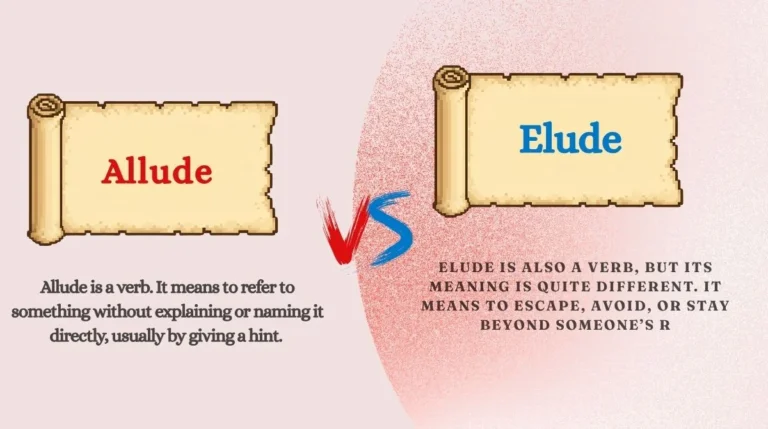
Elude
Have you ever written a sentence and stopped because you could not decide between allude and elude? You are not alone.
These two words look and sound almost the same, and both come from Latin roots connected with ludere, meaning “to play.” But their meanings are very different.
The confusion usually happens because both words contain -lude and have the same ending sound. However, the first part of each word gives you a useful clue.
Allude is connected with making a reference or hinting at something, while elude is connected with escaping, avoiding, or failing to reach something.
You may see these words in books, newspapers, school essays, movies, business writing, and everyday conversations.
For example, someone may allude to a problem without explaining it clearly.
A difficult goal may elude someone, meaning they cannot achieve it. A person can also elude the police by avoiding capture.
By the end of this guide, the difference should feel much easier.
You will learn what each word means, how to use it in a sentence, which prepositions go with it, the mistakes learners often make, and a simple memory trick that can help you choose the right word quickly.
What Does “Allude” Mean?
Allude is a verb. It means to refer to something without explaining or naming it directly, usually by giving a hint. Cambridge defines allude to as mentioning someone or something without talking about it directly, while Merriam-Webster describes allude as making an indirect reference.
Think of it this way: when you allude to something, you do not fully say it. You point toward it with words.
For example:
“She alluded to problems at work.”
This means she mentioned the problems, but she did not explain them in detail.
When should you use “allude”?
Use allude when a person mentions an idea, event, person, problem, or experience indirectly.
The most common structure is:
allude to + person/thing
Examples:
- The teacher alluded to an important rule but did not explain it.
- He alluded to his past during the interview.
- She alluded to some family problems.
- The speaker alluded to the recent changes in the company.
- The book alludes to several famous historical events.
- My friend alluded to a surprise, but he would not tell me what it was.
- The manager alluded to possible changes in the schedule.
- The writer alluded to the earlier chapter.
Notice an important point: allude is normally followed by “to.” So learners often remember it as the phrase allude to. Cambridge specifically gives allude to someone/something as the standard construction.
Is “allude” always indirect?
Usually, yes, especially in modern everyday usage. But there is a useful detail here. Merriam-Webster notes that allude has also been used for a more direct reference for a long time. So the idea that allude can only mean “indirectly mention” is too strict. Still, for learners, remembering “hint or refer to” is the safest and clearest rule.
Common confusion with “allude”
One common mistake is treating allude as a synonym for avoid. It is not.
- Correct: The politician alluded to the issue.
- Meaning: The politician referred to the issue.
It does not mean that the politician escaped the issue.
Another mistake is forgetting to:
- Less natural for learners: She alluded the problem.
- Standard learner-friendly form: She alluded to the problem.
The verb is pronounced /əˈluːd/, with the stress on the second syllable.
What Does “Elude” Mean?
Elude is also a verb, but its meaning is quite different. It means to escape, avoid, or stay beyond someone’s reach. It can describe a person escaping capture, or a goal, answer, memory, or understanding that remains out of reach.
There are three especially useful meanings to remember.
1. To escape or avoid being caught
When someone eludes another person, they successfully avoid being caught or stopped.
Examples:
- The suspect eluded the police.
- The fox eluded the hunters.
- The thief managed to elude capture.
- The driver eluded the officers and disappeared.
- The criminal had eluded the authorities for years.
- The bird quickly eluded the cat.
Oxford describes this use as managing to avoid or escape from someone or something, especially in a clever way.
2. To fail to achieve something
We can also use elude when a desired result stays out of reach.
Examples:
- The championship has eluded her for years.
- Success continued to elude the young team.
- A gold medal eluded him once again.
- Financial stability has eluded many families.
- The company worked hard, but major profits continued to elude it.
- Victory seemed close, but it still eluded us.
Cambridge gives this meaning clearly: if something you want eludes you, you do not succeed in achieving it.
3. To be impossible to remember or understand
This meaning can seem strange at first, but it is very common in formal English.
Examples:
- Her name eludes me.
- The answer still eludes me.
- The meaning of the poem eluded the students.
- I know his face, but his name eludes me.
- The solution continued to elude the researchers.
- The reason for the mistake eluded everyone.
Here, the idea is that the information is just out of reach.
Oxford gives examples such as sleep, chart success, and a tiny detail that can all “elude” someone. Cambridge also uses the pattern “her name eludes me” for something a person cannot remember.
The pronunciation is /ɪˈluːd/. Notice that it is very close to allude in sound, which is one reason the two words are so easy to mix up.
Difference Between Allude and Elude
The easiest way to understand the difference is to focus on the action.
Allude = refer to or hint at something.
Elude = escape, avoid, or remain out of reach.
Here is a simple comparison:
| Feature | Allude | Elude |
|---|---|---|
| Part of speech | Verb | Verb |
| Basic meaning | Refer to or hint at | Escape, avoid, or stay beyond reach |
| Common structure | allude to something | elude someone/something |
| Main idea | Mentioning | Escaping or failing to reach |
| Typical object | An idea, person, topic, event | A person, police, capture, goal, answer, memory |
| Example | She alluded to the problem. | The suspect eluded the police. |
| Another example | He alluded to his childhood. | The answer eluded me. |
Usage difference
Compare these two sentences:
The writer alluded to the war.
Here, the writer mentioned or referred to the war.
The writer eluded the interviewer.
Here, the writer avoided or escaped the interviewer.
The two verbs may look almost identical, but they describe completely different actions.
Grammar logic
There is an important grammar difference as well.
Allude is commonly used with to:
subject + allude + to + noun
For example:
The speaker alluded to the report.
Elude is normally a transitive verb, which means it takes an object directly:
subject + elude + object
For example:
The suspect eluded the police.
We do not normally say:
The suspect eluded to the police.
That structure is wrong because elude does not work like “allude to.”
Meaning comparison
Imagine a classroom.
A student says:
“Someone in this class cheated on the test.”
The student has not named the person, but has given a clue. The student alluded to the cheating incident.
Now imagine the teacher tries to find the student who cheated, but the student runs away and cannot be caught. The student eludes the teacher.
One word points toward something. The other word moves away from something.
Grammar Rules You Must Remember
Rule #1: Use “allude to” when you mean “refer to”
The safest pattern is:
allude to + noun/person/idea
Example:
The manager alluded to changes in the company.
Do not confuse this with elude.
Rule #2: Use “elude” when something escapes or remains out of reach
Example:
The police searched for the suspect, but he eluded them.
You can also use it for goals:
The dream of winning the title has eluded her.
The important idea is something cannot be caught, achieved, remembered, or understood.
Rule #3: “Allude” usually needs “to”
For beginners, remember this fixed pattern:
allude to
Examples:
He alluded to the problem.
She alluded to her childhood.
The article alludes to an older study.
This pattern is especially useful in formal writing.
Rule #4: “Elude” does not take “to” in the same way
Say:
The criminal eluded the police.
Not:
The criminal eluded to the police.
Say:
The answer eluded me.
Not:
The answer eluded to me.
This direct-object pattern is a helpful grammar clue.
Common Mistakes Students Make
These mistakes are common because the words are so similar in spelling and sound.
Mistake 1: Using “elude” when you mean “mention”
Wrong:
The article eluded to the famous event.
Correct:
The article alluded to the famous event.
Why? Because the article referred to the event. It did not escape from it.
Mistake 2: Using “allude” when you mean “escape”
Wrong:
The thief alluded the police.
Correct:
The thief eluded the police.
The thief escaped or avoided capture.
Mistake 3: Adding “to” after “elude”
Wrong:
The answer eluded to me.
Correct:
The answer eluded me.
The answer was difficult for me to remember or understand.
Mistake 4: Forgetting “to” after “allude”
Wrong:
She alluded the problem.
Better:
She alluded to the problem.
This is probably the easiest grammar rule to use when you are unsure.
Why do these mistakes happen?
The two verbs are almost twins in appearance. Their pronunciation is also very similar. Both end in -lude, and both have roots in Latin words built from ludere.
The solution is not to memorize long dictionary definitions. Instead, connect each word with one strong idea:
Allude → mention
Elude → escape
Once those ideas are fixed in your mind, your sentence choices become much easier.
Easy Trick to Remember the Difference
Here is a classroom trick that works well.
Think: “A = Add a hint”
ALLUDE starts with A.
Think:
A = Add a hint
When you allude to something, you add a hint about it rather than saying everything clearly.
She alluded to the surprise.
She gave a hint about the surprise.
Think: “E = Escape”
ELUDE starts with E.
Think:
E = Escape
When someone eludes the police, they escape.
When an answer eludes you, it stays out of your reach.
The suspect eluded the police.
The answer eluded me.
This little trick is simple, but it can save you from a lot of mistakes.
There is another way to think about it:
Allude points toward an idea.
Elude moves away from a problem, person, or goal.
That mental picture is often easier to remember than a dictionary definition.
Daily Life Examples
These words are not only for difficult books or formal exams. They appear in many real-life situations.
Example 1: Talking about a secret
A: Why did Sarah say she was “having a difficult week”?
B: I think she was alluding to problems at home.
She did not explain the problems directly. She only hinted at them.
Example 2: Talking about a football match
A: Did your team win the final?
B: No. The championship eluded us again.
The team failed to achieve the championship.
Example 3: Forgetting someone’s name
A: Who was that actor?
B: I know his face, but his name eludes me.
The speaker cannot remember the name.
Example 4: A difficult question
A: Did you understand the teacher’s final question?
B: Not really. The answer eluded me.
The answer was beyond the speaker’s understanding.
Example 5: A news report
A: Did the report mention the old scandal?
B: Yes, but it only alluded to it.
The report referred to the scandal without discussing it fully.
Example 6: Avoiding the police
A: Was the suspect caught?
B: No. He eluded the police for several days.
He successfully avoided being caught.
Example 7: A manager talking about change
A: Did your boss say the company will change its schedule?
B: He alluded to possible changes, but he gave no details.
He hinted at the changes.
Example 8: Reaching a goal
A: Has Maya finally won the competition?
B: Not yet. First place has eluded her twice.
She has failed to achieve first place.
Example 9: Talking about a book
A: Why did the author mention that old legend?
B: The story alludes to several ancient myths.
The story refers to those myths.
Example 10: Remembering a detail
A: You looked confused during the meeting.
B: I knew there was one important point, but it eluded me.
The speaker could not remember or understand the point.
Practice Section
Choose allude or elude in each sentence. Remember to think about the meaning before you choose.
1.
The speaker ________ to the company’s financial problems without giving details.
2.
The runner managed to ________ the reporters after the race.
3.
She said the answer was ________ her.
4.
The novel ________ to a famous historical event.
5.
The team worked hard, but the trophy continued to ________ them.
Answers
1. alluded — The speaker referred to the problems indirectly.
2. elude — The runner avoided or escaped the reporters.
3. eluding — The answer was beyond her reach or understanding.
4. alludes — The novel refers to the event.
5. elude — The team has not succeeded in achieving the trophy.
A useful test is to replace the word mentally.
If refer to / hint at works, choose allude.
If escape / remain out of reach / fail to achieve works, choose elude.
FAQs About Allude and Elude
What is the difference between allude and elude?
Allude means to refer to something, usually without naming or explaining it directly. Elude means to escape, avoid, or remain beyond someone’s reach. For example, “She alluded to the problem,” but “The answer eluded me.”
Can we use “allude” in questions?
Yes. You can use it in questions whenever you want to ask whether someone referred to something.
For example:
“Did he allude to the meeting?”
The normal structure is allude to + person or thing.
Is “allude” formal or informal?
Allude is more common in formal, academic, literary, and careful speech than in very casual conversation. It is still a normal English word, though, especially when talking about indirect references.
Is “elude” formal or informal?
Elude is also somewhat formal. It is common in news writing, books, essays, sports writing, and serious conversation. It can describe escaping capture or failing to achieve or remember something.
Can “elude” mean “forget”?
Not exactly. It is better to say that something eludes your memory or eludes you when you cannot remember it. For example, “Her name eludes me” means “I cannot remember her name.”
Is “allude to” always about something indirect?
Usually, yes, and this is the best meaning for learners to remember. However, Merriam-Webster notes that allude has also been used for direct reference, so the word is not limited by an absolute rule that every reference must be indirect.
Final Conclusion
Allude and elude are easy to confuse because they look almost the same and have very similar pronunciations. The good news is that their meanings are actually quite different once you learn the main idea behind each one.
Use allude when someone refers to or hints at a person, idea, topic, event, or problem. The most common pattern is allude to.
Use elude when someone or something escapes, avoids, stays out of reach, or cannot be achieved, remembered, or understood. It usually takes a direct object, as in “The suspect eluded the police” or “The answer eluded me.”
The easiest memory trick is:
ALLUDE = Add a hint.
ELUDE = Escape.
Try using each word in your own sentences today. A few minutes of practice can make this pair much easier to remember, and soon you will be able to choose the right word without stopping to think.

Evan Rellmont is a writer who turns thoughtful ideas into meaningful words, creating stories and reflections that connect, inspire, and leave a lasting impression.
1 thought on “Allude vs Elude: What’s the Difference? Easy Guide for 2026”