
Miner and minor are easy to mix up because they sound almost exactly the same in everyday English.
When you hear someone say one of these words, you may not know which spelling they mean.
This is especially common for English learners because the difference is in the spelling and meaning, not usually in the pronunciation.
A miner is generally a person who works in a mine, such as a coal miner or gold miner.
The word can also be used for someone involved in cryptocurrency mining.
A minor, on the other hand, has several meanings. It can describe something that is small, less serious, or less important.
It can also mean a person who is legally below the age of adulthood. In American English, it can refer to a student’s secondary subject at college.
That may sound like a lot to remember, but the difference becomes much easier when you connect each word to a simple idea.
Think about mine when you see miner. A miner works in a mine.
Think about small, less important, or underage when you see minor.
This spelling difference matters in school writing, emails, exams, essays, news reports, and everyday communication.
Writing minor when you mean a person who works in a mine can completely change the meaning of a sentence.
By the end of this guide, you will know exactly when to use miner and when to use minor, how their grammar works, and how to remember the correct spelling without guessing.
What Does “Miner” Mean?
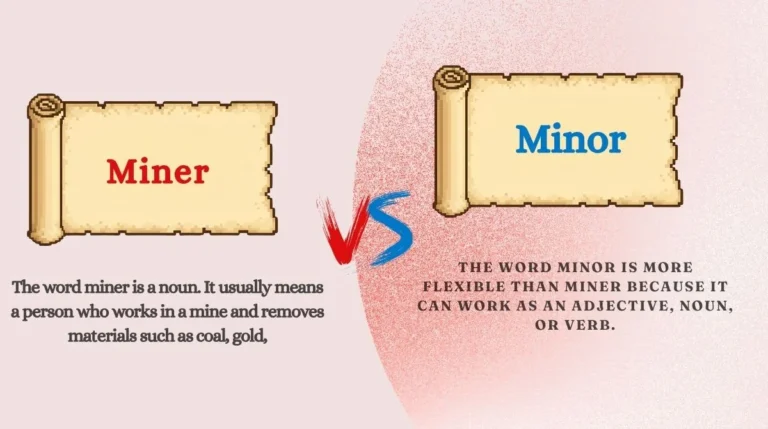
The word miner is a noun. It usually means a person who works in a mine and removes materials such as coal, gold, copper, or other useful minerals from the ground. Cambridge Dictionary defines a miner as a person who works in a mine.
The easiest way to understand this word is to connect it directly with mine:
mine → miner
A miner is a person who works in a mine.
For example, a coal miner works in coal mines, while a gold miner looks for or extracts gold.
The word can also be used in modern technology. A cryptocurrency miner is a person or computer system that uses special software to help process certain cryptocurrency transactions and may receive digital tokens as a reward.
When should you use “miner”?
Use miner when you are talking about:
- A person who works in a mine
- Someone who extracts minerals from the ground
- A coal miner, gold miner, or similar worker
- A person or system involved in cryptocurrency mining
It is normally used as a countable noun, so you can say:
- a miner
- one miner
- two miners
- many miners
Grammar rule for “miner”
Because miner is a noun, it usually names a person or, in modern technology, a participant in a mining process.
You can use it after articles and numbers:
- a miner
- the miner
- three miners
- several miners
The plural form is miners.
Examples with “miner”
- The miner worked underground for eight hours.
- Her grandfather was a coal miner.
- Several miners were waiting outside the mine.
- The gold miner searched the area carefully.
- My history teacher told us about miners during the industrial revolution.
- The miners returned to work after the safety inspection.
- A cryptocurrency miner uses software to help maintain a blockchain network.
- The company hired more miners for the new project.
Notice that miner always connects naturally with the idea of mining or a mine.
A common learner confusion
Many learners see the word miner and think it might describe something that is “small” because it sounds like minor.
That is not correct.
Miner = a person involved in mining
Minor = small, less important, or under the legal adult age
For example:
The miner was injured at work.
This means a worker in a mine was injured.
But:
The minor was injured at work.
This means a person who is legally underage was injured.
Those are two completely different meanings.
What Does “Minor” Mean?
The word minor is more flexible than miner because it can work as an adjective, noun, or verb.
Its most common adjective meaning is small, less important, or less serious compared with something else. Cambridge Dictionary gives examples such as minor problem, minor injury, and minor adjustments.
It is often the opposite of major.
So:
major = important, serious, or large
minor = less important, less serious, or smaller
For example:
It was a minor problem.
This means the problem was not very serious.
When should you use “minor”?
Use minor when you mean:
- Something that is small or not very serious
- Something that is less important than another thing
- A person who is legally below the age of adulthood
- A secondary subject in college, especially in American English
- A musical key or scale associated with the minor system
- The verb minor, meaning to study something as a secondary college subject in American English
The exact meaning depends on the sentence.
“Minor” as an adjective
As an adjective, minor comes before a noun in many common sentences:
- a minor problem
- a minor injury
- a minor change
- a minor mistake
- a minor accident
- a minor issue
Examples:
- The doctor said it was only a minor injury.
- We had a minor problem with the computer.
- There are a few minor changes to the plan.
- He made a minor mistake on the test.
- The car had only minor damage.
- The disagreement was a minor issue.
Cambridge Dictionary explains this use as having little importance, influence, or effect, especially when compared with something of the same type.
“Minor” as a noun
As a noun, minor can mean a person who is not yet legally an adult. The exact legal age depends on the country and the specific law, so the word is used in legal contexts rather than as a simple statement about someone’s exact age.
Examples:
- The law gives special protection to minors.
- The person involved was a minor.
- Adults have a responsibility to protect minors from harm.
The plural is minors.
“Minor” in education
In American college English, a minor is a subject that a student studies as a secondary field, while a major is the main field of study. Cambridge gives the example I minored in Spanish in college.
For example:
My major is biology, but my minor is English.
This means biology is the student’s main subject, while English is the secondary subject.
“Minor” in music
You may also see minor in music:
- a minor key
- a minor scale
- a minor chord
In basic music language, minor describes a musical system that often gives a darker or sadder feeling compared with major.
For English learners, this is usually less important than the everyday meanings, but it is useful to recognize the word when you see it.
Difference Between Miner and Minor: Detailed Explanation
The biggest difference is simple:
Miner is connected to mining.
Minor is connected to ideas such as small, less important, underage, or secondary.
Here is a quick comparison:
| Feature | Miner | Minor |
|---|---|---|
| Part of speech | Mainly noun | Adjective, noun, and verb |
| Main meaning | A person who works in a mine | Something less important/small, or a person under legal adulthood |
| Related word | Mine, mining | Major |
| Common phrase | coal miner | minor problem |
| Plural | miners | minors |
| Used in college | No | Yes, especially in U.S. English |
| Used in music | No | Yes |
| Meaning connected to underground work | Yes | No |
Usage difference
Compare these sentences:
The miner went underground.
The person is a worker in a mine.
The minor problem was fixed quickly.
The problem was small or not serious.
Now compare:
The miner needed a helmet.
This describes a mining worker.
The minor needed permission from an adult.
This describes someone who is legally underage.
The spelling changes the meaning completely.
Grammar logic
One useful clue is that miner comes from the noun mine.
A mine is a place where people extract useful materials.
A miner is the person who works there.
You can remember the relationship:
mine + -er = miner
English often uses -er to make a word for a person who performs an action.
For example:
- teach → teacher
- drive → driver
- farm → farmer
- mine → miner
The word minor does not come from this pattern.
Sentence structure difference
Because miner is normally a noun, you usually use it where a person or thing can appear:
The miner arrived early.
We interviewed the miner.
Three miners were rescued.
Because minor is often an adjective, it can directly describe a noun:
a minor injury
a minor mistake
a minor change
It can also act as a noun:
The minor called her parents.
And in American English, it can function as a verb:
She minored in history.
This difference in grammar is a powerful way to decide which word belongs in a sentence.
Meaning comparison
Think of these pairs:
miner / mine
The miner works in the mine.
minor / major
The mistake was minor, not major.
These two word families give you an excellent memory system.
Grammar Rules You Must Remember
Rule 1: Use “miner” for a person connected with a mine
When the sentence is about someone who extracts minerals or works in mining, choose miner.
Example:
The miner carried his equipment underground.
You can usually connect the word to mine or mining.
Rule 2: Use “minor” for something small, less serious, or less important
When you are describing a problem, change, injury, mistake, or similar thing as not very serious, use minor.
Example:
She suffered a minor injury.
The injury was not major or severe.
Rule 3: “Minor” can be a noun for an underage person
When the sentence is about someone who has not reached the legal adult age, minor can be used as a noun.
Example:
The website requires parental permission for minors.
Do not write miners unless you are talking about people involved in mining.
Rule 4: Use “minor in” for a secondary college subject
In American English, a student can minor in a subject.
Example:
He majored in business and minored in psychology.
The structure is:
subject + minored in + field
For example:
I minored in English.
This is different from miner, which is a noun and does not work in this structure.
Common Mistakes Students Make
The main reason these words cause mistakes is pronunciation. In common English pronunciation, miner and minor are pronounced the same or nearly the same, so listening alone does not always help you choose the spelling.
The safest method is to look at the meaning and grammar.
Mistake 1: Using “minor” for a mining worker
Wrong:
My grandfather was a minor.
That sentence could mean your grandfather was underage, which probably is not what you mean.
Correct:
My grandfather was a miner.
He worked in a mine.
Mistake 2: Using “miner” for a small problem
Wrong:
We had a miner problem with the printer.
That spelling changes the word into a noun connected with mining.
Correct:
We had a minor problem with the printer.
Mistake 3: Mixing up “major” and “minor”
Students sometimes memorize minor only as a sound, without remembering its relationship with major.
Remember:
major problem = more serious or important
minor problem = less serious or important
For example:
It was a major accident.
It was a minor accident.
Mistake 4: Confusing “minor” with a child’s name
A person who is legally underage can be called a minor, but that does not mean every child should always be called a minor in everyday conversation.
Words such as child, kid, teenager, or young person may sound more natural depending on the situation.
Minor is especially common in legal and formal contexts.
Mistake 5: Forgetting that “minor” can be a verb
In American college English:
She minored in French.
Do not confuse this with miner.
The ending may sound the same, but the grammar and meaning are completely different.
Easy Trick to Remember the Difference
Here is a simple memory trick that works well for students.
Miner has “mine” inside it
Look closely:
MINER
It begins with MINE.
Think:
MINER → MINE → MINING
A miner works in a mine.
That is your strongest memory clue.
Now remember:
MINOR → MAJOR
These words are opposites in many situations.
For example:
a major problem / a minor problem
a major mistake / a minor mistake
major damage / minor damage
So you can use this two-part memory system:
Miner = mine
Minor = opposite of major
That is much easier than trying to memorize a long dictionary definition.
Daily Life Examples
Here are some simple examples you might hear or use in real conversations.
1. Talking about a mining worker
A: What did your grandfather do?
B: He was a miner.
Here, miner means he worked in a mine.
2. Talking about a small problem
A: Is the computer badly damaged?
B: No, it has only a minor problem.
The problem is not serious.
3. Talking about an injury
A: Are you okay after the accident?
B: Yes. I only have a minor injury.
The injury is relatively small or not serious.
4. Talking about a mistake
A: Did you make any errors in the report?
B: Just one minor mistake.
The mistake was small and did not greatly affect the report.
5. Talking about age
A: Can a minor sign this form alone?
B: It depends on the rules and the situation.
Here, minor refers to a person who is legally underage.
6. Talking about a job
A: Why does he wear a helmet at work?
B: He is a miner, so he needs protective equipment.
The job is mining.
7. Talking about college
A: What are you studying at university?
B: My major is economics, and I minored in English.
Here, minor refers to a secondary field of study.
8. Talking about changes
A: Did you change the whole design?
B: No, I made a few minor changes.
The changes were small.
9. Talking about an underground worker
A: Who rescued the workers?
B: The emergency team rescued the miners.
Use miners because these people worked in a mine.
10. Talking about an unimportant detail
A: Was the delay a serious problem?
B: No, it was only a minor issue.
The issue was not important or serious.
These examples show why the context matters more than the sound of the word.
Practice Section
Choose miner or minor in each sentence.
- The ______ worked in a coal mine for many years.
- We had a ______ problem with the internet.
- The hospital said his injuries were ______.
- Several ______ were waiting outside the mine.
- She majored in history and ______ in English.
Answers
- miner
- minor
- minor
- miners
- minored
Try to explain why each answer is correct. That step helps you remember the difference much longer than simply checking the answer.
FAQs About Miner vs Minor
What is the difference between miner and minor?
Miner usually means a person who works in a mine or is involved in mining. Minor usually means something small, less important, or less serious. It can also mean a person who is legally underage, a secondary college subject, or a musical term.
Are miner and minor pronounced the same?
In standard modern English, they are generally pronounced the same or nearly the same: /ˈmaɪnər/ in American English and /ˈmaɪnə(r)/ in British English. Because the pronunciation is so similar, learners often rely on context and spelling to tell them apart.
Is a miner a person who works underground?
Usually, yes. A miner is a person who works in a mine, often extracting materials such as coal or gold. The word can also be used in modern contexts such as cryptocurrency mining.
Is minor formal or informal?
It depends on the meaning. Minor is a normal everyday adjective in phrases such as minor problem and minor injury. The noun minor, meaning an underage person, is especially common in formal, legal, and official contexts.
Can minor be used as a verb?
Yes. In American English, minor can be a verb meaning to study a subject as a secondary field in college. For example: I minored in mathematics.
What is an easy way to remember miner and minor?
Remember two connections:
Miner → mine → mining
Minor → major → less important or less serious
When you see miner, think about a person working in a mine. When you see minor, think about something smaller, less important, underage, or secondary.
Final Conclusion
The difference between miner and minor becomes simple once you stop relying on pronunciation and start looking at meaning.
A miner is connected to a mine. It usually means a person who works in a mine, such as a coal or gold miner. It can also describe someone involved in cryptocurrency mining.
A minor has several meanings. It can describe something that is small, less important, or less serious. It can also refer to a person who is legally underage. In American English, it may describe a student’s secondary college subject, and it can also be used as a verb in phrases such as minor in English.
The easiest memory trick is:
Miner = mine
Minor = major’s opposite
Once you practice these two connections, you will be much less likely to confuse the spellings. Pay attention to the sentence around the word, and the correct choice will usually become clear.

Evan Rellmont is a writer who turns thoughtful ideas into meaningful words, creating stories and reflections that connect, inspire, and leave a lasting impression.