
Have you ever typed “I am loosing my patience” or “She is loosing her keys” and then wondered whether the spelling was correct? You are not alone.
Loosing and losing look almost the same, and both are connected to verbs, so they can be very confusing for English learners.
The important thing is that these words do not have the same meaning. In fact, they come from two different verbs.
Losing is the -ing form of lose, while loosing is the -ing form of the much less common verb loose. Oxford lists losing as the -ing form of lose, while loosing is the -ing form of loose.
The confusion usually happens because learners see the word lose and think the spelling should become loosing when adding -ing. English spelling does not work that way here.
Once you understand what each word means, the difference becomes much easier. You will know why we say “I am losing my phone”, “They are losing the game”, and “He is losing his temper”, but why “loosing” is normally reserved for a very different meaning, such as releasing something or making something less tight.
Cambridge and Oxford both define lose around ideas such as no longer having something, being unable to find something, or being defeated.
By the end, you should be able to choose the correct spelling confidently in schoolwork, emails, messages, social media posts, and everyday English.
What Does “Loosing” Mean?
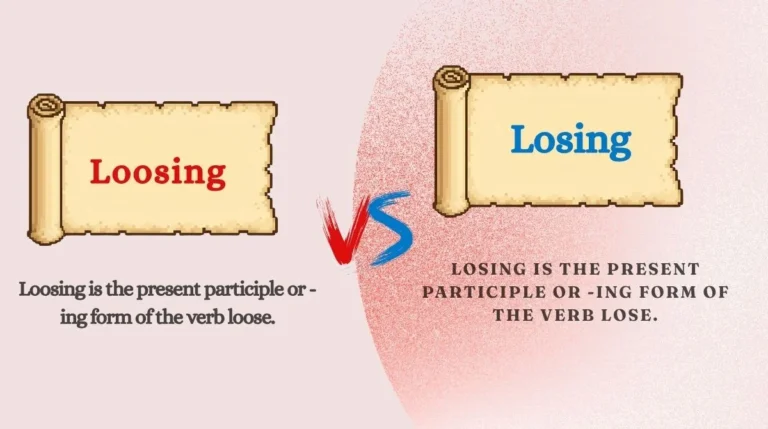
Loosing is the present participle or -ing form of the verb loose.
The verb loose means to release something, set something free, or make something less tight. It is a real English word, but it is much less common than lose. Oxford marks the verb loose as formal and gives examples involving releasing something or making something loose, such as loosening reins.
So, when you write loosing, you are talking about the action of releasing or making something less tight, not about failing to keep something.
When should you use “loosing”?
Use loosing only when the meaning comes from the verb loose.
For example:
- The rider was loosing the reins.
- The rope was loosing from the knot.
- The army was loosing arrows at the target.
- He was loosing the bird from its cage.
- The worker was loosing the tight rope.
- She was loosing the straps on the bag.
- The movement was loosing a wave of excitement.
- The hunter was loosing an arrow.
Some of these examples may sound unusual in everyday modern English because speakers often prefer releasing or loosening instead. Oxford specifically gives loose meanings such as releasing something, making something loose, and firing bullets or arrows.
Grammar rule for “loosing”
The basic pattern is:
loose + ing = loosing
Here, loose is the base verb, and loosing is its -ing form.
For example:
The horse is loose.
The rider is loosing the reins.
Notice that the meaning is related to making something free or less tight.
Why does “loosing” sound strange?
For many learners, the strange part is that they rarely see loosing in normal conversation. That is because modern English usually uses other words in many situations.
For example, instead of:
He is loosing the rope.
A speaker may naturally say:
He is loosening the rope.
And instead of:
She is loosing the prisoner.
A speaker may say:
She is releasing the prisoner.
So loosing is a correct word, but it is not normally the word you need when you mean that something has disappeared, is no longer available, or is being lost.
Common confusion with “loosing”
The biggest mistake is using loosing when you really mean losing.
For example:
❌ I am loosing my wallet.
✅ I am losing my wallet.
The first sentence suggests the action comes from loose, which does not make sense here. The second sentence means you are no longer able to find or keep your wallet.
What Does “Losing” Mean?
Losing is the present participle or -ing form of the verb lose.
This is the word you will use much more often in everyday English.
The verb lose has several common meanings. It can mean to stop having something, to be unable to find something, to be defeated, to fail to keep something, or to stop feeling something. Cambridge and Oxford both list these everyday meanings.
Examples include losing your keys, losing a game, losing money, losing confidence, and losing interest.
When should you use “losing”?
Use losing when something is being lost.
Here are some common examples:
- I am losing my keys again.
- She is losing interest in the project.
- We are losing the game.
- He is losing money every month.
- They are losing customers.
- I am losing my patience.
- The company is losing business.
- She is losing confidence.
- He is losing his phone all the time.
- The team is losing by two points.
These uses match the normal meanings of lose. Oxford notes that lose can mean being unable to find something, no longer having something, being defeated, failing to keep something, and more.
Grammar rule for “losing”
The spelling is:
lose + ing = losing
The final e is removed before adding -ing.
So:
lose → losing
Not:
lose → loosing
This is one of the most important spelling rules to remember for this pair.
More meanings of “losing”
The word can describe many situations.
When you cannot find something:
I’m losing my keys again.
When you are being defeated:
Our team is losing the match.
Oxford specifically uses lose for being defeated in competitions, races, elections, arguments, and battles.
When you stop having something:
She is losing her job.
When you stop feeling something:
He is losing interest in the course.
When something is reduced:
The business is losing money.
Cambridge also gives examples of lose meaning no longer having something, having something taken away, or stopping feeling things such as confidence or interest.
Common confusion with “losing”
Students sometimes think that losing should contain two o letters because they hear the long vowel sound in lose.
That is a spelling mistake.
Remember:
lose → losing
The word has only one o after the l:
losing
Difference Between Loosing and Losing
The easiest way to understand the difference is to focus on the base verb and the meaning.
| Word | Base verb | Main meaning | Commonness | Example |
|---|---|---|---|---|
| loosing | loose | releasing or making something less tight | Uncommon | He was loosing the reins. |
| losing | lose | no longer having, failing to keep, or being defeated | Very common | She is losing her keys. |
The two words look nearly identical, but one extra o changes the verb.
1. Meaning difference
Loosing comes from loose.
Losing comes from lose.
Compare:
The rider is loosing the reins.
This suggests the rider is releasing or making the reins less tight.
The rider is losing the reins.
This suggests the rider is no longer able to keep or hold the reins.
That is a major difference in meaning.
2. Usage difference
Losing appears constantly in everyday speech.
You may hear:
“I’m losing my phone.”
“We’re losing time.”
“She’s losing patience.”
“They’re losing money.”
“He’s losing the game.”
By contrast, loosing is uncommon. It tends to appear in specific or formal contexts involving release, freedom, ropes, reins, arrows, or similar ideas. Oxford’s verb entry gives loose the meanings “release” and “make something loose,” among others.
3. Grammar difference
Both are -ing forms, but they belong to different verbs.
lose → losing
loose → loosing
This is why you cannot replace one with the other simply because they sound similar.
4. Sentence structure
Both words can appear after forms of be in the present continuous:
She is losing her wallet.
He is loosing the rope.
However, the object and meaning change.
With losing, the object is often something you no longer have, something you fail to keep, or something you are failing to win.
With loosing, the object is usually something being released or made less tight.
5. Meaning comparison
Think of these two ideas:
Losing = something is going away from you or you fail to keep it.
Loosing = you are setting something free or making it less tight.
That simple contrast will solve most spelling problems.
Grammar Rules You Must Remember
Rule 1: “Losing” comes from “lose”
The verb lose changes to losing when you add -ing.
lose → losing
Example:
I am losing my keys.
Do not write:
❌ I am loosing my keys.
Rule 2: “Loosing” comes from “loose”
The verb loose changes to loosing.
loose → loosing
Example:
He was loosing the horse from the stable.
The meaning is related to releasing or setting free.
Oxford confirms that loose can mean to release something or make something loose.
Rule 3: One “o” does not mean one meaning, but it matters for spelling
Many students remember the difference like this:
lose = losing
loose = loosing
The spelling tells you which verb you are using.
This is especially important because lose and loose already have different meanings before the -ing ending is added.
Rule 4: Use the meaning, not just the sound
When speaking, these words can sound very similar, so listening alone may not help.
Ask yourself:
Am I talking about something being lost?
Use losing.
Am I talking about releasing something or making it less tight?
Use loosing.
For example:
I am losing my jacket.
You cannot find or keep your jacket.
I am loosing the knot.
You are making the knot less tight.
Common Mistakes Students Make
The most common mistake is replacing losing with loosing.
This happens because learners often know the word loose, which means “not tight,” and accidentally connect it to situations involving loss.
Mistake 1
❌ She is loosing her phone.
✅ She is losing her phone.
The intended meaning is that she no longer has or cannot find her phone.
Mistake 2
❌ We are loosing the match.
✅ We are losing the match.
A team that is being defeated is losing.
Oxford lists lose as the verb used when someone is defeated in a game, race, argument, election, or other competition.
Mistake 3
❌ I am loosing patience.
✅ I am losing patience.
The expression is lose patience, so its -ing form is losing patience.
Mistake 4
❌ He is loosing money.
✅ He is losing money.
Again, this comes from lose money.
Mistake 5
❌ They are loosing customers.
✅ They are losing customers.
A company that no longer keeps its customers is losing customers. Cambridge gives lose examples involving jobs, market share, sales, and other things that are no longer kept.
Why do these mistakes happen?
There are several reasons.
First, lose is an irregular verb in its past tense:
lose → lost
That makes some learners unsure about how the present participle should be formed.
Second, the word loose is much easier to connect to the spelling loosing, especially because it already ends in -se.
Third, both words have similar sounds. English has many pairs where spelling and pronunciation do not make the difference obvious.
An easy correction tip
When you are unsure, remove -ing.
Ask:
What is the base verb?
If the base verb is lose, write:
losing
If the base verb is loose, write:
loosing
That small habit can prevent a lot of mistakes.
Easy Trick to Remember the Difference
Here is a simple memory trick:
Lose something → losing
Think about your phone, keys, money, game, time, patience, or confidence.
You lose them.
So:
lose → losing
Examples:
- losing my keys
- losing money
- losing the game
- losing patience
- losing time
Loose something → loosing
Think about something being released or made less tight.
So:
loose → loosing
A rope can become loose.
A person can release a bird.
A rider can loosen or release the reins.
One important note: although loosing is technically correct in certain contexts, everyday speakers often choose loosening or releasing because those words sound more natural.
A useful classroom sentence to remember is:
You lose a phone, but you can loose a rope.
That distinction is not perfect for every possible context, but it is excellent for remembering the main difference.
Daily Life Examples
The word losing is far more common in ordinary conversation. Here are some natural examples you may hear or use every day.
1. Losing a phone
A: Where is your phone?
B: I think I’m losing it again. I can’t find it anywhere.
Here, losing means you no longer know where the phone is.
2. Losing a game
A: How is your team doing?
B: We’re losing by three points.
This means the team is currently behind.
3. Losing patience
A: Why are you upset?
B: I’m losing my patience with this computer.
This means the speaker is becoming less patient.
4. Losing money
A: How is your new business going?
B: Honestly, we’re losing money right now.
The business is spending or failing to earn enough money.
5. Losing time
A: We need to leave soon.
B: I know. We’re losing time.
This means valuable time is passing or being wasted.
6. Losing interest
A: Do you still enjoy the course?
B: Not really. I’m losing interest.
The speaker is becoming less interested.
7. Losing confidence
A: Why don’t you want to give the presentation?
B: I’m losing confidence.
The speaker’s confidence is becoming weaker.
8. Losing keys
A: Have you seen my keys?
B: No. Are you losing them again?
This is a very common everyday use.
9. Loosing the reins
A: Why is the horse moving faster?
B: The rider is loosing the reins.
Here, the meaning comes from the less common verb loose: to release or make something less tight.
10. Loosing an arrow
The archer was loosing arrows toward the target.
This is another specialized use of loose, which Oxford includes in its dictionary definition.
Notice how different the meanings are. In the first eight examples, something is being lost, reduced, or no longer kept. In the last two, something is being released.
Practice Section
Choose loosing or losing in each sentence.
1.
I am ______ my keys again.
2.
Our team is ______ the final match.
3.
The rider was ______ the reins.
4.
She is ______ interest in the subject.
5.
The archer was ______ arrows at the target.
Answers
1. losing
I am losing my keys again.
2. losing
Our team is losing the final match.
3. loosing
The rider was loosing the reins.
4. losing
She is losing interest in the subject.
5. loosing
The archer was loosing arrows at the target.
A good way to check every answer is to identify the base verb first.
lose → losing
loose → loosing
FAQs
What is the difference between loosing and losing?
Losing is the -ing form of lose and usually means no longer having something, failing to keep something, or being defeated. Loosing is the -ing form of loose and means releasing something or making something less tight.
Is “loosing” a real word?
Yes. Loosing is a real English word, but it is much less common than losing. It comes from the verb loose, which can mean to release something, make something less tight, or fire an arrow or bullet.
Is “losing” correct in “I am losing my keys”?
Yes. Losing is correct because the sentence comes from the verb lose. Cambridge defines lose as being unable to find something or no longer having something.
Can I use “loosing” in everyday conversation?
You can, but you probably will not need it very often. In many everyday situations, speakers prefer words such as releasing or loosening. The word loosing is correct in specific contexts, especially when something is being released or made less tight.
Why is it “losing” and not “loosing”?
Because the base verb is lose, not loose. When lose takes the -ing ending, the final e is removed:
lose → losing
By contrast:
loose → loosing
The different spelling reflects the different base verbs.
Is “losing” used for people, things, and games?
Yes. Losing has many common uses. You can be losing your keys, losing money, losing confidence, losing a person, or losing a game. Oxford and Cambridge both list several of these meanings.
Conclusion
The difference between loosing and losing becomes much easier when you stop looking only at the spelling and focus on the base verb.
Losing comes from lose. It is the word you need when something is disappearing from your possession, when you fail to keep something, when you are being defeated, or when something such as patience, confidence, or interest is becoming weaker.
Loosing comes from loose. It is a real word, but it is much less common. It relates to releasing something, setting something free, making something less tight, or, in some contexts, firing an arrow or similar object.
The easiest spelling rule is:
lose → losing
loose → loosing
When you are writing, ask yourself what you really mean. Are you losing something, or are you loosing something? Once you connect the spelling to the meaning, this common English mistake becomes much easier to avoid.
Keep practicing with real sentences, and soon losing will become automatic while loosing will stay in its proper place.

Evan Rellmont is a writer who turns thoughtful ideas into meaningful words, creating stories and reflections that connect, inspire, and leave a lasting impression.
1 thought on “Loosing vs Losing: What’s the Difference? Easy Guide for 2026”