
Have you ever written the number 40 and suddenly stopped because you were not sure whether it is spelled fourty or forty? You are not alone.
This is one of those small English spelling problems that can confuse even learners who already know basic English very well.
The confusion is understandable because the word comes from four, so many people naturally think that the correct spelling should be fourty. It looks logical. After all, four + -ty seems like it should make fourty.
However, English spelling does not always follow a simple pattern, and this is a good example.
The correct spelling is forty. The spelling fourty is incorrect in standard English.
Knowing the correct form matters because numbers appear everywhere in daily life. You may need to write your age, a price, an address, a score, a date, a quantity, or a phone-related detail.
A small spelling mistake in a common number can make your writing look less polished.
By the end of this guide, you will understand why forty is correct, why fourty is wrong, how to use the word in sentences, and how to remember its spelling without having to think twice.
You will also see common mistakes, everyday examples, practice questions, and simple memory tricks that make the rule easy to keep in mind.
What Does “Fourty” Mean?
Is “fourty” a real English word?
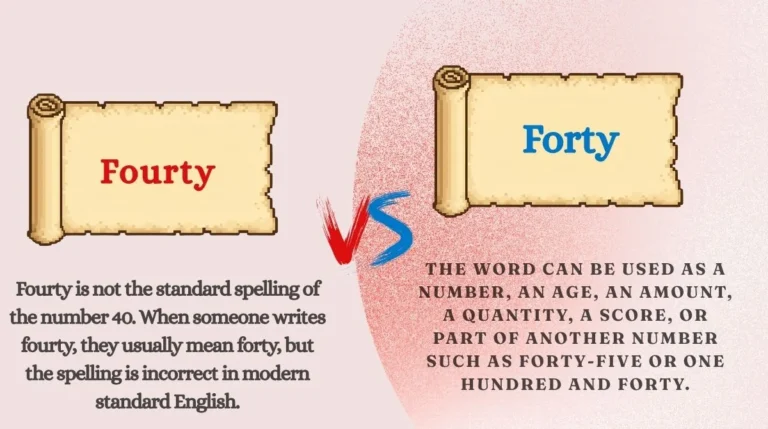
Fourty is not the standard spelling of the number 40. When someone writes fourty, they usually mean forty, but the spelling is incorrect in modern standard English.
So, if you are talking about the number that comes after thirty-nine and before forty-one, the correct written form is:
Forty = 40
There is no standard English spelling rule that allows fourty as an alternative. It is simply a common spelling error.
Why do people write “fourty”?
The main reason is easy to understand. Learners already know the word four, which is spelled with four letters: f-o-u-r. When they want to make the number ten-times style, they may add -ty and get fourty.
This looks reasonable, but English has a special spelling for 40.
Compare these forms:
- four → 4
- fourteen → 14
- forty → 40
Notice that forty loses the u from four.
That small change is what causes the confusion.
When should you use “fourty”?
In standard written English, you should not use fourty. It is considered a misspelling.
You may sometimes see it in old documents, informal writing, learner exercises, social media posts, or text written by someone who does not know the standard spelling. That does not make it correct.
For schoolwork, exams, professional writing, emails, websites, and other formal situations, always choose forty.
Examples with “fourty”
Because fourty is incorrect, these examples show what learners often write by mistake:
- ❌ I am fourty years old.
- ❌ There are fourty students in the room.
- ❌ The bag costs fourty dollars.
- ❌ She waited for fourty minutes.
- ❌ He scored fourty points.
- ❌ My grandmother is fourty-five.
Each sentence should use forty, not fourty.
Common learner confusion
A common question is: “If four is written with a u, why does forty lose it?”
The answer is that English spelling developed over time, and not every related word keeps exactly the same letters. The number forty has its own established spelling. It is one of those forms you simply need to learn.
Think of it as a spelling fact rather than a mistake in logic. Your brain is making a reasonable connection, but English does not always reward that connection.
So remember:
Four is 4, but forty is 40.
What Does “Forty” Mean?
Simple definition
Forty is the correct English word for the number 40.
It comes between thirty-nine (39) and forty-one (41).
The word can be used as a number, an age, an amount, a quantity, a score, or part of another number such as forty-five or one hundred and forty.
When should you use “forty”?
Use forty whenever you need to write the number 40 in words.
For example:
- I have forty books.
- She is forty years old.
- We waited forty minutes.
- The price is forty dollars.
It can also appear in larger numbers:
- forty-one
- forty-two
- forty-three
- forty-four
- forty-five
- forty-six
- forty-seven
- forty-eight
- forty-nine
This is important because once you know the spelling of forty, you can correctly spell all the numbers from 41 to 49.
Grammar rule
Forty is a number word, so it can work as a determiner before a plural noun.
For example:
- forty students
- forty questions
- forty days
- forty apples
The noun after forty is normally plural because the number is greater than one.
You can also use it with expressions of age:
- He is forty.
- She is forty years old.
When writing a compound number from 41 to 99, a hyphen is normally used between the tens and ones:
- forty-one
- forty-two
- fifty-six
- seventy-eight
8 example sentences with “forty”
- My father is forty years old.
- There are forty students in the class.
- I spent forty minutes reading.
- The shop is about forty miles away.
- She bought forty notebooks for the students.
- The team scored forty points in the game.
- We need forty chairs for the event.
- He saved forty dollars last week.
All of these sentences use forty, the correct spelling.
Difference Between Fourty and Forty
The difference is actually very simple:
Forty is correct. Fourty is incorrect.
This is not a case where two words have different meanings. They are not two separate English words with different uses. Instead, one is the standard spelling and the other is a common misspelling.
| Word | Correct? | Meaning | Example |
|---|---|---|---|
| fourty | ❌ No | Intended to mean 40 | ❌ I have fourty books. |
| forty | ✅ Yes | The number 40 | ✅ I have forty books. |
Usage difference
There is no real usage difference between the two spellings because fourty should not be used in standard English.
When you mean the number 40, write forty.
Grammar logic
The grammar is not difficult. Both forms are usually intended to function as the same number. The problem is spelling, not sentence structure.
For example:
- ❌ She is fourty.
- ✅ She is forty.
The grammar pattern is fine in both sentences. The first one fails only because the number is misspelled.
Sentence structure difference
There is also no special sentence structure for fourty versus forty.
You can place forty in many common structures:
Forty + plural noun
- forty students
- forty pages
- forty minutes
Subject + be + forty
- She is forty.
- He is forty.
Forty + compound number
- forty-one
- forty-five
- forty-nine
Meaning comparison
Both forms are generally intended to refer to the same number: 40.
But only forty is accepted as the correct standard spelling.
This means the easiest rule is:
If you mean 40, spell it F-O-R-T-Y.
Grammar Rules You Must Remember
Rule 1: The correct spelling of 40 is “forty”
This is the most important rule.
Do not add the u found in four.
- ✅ forty
- ❌ fourty
Example:
There are forty students in my school bus.
Rule 2: “Forty” can be used before plural nouns
When the number describes more than one thing, the noun is usually plural.
- forty books
- forty people
- forty cars
- forty questions
Example:
The teacher gave us forty questions.
Not:
The teacher gave us forty question.
Rule 3: Numbers from 41 to 49 begin with “forty”
The spelling stays forty when you add another number.
- forty-one
- forty-two
- forty-three
- forty-four
- forty-five
- forty-six
- forty-seven
- forty-eight
- forty-nine
Example:
My brother is forty-two years old.
A common error is to carry the incorrect spelling into the larger number:
❌ fourty-two
✅ forty-two
Rule 4: Use a hyphen in numbers such as “forty-five”
When a number between 21 and 99 is made from a tens word plus a single-digit number, standard written English normally uses a hyphen.
For example:
- twenty-one
- thirty-five
- forty-two
- sixty-seven
- ninety-nine
Example:
The hotel has forty-five rooms.
The key point is that forty never changes to fourty.
Common Mistakes Students Make
One of the biggest reasons this error happens is that learners spell words according to what seems logical.
English has many spelling patterns that are not completely predictable. Learners often see:
four + ty = fourty
That looks natural, especially when they compare it with words such as:
- thirty
- fifty
- sixty
- seventy
- eighty
- ninety
But the correct form has a shorter spelling:
forty
Mistake 1: Adding the “u”
❌ fourty dollars
✅ forty dollars
The easiest fix is to remember that forty has no “u.”
Mistake 2: Writing “fourty” in ages
❌ My mother is fourty years old.
✅ My mother is forty years old.
Because age is such a common topic, this error appears often in everyday writing.
Mistake 3: Writing “fourty” in compound numbers
❌ forty? Wait—this is where many learners write: fourty-six
✅ forty-six
The spelling of the base number stays forty, even when another digit follows it.
Mistake 4: Assuming “fourty” is acceptable because it is understandable
Someone may understand what you mean when you write fourty. However, being understandable does not make a spelling correct.
For example, a reader may still understand:
I am fourty years old.
But in a school assignment or professional document, the expected form is:
I am forty years old.
Easy correction tip
Whenever you write this number, stop for one second and ask yourself:
Does forty have a “u”?
The answer is no.
That tiny pause can prevent the mistake.
Easy Trick to Remember the Difference
Here is a simple memory trick:
“Four has U, forty does not.”
You can memorize the pair like this:
FOUR = U
FORTY = no U
Imagine the U in four getting dropped when the word becomes forty.
Another useful trick is to focus on the middle:
FOUR
FORTY
The word forty is shorter than you may expect. It is only:
F-O-R-T-Y
There is no U between R and T.
You can also remember a simple classroom sentence:
“Four has U, forty has no U.”
Say it aloud a few times. It is short, clear, and easy to remember.
One more idea is to connect the spelling with the number itself:
4 = four
40 = forty
Do not try to build the second spelling mechanically from the first one. Treat forty as its own spelling.
That is often the easiest way to avoid the problem.
Daily Life Examples
The word forty appears in normal conversations more often than many learners realize. Here are some easy examples from everyday situations.
1. Talking about age
A: How old is your uncle?
B: He is forty years old.
2. Talking about money
A: How much is this shirt?
B: It is forty dollars.
3. Talking about time
A: How long did you wait?
B: About forty minutes.
4. Talking about quantity
A: How many students are coming?
B: Around forty students.
5. Talking about distance
A: Is the airport far from here?
B: Yes, it is about forty miles away.
6. Talking about a score
A: How many points did your team get?
B: We got forty points.
7. Talking about age in a casual sentence
A: You do not look forty!
B: Thank you. I will take that as a compliment.
8. Talking about a number of pages
A: How long is the report?
B: It is about forty pages.
9. Talking about objects
A: How many boxes do we need?
B: We need forty boxes.
10. Talking about an exact number
A: How many guests have arrived?
B: Forty guests have arrived so far.
These examples show how common the number is in normal speech and writing. Once you learn the correct spelling, you can use it confidently in many situations.
Practice Section
Choose the correct spelling in each sentence.
1.
I bought (fourty / forty) apples.
2.
My grandfather is (fourty / forty) years old.
3.
The journey took (fourty / forty) minutes.
4.
She scored (fourty / forty) points.
5.
There are (fourty-five / forty-five) students in the hall.
Answers
- forty
- forty
- forty
- forty
- forty-five
Quick self-check
Try to write these without looking:
- 40 = ______
- 41 = ______
- 45 = ______
- 49 = ______
Correct answers:
- 40 = forty
- 41 = forty-one
- 45 = forty-five
- 49 = forty-nine
The important part is to keep the spelling forty in every one.
FAQs
What is the difference between fourty and forty?
Forty is the correct spelling of the number 40. Fourty is a common spelling mistake and is not the standard form used in modern English.
Is “fourty” a correct spelling?
No. In standard English, fourty is incorrect. The correct spelling is forty, without the letter u.
Why is forty spelled without the “u” in four?
English spelling has developed over a long period, and related words do not always keep all the same letters. The established spelling of the number 40 is forty, so it needs to be learned as a special spelling.
Is forty used in formal English?
Yes. Forty is the normal and standard spelling in both formal and informal English. You can use it in schoolwork, business writing, exams, emails, reports, and everyday conversation.
How do you spell 45 correctly?
The correct spelling is forty-five. The first part must be forty, not fourty. A hyphen connects the tens number and the single-digit number.
What is an easy way to remember forty?
Remember this sentence:
“Four has U, forty has no U.”
It reminds you that the u appears in four but disappears in forty.
Can “fourty” be used in a sentence?
It may appear in a sentence as a spelling mistake, but it should not be used in standard English writing. Replace it with forty.
Is “forty” related to the word “four”?
Yes. The number refers to the same numerical family, but its standard spelling is forty, not a direct letter-by-letter combination of “four” and “-ty.” English spelling often has historical forms that must simply be memorized.
Conclusion
Choosing between fourty or forty is easy once you remember one key fact: forty is the correct spelling of 40.
The incorrect form fourty is common because it seems to come naturally from the word four. That is why many students, and even some fluent speakers, make the mistake from time to time. Still, standard English uses forty without the letter u.
You can use forty when talking about age, money, time, distance, people, objects, scores, and many other everyday things. The same spelling is also used in compound numbers such as forty-one, forty-five, and forty-nine.
The easiest memory trick is:
Four has U, forty has no U.
Keep that sentence in your mind whenever you write the number 40. With a little practice, the spelling will soon feel completely natural. Once you remember this small rule, you will never need to wonder about fourty or forty again.

Evan Rellmont is a writer who turns thoughtful ideas into meaningful words, creating stories and reflections that connect, inspire, and leave a lasting impression.
1 thought on “Fourty or Forty: Which Spelling Is Correct in 2026?”