
English has many word combinations that sound exactly the same but work differently in a sentence. Pick up vs pickup is a good example.
Both forms contain the same words and are pronounced almost the same, but the space between them can change their grammar and meaning.
This can be confusing for English learners because we often hear sentences such as “I’ll pick you up,” “The pickup is ready,” and “What time is pickup?” They look very similar, yet pick up and pickup do not play the same role.
The good news is that the difference becomes much easier when you look at the job each form does in a sentence. Pick up is usually a phrasal verb.
It describes an action, such as lifting something, collecting someone, learning something, or getting better.
Pickup is usually a noun, and it can also work as a modifier before another noun. It can refer to the act or service of collecting someone or something, or to a type of vehicle.
This small difference matters in emails, school writing, text messages, travel conversations, workplace English, and everyday speech. Using the correct form makes your sentence clearer and more natural.
By the end, you will know when to write pick up, when to write pickup, how sentence structure changes, which common mistakes to avoid, and how to remember the difference without memorizing a long grammar rule.
What Does “Pick Up” Mean?
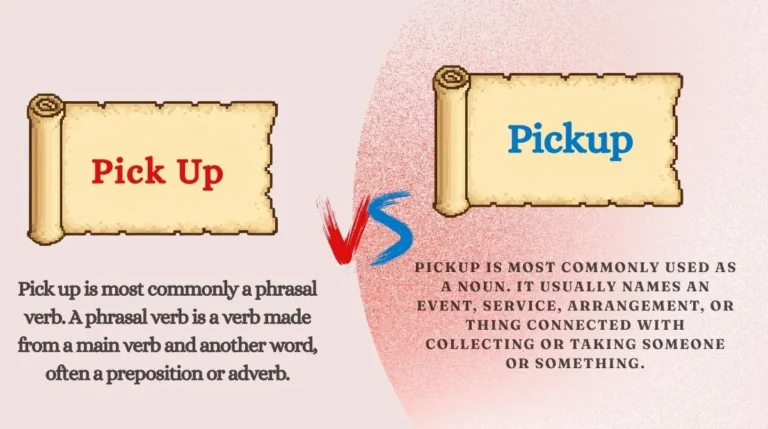
Pick up is most commonly a phrasal verb. A phrasal verb is a verb made from a main verb and another word, often a preposition or adverb.
Here, pick is the main verb and up is the particle.
The basic idea of pick up is to take, collect, lift, or get something. However, English speakers use it in several other ways too.
1. Pick up means to lift something
When you take something from a lower place and lift it, you can use pick up.
For example:
- Please pick up that pen from the floor.
- She picked up the book from the table.
- He bent down to pick up the toy.
- Can you pick up the paper?
- I picked up my bag and left the room.
- The child picked up a small stone.
In these examples, an action is happening. That is one of the clearest signs that pick up is functioning as a verb.
2. Pick up means to collect someone or something
Another very common meaning is to go somewhere and collect a person or thing.
For example:
- I will pick up my sister after school.
- Can you pick me up at the airport?
- Dad is going to pick up the kids.
- She picked up the package this morning.
- We need to pick up some groceries.
- The driver will pick up the passengers at 8 a.m.
This meaning is especially common in everyday spoken English.
Notice the sentence:
I will pick you up at six.
Because pick up is a phrasal verb, a pronoun normally goes between the two parts:
pick + you + up
We say:
- Pick me up.
- Pick him up.
- Pick her up.
Not:
- Pick up me.
- Pick up him.
- Pick up her.
With a normal noun, both positions can sometimes work:
- Pick up the box.
- Pick the box up.
However, with a pronoun, the middle position is required:
- Pick it up.
- Pick them up.
3. Pick up can mean learn something
English speakers also use pick up when someone learns a skill or information naturally.
For example:
- She picked up some Spanish while living in Madrid.
- I picked up a few useful phrases.
- Children often pick up new words quickly.
- He picked up the basics of cooking from his mother.
Here, the person is not physically lifting anything. The phrase has a different, figurative meaning: to learn or acquire something, often without formal study.
4. Pick up can mean improve
Another useful meaning is “to become better” or “to become more active.”
For example:
- Business is starting to pick up.
- Sales picked up after the holiday.
- The rain picked up in the evening.
- The conversation picked up after dinner.
In these cases, pick up is still a verb, but the meaning is not physical.
Grammar rule for “pick up”
Because pick up is a verb, it can change tense:
- Present: I pick up my son every day.
- Past: I picked up my son yesterday.
- Future: I will pick up my son tomorrow.
- Continuous: I am picking up my son now.
- Perfect: I have picked up my son already.
This is an important clue. When you need an action word, pick up is usually the form you need.
A common learner confusion
Many learners see “pickup” used in sentences like “Pickup is at 3 p.m.” and begin writing pickup everywhere.
That can create errors.
Compare:
- I will pick up the order at 3 p.m.
- Pickup is at 3 p.m.
The first sentence describes an action, so pick up is the correct form.
The second sentence uses pickup as a noun. The meaning is the collection process or scheduled collection time.
What Does “Pickup” Mean?
Pickup is most commonly used as a noun. It usually names an event, service, arrangement, or thing connected with collecting or taking someone or something.
The exact meaning depends on the sentence.
1. Pickup means the act of collecting someone or something
For example:
- Pickup is available after 5 p.m.
- Your order is ready for pickup.
- The store offers free pickup.
- Please wait in the pickup area.
- We are changing the pickup location.
- There is a small fee for pickup.
Here, pickup is the name of the activity or service.
You can often test this by asking:
What is it?
The answer might be “pickup.”
For example:
“What is at the front desk?”
“The pickup is at the front desk.”
This noun use is especially common in shopping, transportation, schools, delivery services, and workplaces.
2. Pickup can refer to a vehicle
In American English, pickup can also refer to a pickup truck, a type of vehicle with an open cargo area at the back.
Examples:
- He drives a pickup.
- They bought a new pickup last year.
- The tools are in the pickup.
- A red pickup is parked outside.
In this meaning, pickup is a noun for a vehicle.
British English speakers often use pick-up or pickup truck, depending on the context and style guide.
3. Pickup can describe something related to collecting
You may also see pickup before another noun as a modifier.
Examples:
- pickup service
- pickup location
- pickup time
- pickup truck
- pickup point
- pickup area
For example:
- What is the pickup time?
- Please go to the pickup area.
- The hotel provides a pickup service.
- We need to confirm the pickup location.
Here, pickup is not the main verb. It helps describe another noun.
Is “pickup” ever a verb?
In standard modern English, the normal verb spelling is pick up, with a space.
So write:
- I will pick up the documents.
- Can you pick up the children?
- She picked up the phone.
Do not normally write:
- I will pickup the documents.
- Can you pickup the children?
- She pickedup the phone.
The one-word form is generally used as a noun or modifier, not as the ordinary phrasal verb.
What about “pick-up” with a hyphen?
You may also see pick-up.
This happens because English spelling changes depending on the role of a word and the style used by a publication. Some dictionaries and style guides recognize pick-up as a noun or modifier, while many modern texts use pickup.
For learners, the easiest working rule is:
Use “pick up” for the verb. Use “pickup” for the noun or modifier.
When reading, however, do not be surprised if you see pick-up.
Difference Between Pick Up and Pickup
The biggest difference is simple:
Pick up = verb phrase
Pickup = noun or modifier
That one idea will solve most questions.
Comparison table
| Feature | Pick up | Pickup |
|---|---|---|
| Main grammar role | Phrasal verb | Noun / modifier |
| Spelling | Two words | One word |
| Describes an action? | Yes | Usually no |
| Can change tense? | Yes | No |
| Example | I will pick up the parcel. | The pickup is ready. |
| Common meaning | Collect, lift, learn, improve | Collection, service, vehicle |
| Pronoun position | Pick it up | Not applicable |
| Can modify another noun? | No | Yes |
Compare the meaning
Look at these two sentences:
I will pick up my order at noon.
Here, pick up tells us what the speaker will do. It is an action.
My order is ready for pickup at noon.
Here, pickup names the collection process. It is a noun.
The basic idea is almost the same, but the grammar is different.
Compare the sentence structure
With pick up, you have a subject doing an action:
Subject + pick up + object
- I pick up my bag.
- She picks up the mail.
- They picked up the children.
You can also move the object in some sentences:
- Pick up the box.
- Pick the box up.
With a pronoun:
- Pick it up.
With pickup, the word itself acts like a thing or concept:
Subject + pickup + other information
- Pickup is available today.
- The pickup starts at 4 p.m.
- We offer free pickup.
- The pickup location has changed.
It can also come before another noun:
- pickup time
- pickup service
- pickup point
Meaning comparison in real life
Imagine ordering food online.
You might say:
I will pick up my food at 7.
You are talking about your action.
The restaurant might say:
Food pickup begins at 7.
The restaurant is talking about the service or process.
Same basic idea. Different grammatical job.
Grammar Rules You Must Remember
Rule #1: Use “pick up” when it is the verb
If you are describing an action someone performs, write pick up as two words.
Examples:
- Please pick up your shoes.
- I need to pick up my medicine.
- She picked up the phone.
- We are picking up the guests.
A useful test is to change the tense.
If you can write picked up, picking up, or will pick up, you are dealing with the verb.
Rule #2: Use “pickup” when it is a noun
When you are naming the collection process, service, or arrangement, pickup is commonly one word.
Examples:
- Your order is ready for pickup.
- Pickup is available from 10 a.m.
- We offer free pickup.
- The pickup was delayed.
You can often put “the” or “a” before it:
- the pickup
- a pickup
That is a strong sign that it is being used as a noun.
Rule #3: A pronoun goes in the middle of the phrasal verb
With pick up, short pronouns usually come between pick and up.
Correct:
- Pick me up.
- Pick her up.
- Pick them up.
- Pick it up.
Incorrect:
- Pick up me.
- Pick up her.
- Pick up them.
This rule is especially useful in spoken English.
Rule #4: “Pickup” can modify another noun
One-word pickup can appear before another noun to describe something connected with collection.
Examples:
- pickup time
- pickup location
- pickup service
- pickup truck
- pickup point
For example:
What is the pickup time?
The word “pickup” is describing the kind of time being discussed.
Common Mistakes Students Make
Mistake 1: Writing “pickup” as the verb
Incorrect:
I will pickup the package tomorrow.
Correct:
I will pick up the package tomorrow.
Why? Because the sentence describes an action.
A simple correction tip is to look for the subject and action. If someone is doing the collecting, lifting, or learning, you probably need pick up.
Mistake 2: Writing “pick up” when you need a noun
Incorrect:
Your order is ready for pick up.
This form can be seen in informal writing, and some organizations use it stylistically, but pickup is a common standard noun spelling.
Better:
Your order is ready for pickup.
This is especially useful in customer-service writing and signs.
Mistake 3: Using the wrong form with a pronoun
Incorrect:
Can you pick up me at six?
Correct:
Can you pick me up at six?
The pronoun belongs between the verb and particle.
Remember:
pick + person + up
Mistake 4: Confusing “pickup time” with “pick up time”
When pickup describes the noun “time,” the closed form is commonly used:
What is the pickup time?
But when the sentence contains the verb, you need two words:
What time should I pick you up?
These sentences are very close in meaning, but their grammar is different.
Mistake 5: Thinking pronunciation tells you the spelling
This is one of the biggest problems.
When spoken quickly, pick up and pickup can sound almost identical. English spelling cannot always be predicted from sound.
That is why you should look at the word’s role in the sentence, not only how it sounds.
Easy Trick to Remember the Difference
Here is a simple classroom trick:
Action = two words. Thing or service = one word.
Think of the space in pick up as showing movement.
You pick up a bag.
You pick up your friend.
You pick up a new skill.
All of these describe something you do.
Now remove the space:
pickup
It becomes the name of something.
- pickup service
- pickup location
- pickup time
- pickup truck
So ask yourself one question:
“Am I talking about doing something, or am I naming something?”
If you are talking about doing it, choose pick up.
If you are naming the service, event, arrangement, or vehicle, choose pickup.
A real-life memory example
Imagine a food order.
You say:
I will pick up my order.
You are doing something.
The restaurant says:
Your order is ready for pickup.
The restaurant is naming the collection service.
The grammar changes because the job of the word changes.
That is the easiest way to remember the difference.
Daily Life Examples
These examples show how the two forms appear naturally in conversations.
Example 1: Talking about a ride
A: What time will you arrive?
B: I’ll pick you up at 8.
The verb is pick up, and the pronoun “you” goes in the middle.
Example 2: Talking about an order
A: Can I get delivery?
B: Yes, but pickup is free.
Here, pickup is a noun describing the collection option.
Example 3: At school
A: Who is collecting the children?
B: Their mother will pick them up after class.
This is an action, so use two words.
Example 4: At a store
A: Where do I collect my order?
B: Go to the pickup area near the entrance.
Here, pickup modifies “area.”
Example 5: At the airport
A: Who is coming to get you?
B: My brother will pick me up.
Again, this is a verb phrase.
Example 6: Talking about a schedule
A: What time can I collect the package?
B: Your pickup time is 3:30 p.m.
Here, pickup describes “time.”
Example 7: Learning English
A: How did you learn those expressions?
B: I picked them up by watching English movies.
Here, pick up means learn naturally.
Example 8: Talking about business
A: How are sales this month?
B: They are starting to pick up.
Here, the phrase means improve or become more active.
Example 9: Talking about a vehicle
A: What kind of vehicle does he drive?
B: He has a pickup.
Here, pickup means a pickup truck.
Example 10: Delivery service
A: Do you collect old furniture?
B: Yes. We provide a pickup service.
Here, pickup is describing the type of service.
Practice Section
Choose pick up or pickup to complete each sentence.
1.
I will ______ the children after school.
2.
Your order is ready for ______.
3.
What is the ______ time?
4.
Can you ______ the phone?
5.
The store offers free ______.
Answers
1. pick up
“I will pick up the children after school.”
This describes an action.
2. pickup
“Your order is ready for pickup.”
Here, it is a noun.
3. pickup
“What is the pickup time?”
“Pickup” modifies the noun “time.”
4. pick up
“Can you pick up the phone?”
This is a verb phrase.
5. pickup
“The store offers free pickup.”
The word names a service.
FAQs
What is the difference between pick up and pickup?
Pick up is normally a phrasal verb used for an action: “I will pick up the package.” Pickup is usually a noun or modifier: “The package is ready for pickup.” The spelling depends on the grammatical role.
Can we use “pick up” in questions?
Yes. Pick up is often used in everyday questions.
Examples include: “Can you pick me up?” and “What time should I pick you up?” Remember that pronouns usually come between “pick” and “up.”
Is “pickup” formal or informal?
Pickup is a normal English noun and is widely used in everyday, business, retail, school, and transportation contexts. It is not simply an informal version of pick up. The two forms usually have different grammatical jobs.
Is it “pick up time” or “pickup time”?
Pickup time is a common standard spelling when the word is being used as a modifier before “time.” For example: “Please confirm your pickup time.” When you use the phrase as a verb, write it separately: “What time should I pick you up?”
Can “pickup” mean a truck?
Yes. In American English, pickup commonly refers to a pickup truck. For example: “He drives a pickup.” You may also see pickup truck when the full vehicle name is needed.
Is “pick-up” also correct?
You may see pick-up with a hyphen, especially in dictionaries, older writing, or particular style guides. English spelling conventions vary in some compounds. For everyday learner writing, a useful rule is to use pick up for the verb and pickup for the noun or modifier.
Conclusion
The difference between pick up and pickup is much easier once you focus on grammar instead of pronunciation.
Pick up is usually a phrasal verb. It describes an action such as lifting something, collecting a person, learning a skill, or improving. Because it is a verb, it can change tense: pick up, picked up, picking up, will pick up.
Pickup is usually a noun. It can describe the act or service of collecting someone or something, and it can also describe a pickup truck. It is also commonly used before another noun in expressions such as pickup time, pickup location, and pickup service.
The best memory rule is simple: action = pick up; thing, service, or description = pickup.
Once you start noticing this difference in signs, messages, online orders, and everyday conversations, the correct spelling will feel much more natural. Read the whole sentence, identify the job of the word, and then choose the form that fits. With a little practice, this common English confusion becomes easy.

Evan Rellmont is a writer who turns thoughtful ideas into meaningful words, creating stories and reflections that connect, inspire, and leave a lasting impression.