
Have you ever typed “truely” and then stopped to wonder whether it should be “truly”? You are not alone.
This is one of those small English spelling problems that can confuse even people who already know a lot of English.
The confusion is easy to understand. The adjective is true, so when learners want to make an adverb, they naturally think that they can simply add -ly:
true + ly = truely
That looks logical, but standard English does not use that spelling. The correct form is truly, without the e.
Dictionaries such as Cambridge, Oxford, and Merriam-Webster all recognize truly as the standard adverb. It can mean sincerely, in a way that is true, or as an intensifier meaning something like “really” or “indeed.”
This little spelling difference matters because truly is common in everyday English, school writing, emails, essays, apologies, compliments, and formal communication.
You may also see it in phrases such as “I truly appreciate your help” or “She is truly talented.”
By the end of this guide, you will know why truly is correct, why truely is not the standard modern spelling, how to use the word naturally, and how to remember the spelling without checking a dictionary every time.
What Does “Truely” Mean?
Is “truely” a real English word?
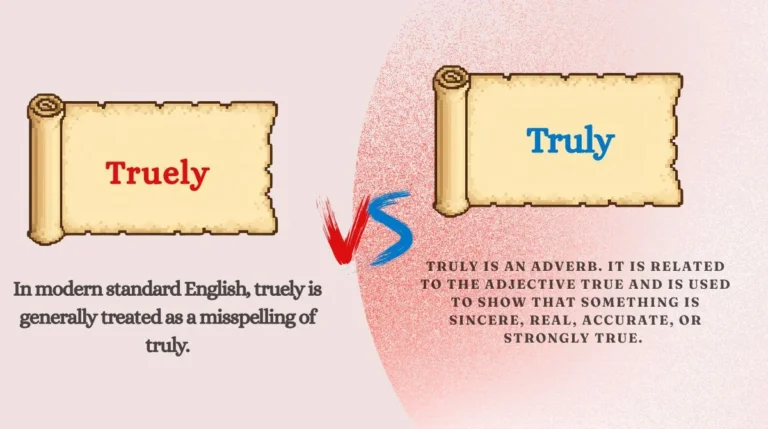
In modern standard English, truely is generally treated as a misspelling of truly. It is not the form you should use in normal academic, professional, or everyday writing. Scribbr also identifies truely as a mistaken form, while truly is the accepted adverbial form of true.
You may occasionally find truely in old texts or historical discussions of English spelling. Historical spelling was much less fixed than modern English spelling, and older writers sometimes used forms that are no longer standard today. Dictionary.com notes that truely was historically used, including by Shakespeare, but modern standard English settled on truly.
For a learner today, however, the practical rule is simple:
Do not use “truely” in standard English. Use “truly.”
Why does “truely” look correct?
The problem comes from a common spelling pattern. English often forms adverbs by adding -ly to adjectives:
- quick → quickly
- slow → slowly
- careful → carefully
- quiet → quietly
- honest → honestly
So when learners see true, they may naturally create truely.
The problem is that English spelling does not work in exactly the same way for every adjective. True changes its spelling before the suffix is added:
true → truly
The final e disappears.
Can “truely” ever be used?
For normal modern English writing, no. Even if a reader can understand it, it will usually look like a spelling mistake.
For example:
- ❌ I am truely sorry.
- ✅ I am truly sorry.
- ❌ She truely cares about her students.
- ✅ She truly cares about her students.
- ❌ This is truely amazing.
- ✅ This is truly amazing.
If you are writing a school assignment, website, business email, cover letter, social post, or formal message, choose truly.
Historical note
There is an interesting reason this mistake feels so natural. English spelling developed over many centuries, and words did not always have the fixed spellings we use today. Older forms related to truly included several different spellings. Over time, truly became the standard modern form.
So, if truely seems logical to you, that is understandable. The important thing is to remember the modern standard.
What Does “Truly” Mean?
Truly is an adverb. It is related to the adjective true and is used to show that something is sincere, real, accurate, or strongly true. Oxford lists several uses, including emphasizing sincerity, emphasizing a quality, and emphasizing that a description is accurate or correct.
Cambridge also defines truly as an adverb used to emphasize that what you are saying is true.
Meaning 1: Sincerely or honestly
We often use truly when we want to show that a feeling or statement is genuine.
For example:
I truly appreciate your kindness.
This means the appreciation is sincere. The speaker is not simply being polite.
More examples:
- I truly believe you can do it.
- She truly cares about her family.
- I am truly sorry for my mistake.
- He truly wants to help.
- We truly appreciate your support.
- They truly understand the problem.
- I truly hope everything goes well.
- She truly enjoyed the experience.
In these sentences, truly adds a feeling of honesty or sincerity.
Meaning 2: Really or very
Truly can also be used to emphasize an adjective or description. In this use, it can be close in meaning to really, extremely, or remarkably.
For example:
It was a truly wonderful evening.
The speaker is strongly emphasizing how wonderful the evening was.
More examples:
- That was a truly beautiful performance.
- She is a truly talented singer.
- This is a truly difficult problem.
- He gave a truly amazing speech.
- The view was truly breathtaking.
- It was a truly memorable day.
Cambridge and Oxford both show this emphasizing use.
Meaning 3: In a way that is true or accurate
Truly may also emphasize truth or accuracy.
For example:
Is this statement truly accurate?
Here, the speaker is asking whether the statement is actually accurate.
Another example:
The country is not truly democratic unless people can vote freely.
Here, truly means genuinely or in the real sense of the word. Merriam-Webster includes meanings connected with being in agreement with fact and with something being genuine rather than false.
Grammar rule for “truly”
The most important grammar point is this:
Truly is an adverb.
It can modify a verb, adjective, or another part of a sentence depending on the meaning.
Examples:
- She truly believes in the project.
→ modifies the verb believes - It is truly beautiful.
→ emphasizes the adjective beautiful - He truly understands the situation.
→ modifies understands
The word is flexible, but its main job is to add emphasis, sincerity, or a sense of truth.
Difference Between Truely and Truly
The difference is actually much simpler than it first appears.
Truly is the correct modern spelling. Truely is a common misspelling.
Comparison table
| Point | Truely | Truly |
|---|---|---|
| Standard English spelling | ❌ No | ✅ Yes |
| Dictionary form | Not standard | Standard adverb |
| Related adjective | True | True |
| Meaning | Intended to mean the same as truly | Sincerely, genuinely, really, accurately |
| Best for formal writing | ❌ No | ✅ Yes |
| Correct example | — | I truly understand. |
Usage difference
There is no real difference in meaning because truely is normally an incorrect spelling of the word the writer intended to use.
Compare:
- ❌ I truely understand your concern.
- ✅ I truly understand your concern.
The second sentence is the correct standard form.
Another pair:
- ❌ Your support means truely a lot to me.
- ✅ Your support means truly a lot to me.
Grammar logic
The adjective is:
true
The adverb is:
truly
The spelling does not become truely.
One useful way to see it is:
true → truly
The word keeps its basic meaning, but the final e is removed before -ly is used.
This is one reason English spelling can feel frustrating. A pattern may work for many words but not every word.
For example:
- kind → kindly
- slow → slowly
- clear → clearly
But:
- true → truly
So do not assume that every adjective ending in a silent e will behave exactly the same way. Spelling patterns have exceptions and historical reasons.
Sentence structure difference
Because truly is an adverb, it commonly appears before the main verb:
I truly believe you.
It can also appear before an adjective:
She is truly happy.
It may appear at the beginning of a sentence for emphasis:
Truly, this was an unforgettable experience.
It can even appear in fixed expressions such as yours truly, which Oxford and Merriam-Webster both recognize.
Grammar Rules You Must Remember
Rule 1: Use “truly,” not “truely”
This is the most important rule.
✅ She is truly happy.
❌ She is truely happy.
When you want the adverb related to true, write truly.
Rule 2: “Truly” is an adverb
An adjective describes a noun, while an adverb can give more information about a verb, adjective, or another part of the sentence.
Compare:
She is true to her word.
Here, true is an adjective.
She truly cares about her friends.
Here, truly is an adverb.
Knowing the part of speech can help you understand where the word belongs in a sentence.
Rule 3: “Truly” can show sincere feelings
Use truly when you want to make a feeling sound genuine or heartfelt.
Examples:
I truly appreciate your help.
He truly loves his work.
We are truly grateful.
The word adds a sense of sincerity. Oxford specifically lists this use for feelings and statements that are sincere or real.
Rule 4: “Truly” can emphasize an adjective
You can place truly before an adjective when you want to strongly emphasize the quality.
Examples:
It was a truly exciting match.
She is a truly wonderful teacher.
This is a truly difficult question.
Here, truly is not simply saying that something is true. It adds strong emphasis.
Common Mistakes Students Make
Many learners make this mistake for a perfectly understandable reason: they follow a spelling pattern that usually works.
Mistake 1: Adding “-ly” directly to “true”
Students often think:
true + ly = truely
But the standard spelling is:
true → truly
For example:
❌ I truely believe you.
✅ I truly believe you.
Mistake 2: Using “trully”
Another spelling mistake is trully.
This probably happens because learners remember words such as:
- fully
- really
- usually
and expect a double l.
But truly has only one l.
Correct spelling:
T-R-U-L-Y
Not:
T-R-U-E-L-Y
And not:
T-R-U-L-L-Y
Mistake 3: Writing “truley”
Some learners remove the e but accidentally put it in the wrong place.
❌ truley
✅ truly
The word is simply:
truly
Mistake 4: Confusing “truly” with “true”
Another common problem is using the adjective when an adverb is needed.
For example:
❌ I true believe him.
✅ I truly believe him.
The verb believe needs the adverb truly in this sentence.
Easy correction tip
Whenever you are about to write truely, stop and ask:
“Am I trying to write the adverb from true?”
If the answer is yes, write truly.
A quick visual check can also help:
TRU + LY = TRULY
There is no E after the U.
Easy Trick to Remember the Difference
Here is a simple memory trick for students:
True loses E, then gets LY
Think of it as:
TRUE − E + LY = TRULY
Start with:
TRUE
Remove the final E:
TRU
Add LY:
TRULY
That gives you the correct spelling.
Another easy trick is to remember this sentence:
Truly has the same “tru” beginning as true, but the final e is gone.
You can also connect it with a short rhyme:
True is TRUE, but truly drops the E.
This may sound simple, but small memory sentences are helpful when you are learning spelling.
A second memory clue
Think of the word as four small parts:
T – R – U – L – Y
There is no E in the middle.
Write it several times:
truly
truly
truly
truly
After a little practice, the correct pattern starts to look more natural.
Daily Life Examples
The word truly is common in real conversations, emails, messages, reviews, and personal writing.
Example 1: Showing gratitude
A: Thanks for helping me with the project.
B: I truly appreciate it.
Here, truly shows sincere appreciation.
Example 2: Giving an apology
I am truly sorry for being late.
The speaker wants the apology to sound sincere.
Example 3: Talking about belief
I truly believe that you can succeed.
The speaker strongly and sincerely believes it.
Example 4: Complimenting someone
You are truly talented.
The speaker is strongly emphasizing the person’s talent.
Example 5: Talking about a place
This is a truly beautiful city.
Here, truly adds strong emphasis to beautiful.
Example 6: Asking for the truth
Do you truly believe that story?
This asks whether the person genuinely believes it.
Example 7: Talking about feelings
She truly cares about her students.
The word suggests that her care is genuine.
Example 8: Describing an experience
It was a truly unforgettable trip.
The speaker strongly emphasizes the experience.
Example 9: Showing hope
I truly hope you feel better soon.
This sounds sincere and warm.
Example 10: Talking about reality
We need to understand what truly happened.
Here, truly focuses on the actual facts.
These uses match the main dictionary meanings of truly: sincerity, truth, accuracy, and strong emphasis.
Practice Section
Choose the correct option: truely or truly.
1. I ______ appreciate your help.
2. She is ______ happy with the result.
3. Do you ______ believe him?
4. He was ______ sorry about the mistake.
5. This is a ______ amazing opportunity.
Answers
- truly
- truly
- truly
- truly
- truly
Why?
Because truly is the standard modern spelling in every sentence above. Truely is not the spelling you should use in standard English writing.
Try making five original sentences with truly. One sentence can describe a feeling, one can describe a person, and another can describe an experience. Creating your own examples is often more effective than simply memorizing a spelling rule.
Frequently Asked Questions
1. What is the difference between truely and truly?
Truly is the correct standard spelling. Truely is generally a misspelling of truly in modern English. The two forms are not normally treated as different words with different meanings. Use truly in writing, speaking, schoolwork, and professional communication.
2. Is “truely” a correct English word?
Not in standard modern English. You may find truely in historical texts or older spelling records, but modern English uses truly. For present-day writing, truely should be corrected to truly.
3. Why is truly spelled without the e?
The word comes from true, but the standard spelling changes when forming the adverb: true → truly. The final e is dropped. This is why truely may look logical but is not the accepted modern spelling.
4. Can we use truly in questions?
Yes. Truly can be used in questions when you want to ask whether something is genuine, sincere, or actually true.
For example:
Do you truly believe that?
This means, roughly, “Do you really or sincerely believe that?”
5. Is truly formal or informal?
Truly is a normal English adverb that works in both everyday and formal writing. It can sound warm and personal in phrases such as “I truly appreciate it,” while it can also fit formal statements such as “The results are truly remarkable.”
6. Is “truly” the adverb of “true”?
Yes. True is the adjective, and truly is the related adverb.
Compare:
She is true to her promise.
She truly means what she says.
Oxford lists true as an adjective and truly as its related adverb.
Conclusion
The spelling question is easy once you remember one important fact:
The correct spelling is “truly,” not “truely.”
The word truly is an adverb related to true. We use it to show sincerity, truth, accuracy, or strong emphasis. You can say “I truly appreciate your help,” “She truly believes him,” or “That was a truly amazing experience.” These are all natural examples of standard English.
The biggest reason learners write truely is that true + ly seems like the obvious spelling. English, however, changes the word to truly by removing the final e.
So keep this little formula in mind:
TRUE − E + LY = TRULY
There is no e in the middle and only one l.
The next time you want to write “I truly agree” or “I am truly grateful,” you will know exactly which spelling to choose. A few minutes of practice can make this common spelling mistake disappear for good.

Evan Rellmont is a writer who turns thoughtful ideas into meaningful words, creating stories and reflections that connect, inspire, and leave a lasting impression.