
Many English learners are confused about whether to write infact or in fact. The two forms may sound almost identical when we speak, so it is easy to type them as one word.
However, standard English has a clear answer: in fact is correct, while infact is not the standard spelling.
Have you ever typed a sentence and suddenly stopped because you were unsure whether to write infact or in fact? You are not alone.
This is a very common spelling problem, especially for English learners.
The confusion happens because we often say the two words quickly in normal conversation.
When spoken aloud, the small space between in and fact can almost disappear.
The good news is that the rule is simple. In fact is always written as two separate words when you use it as the common English phrase meaning “actually,” “really,” or “in truth.” Dictionaries such as Cambridge and Merriam-Webster list in fact as a standard English phrase.
This small spelling difference matters because correct word spacing makes your writing clearer and more professional.
You may use this phrase in school assignments, emails, blog posts, essays, conversations, and everyday messages.
By the end of this guide, you will know why infact is incorrect, how in fact works in a sentence, where to place it, how punctuation works with it, and how to remember the correct form without thinking twice.
What Does “Infact” Mean?
Is “infact” a correct English word?
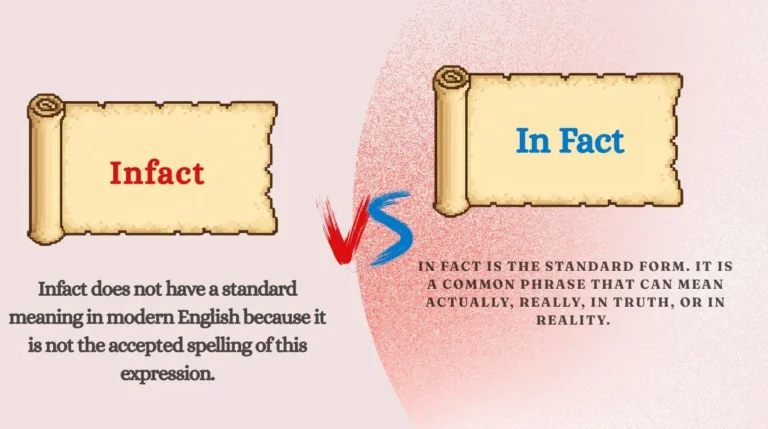
Infact does not have a standard meaning in modern English because it is not the accepted spelling of this expression.
When someone writes infact, they normally mean in fact. The problem is that in fact is a two-word phrase, not one single word.
So, you should write:
- Correct: In fact, I was already there.
- Incorrect: Infact, I was already there.
The important thing to remember is that joining the two words does not create a new standard English word.
Why do people write “infact”?
There are several simple reasons. First, the phrase is often pronounced quickly in speech. Second, English has many words that originally developed from combinations of smaller words, so learners may naturally assume that this one works the same way. Third, fast typing can cause spaces to disappear.
For example, a learner may think:
“I say in fact as one sound, so maybe I can write it as one word.”
That reasoning is understandable, but English spelling does not always follow pronunciation.
When should you use “infact”?
You should not use “infact” in standard English writing. Instead, use in fact.
There is no normal grammar rule that tells you to choose infact in formal, informal, academic, or spoken English. The correct form remains in fact.
Here are some common examples showing the mistake:
- Wrong: Infact, I don’t know him.Correct: In fact, I don’t know him.
- Wrong: She is infact very talented.Correct: She is in fact very talented.
- Wrong: Infact, we finished early.Correct: In fact, we finished early.
- Wrong: I thought it was easy, infact.Correct: I thought it was easy, in fact.
- Wrong: He infact lives nearby.Correct: He in fact lives nearby.
- Wrong: Infact, nobody complained.Correct: In fact, nobody complained.
- Wrong: The task was infact harder than expected.Correct: The task was in fact harder than expected.
- Wrong: Infact, she had already called me.Correct: In fact, she had already called me.
The common confusion is not about meaning. In these examples, the writer understands the idea. The mistake is simply joining two separate words together.
What Does “In Fact” Mean?
In fact is the standard form. It is a common phrase that can mean actually, really, in truth, or in reality. Merriam-Webster defines it as “in truth,” while Cambridge gives the meaning “actually.”
Cambridge also explains that in fact can work as a discourse marker. It may add more information, strengthen something that was just said, or show that reality is different from what someone expected.
When do we use “in fact”?
We commonly use it in four situations.
1. To add stronger information
You can use in fact to give an important extra detail.
Sarah is a good student. In fact, she is one of the best students in her class.
The second sentence gives stronger information about Sarah.
2. To correct an idea
It can also correct something that is not completely true.
I thought the shop was closed. In fact, it was still open.
The phrase tells the reader that the real situation was different.
3. To emphasize a fact
Sometimes you already know something is true, but you want to give it extra emphasis.
He is in fact the oldest person on the team.
Here, in fact draws attention to the truth of the statement.
4. To introduce a surprising reality
The phrase is especially useful when the true information is different from what people expect.
The exam looked difficult. In fact, it was quite easy.
The first idea creates one expectation. The second sentence gives the real situation.
8 examples with “in fact”
- In fact, I have never visited London.
- She looks young, but she is in fact forty years old.
- I thought he was angry. In fact, he was just tired.
- We expected ten guests. In fact, twenty people arrived.
- He said he knew the answer, and in fact, he did.
- The journey was longer than we expected. It was five hours, in fact.
- Many people think the test is easy, but in fact, it requires careful study.
- I wasn’t late. In fact, I arrived ten minutes early.
These examples show that in fact can appear in different places in a sentence. Cambridge notes that it is commonly used at the beginning of a clause, although it can also appear at the end in informal situations.
Difference Between Infact and In Fact (Detailed)
The biggest difference is very simple: one is not the standard spelling, and the other is correct.
| Point | Infact | In fact |
|---|---|---|
| Spelling | Incorrect in standard English | Correct |
| Number of words | One | Two |
| Standard dictionary phrase | No | Yes |
| Meaning | Intended to mean “in fact” | Actually; in truth; in reality |
| Formal writing | Avoid it | Correct |
| Academic writing | Avoid it | Correct |
| Everyday conversation | Not used as standard spelling | Common |
| Example | ❌ Infact, she agreed. | ✅ In fact, she agreed. |
Usage difference
There is no real meaning difference because infact is normally just an incorrect attempt to write in fact.
This means you should never think of the two forms as two vocabulary choices, like their and there. You are not selecting between two correct words.
Instead, think of it this way:
infact = spelling mistake
in fact = correct English phrase
Grammar logic
The phrase contains two separate words:
- in — a preposition
- fact — a noun
Together, in fact forms a fixed phrase used to show truth, reality, emphasis, or clarification.
The noun fact means something known or believed to be true or an actual piece of information.
Because the expression is written as in + fact, the space needs to remain.
Sentence structure
You can place in fact in several positions.
At the beginning:
In fact, I knew about the problem.
In the middle:
I did, in fact, know about the problem.
Near the end:
The trip was a success, in fact.
The exact position depends on what you want to emphasize and how natural the sentence sounds.
Meaning comparison
Consider this pair:
She said she was busy. In fact, she was free.
The phrase introduces the reality.
Now compare:
He looked nervous. In fact, he was excited.
Again, the phrase changes or clarifies the reader’s understanding.
This is why in fact is useful in both everyday speaking and careful writing. Collins also describes it as a phrase used to add detail or draw attention to information that modifies, contradicts, or contrasts with an earlier statement.
Grammar Rules You Must Remember
Rule 1: Always write “in fact” as two words
This is the most important rule.
✅ In fact, she is very friendly.
❌ Infact, she is very friendly.
Do not join in and fact together.
Rule 2: “In fact” can begin a sentence
It is perfectly normal to start a sentence with this phrase.
In fact, I have already finished the work.
When it starts the sentence and introduces additional information, a comma is commonly used afterward.
In fact, he was right.
Rule 3: “In fact” can appear inside a sentence
You do not always need to place it at the beginning.
She is, in fact, my cousin.
I did, in fact, send the email.
Here, commas are commonly used to set the phrase apart as an interrupting expression.
Rule 4: “In fact” can correct or contrast with an earlier idea
This is one of its most useful functions.
I thought the restaurant would be crowded. In fact, there were only three customers.
The phrase tells us that the real situation was different.
Another example:
He looked nervous, but in fact, he was completely relaxed.
This use is common when a speaker wants to correct an assumption or make the truth clearer. Cambridge and Collins both describe this kind of use.
Common Mistakes Students Make
Mistake 1: Joining the words
The most common mistake is simple:
❌ Infact, I don’t agree.
✅ In fact, I don’t agree.
Students often make this error because the phrase sounds connected when spoken.
Easy correction tip: When writing, mentally pronounce the phrase as two parts: in / fact.
Mistake 2: Treating “infact” as a formal version
Some learners believe that infact may be acceptable in informal English while in fact is more formal.
That is not the correct way to understand the difference.
The issue is not formality. The standard spelling is simply in fact.
Mistake 3: Forgetting punctuation
Consider:
In fact I already knew.
This sentence may be understandable, but when the phrase introduces a sentence or independent statement, a comma is commonly used:
In fact, I already knew.
However, punctuation depends on the exact structure. For example:
She is in fact the manager.
Here, commas are not always necessary if the phrase is closely integrated into the sentence.
Mistake 4: Using too many “in fact” phrases
Because it is useful, learners sometimes repeat it too often:
In fact, I like tea. In fact, my brother likes tea. In fact, we drink tea every day.
That sounds unnatural.
A good writer uses the phrase when it adds meaning, especially to clarify, correct, or emphasize information.
Mistake 5: Confusing spelling with pronunciation
You may hear native speakers say the phrase very quickly:
“infact”
But fast pronunciation does not mean the written form becomes one word.
English pronunciation often joins or reduces sounds. Spelling follows different rules.
Easy Trick to Remember the Difference
Here is a simple memory trick:
Think of “in fact” as “in reality”
Whenever you can replace the phrase with in reality, remember to write in fact.
For example:
She seemed angry. In fact, she was worried.
You can think:
She seemed angry. In reality, she was worried.
Because in reality has a space, this can remind you that in fact also has a space.
Another useful trick is to remember that fact is already a complete noun.
You have:
in + fact
Just like:
in school
in class
in time
in fact
You would not normally combine in and school into inschool. In the same way, do not write infact.
A classroom memory line
Think:
A fact needs its space.
Whenever you write this expression, leave a space between in and fact.
That tiny habit can prevent the mistake every time.
Daily Life Examples
The phrase is common in normal conversations, not just grammar books. Here are some natural examples you may hear or use.
Example 1: Talking about food
A: Do you like spicy food?
B: Yes. In fact, spicy food is my favorite.
Here, the second speaker adds stronger information.
Example 2: Correcting a misunderstanding
A: I thought Tom was from Canada.
B: No. In fact, he is from Australia.
The phrase helps correct the first assumption.
Example 3: Talking about work
A: Did you finish the report?
B: Yes. In fact, I finished it this morning.
The second sentence adds useful detail.
Example 4: Talking about age
My sister looks younger than me, but she is in fact older.
The phrase points out the real situation.
Example 5: Talking about travel
A: Was the hotel expensive?
B: Not really. In fact, it was cheaper than the other hotels.
The phrase introduces a result that may surprise the listener.
Example 6: Talking about school
I thought the homework would take an hour. In fact, I finished it in twenty minutes.
The expression contrasts expectation with reality.
Example 7: Talking about a friend
People think Ali is quiet, but in fact, he talks a lot with his friends.
This gives a more accurate picture of Ali.
Example 8: Talking about plans
A: Are you going to the party tonight?
B: In fact, I’m organizing it.
This use gives the listener a surprising or important piece of information.
Example 9: Talking about money
The phone looks expensive, but in fact, it was on sale.
Again, the phrase helps correct an assumption.
Example 10: Giving emphasis
He is, in fact, the person who started the company.
Here, in fact emphasizes an important truth.
Practice Section
Choose the correct option: infact or in fact.
1. ________, I don’t remember meeting her before.
2. The movie was, ________, much better than I expected.
3. ________ she was already at home when I called.
4. He looked tired, but ________ he was feeling fine.
5. I thought the book was short. It was 500 pages, ________.
Answers
1. In fact
Correct sentence:
In fact, I don’t remember meeting her before.
2. in fact
The movie was, in fact, much better than I expected.
3. In fact
In fact, she was already at home when I called.
4. in fact
He looked tired, but in fact, he was feeling fine.
5. in fact
I thought the book was short. It was 500 pages, in fact.
Remember: every answer uses two words.
FAQs
What is the difference between infact and in fact?
In fact is the correct standard English form. It usually means “actually,” “in truth,” or “in reality.” Infact is not the standard spelling of this phrase and should be avoided in normal English writing.
Is “infact” one word or two words?
In standard English, it is not written as one word. The correct form is in fact, with a space between in and fact. This applies to everyday, academic, business, and professional writing.
Can we use “in fact” in a sentence?
Yes. In fact can be used at the beginning, in the middle, or sometimes at the end of a sentence. It is often used to add information, emphasize a point, or show that reality is different from what someone expected.
Is “in fact” formal or informal?
In fact can be used in both formal and informal English. It works naturally in conversations, emails, essays, reports, and academic writing. The exact sentence should determine the style, not the phrase itself.
Does “in fact” mean “actually”?
Yes. One common meaning of in fact is actually or in truth. For example, “I thought he was busy, but in fact, he was free” means that he was actually free. Cambridge and Merriam-Webster both give meanings along these lines.
Why do people write “infact”?
Usually because the phrase is pronounced quickly and can sound like one unit. Fast typing, spelling habits, and confusion about English word formation can also cause the mistake. Even though the error is common, the correct written form remains in fact.
Conclusion
The confusion between infact and in fact is easy to solve once you remember one basic rule: write the expression as two words.
In fact is the correct form. It can mean actually, in truth, or in reality, and it is useful when you want to add information, correct an idea, emphasize a point, or show the true situation. Dictionaries and grammar references recognize it as a standard English phrase.
Infact is not the standard spelling, so avoid it in essays, emails, websites, schoolwork, and professional writing.
A simple memory trick is to connect in fact with in reality. Both contain two separate words. The next time you type this phrase, stop for one second and check the space. That small habit will quickly make the correct spelling automatic.
Good grammar is often about small details. Mastering these little differences can make your English clearer, more natural, and more confident.

Evan Rellmont is a writer who turns thoughtful ideas into meaningful words, creating stories and reflections that connect, inspire, and leave a lasting impression.