
Have you ever written a sentence and suddenly stopped because you were not sure whether to write “usage” or “useage”?
You are not alone. This is a common spelling problem, especially for English learners.
The two forms look very similar, and it is easy to think that “useage” is simply “use” plus “age.” But English spelling does not always work that way.
The correct spelling is usage. Useage is a common misspelling and should be avoided in standard English.
The word usage is useful in many situations. It can talk about the way a word or phrase is used in English, the amount or manner in which something is used, or a common practice followed by people.
Major dictionaries such as Merriam-Webster, Oxford, and Cambridge all list usage as the standard noun.
This small spelling difference matters because “usage” appears often in school work, grammar lessons, essays, business writing, technical writing, and everyday English.
By the end of this guide, you will know exactly why usage is correct, what it means, how to use it in a sentence, why learners write useage, and how to remember the spelling without getting confused again.
What Does “Usage” Mean?
Usage is the correct English word and spelling.
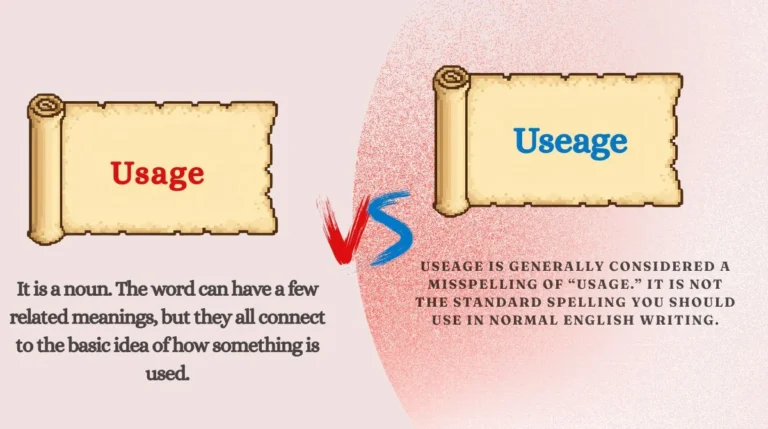
It is a noun. The word can have a few related meanings, but they all connect to the basic idea of how something is used.
Oxford defines usage as the way words are used in a language and also as the fact, amount, or manner of something being used. Cambridge gives similar meanings, including the way a particular word or language is used and the way something is treated or used.
Merriam-Webster also explains that usage can mean an accepted or established practice, the way words are actually used, or the action, amount, or manner of using something.
When Should You Use “Usage”?
Use usage when you are talking about the way something is used rather than simply saying that someone uses it.
For example:
- The teacher explained the correct usage of the word.
- This book is a guide to English usage.
- We are studying common usage in modern English.
- Water usage has increased this year.
- The phone tracks your daily data usage.
- Heavy usage can damage the machine.
- The dictionary explains the usage of difficult words.
- The software helps reduce energy usage.
Notice that the word does not usually mean simply “use” in every sentence. It often focuses on a pattern, amount, manner, or accepted way of using something.
Usage as a Grammar Word
English teachers often use usage when talking about the way language is used.
For example:
The word is common in informal usage.
Here, usage means the way people use the word.
You may also hear:
Correct word usage is important in formal writing.
That means using words in an appropriate and accepted way.
Usage in Everyday Situations
The word is not limited to grammar books.
We can talk about:
- water usage
- electricity usage
- internet usage
- fuel usage
- data usage
- computer usage
- energy usage
- road usage
In these examples, usage often refers to the amount or manner in which something is used.
For instance:
My monthly internet usage is very high.
This means the person uses a large amount of internet data.
A Common Confusion About “Usage”
Many learners think usage is just another spelling of useage. It is not.
The correct word is:
usage
Not:
useage
There is no standard English spelling useage for this noun. If you are writing an email, essay, school assignment, website, or professional document, choose usage.
What Does “Useage” Mean?
This part is much simpler.
“Useage” is a misspelling
Useage is generally considered a misspelling of “usage.” It is not the standard spelling you should use in normal English writing.
That means you should not normally write:
❌ The correct useage of this word is difficult.
Write:
✅ The correct usage of this word is difficult.
You may sometimes see useage online, in user-generated content, old documents, informal writing, or typed messages. Seeing a spelling on the internet, however, does not make it standard English.
Why Do People Write “Useage”?
The mistake is understandable.
English learners already know the verb use, and they may expect a noun made from it to keep the full spelling:
use + age = useage
That seems logical at first.
But the standard word developed as usage, not useage. The historical form comes through Middle English and Old French, with the modern spelling established long ago. Merriam-Webster traces the word to Middle English and Anglo-French, while Oxford gives its origin as Middle English and Old French.
Another reason for the mistake is pronunciation. Usage is pronounced roughly like “YOO-sij” in common English, so the spelling may not feel obvious to learners. Oxford and Cambridge both give pronunciations beginning with /ˈjuː…/.
Examples of the Mistake
Here are some common examples:
- ❌ The useage of social media is growing.
- ✅ The usage of social media is growing.
- ❌ Check the useage of this phrase.
- ✅ Check the usage of this phrase.
- ❌ We monitor electricity useage.
- ✅ We monitor electricity usage.
- ❌ This guide explains proper word useage.
- ✅ This guide explains proper word usage.
- ❌ Data useage has increased.
- ✅ Data usage has increased.
The correction is simple every time: remove the extra e.
Difference Between Usage and Useage
The biggest difference is that one is standard English and the other is a spelling error.
| Word | Correct? | Part of Speech | Meaning |
|---|---|---|---|
| usage | ✅ Yes | Noun | The way, amount, or manner of using something |
| useage | ❌ No, in standard English | — | Common misspelling of “usage” |
Usage Difference
Usage is used when you want to talk about how something is used.
For example:
The dictionary explains the usage of the word.
Here, we are talking about the way the word is used.
Another example:
Electricity usage fell during the summer.
Here, usage refers to how much electricity people used.
Grammar Difference
There is no real grammar difference between the two forms because useage is not the standard noun form.
You should not think of them as two different words with two separate meanings.
It is better to think of them this way:
usage = correct word
useage = spelling mistake
That makes the choice much easier.
Sentence Structure with “Usage”
Because usage is a noun, it can appear in several common structures.
1. Usage + of + noun
The usage of plastic has become a concern.
The usage of this expression is common.
2. Adjective + usage
Internet usage is increasing.
Heavy usage may reduce battery life.
Common usage can change over time.
3. Verb + usage
The company monitors energy usage.
The app tracks data usage.
The study measures water usage.
4. Usage + noun
usage patterns
usage rates
usage levels
usage data
These patterns are very common in academic, technical, business, and educational writing.
Meaning Comparison
The word usage often has a slightly more specific or formal feel than use.
Compare:
We use a lot of electricity.
and:
Our electricity usage is high.
The first sentence uses use as a verb.
The second uses usage as a noun to talk about the amount or pattern of use.
That small difference is useful to understand.
Grammar Rules You Must Remember
Rule 1: Use “usage” as the standard spelling
This is the most important rule.
✅ The correct usage of the term is important.
Not:
❌ The correct useage of the term is important.
Whenever you mean the noun referring to the way or amount something is used, spell it usage.
Rule 2: “Usage” is a noun
Because usage is a noun, it can be the subject or object of a sentence.
Usage varies from one region to another.
Here, usage is the subject.
The teacher explained the correct usage of the word.
Here, usage is the object.
The verb use, however, is commonly used as a verb:
I use this dictionary every day.
So do not mix up the forms.
Rule 3: “Usage” can describe language
One important meaning of usage is the way words and phrases are actually used.
For example:
The dictionary gives examples of common English usage.
This expression is acceptable in informal usage.
Teachers often discuss correct grammar and word usage.
Merriam-Webster, Oxford, and Cambridge all recognize this language-related meaning.
Rule 4: Do not create “useage” by adding “-age” to “use”
This is the spelling trap.
Many students think:
use + age = useage
But English does not always create words by simply putting one visible part after another.
The established spelling is:
usage
That means you need to learn this word as its own spelling.
Common Mistakes Students Make
Mistake 1: Adding an Extra “e”
The most common mistake is:
❌ useage
Students often see the word use and then add age.
The solution is to remember:
usage, not useage
Mistake 2: Thinking “Use” and “Usage” Are Spelled in the Same Pattern
They are related in meaning, but their spellings are not identical.
Compare:
use
and:
usage
There is no extra e after the s in usage.
Mistake 3: Trusting Pronunciation Too Much
English spelling and pronunciation do not always match perfectly.
You may hear usage and imagine a spelling like useage. But pronunciation alone cannot tell you the correct spelling.
A better approach is to remember the written form:
U-S-A-G-E
Mistake 4: Using “Useage” in Academic Writing
A spelling mistake in a casual text may go unnoticed. But in school assignments, essays, reports, CVs, websites, and professional writing, repeated spelling errors can make your writing look less polished.
So when writing something important, always use:
usage
Mistake 5: Thinking Both Forms Are Acceptable Variants
They are not standard spelling variants.
You should not write:
“Either usage or useage is correct.”
For normal modern English writing, the safe and correct choice is usage.
Easy Trick to Remember the Difference
Here is a very simple memory trick.
Remember: “Use” loses its extra “e”
Start with:
use
Now turn it into the noun:
usage
Do not write:
useage
You can think:
Use → Usage
The e disappears before the rest of the word.
A second memory trick is to say the word slowly:
u-sa-ge
Then picture the spelling:
USAGE
not
USEAGE
A Simple Classroom Trick
Imagine your teacher writes two words on the board:
USEAGE ❌
USAGE ✅
Then cross out the extra E in useage.
You can tell yourself:
“Usage uses less e.”
It is a small trick, but it can help you remember the spelling when you are writing quickly.
Daily Life Examples of “Usage”
You will see usage in many real-life situations, especially in technology, education, business, and everyday speech.
1. At home
Our electricity usage is higher in winter.
This means the family uses more electricity.
2. On your phone
Check your mobile data usage before the month ends.
Here, usage means the amount of mobile data used.
3. In school
The teacher corrected my word usage.
This means the teacher corrected the way the words were used.
4. At work
The company is trying to reduce paper usage.
The company wants employees to use less paper.
5. While studying English
This dictionary has notes about common word usage.
The notes explain how words are normally used.
6. Talking about the internet
My internet usage increases when I work from home.
The person uses more internet while working from home.
7. Talking about machines
The machine should last for years with normal usage.
Here, usage means ordinary use of the machine.
8. Talking about grammar
English usage can change over time.
The way people use English can change.
9. Talking about water
The city wants to reduce water usage.
The goal is to use less water.
10. Talking about software
The app records daily usage.
The app records how much or how often it is used.
These examples show why usage is a practical word. It is not limited to grammar lessons. You can use it in conversations, school writing, technology, business, and daily life.
Practice Section
Choose the correct word in each sentence.
1. The teacher explained the correct ______ of the phrase.
A. useage
B. usage
2. Our electricity ______ has gone up.
A. usage
B. useage
3. This guide explains English ______.
A. useage
B. usage
4. The app tracks your daily data ______.
A. usage
B. useage
5. Please check the ______ of this word in a dictionary.
A. usage
B. useage
Answers
- B — usage
- A — usage
- B — usage
- A — usage
- A — usage
Every answer uses the same correct spelling: usage.
That is exactly why the distinction is easy once you remember that useage is a misspelling.
FAQs
What is the difference between usage and useage?
Usage is the correct standard English spelling. It is a noun meaning the way, amount, or manner in which something is used. Useage is a common misspelling and should normally be avoided.
Is useage a word?
In standard modern English, useage is not the spelling you should use for this noun. When you mean the way or amount something is used, write usage. Major dictionaries list usage as the standard form.
Can I use usage in a sentence?
Yes. Usage is a common noun and can be used in many types of sentences.
For example:
Internet usage is increasing.
You can also say:
The teacher discussed the correct usage of the word.
Is usage formal or informal?
Usage can be used in both everyday and formal English. It is especially common in academic, technical, business, and grammar-related writing, but you can also use it in normal conversation.
Why is usage spelled without an extra e?
The standard form developed historically as usage, rather than by simply adding “-age” to the modern spelling of use. Dictionaries trace the word through Middle English and French.
For modern learners, the easiest approach is simply to memorize the correct spelling:
usage
Is “usage” the same as “use”?
They are closely related, but they are not always used in the same way. Use can be a verb or noun, while usage is a noun that often focuses on how, how much, or in what way something is used.
For example:
I use the app every day.
but:
My app usage is increasing.
Conclusion
The spelling choice is actually very simple once you know the rule: usage is correct, and useage is a common misspelling.
The word usage is a noun used to describe the way something is used, the amount it is used, or the way words and language are commonly used. It appears in phrases such as English usage, internet usage, data usage, water usage, and word usage. Major English dictionaries recognize these meanings and use usage as the standard spelling.
The best way to remember it is to keep the spelling simple:
USE → USAGE
Do not add the extra e.
When you see useage, stop and check it. In standard English, you almost certainly want usage.
A little spelling practice can make this mistake disappear from your writing completely. Once usage becomes familiar to your eyes, you will probably never hesitate over it again.

Evan Rellmont is a writer who turns thoughtful ideas into meaningful words, creating stories and reflections that connect, inspire, and leave a lasting impression.