
Have you ever written aluminum in one place and aluminium in another and wondered which one is actually correct? You are not alone.
This is a very common spelling question for English learners because both forms appear in dictionaries, schools, websites, books, product labels, and everyday conversations.
The good news is simple: aluminum and aluminium refer to the same chemical element and the same metal.
The main difference is the variety of English being used. Aluminum is the usual spelling in American English, while aluminium is the usual spelling in British English and many other varieties of English.
Cambridge Dictionary specifically identifies aluminum as the US spelling of aluminium and aluminium as the UK spelling.
This small spelling difference can still cause problems for learners. You may see aluminium foil in one book and aluminum foil on an American website.
You might even wonder whether the two words have slightly different meanings or uses.
They do not. The difference is mainly regional spelling, not meaning.
By the end of this guide, you will know which form to use in American and British English, how to pronounce each form, how the word behaves in a sentence, and how to avoid common spelling mistakes.
You will also learn an easy way to remember the difference without having to memorize a complicated rule.
What Does “Aluminum” Mean?
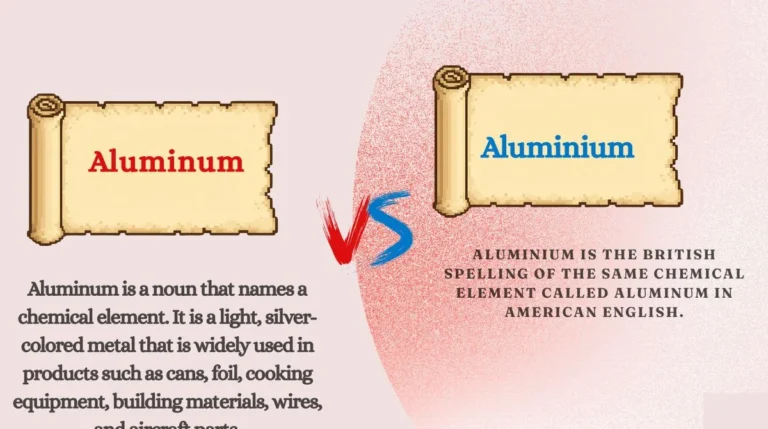
Aluminum is a noun that names a chemical element. It is a light, silver-colored metal that is widely used in products such as cans, foil, cooking equipment, building materials, wires, and aircraft parts. Its chemical symbol is Al, and it is element number 13 on the periodic table.
The spelling aluminum is especially common in American English. Cambridge Dictionary lists it as the US form and gives aluminium as the British equivalent.
When should you use “aluminum”?
Use aluminum when you are writing in American English or when the style of your publication follows American spelling.
For example, an American newspaper, American school assignment, or US-based website may prefer:
- aluminum foil
- aluminum can
- aluminum frame
- aluminum ladder
- aluminum sheet
The word normally works as a noun, especially when you are talking about the metal itself or an object made from it.
Grammar rule for “aluminum”
Aluminum is generally an uncountable noun when it means the metal as a material.
You would normally say:
The frame is made of aluminum.
You would not normally say:
The frame is made of an aluminum.
However, aluminum can be used before another noun as a describing word:
We bought an aluminum ladder.
Here, aluminum tells us what the ladder is made from.
Examples with “aluminum”
- The window frame is made of aluminum.
- Please cover the food with aluminum foil.
- This aluminum chair is surprisingly light.
- The factory produces aluminum cans.
- The aircraft uses aluminum parts to reduce weight.
- He bought an aluminum ladder for the house.
- The old aluminum door needs to be repaired.
- Aluminum is useful because it is light and strong.
Notice something important: the meaning does not change from sentence to sentence. The word always refers to the same metal.
A common learner confusion
Many learners think aluminum and aluminium might be two different materials. They are not.
The extra i and u arrangement in aluminium does not create a new meaning. It is simply a different regional spelling.
So these two sentences mean the same thing:
The can is made of aluminum.
The can is made of aluminium.
The first is more typical of American English, while the second is more typical of British English.
What Does “Aluminium” Mean?
Aluminium is the British spelling of the same chemical element called aluminum in American English. It is a light, silver-colored metal and has the chemical symbol Al and atomic number 13.
The spelling aluminium is widely used in British English and in dictionaries that follow British spelling conventions. Cambridge Dictionary identifies it as the UK spelling and gives aluminum as the US form.
When should you use “aluminium”?
Use aluminium when you are following British English spelling.
For example:
- aluminium foil
- aluminium cans
- aluminium frame
- aluminium ladder
- aluminium window
- aluminium alloy
This spelling is very common in British writing and in many educational and scientific contexts outside the United States.
The word also appears in international scientific material. For example, an IUPAC periodic-table publication lists the element as aluminium, with the symbol Al and atomic number 13, while noting aluminum as the alternative form.
Grammar rule for “aluminium”
Just like aluminum, aluminium is normally an uncountable noun when it refers to the metal as a material.
For example:
Aluminium is widely used in construction.
You can also use it before another noun:
She bought an aluminium pan.
Here, aluminium describes the material used to make the pan.
Examples with “aluminium”
- The car has an aluminium body panel.
- We use aluminium foil in the kitchen.
- The company makes aluminium window frames.
- Aluminium is a light metal.
- These cans are made from recycled aluminium.
- He repaired the aluminium gate yesterday.
- The aircraft contains many aluminium components.
- The shop sells aluminium ladders.
Again, the important point is that aluminium has exactly the same basic meaning as aluminum.
A common learner confusion
Students sometimes think aluminium is more correct because it looks longer and more formal.
That is not the right way to think about it.
Neither spelling is automatically “more correct” in every situation. The better choice depends on the English variety you are using.
If your school, website, employer, or publication uses American English, aluminum is the natural choice.
If it uses British English, aluminium is the natural choice.
Difference Between Aluminum and Aluminium
The biggest difference between aluminum and aluminium is spelling and regional preference.
There is no important difference in the basic meaning. Both words describe the same chemical element and metal. Cambridge Dictionary explicitly treats one as the US spelling and the other as the UK spelling.
Comparison Table
| Feature | Aluminum | Aluminium |
|---|---|---|
| Basic meaning | Same light metal | Same light metal |
| Main spelling variety | American English | British English |
| Part of speech | Noun | Noun |
| Countability | Usually uncountable | Usually uncountable |
| Chemical symbol | Al | Al |
| Atomic number | 13 | 13 |
| Example | aluminum foil | aluminium foil |
| Common style | US spelling | UK spelling |
Usage difference
The easiest rule is:
American English → aluminum
British English → aluminium
Consider these examples:
The company makes aluminum cans.
This is natural in American English.
The company makes aluminium cans.
This is natural in British English.
The object is the same. The metal is the same. The meaning is the same.
Only the spelling changes.
Grammar logic
There is no special grammar rule that says one should be used for a particular type of sentence. You can use either word as a noun, or before another noun to describe material.
For example:
I bought aluminum foil.
I bought aluminium foil.
Both are grammatically correct.
The important thing is consistency. If you are writing in American English, it is better to keep aluminum throughout your text. If you are using British English, keep aluminium throughout.
Sentence-structure difference
There is almost no sentence-structure difference.
Both forms can appear:
As the main noun:
Aluminum is easy to recycle.
Aluminium is easy to recycle.
Before another noun:
an aluminum can
an aluminium can
After “made of”:
The frame is made of aluminum.
The frame is made of aluminium.
With common compounds:
aluminum foil
aluminium foil
So, changing the spelling does not require you to rebuild the sentence.
Meaning comparison
There is no separate dictionary meaning that makes aluminum one metal and aluminium another.
They are two English spellings for the same element. The scientific symbol Al stays the same regardless of which spelling you write.
This is similar to other British and American spelling differences, such as:
- colour / color
- favourite / favorite
- centre / center
- organise / organize
The spelling may change, but the basic meaning remains the same.
What about pronunciation?
Pronunciation is another place where learners may notice a difference.
Cambridge gives aluminum as approximately /əˈluː.mə.nəm/ and aluminium as approximately /ˌæl.jəˈmɪn.i.əm/.
A simple learner-friendly guide is:
- aluminum → uh-LOO-muh-num
- aluminium → al-yoo-MIN-ee-um
The exact sound can vary by speaker and accent, but the spelling difference is easy to recognize.
Grammar Rules You Must Remember
Rule 1: The two spellings have the same basic meaning.
Do not treat aluminum and aluminium as different vocabulary words.
Example:
This product is made of aluminum.
This product is made of aluminium.
Both sentences refer to the same material.
Rule 2: Use “aluminum” for American English.
When your writing follows US spelling, aluminum is the standard choice.
Example:
The manufacturer uses aluminum for the cans.
This sounds natural in American English.
Tip: If the rest of your writing uses color, center, and favorite, then aluminum will usually fit that style.
Rule 3: Use “aluminium” for British English.
When your writing follows UK spelling, aluminium is the standard choice.
Example:
The manufacturer uses aluminium for the cans.
This fits British spelling conventions.
Tip: If your writing uses colour, centre, and favourite, then aluminium will normally match that style.
Rule 4: Keep your spelling consistent.
The biggest practical mistake is mixing the two forms in the same piece of writing without a reason.
For example, this looks inconsistent:
The kitchen has aluminium windows, an aluminum door, and aluminium shelves.
It is not impossible to understand, but the spelling changes for no clear reason.
A cleaner version would be:
American English:
The kitchen has aluminum windows, an aluminum door, and aluminum shelves.
British English:
The kitchen has aluminium windows, an aluminium door, and aluminium shelves.
Consistency makes your writing look more polished and professional.
Common Mistakes Students Make
Learning this word is usually easy once you understand that the problem is spelling variety rather than meaning.
Mistake 1: Thinking one spelling is wrong
A common student may write:
❌ Aluminum is wrong. The correct spelling is aluminium.
That statement is too broad.
A better way to think about it is:
✅ Aluminum is the standard American spelling.
✅ Aluminium is the standard British spelling.
Both are accepted English spellings in their normal regional contexts.
Mistake 2: Changing the meaning
Some learners believe aluminum may refer to a different grade or type of metal.
That is incorrect.
❌ Aluminum means one type of metal, while aluminium means another.
✅ They are different spellings for the same element.
Mistake 3: Mixing spelling styles
A student may start an essay with British spellings and then switch to American spellings.
For example:
❌ The colour of the center is silver, and the frame is made of aluminum.
Here, colour is British spelling, while center and aluminum are American spellings.
A more consistent British version would be:
✅ The colour of the centre is silver, and the frame is made of aluminium.
An American version would be:
✅ The color of the center is silver, and the frame is made of aluminum.
The point is not that mixing varieties makes the sentence impossible to understand. The point is that consistent spelling is better style.
Mistake 4: Treating the word as normally countable
When you mean the material, aluminum/aluminium is generally uncountable.
So this is natural:
✅ The table is made of aluminum.
Not:
❌ The table is made of an aluminum.
But you can use an article when a different noun follows it:
✅ an aluminum table
Here, an belongs to table, not to the metal itself.
Mistake 5: Searching for a grammar difference that does not exist
This is perhaps the biggest confusion.
Students sometimes ask:
“Does aluminum go with one tense and aluminium go with another?”
No.
The spelling has nothing to do with tense, subject-verb agreement, sentence order, or verb forms.
You can use either spelling in:
It is made of aluminum.
It was made of aluminium.
They use aluminum in many products.
They use aluminium in many products.
The grammar stays the same.
Easy Trick to Remember the Difference
Here is a simple classroom trick.
Think about the letter “I”
American English:
ALUMINUM
British English:
ALUMINIUM
The British spelling has an extra i before the final um.
A useful memory line is:
British = aluminium, with the extra “i”.
Another easy trick is to connect the spelling with familiar British words that often keep traditional endings.
For example:
- colour
- favourite
- centre
- aluminium
If your writing uses these British forms, aluminium will probably feel natural.
On the other hand, American English often uses shorter spellings:
- color
- favorite
- center
- aluminum
You do not need to memorize a long chemistry rule. Just remember the regional pattern.
Real-life logic
Imagine you are writing for two different readers.
You are writing a school assignment for a teacher in the United States. Use:
aluminum
Now imagine you are writing for a British audience. Use:
aluminium
You are not changing the metal. You are simply changing the spelling to match your audience.
That is the easiest way to think about it.
Daily Life Examples
These examples show how the two spellings work in normal conversation.
1. In the kitchen
A: What is this foil made of?
B: It is made of aluminum.
British version:
A: What is this foil made of?
B: It is made of aluminium.
2. Talking about a window
A: Is that a wooden frame?
B: No, it is an aluminum frame.
British version:
No, it is an aluminium frame.
3. Buying a ladder
A: Which ladder should I buy?
B: The aluminum one is lighter.
British version:
The aluminium one is lighter.
4. Recycling cans
A: Do these cans go in the recycling bin?
B: Yes. They are aluminum cans.
British version:
Yes. They are aluminium cans.
5. Cooking
A: Can I cover the dish with this foil?
B: Yes, use the aluminum foil.
British version:
Yes, use the aluminium foil.
6. Talking about a car
A: Why is the car so light?
B: It has some aluminum parts.
British version:
It has some aluminium parts.
7. At a hardware store
A: Do you have an aluminum ladder?
B: Yes, we have several sizes.
British version:
Do you have an aluminium ladder?
8. Talking about a gate
A: Is the gate steel?
B: No, it is aluminum.
British version:
No, it is aluminium.
9. In a science class
Teacher: What is the symbol for aluminum?
Student: Al.
In British English, the teacher may ask:
Teacher: What is the symbol for aluminium?
Student: Al.
The symbol remains the same.
10. Talking about recycling
A: Why should we recycle these cans?
B: Because aluminum can be recycled and used again.
British version:
Because aluminium can be recycled and used again.
These examples show how little the sentence changes. Usually, you only need to change the spelling.
Practice Section
Choose the correct option according to the English variety mentioned.
1. American English
The airplane contains many parts made of ______.
A. aluminium
B. aluminum
2. British English
We put the food on a sheet of ______ foil.
A. aluminum
B. aluminium
3. American English
He bought an ______ ladder.
A. aluminum
B. aluminium
4. British English
The window has a strong ______ frame.
A. aluminum
B. aluminium
5. General meaning
Which statement is correct?
A. They are two different metals.
B. They are different regional spellings of the same metal.
Answers
- B. aluminum
- B. aluminium
- A. aluminum
- B. aluminium
- B. They are different regional spellings of the same metal.
FAQs
1. What is the difference between aluminum and aluminium?
There is no difference in the basic meaning. Both words refer to the same chemical element and metal. Aluminum is the usual American spelling, while aluminium is the usual British spelling.
2. Is aluminum or aluminium correct?
Both spellings are correct. The choice depends mainly on the English variety you are using. Use aluminum for American English and aluminium for British English.
3. Is aluminium the British spelling?
Yes. Aluminium is the standard British English spelling. Cambridge Dictionary lists aluminium as the UK form and aluminum as the US form.
4. Is aluminum the American spelling?
Yes. Aluminum is the standard American English spelling. It has no second i before the final um.
5. Does aluminum mean the same thing as aluminium?
Yes. They have the same basic meaning and refer to the same element, with the chemical symbol Al and atomic number 13.
6. Which spelling should I use in an English essay?
Follow the spelling system required by your school, teacher, publisher, or audience. For American English, choose aluminum. For British English, choose aluminium. Most importantly, stay consistent throughout your essay.
Conclusion
The difference between aluminum and aluminium is much easier than it first appears. Both words refer to the same light, silver-colored metal and the same chemical element. The main difference is the spelling used in different varieties of English.
Remember the simple rule: aluminum is the usual American English spelling, while aluminium is the usual British English spelling. Cambridge Dictionary confirms this regional difference, and IUPAC reference material lists the element as aluminium while recognizing aluminum as an alternative form.
You do not need to worry about changing the grammar of your sentence. The noun works in the same way with either spelling. Just choose the form that matches your audience and keep your spelling consistent.
A little practice will make this choice automatic. When you see both forms again, simply ask yourself: Am I writing American English or British English? Once you answer that question, the correct spelling becomes easy.

Evan Rellmont is a writer who turns thoughtful ideas into meaningful words, creating stories and reflections that connect, inspire, and leave a lasting impression.