
English has many words that sound almost the same when people speak quickly.
This can make spelling and word choice confusing, especially for beginners and non-native English speakers.
One example is the phrase people sometimes search as “Yeah or neah.” You may have seen or heard these words in conversations, text messages, social media posts, or even in questions about voting.
The first word, yeah, is easy to understand. It is a common informal way to say yes.
People use it every day when talking with friends, family, classmates, and coworkers. Merriam-Webster defines yeah as an informal form of yes.
The second word creates the real problem. Neah is not a standard English word used for “no.” In most cases, people who write “neah” are probably trying to write nay or nah. These words are different from each other.
Nay is a real English word meaning “no,” but it is old-fashioned or formal in many situations. Nah is an informal spoken form of “no.”
Understanding this difference will help you avoid spelling mistakes and choose the right word for the situation.
You will also learn when yeah, nay, nah, yea, and yes should be used in everyday English, formal writing, and voting.
What Does “Yeah” Mean?
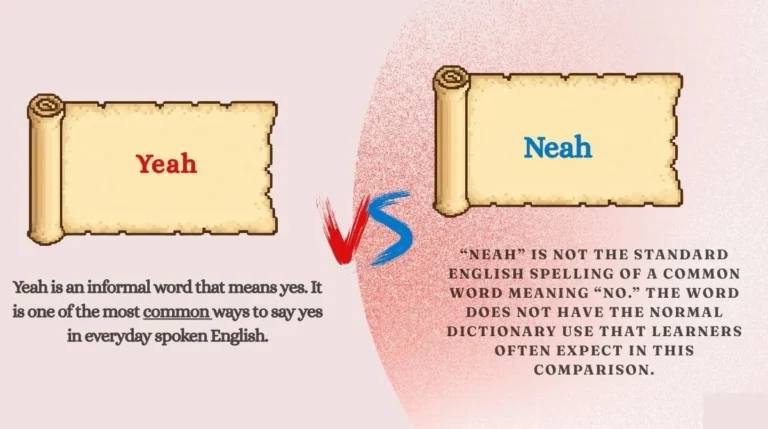
Yeah is an informal word that means yes. It is one of the most common ways to say yes in everyday spoken English. Friends often use it when they agree with someone, answer a question, or confirm something.
For example, if your friend asks, “Are you coming with us?” you can say, “Yeah, I am.” This sounds natural and friendly.
Merriam-Webster lists yeah as an informal synonym of yes. Dictionary.com also describes it as an informal form of yes.
When Should You Use “Yeah”?
Use yeah when the situation is casual and conversational. It works well in:
- Everyday conversations
- Text messages
- Casual online chats
- Friendly emails
- Dialogue in stories
- Informal questions and answers
You would normally choose yes instead of yeah in a very formal situation, such as a formal report, academic writing, or an important professional statement.
Grammar Rule for “Yeah”
Yeah usually works as an adverb or response word. It can stand alone or appear at the beginning of a sentence.
You can say:
“Yeah.”
You can also say:
“Yeah, I agree.”
Or:
“Yeah, that sounds good.”
It does not change according to the subject. You do not make forms like yeahs or yead. The word stays yeah.
Examples of “Yeah”
- Yeah, I understand what you mean.
- Yeah, we can meet after lunch.
- “Did you finish your homework?” “Yeah.”
- Yeah, that movie was really funny.
- “Are you tired?” “Yeah, a little.”
- Yeah, I think this is the right answer.
- She said yeah when I asked her.
- Yeah, sure. I can help you with that.
Common Confusion About “Yeah”
Many learners confuse yeah with yea. Although they look very similar, they are not normally used in the same way.
Yeah is the everyday informal form of yes.
Yea is an older word and is commonly connected with formal voting or traditional expressions. Merriam-Webster defines yea as an affirmative vote and as a word meaning yes.
So:
Yeah, I agree. ✅
Yea, I agree. ⚠️ Unnatural in normal modern conversation.
In a formal vote, however:
I vote yea. ✅
That distinction is important.
What Does “Neah” Mean?
This is where many learners need to slow down.
“Neah” is not the standard English spelling of a common word meaning “no.” The word does not have the normal dictionary use that learners often expect in this comparison.
So, when someone writes “neah,” they may actually mean one of two different words:
nay or nah.
These are real words, but they have different levels of formality and different histories.
“Nay” Means No
Nay is a real English word. It can mean no, especially in formal, old-fashioned, or traditional language. Merriam-Webster describes nay as an old-fashioned word meaning “no,” and it is also used for a negative vote.
For example:
“Nay, I do not agree.”
This sentence is grammatically correct, but it sounds quite old-fashioned today.
The word nay is especially common in phrases connected with voting:
“The ayes have it, with 40 nays.”
Here, nays means votes against a proposal. Merriam-Webster gives nay as both a negative reply or vote and a person who votes no.
“Nah” Means No in Casual Speech
Another likely word behind “neah” is nah.
Nah is an informal way of saying no.
For example:
“Do you want some coffee?”
“Nah, I’m okay.”
This is very natural in casual speech.
However, nah is not suitable for every situation. A teacher writing a formal letter would normally choose no rather than nah.
Examples of “Nah”
- Nah, I’m not hungry.
- “Are you going out tonight?” “Nah.”
- Nah, that’s not what I meant.
- “Do you need help?” “Nah, I’m fine.”
- Nah, I don’t think so.
- “Want another piece?” “Nah, thanks.”
- Nah, we can do it tomorrow.
- “Are you sure?” “Nah, not really.”
Why Do People Write “Neah”?
English spelling is not always based on pronunciation. People often spell words the way they think they sound.
Because yeah, nay, nah, and similar sounds can appear in fast conversation, learners may create spellings such as neah.
The important thing to remember is that pronunciation alone is not a safe guide to spelling. Always check the standard written form.
Difference Between Yeah and Neah
The biggest point is simple:
Yeah is a correct standard English word. Neah is not the standard word you normally want here.
If your intended meaning is yes, use yeah in informal situations.
If your intended meaning is no, use no in general English, nah in casual speech, or nay in old-fashioned/formal voting contexts.
Comparison Table
| Word | Meaning | Tone | Common Use | Example |
|---|---|---|---|---|
| yeah | yes | Informal | Conversation and casual writing | Yeah, I agree. |
| no | negative answer | Neutral | Everyday and formal English | No, thank you. |
| nah | no | Very informal | Casual conversation | Nah, I’m good. |
| nay | no | Formal/old-fashioned | Voting or traditional language | The proposal received 10 nays. |
| neah | Not standard in this meaning | Incorrect/unclear | Avoid | ❌ Neah, I don’t think so. |
| yea | yes/affirmative vote | Formal/old-fashioned | Voting | I vote yea. |
Usage Difference
Yeah is about agreement or a positive answer.
Example:
“Are you ready?”
“Yeah.”
Nay is about disagreement or a negative answer, particularly in traditional or formal settings.
Example:
“Did he vote in favor?”
“Nay, he voted against it.”
Nah has the same basic negative meaning as no, but it sounds much more casual.
Example:
“Do you want to come?”
“Nah, I’m staying home.”
Grammar Logic
There is no special complicated grammar rule here. These are mainly response words.
You use them to answer a question or react to what someone has said.
For example:
Are you busy?
Yeah.
Do you want tea?
Nah.
Did the committee approve it?
Nay.
The main difference is not sentence structure. It is meaning, spelling, tone, and context.
Sentence Structure
Yeah can be used alone:
Yeah.
It can also begin a full sentence:
Yeah, I remember him.
Nah works in exactly the same general way:
Nah.
Nah, I don’t want any.
Nay can also stand alone:
Nay.
But because nay sounds formal or old-fashioned, it is much less common in normal daily conversations.
Grammar Rules You Must Remember
Rule 1: Use “yeah” for informal “yes.”
When you are speaking casually, yeah is a natural replacement for yes.
Example:
“Can you help me?”
“Yeah, sure.”
This sounds friendly and normal.
In very formal writing, choose yes instead.
Rule 2: Do not use “neah” as the normal spelling of “no.”
If you mean the casual word for no, write:
nah
If you mean the standard neutral word, write:
no
If you mean the traditional or voting word, write:
nay
Avoid inventing neah as the spelling.
Incorrect:
Neah, I don’t want it. ❌
Correct:
Nah, I don’t want it. ✅
Or:
No, I don’t want it. ✅
Rule 3: Use “nay” mainly in formal, traditional, or voting contexts.
Nay is a genuine English word, but it is not the normal choice in casual conversation.
Example:
The motion passed with 35 yeas and 12 nays.
That kind of sentence sounds natural in a discussion of formal voting.
But if your friend asks:
“Do you want pizza?”
You would normally say:
“No.”
or:
“Nah.”
You would not normally say:
“Nay.”
Rule 4: “Yea” and “yeah” are not interchangeable in every situation.
Yeah is the casual word for yes.
Yea is associated with affirmative votes and older/formal language. Merriam-Webster specifically defines yea as an affirmative vote as well as a word meaning yes.
So:
Yeah, I want to go. ✅
I vote yea. ✅
The two spellings have different uses.
Common Mistakes Students Make
Mistake 1: Writing “neah” for “nah”
This is one of the biggest spelling problems in this topic.
Wrong:
Neah, I’m busy. ❌
Correct:
Nah, I’m busy. ✅
Or use the neutral word:
No, I’m busy. ✅
The mistake usually happens because the learner is writing the sound they hear instead of remembering the standard spelling.
Mistake 2: Using “nay” with friends
Nay is not grammatically wrong, but it can sound strange in modern casual speech.
Imagine this conversation:
Friend: Do you want ice cream?
You: Nay.
The sentence is understandable, but it may sound humorous, dramatic, or old-fashioned.
A normal response would be:
No.
Or:
Nah.
Mistake 3: Using “yeah” in very formal writing
Although yeah is a standard dictionary word, it is informal.
For example, in a formal report:
Yeah, the results were successful. ❌
A better choice is:
Yes, the results were successful. ✅
The problem is not grammar. It is register, which means the level of formality that fits the situation.
Mistake 4: Confusing “yea” and “yeah”
These spellings may look similar, but they have different common uses.
Yeah = casual yes
Yea = affirmative vote / older use
Example:
Yeah, I understand. ✅
The members voted yea. ✅
Mistake 5: Thinking every word that sounds like “no” has the same spelling
English has several informal and historical forms.
You may hear:
no
nah
nay
They are not interchangeable in every sentence.
The safest choice for learners is simple:
Use no for standard everyday English, nah for very casual speech, and nay when the context is formal, traditional, or related to voting.
Easy Trick to Remember the Difference
Here is a simple memory trick.
Think:
Yeah = Yes
Both are used when you agree.
Then remember:
Nah = No
Both are casual ways to respond in everyday speech.
And:
Nay = No in formal or old-fashioned language
You can also remember the voting pair:
Yea = Yes
Nay = No
That pair is especially useful because both words are often used together in voting.
Here is the easiest pattern:
Yeah → casual yes
Nah → casual no
Yea → formal/old-fashioned yes
Nay → formal/old-fashioned no
No → normal yes/no answer system
Once you learn these five words as a group, the spelling becomes much easier.
Daily Life Examples
Real conversations make these words easier to understand.
Example 1: Accepting an invitation
Tom: Are you coming to the party?
Sam: Yeah, I’ll be there.
Here, yeah means yes.
Example 2: Refusing food casually
Anna: Do you want another sandwich?
Mike: Nah, I’m full.
Here, nah is a casual form of no.
Example 3: A formal vote
Chairperson: All those in favor, say yea.
Member: Yea.
Here, yea means an affirmative vote.
Example 4: Voting against a proposal
Chairperson: All those against?
Member: Nay.
Here, nay means no or a negative vote.
Example 5: Casual agreement
Sara: This restaurant is expensive.
Lina: Yeah, it really is.
The speaker agrees with the statement.
Example 6: Casual refusal
Dad: Do you need anything from the store?
Son: Nah, I’m okay.
This sounds natural in family conversation.
Example 7: Formal workplace writing
Manager: Do you approve the new plan?
Employee: Yes, I approve it.
Here, yes is better than yeah because the situation is more formal.
Example 8: Historical or dramatic speech
Character: Shall we continue our journey?
Character: Nay, we must turn back.
This sounds dramatic or old-fashioned. That is exactly the kind of style where nay can work well.
Example 9: Casual text message
“Are you free tonight?”
“Yeah, I am.”
This is a natural use of yeah in texting.
Example 10: Saying no without sounding too formal
“Want to watch another episode?”
“Nah, I’m too tired.”
The word nah makes the answer sound relaxed and conversational.
Practice Section
Choose the best answer: yeah, no, nah, yea, or nay.
1. “Are you ready for school?”
“_____ , I’m ready.”
2. “Do you want some more cake?”
“_____ , thanks. I’m full.”
3. “The committee had 20 yeas and 8 _____.”
Which word completes the sentence?
4. Which word is best for a casual answer meaning “yes”?
yeah / nay
5. Which spelling should you normally avoid when you mean casual “no”?
nah / neah
Answers
1. Yeah — It is a natural informal answer meaning yes.
2. Nah — This is a casual way to say no.
3. Nays — Nays means negative votes.
4. Yeah — It is the common informal form of yes.
5. Neah — This is not the standard spelling for the casual word nah.
FAQs
What is the difference between yeah and neah?
Yeah is a standard informal English word meaning yes. Neah, however, is not the standard spelling of the common negative response. You may mean nah, which means no in casual speech, or nay, an older/formal word meaning no.
Is “neah” a correct English word?
Not in the usual sense intended by learners who use it as the opposite of yeah. The standard words are no, nah, and nay, depending on the situation. For normal writing, avoid neah and choose the word that matches your meaning.
Can we use “yeah” in questions?
Yes, yeah can appear in questions and conversational expressions. For example, “Yeah? What happened?” can show interest or ask someone to continue. The expression “Oh yeah?” can also show surprise, doubt, or interest in conversation.
Is “yeah” formal or informal?
Yeah is informal. It is very common in everyday speech, texting, casual conversations, and friendly communication. In a formal letter, academic paper, or professional report, yes is usually a better choice.
Is “nay” the same as “no”?
Basically, yes, but the tone is different. Nay can mean no, but it is commonly old-fashioned, literary, or associated with formal voting. For a normal conversation, no is much more natural, while nah works in very casual speech.
What is the difference between “yea” and “yeah”?
Yeah is the modern informal word meaning yes. Yea is often used for an affirmative vote and can also appear in older or more formal language. For example, “Yeah, I agree” is casual, while “I vote yea” is a voting expression.
Conclusion
The phrase “Yeah or neah” can be confusing because the second spelling is not the standard English form learners normally need. The key is to think about both meaning and situation.
Yeah means yes and is very common in casual spoken English. It is friendly and natural, but yes is usually better in formal writing.
For a negative response, use no in standard English. Use nah when you are speaking casually with friends or family. Use nay mainly in formal, traditional, literary, or voting contexts.
Also remember the useful voting pair:
yea = yes
nay = no
Most importantly, avoid writing neah when you mean nah or nay. Once you connect each spelling with its meaning and level of formality, these words become much easier to use correctly. Keep noticing them in real conversations, and your English will become more natural over time.

Evan Rellmont is a writer who turns thoughtful ideas into meaningful words, creating stories and reflections that connect, inspire, and leave a lasting impression.