
Have you ever typed “beleive” and then stopped because it suddenly looked wrong? You are not alone.
Believe is a very common English word, but its spelling causes problems for many students, especially because the letters i and e can be difficult to place correctly.
The confusion usually comes from the familiar spelling idea “i before e, except after c.” That little rhyme can help with some English words, but it is not a perfect rule. In fact, English has many exceptions, so learners often remember the sound of a word but put the letters in the wrong order.
Merriam-Webster explains that the famous rule is useful only for certain spelling patterns and has many exceptions.
The good news is simple: when you mean to accept something as true, to trust someone, or to think that something is true, the correct spelling is believe.
Beleive is a misspelling.
This difference matters because believe appears everywhere in everyday English.
You see it in school writing, text messages, conversations, emails, books, and questions such as “Do you believe me?”
By the end of this guide, you will know the correct spelling, understand the meaning and grammar of believe, learn why beleive is wrong, and use the word confidently in real-life sentences.
What Does “Believe” Mean?
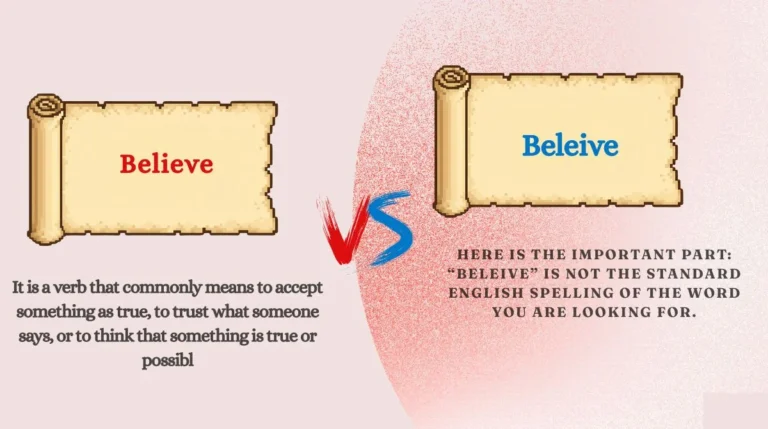
Believe is the correct spelling.
It is a verb that commonly means to accept something as true, to trust what someone says, or to think that something is true or possible. Merriam-Webster defines it in several related ways, including accepting something as true, accepting someone’s word or evidence, and holding an opinion. Oxford also lists meanings such as feeling certain that something is true, thinking something is true or possible, and having an opinion.
When do we use “believe”?
We use believe in many everyday situations.
You can use it when you trust a person:
I believe you.
You can use it when you think a statement is true:
I believe your story.
You can use it when you have an opinion:
I believe this is the best choice.
You can also use it with in to show faith, trust, or confidence in a person, idea, system, or thing:
I believe in you.
The meaning changes slightly depending on what comes after the verb. Believe someone often means accepting what that person says. Believe in someone or something can mean having trust, confidence, or faith in them.
Grammar rule for “believe”
Believe is a verb.
Its common forms are:
| Form | Example |
|---|---|
| Base form | believe |
| He/She/It form | believes |
| Past tense | believed |
| -ing form | believing |
Oxford lists these forms as believe, believes, believed, and believing. It also notes that believe is normally not used in the progressive tenses.
For example:
- I believe you.
- She believes me.
- They believed the news.
- We are believing is generally not the normal everyday form when you simply mean “think something is true.”
Example sentences with “believe”
- I believe you.
- Do you believe me?
- She believes that he is honest.
- I believe this plan will work.
- They believed the story at first.
- We believe in helping others.
- He does not believe the excuse.
- I can’t believe how quickly time passed.
Notice that the word works naturally in questions, negative sentences, statements, and longer clauses.
Common learner confusion
A very common mistake is writing:
❌ I beleive you.
The correct sentence is:
✅ I believe you.
The problem is the order of the middle vowels. The correct spelling is:
bel + ieve
not:
bel + eive
It is easy to hear the word and remember the sound without remembering which vowel comes first. That is why believe often appears on lists of commonly misspelled English words. Grammarly specifically lists beleive as a common misspelling of believe.
Another mistake is forgetting the final e:
❌ beliv
✅ believe
So remember the full spelling:
B-E-L-I-E-V-E
What Does “Beleive” Mean?
Here is the important part: “beleive” is not the standard English spelling of the word you are looking for.
In normal English writing, beleive is treated as a misspelling of believe. It does not represent a different verb with a different meaning. When someone writes beleive, they almost always mean believe.
That means you should not choose beleive in schoolwork, formal writing, business communication, websites, essays, or everyday messages.
Why do people write “beleive”?
The main reason is the confusing order of i and e.
A learner may know that the word is pronounced approximately bi-LEEV, but pronunciation does not tell you exactly which letters should appear in the spelling.
Many students also know the old rhyme:
“I before E, except after C.”
That rhyme points toward the spelling ie in words such as believe, but English spelling has too many exceptions for the rhyme to work as a complete rule. Merriam-Webster calls the saying an unreliable general rule and gives examples such as seize, height, and weird that do not fit it neatly.
So, if you have been writing beleive, do not feel that the mistake is strange. It is a very common spelling error.
Grammar rule for “beleive”
There is no separate grammar rule for beleive because it is not the standard spelling of a separate word.
You should replace it with believe.
For example:
❌ I beleive she is right.
✅ I believe she is right.
❌ Do you beleive him?
✅ Do you believe him?
❌ We beleive in hard work.
✅ We believe in hard work.
Example sentences using the incorrect spelling
These sentences show what learners sometimes write:
- ❌ I beleive you.
- ❌ She beleives his story.
- ❌ Do they beleive this?
- ❌ I beleived the news.
- ❌ We beleive in ourselves.
- ❌ He doesn’t beleive me.
- ❌ They beleived that the plan would succeed.
- ❌ I can’t beleive my eyes.
Every one of these should use believe or one of its correct forms.
The correct versions
- ✅ I believe you.
- ✅ She believes his story.
- ✅ Do they believe this?
- ✅ I believed the news.
- ✅ We believe in ourselves.
- ✅ He doesn’t believe me.
- ✅ They believed that the plan would succeed.
- ✅ I can’t believe my eyes.
The key lesson is simple: “beleive” is not an alternative spelling. It is a spelling mistake.
Difference Between Believe and Beleive
The difference is very easy once you know that one is correct and the other is not.
| Feature | Believe | Beleive |
|---|---|---|
| Standard English spelling | ✅ Yes | ❌ No |
| Word type | Verb | Misspelling |
| Meaning | To accept as true, trust, or think something is true | No separate standard meaning |
| Used in formal writing | ✅ Yes | ❌ No |
| Used in questions | ✅ Yes | ❌ No |
| Used with “in” | ✅ Yes | ❌ No |
| Correct past form | believed | Not applicable |
| Correct -ing form | believing | Not applicable |
| Example | I believe you. | ❌ I beleive you. |
Usage difference
There is no true meaning difference between the two forms because beleive is not a standard spelling variant of the verb.
When you see these two words compared, think of them as:
believe = correct
beleive = incorrect
That is all you need to remember for normal English.
Grammar logic
The word believe functions as a verb. It can take an object, a clause, or the preposition in, depending on its meaning.
For example:
believe + person
I believe Sarah.
believe + that-clause
I believe that Sarah is honest.
believe + in + noun/pronoun
I believe in Sarah.
Each structure is normal English. Oxford gives similar patterns, including believe somebody, believe something, believe that…, and believe in something/somebody.
Sentence structure difference
Because beleive is a misspelling, it cannot be used as a correct sentence structure.
Compare:
✅ I believe him.
❌ I beleive him.
The grammar structure is the same, but the second sentence fails because its spelling is wrong.
Meaning comparison
There is one meaning only in ordinary usage:
believe = to accept something as true, trust someone, or hold an opinion.
beleive = incorrect spelling of believe.
This is why searching for a special “meaning” of beleive is unnecessary. The fix is simply to correct the spelling.
Grammar Rules You Must Remember
Rule 1: The correct spelling is “believe”
When you mean “accept as true” or “trust,” use:
believe
Not:
beleive
Example:
✅ I believe your explanation.
The middle part is ie, not ei.
A useful way to see it is:
bel + ie + ve
Rule 2: Add “s” correctly with he, she, and it
In the simple present tense, use believes with he, she, and it.
Examples:
✅ She believes me.
✅ He believes the story.
✅ My teacher believes in hard work.
Do not write:
❌ She believe me.
And do not accidentally create:
❌ She beleives me.
The correct form is:
believes
The spelling sequence remains ie:
b-e-l-i-e-v-e-s
Rule 3: The past tense is “believed”
To make the simple past, add -d to the base form:
believe → believed
Examples:
✅ I believed him yesterday.
✅ They believed the news.
✅ She believed that the answer was correct.
Be careful with spelling:
❌ beleived
✅ believed
The i-e order in believe stays in place.
Rule 4: The -ing form is “believing”
When the verb takes -ing, the final e is dropped:
believe → believing
Examples:
✅ I am believing in myself is grammatically possible in special contexts, but it is not the usual way to express a simple present belief.
✅ The phrase “seeing is believing” uses the word naturally as an expression.
More importantly, remember the spelling:
believing
not:
❌ beleiving
The spelling changes from believe to believing, but the important middle sequence remains clear.
Oxford lists believing as the standard -ing form.
Common Mistakes Students Make
Mistake 1: Writing “beleive”
This is the most direct problem.
❌ I beleive you.
✅ I believe you.
The best correction tip is to train your eyes to look for ie in the middle.
Mistake 2: Writing “belive”
Some learners remember the beginning but forget the final e.
❌ I belive you.
✅ I believe you.
The word needs two letters e around the v at the end:
believe
Mistake 3: Writing “beleived”
Learners sometimes combine the wrong base spelling with the past-tense ending.
❌ She beleived him.
✅ She believed him.
Start with the correct base form first:
believe
Then make it past tense:
believe + d = believed
Mistake 4: Writing “beleives”
The same problem can happen in the third-person singular.
❌ He beleives me.
✅ He believes me.
Do not change the internal order of the vowels when adding -s.
Mistake 5: Assuming “i before e” is a perfect rule
This is a slightly more advanced spelling lesson, but it is worth knowing.
You may have learned:
i before e, except after c
The rule can help with certain words, and believe fits the basic ie pattern. However, it does not explain every English spelling. Merriam-Webster points out many exceptions, including seize, weird, height, and others.
So do not try to solve every spelling problem by forcing this rhyme onto every word.
For believe, it is better to remember the actual spelling.
Mistake 6: Confusing “believe” with “belief”
These words are related, but they are different parts of speech.
Believe is a verb:
I believe you.
Belief is a noun:
Her belief in herself is strong.
Oxford defines belief as a strong feeling that something or someone exists or is true, or confidence in something or someone.
The spelling is different:
believe → verb
belief → noun
This is another useful word family to learn together.
Easy Trick to Remember the Difference
Here is a simple classroom trick:
Think: “I before E” in BELIEVE
Look at the middle:
bel + IE + ve
The letters are:
I → E
So:
✅ BELIEVE
Not:
❌ BELEIVE
You can break the word into small pieces:
BE – LIEVE
Or simply memorize this little visual:
bel + ie + ve = believe
A second memory trick
Connect believe with these words:
- relieve
- retrieve
- achieve
Several familiar words use the ie pattern.
You can also remember the phrase:
“I believe in I before E.”
It is not a universal spelling rule, but it can serve as a personal memory trick for this particular word.
But do not trust the rhyme blindly
This part is important. The famous rhyme is a spelling aid, not a magical English law. Merriam-Webster notes that it has many exceptions and was never a complete description of English spelling.
So for this word, your safest habit is visual memory:
B E L I E V E
Write it several times. Read it. Use it in sentences. After enough practice, the correct pattern becomes automatic.
Daily Life Examples
The verb believe is extremely common in normal conversation. Here are examples you may hear at school, at work, at home, or in casual chats.
1. Trusting someone
A: Did you tell your parents what happened?
B: Yes, and they believed me.
Here, believed me means they accepted what I said as true.
2. Asking for trust
A: I didn’t break the window.
B: Do you really expect me to believe you?
This use is common when someone is questioning another person’s story.
3. Expressing an opinion
I believe this is the right decision.
Here, the speaker is expressing a strong opinion.
Oxford notes that believe can be used to express an opinion and can be stronger than think in some contexts.
4. Showing confidence in a person
**My parents always believe in me.
Here, believe in means to have confidence in someone’s ability or value.
5. Talking about an idea
Do you believe in ghosts?
This asks whether someone accepts that ghosts exist or has faith in that idea.
6. Showing surprise
I can’t believe it’s already Friday!
This is very common in spoken English. It often expresses surprise rather than a serious discussion about whether something is true.
7. Talking about a possibility
I believe the shop is still open.
The speaker thinks this is true, although they may not be completely certain. Oxford includes this use of believe for something considered true or possible.
8. Talking about what someone said
I don’t believe everything I read online.
This means the speaker does not automatically accept every piece of information as true.
9. Using a common expression
Believe it or not, he finished the whole project in one day.
This phrase introduces something surprising but presented as true. Oxford lists believe it or not as an informal expression used to introduce surprising information.
10. Expressing strong support
You can do this. I believe in you!
This is one of the most natural and encouraging uses of the word.
Practice Section
Choose the correct option in each sentence.
1. I really ______ you.
A. believe
B. beleive
2. She ______ that the test will be easy.
A. believes
B. beleives
3. We ______ his story yesterday.
A. believed
B. beleived
4. Do you ______ in yourself?
A. believe
B. beleive
5. I can’t ______ what I just saw.
A. believe
B. beleive
Answers
- A. believe
- A. believes
- A. believed
- A. believe
- A. believe
A quick self-check
Before you move on, write this sentence from memory:
I believe you.
Now look at the middle:
ie
That two-letter pattern is the part that many learners accidentally reverse.
FAQs
What is the difference between believe and beleive?
Believe is the correct English spelling. Beleive is a common misspelling and is not the standard spelling of a separate word.
Use believe when you mean to accept something as true, trust someone, or think that something is true.
Is “beleive” a correct spelling?
No. In standard English, beleive is considered an incorrect spelling of believe. Grammarly lists beleive among common misspellings of the word.
The correct form is:
✅ believe
Can we use “believe” in questions?
Yes. Believe is very common in questions.
For example:
Do you believe me?
Do you believe this story?
What do you believe?
These are all natural English sentences.
Is “believe” formal or informal?
Believe is a normal English verb used in both everyday and formal English.
You can use it in casual conversation:
I believe you.
You can also use it in formal writing:
Researchers believe that the results are significant.
Oxford shows the word in everyday, opinion, and more formal patterns.
Is “believe in” the same as “believe”?
Not always.
Believe someone/something often means accepting what a person says or accepting a statement as true:
I believe him.
Believe in someone/something often means having faith, trust, or confidence:
I believe in you.
It can also refer to accepting the existence or value of something:
Do you believe in ghosts?
Merriam-Webster lists both uses.
Why is “believe” so easy to misspell?
The main reason is the vowel order ie. English spelling does not always match pronunciation perfectly, and learners may remember the sound without remembering the exact letter sequence.
Also, the well-known “i before e” saying is helpful in some cases but has many exceptions.
Conclusion
When choosing between believe or beleive, the answer is clear: believe is the correct spelling, while beleive is a misspelling.
The word believe is a common verb that means to accept something as true, trust someone, or hold an opinion. You can use it in everyday sentences such as “I believe you,” “Do you believe me?” and “I believe in you.” Its common forms include believe, believes, believed, and believing.
The easiest way to avoid the spelling mistake is to remember the middle letters:
B-E-L-I-E-V-E
Think IE, not EI.
It is also useful to remember that the famous “i before e” rule is not perfect. English has plenty of exceptions, so learning common words by sight and repeated use is often the safest approach.
The next time you type beleive, stop for a second and check the middle. Put the I before the E, and you have believe.

Evan Rellmont is a writer who turns thoughtful ideas into meaningful words, creating stories and reflections that connect, inspire, and leave a lasting impression.