
“Who” and “whom” are two small words that cause a surprising amount of trouble. Even native English speakers sometimes pause when they need to choose between them.
For English learners, the confusion can be even greater because both words can refer to a person, and both can appear in questions and sentences.
The good news is that the basic idea is quite simple. The main difference comes from the job the word does in a sentence.
Who is generally used as the subject—the person doing an action.
Whom is traditionally used as the object—the person receiving an action or affected by it.
For example, compare these two questions:
- Who called you?
- Whom did you call?
In the first question, the person is doing the calling. In the second, the person is receiving the call.
There is another important point: modern English does not always follow the old formal rule.
In everyday conversation, many speakers use who where traditional grammar would use whom.
This is why you may hear “Who did you invite?” much more often than “Whom did you invite?”
Once you learn a simple subject-and-object test, these words become much easier.
You will also learn when whom sounds natural, when who is better, and how to avoid common mistakes in formal writing and everyday speech.
What Does “Who” Mean?
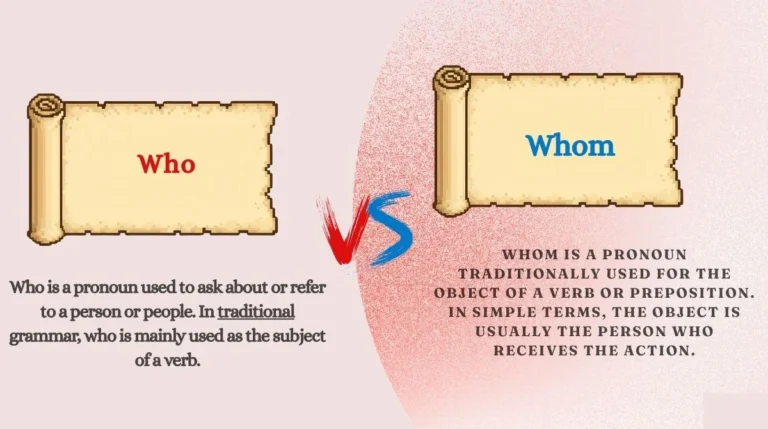
Who is a pronoun used to ask about or refer to a person or people. In traditional grammar, who is mainly used as the subject of a verb.
The subject is the person who performs the action.
Look at this example:
Who opened the door?
The person doing the action “opened” is the unknown person. Therefore, who is the subject.
When Do We Use “Who”?
We use who when asking which person or people are responsible for an action, or when the person being discussed is the subject of the sentence.
It is especially common in questions:
- Who is at the door?
- Who broke the glass?
- Who sent this email?
- Who wants some coffee?
We also use who in statements:
- I know who lives here.
- She is the woman who helped me.
- He is the teacher who taught us English.
In each case, who has a subject role.
Grammar Rule for “Who”
A useful rule is:
Use “who” when the person is doing the action.
Consider:
Who wrote this letter?
The unknown person wrote the letter. That person is the subject, so who is correct.
Another example:
Who invited Sarah?
Someone performed the action of inviting Sarah. Again, that person is the subject.
8 Examples of “Who”
- Who called me this morning?
The unknown person is the one who called. - Who made this delicious cake?
The unknown person made the cake. - Who is coming to the party tonight?
We are asking which people are coming. - Who teaches you math?
The person being asked about performs the teaching. - Who left these books on my desk?
Someone left them, so that person is the subject. - Do you know who lives next door?
The person who lives there is the subject of “lives.” - She is the woman who helped my mother.
The woman performed the action of helping. - Who wants to go first?
The person who wants to go first is the subject.
A Common Confusion About “Who”
Learners often think that who must be used whenever a sentence asks about a person. That is not the rule.
The real question is:
What job does the person have in the sentence?
Compare:
Who invited you?
The person did the inviting.
But:
Whom did you invite?
You did the inviting, while the other person received the action.
The difference is not about whether the sentence is a question. It is about the grammatical role of the person.
What Does “Whom” Mean?
Whom is a pronoun traditionally used for the object of a verb or preposition. In simple terms, the object is usually the person who receives the action.
For example:
Whom did you call?
You performed the action. The other person received your call. Therefore, whom is the traditional formal choice.
When Do We Use “Whom”?
In formal English, whom is used when the person is the object of a verb or follows a preposition.
Examples include:
- Whom did you invite?
- Whom did she marry?
- To whom should I send the letter?
- With whom were you speaking?
You will see whom more often in formal writing, official documents, academic language, and careful edited prose.
However, everyday spoken English is more flexible. Native speakers commonly use who instead of whom in many situations.
For example:
Who did you invite?
This is extremely common in ordinary conversation.
The more formal version is:
Whom did you invite?
Both can be understood, but they create different levels of formality.
Grammar Rule for “Whom”
A traditional grammar rule says:
Use “whom” when the person is receiving the action or is the object of a preposition.
Look at:
Whom did you meet?
The hidden statement is:
You met him.
Because him is an object pronoun, whom fits the traditional grammar pattern.
This gives us a very useful test, which we will look at more closely below.
8 Examples of “Whom”
- Whom did you invite to dinner?
You invited the person, so the person is the object. - Whom did she choose for the job?
She performed the choosing. - To whom should I give this package?
“Whom” follows the preposition “to.” - With whom are you traveling?
“Whom” follows “with.” - Whom did the manager speak to?
In formal grammar, the person spoken to is the object. - The student whom I helped passed the exam.
“Whom” is the object of “helped.” - Whom are you looking for?
The person being looked for is the object. - The client to whom I sent the report replied quickly.
“Whom” follows the preposition “to.”
Why Does “Whom” Sound Unusual?
For many learners, whom can sound old-fashioned or overly formal. There is a good reason for this.
In modern spoken English, people often avoid whom and simply use who instead.
For example:
Who did you talk to?
This sounds completely natural in conversation.
The formal version is:
To whom did you talk?
The second sentence is grammatically traditional, but it can sound stiff in casual speech.
So learning whom is still useful, especially for formal writing and exams, but you also need to understand how real people use English today.
Difference Between Who and Whom
The easiest way to understand the difference is to focus on subject versus object.
| Feature | Who | Whom |
|---|---|---|
| Main grammatical role | Subject | Object |
| Basic meaning | Which person does the action? | Which person receives the action? |
| Traditional use | Subject of a verb | Object of a verb or preposition |
| Common in speech | Very common | Less common |
| Formal writing | Common | Common in formal structures |
| Example | Who called you? | Whom did you call? |
| Pronoun test | He/they | Him/them |
1. Subject vs. Object
This is the most important difference.
Who helped John?
The unknown person performed the action “helped.”
So:
Who = subject
Now compare:
Whom did John help?
John performed the action. The other person received the action.
So:
Whom = object
Think of the sentence:
Sarah helped David.
Sarah is the subject.
David is the object.
Therefore:
Who helped David?
Whom did Sarah help?
This pattern works again and again.
2. Sentence Structure
With who, the word is often followed directly by a verb:
Who called?
Who broke the window?
Who knows the answer?
The person represented by who is doing something.
With traditional whom constructions, another subject often performs the action:
Whom did you call?
Whom did she invite?
Whom did they choose?
Here, you, she, and they are the subjects.
3. The Pronoun Test
Here is perhaps the easiest trick.
Replace who/whom with he/him, she/her, or they/them.
If he/she/they sounds right, choose who.
If him/her/them sounds right, choose whom.
For example:
___ called you.
Try:
He called you.
That works.
So:
Who called you?
Now try:
You called ___.
You called him.
That works.
So:
Whom did you call?
This trick is especially helpful for students.
4. Modern English Is More Flexible
Traditional grammar makes a clear distinction between who and whom, but modern English is changing.
Many speakers use who in object positions, especially in informal conversation:
Who did you see?
Who are you talking to?
Who did she invite?
These sentences are normal and widely used.
However, whom still appears naturally after some prepositions and in formal contexts:
To whom should I address this letter?
The person with whom I spoke was very helpful.
So it is important to know both the traditional grammar rule and modern usage.
Grammar Rules You Must Remember
Rule 1: Use “Who” for the Subject
When the person performs the action, use who.
Who opened the window?
Here, the person represented by “who” opened it.
Another example:
Who sent this message?
The unknown person sent the message, so who is the subject.
Rule 2: Use “Whom” for the Object in Formal Grammar
When the person receives the action, traditional grammar uses whom.
Whom did you invite?
You invited the person. You are the subject, while the person invited is the object.
Another example:
Whom did the teacher call?
The teacher performed the calling.
Rule 3: Use “Whom” After a Preposition in Formal English
A preposition is a word such as to, with, for, from, by, about, and of.
In formal English, whom commonly follows these words.
Examples:
To whom did you send the email?
With whom did you travel?
For whom are you buying the gift?
From whom did you receive the letter?
This pattern is useful in formal letters, academic writing, and professional communication.
Rule 4: “Who” Is Often Used Instead of “Whom” in Everyday Speech
Modern English does not always follow the traditional distinction.
In normal conversation, these are very common:
Who did you meet?
Who were you talking to?
Who did she invite?
You do not need to force whom into every conversation simply because the traditional rule says it is the object.
A natural sentence is often better than an unnecessarily formal one.
Common Mistakes Students Make
The confusion usually happens because students try to memorize isolated sentences instead of understanding the role of each word.
Mistake 1: Using “Whom” When the Person Is the Subject
Incorrect:
Whom called you last night?
Why is this wrong?
The person represented by the pronoun is doing the calling.
Correct:
Who called you last night?
A quick test:
He called you.
Not:
Him called you.
Because he is correct, who is correct.
Mistake 2: Thinking “Who” Is Always Wrong Before or After a Preposition
Some learners believe every preposition must be followed by whom.
That is too strict for modern English.
Formal:
To whom were you speaking?
Natural conversation:
Who were you speaking to?
Both are widely understandable, but they have different styles.
The first sounds formal. The second sounds natural and conversational.
Mistake 3: Using “Who” in Very Formal Writing Without Checking the Structure
In casual speech:
Who did you contact?
This is perfectly normal.
In formal writing, however, you may prefer:
Whom did you contact?
Or, after a preposition:
To whom should I send the documents?
Knowing the traditional form helps you choose the right style for professional and academic situations.
Mistake 4: Choosing by Position Instead of Meaning
A sentence can become confusing when students choose based on where the word appears.
Consider:
Who do you think won the competition?
Some students see “do you think” and assume the word must be whom.
But look at the complete idea:
Who won the competition?
The person represented by who is the subject of “won.”
So who remains correct.
Mistake 5: Forgetting the Pronoun Test
When you are unsure, stop and replace the word.
Ask:
Would I say he/she/they or him/her/them?
For example:
___ did Mary invite?
Replace it:
Mary invited him.
So the traditional answer is:
Whom did Mary invite?
For everyday speech, however:
Who did Mary invite?
is very common.
Easy Trick to Remember the Difference
Here is a simple classroom trick:
Who = He
Whom = Him
The endings are not exactly the same, but the idea is easy to remember because who works like subject pronouns such as he and she, while whom works like object pronouns such as him and her.
Try these:
Who ate the cake?
Think:
He ate the cake.
So who.
Now:
Whom did you call?
Think:
You called him.
So whom.
The “M” Trick
There is another little memory trick students often find helpful:
Who → he
Whom → him
Notice that him has an m, and whom also has an m.
So when you can replace the word with him, her, or them, traditional grammar points you toward whom.
For example:
Whom did you see?
You saw him.
Who saw you?
He saw you.
The key is not memorizing hundreds of examples. Learn the he/him test, and many sentences become much easier.
Daily Life Examples
Here are some examples you might actually hear at home, at school, at work, or while talking with friends.
Example 1
A: Who is calling?
B: It’s my brother.
The unknown person is doing the calling, so who is natural.
Example 2
A: Who sent you that message?
B: My manager sent it.
Again, the person is doing the action.
Example 3
A: Who did you meet at the store?
B: I met my old teacher.
Traditional grammar would use whom here, but who is much more common in ordinary conversation.
Example 4
A: Who are you going with?
B: I’m going with Ali.
In formal grammar, you might write:
With whom are you going?
But that sounds quite formal in everyday speech.
Example 5
A: Whom should I contact about the problem?
B: Contact the office manager.
Here, whom sounds suitable because the situation is formal.
Example 6
A: Who wants some tea?
B: I do!
The person who wants tea is the subject.
Example 7
A: Whom did the teacher choose as team leader?
B: She chose Emma.
The teacher performed the choosing, so Emma is the object.
Example 8
A: Who helped you with your homework?
B: My older sister did.
Your sister performed the action, so who is correct.
Example 9
A: To whom should I send this form?
B: Please send it to the admissions office.
This is a formal structure, especially suitable for professional or official communication.
Example 10
A: Who were you talking to?
B: I was talking to my cousin.
This sentence is very natural in spoken English.
A formal alternative would be:
With whom were you talking?
The grammar is more traditional, but the everyday version sounds much more relaxed.
Practice Section
Choose who or whom in each sentence.
1. _____ broke the computer?
a) Who
b) Whom
2. _____ did you invite to the wedding?
a) Who
b) Whom
3. _____ is waiting outside?
a) Who
b) Whom
4. To _____ should I send this email?
a) Who
b) Whom
5. _____ helped you carry the boxes?
a) Who
b) Whom
Answers
1. Who — The person did the action of breaking.
2. Whom — In traditional grammar, the invited person is the object. In everyday conversation, “Who did you invite?” is also very common.
3. Who — The person is the subject of “is waiting.”
4. Whom — It follows the preposition “to” in a formal construction.
5. Who — The person performed the action of helping.
FAQs
What is the basic difference between who and whom?
Who is traditionally used as the subject, or the person doing the action. Whom is traditionally used as the object, or the person receiving the action. For example, “Who called you?” asks about the caller, while “Whom did you call?” asks about the person you called.
Can we use “who” instead of “whom” in questions?
Yes. In modern spoken English, who is very commonly used instead of whom in object questions. “Who did you see?” sounds natural and normal. “Whom did you see?” is more formal and follows traditional grammar.
Is “whom” formal or informal?
Whom is generally more formal. You may see it in professional letters, academic writing, official documents, and careful edited English. In everyday conversation, many speakers prefer who, especially when it sounds more natural.
How can I quickly know whether to use who or whom?
Use the he/him test. If you could replace the word with he, she, or they, use who. If you could replace it with him, her, or them, traditional grammar calls for whom. For example, “He called” gives “Who called?”
Is “Who did you talk to?” grammatically correct?
Yes. It is a normal and widely used sentence in modern English, especially in conversation. Traditional formal grammar may prefer “To whom did you talk?” The second version is more formal, but the first is usually more natural in daily speech.
Should I always use “whom” in formal writing?
Not necessarily, but you should understand where traditional grammar expects it. Whom is especially useful after prepositions and in formal structures. At the same time, modern edited English often accepts or prefers who in some positions, so context and style matter.
Conclusion
The difference between who and whom becomes much easier when you stop thinking about complicated grammar terms and focus on one simple question: Who is doing the action?
Use who when the person is the subject:
Who called you?
Use whom when the person is the object in traditional grammar:
Whom did you call?
The he/him test is one of the easiest ways to make the choice. If he, she, or they fits, use who. If him, her, or them fits, traditional grammar points to whom.
At the same time, remember that real-world English is flexible. In everyday speech, who often replaces whom, especially in questions such as “Who did you meet?” That does not make the sentence strange or incorrect.
The more you notice these patterns in conversations, books, emails, and other English writing, the more natural the choice will feel. Practice a little every day, and these two words will soon stop being a grammar headache.

Evan Rellmont is a writer who turns thoughtful ideas into meaningful words, creating stories and reflections that connect, inspire, and leave a lasting impression.