
“Its” and “it’s” look almost the same, and they sound exactly the same when we speak. That is why many English learners mix them up.
Even students who speak English quite well sometimes pause when they have to write one of these words.
The good news is that the difference is much easier than it first appears. These two forms do different grammar jobs. One shows possession, while the other is a shortened form of two other words.
Once you understand that basic idea, choosing the right form becomes much faster.
This difference matters because both forms are common in everyday English.
You may see them in text messages, school assignments, emails, websites, social media posts, books, and conversations.
A small apostrophe can completely change the grammar of a sentence.
For example:
- The dog hurt its leg.
- It’s getting dark.
The first sentence shows that the leg belongs to the dog. The second sentence means it is getting dark.
By the end of this guide, you will know exactly when to use each form, how to test your sentence, what mistakes to avoid, and how to remember the difference without having to think too hard every time you write.
You will also get plenty of real-life examples and a short practice section to check your understanding.
What Does “Its” Mean?
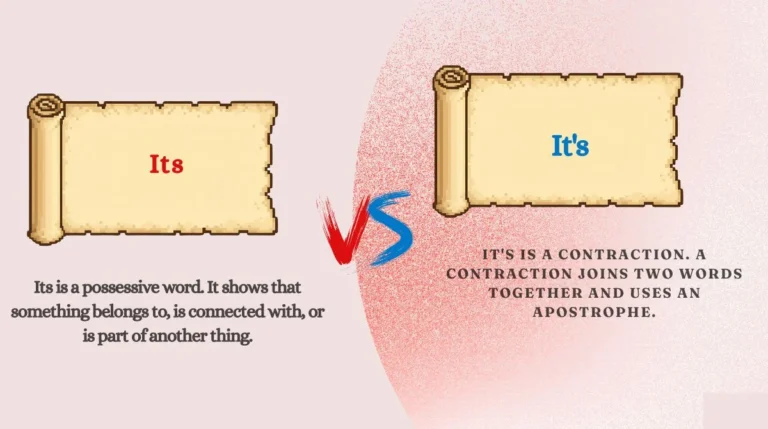
Its is a possessive word. It shows that something belongs to, is connected with, or is part of another thing.
In simple words, its means something like “belonging to it.”
We use it when it is the owner or source of something.
For example:
- The cat cleaned its paws.
- The company changed its policy.
- The tree lost its leaves.
In each sentence, its shows a relationship.
The paws belong to the cat.
The policy belongs to the company.
The leaves are part of the tree.
When Should You Use “Its”?
Use its before a noun when you want to show possession or connection.
Common patterns include:
its + noun
Examples:
- its name
- its color
- its owner
- its purpose
- its shape
- its door
- its price
- its website
Here are eight useful examples:
- The bird is feeding its babies.
- The car lost its front mirror.
- The school updated its rules.
- The phone is known for its long battery life.
- The company opened its new office.
- The dog wagged its tail.
- The restaurant changed its menu.
- The machine stopped working because its motor overheated.
Notice something important: its does not have an apostrophe.
That can feel strange because other possessive forms often use apostrophes. For example:
- Sara’s book
- John’s car
- the girl’s bag
But its is different. It is already a possessive form, so we normally write:
- The dog hurt its paw.
Not:
- The dog hurt it’s paw.
“Its” Can Also Stand Alone in Some Contexts
The possessive form can sometimes appear without a noun when the meaning is already clear.
For example:
- My phone is newer, but its is faster.
However, this structure is much less common in everyday English because its as a standalone possessive pronoun can sound awkward. More natural wording is often:
- My phone is newer, but the other one is faster.
- My phone is newer, but the newer model is faster.
For learners, the most useful rule is simple: when you see its before a noun, it usually shows possession.
Common Learner Confusion
Many students think the apostrophe in it’s must show possession because apostrophes often do that.
That is a reasonable guess, but English has a special rule here.
Compare:
- The boy’s bicycle = possession
- The dog’s collar = possession
- The company’s website = possession
- The dog hurt its leg = possession
So remember: its is the possessive form of it.
What Does “It’s” Mean?
It’s is a contraction. A contraction joins two words together and uses an apostrophe.
The word it’s can mean:
- it is
- it has
The meaning depends on the sentence.
“It’s” Meaning “It Is”
This is the most common use.
Examples:
- It’s cold today.
→ It is cold today. - It’s a beautiful morning.
→ It is a beautiful morning. - It’s difficult to explain.
→ It is difficult to explain. - It’s raining outside.
→ It is raining outside. - It’s time to leave.
→ It is time to leave. - It’s not my fault.
→ It is not my fault. - It’s really expensive.
→ It is really expensive. - It’s getting late.
→ It is getting late.
One very easy test is to replace it’s with it is.
If the sentence still makes sense, it’s is probably correct.
For example:
It’s very hot today.
Replace it:
It is very hot today.
The sentence works perfectly, so it’s is correct.
“It’s” Meaning “It Has”
The same contraction can also mean it has, especially with the present perfect.
Examples:
- It’s been a long day.
→ It has been a long day. - It’s already started.
→ It has already started. - It’s been three weeks since we met.
→ It has been three weeks since we met. - It’s happened before.
→ It has happened before.
This use is common in spoken English.
When Should You Use “It’s”?
Use it’s when you mean it is or it has.
A useful habit is to stop looking at the apostrophe and ask yourself:
“What two words does this contraction stand for?”
If the answer is it is or it has, then it’s is the right choice.
Difference Between Its and It’s
The biggest difference is simple:
Its = possession
It’s = it is / it has
That one idea solves most problems.
Comparison Table
| Word | Meaning | Grammar Function | Example |
|---|---|---|---|
| its | belonging to it | possessive determiner | The dog hurt its leg. |
| it’s | it is | contraction | It’s cold today. |
| it’s | it has | contraction | It’s been a busy week. |
Usage Difference
Use its when something belongs to or is connected with “it.”
- The company increased its prices.
- The tree has lost its branches.
- The computer restarted because its system crashed.
Use it’s when you could write it is or it has instead.
- It’s too late. → It is too late.
- It’s a good idea. → It is a good idea.
- It’s been difficult. → It has been difficult.
Grammar Logic
The two forms are different because they perform different jobs.
Its acts as a possessive determiner. It normally comes before a noun:
- its food
- its color
- its size
- its name
- its owner
It’s is a contraction. It contains a verb:
- it is
- it has
That means it’s often appears in sentences describing a condition, action, situation, or experience.
For example:
Its door is open.
Here, its tells us whose door it is.
But:
It’s open.
Here, it’s means it is.
The difference is only one tiny apostrophe in writing, but the grammar behind it is different.
Sentence Structure Difference
Look at these two patterns:
Its + noun
The company changed its policy.
It’s + adjective / noun / verb form
It’s expensive.
It’s a new company.
It’s raining.
It’s been difficult.
This gives you another useful clue. If a noun comes directly after the word and you are showing possession, its is usually needed.
Grammar Rules You Must Remember
Rule 1: Use “its” to Show Possession
When something belongs to or is connected with “it,” use its without an apostrophe.
Example:
The dog is licking its paw.
The paw belongs to the dog, so its is correct.
Another example:
The phone lost its signal.
The signal is connected with the phone, so use its.
Rule 2: Use “it’s” for “it is”
If you can expand the word to it is, use it’s.
Example:
It’s very cold outside.
Expanded version:
It is very cold outside.
Because the expanded sentence is correct, it’s is correct.
This test works in many everyday sentences:
- It’s easy. → It is easy.
- It’s strange. → It is strange.
- It’s my turn. → It is my turn.
- It’s not ready. → It is not ready.
Rule 3: Use “it’s” for “it has”
Sometimes it’s stands for it has, especially before a past participle.
Example:
It’s been a busy morning.
Expanded:
It has been a busy morning.
Another example:
It’s already finished.
Expanded:
It has already finished.
So do not assume it’s always means it is. It can also mean it has.
Rule 4: Don’t Add an Apostrophe to the Possessive Form
The possessive form is its, not it’s.
Example:
The company needs to protect its customers.
Not:
The company needs to protect it’s customers.
A helpful reminder is this:
Apostrophe in “it’s” = missing letters
The apostrophe tells you that letters have been removed:
- it is → it’s
- it has → it’s
The apostrophe does not mean possession in this case.
Common Mistakes Students Make
These mistakes happen because its and it’s sound identical. When we speak, we cannot hear the difference. The problem appears when we write.
Another reason is that learners know that apostrophes can show possession. That rule is true for many nouns, but its is an important exception.
Mistake 1: Using “it’s” for Possession
Wrong:
The cat cleaned it’s fur.
Correct:
The cat cleaned its fur.
Why?
The fur belongs to the cat. We need the possessive form.
Mistake 2: Forgetting the Apostrophe in “it’s”
Wrong:
Its raining outside.
Correct:
It’s raining outside.
Why?
The sentence means:
It is raining outside.
Since it’s can be expanded to it is, the apostrophe is necessary.
Mistake 3: Using “its” When You Mean “it is”
Wrong:
Its important to practice.
Correct:
It’s important to practice.
The intended meaning is:
It is important to practice.
So it’s is correct.
Mistake 4: Using “it’s” Before a Possessed Noun
Wrong:
The company closed it’s office.
Correct:
The company closed its office.
The office belongs to the company, so use its.
Mistake 5: Trusting the Apostrophe Instead of Checking the Meaning
Some learners simply choose the version that “looks right.”
That is risky.
Instead, replace it’s with it is or it has.
For example:
The dog wagged it’s tail.
Try:
The dog wagged it is tail.
That sounds wrong.
So you need its:
The dog wagged its tail.
The replacement trick is much safer than guessing.
Easy Trick to Remember the Difference
Here is the simplest memory trick:
“It’s” has a hidden verb.
Think:
it’s = it is
or
it’s = it has
The apostrophe is a little signal that two words have been joined.
For example:
It’s cold.
Think:
It is cold.
Or:
It’s been a great day.
Think:
It has been a great day.
If that expansion works, choose it’s.
“Its” Owns Something
Think of its as a small possessive word.
The dog has its toy.
The toy belongs to the dog.
The tree lost its leaves.
The leaves belong to or are part of the tree.
A simple classroom memory line is:
“It’s” can expand. “Its” shows it owns.
That one sentence can save you from many mistakes.
A Quick Three-Second Test
When you are unsure, follow these steps:
Step 1: Look at it’s.
Step 2: Replace it with it is.
Step 3: If that does not work, try it has.
Step 4: If neither works, you probably need its.
For example:
The phone needs its charger.
Try:
The phone needs it is charger.
That is clearly wrong.
So use its.
Daily Life Examples
These forms appear all the time in normal English. Here are some natural examples you may hear at home, at school, at work, or in casual conversation.
Example 1
A: How’s the weather?
B: It’s really hot today.
Here, it’s means it is.
Example 2
A: Where is the dog?
B: It’s in the garden.
Again, it’s means it is.
Example 3
A: Why is the car making that noise?
B: I think its engine needs to be checked.
The engine is part of the car, so its shows connection.
Example 4
A: What happened to the company?
B: It’s closed for the holiday.
This means:
It is closed.
Example 5
A: Does the laptop still have its charger?
B: Yes, it’s in the bag.
The first its shows possession. The second it’s means it is.
Example 6
A: Why is the baby crying?
B: Maybe its blanket fell on the floor.
The blanket belongs to the baby.
Example 7
A: Is the restaurant open?
B: Yes, it’s open until ten.
It’s = it is.
Example 8
A: What do you think about the new phone?
B: I like its camera.
The camera is a feature of the phone.
Example 9
A: Has the meeting started?
B: Yes, it’s already started.
Here, it’s means it has.
Example 10
A: Why is the website not working?
B: Its server may be having a problem.
The server is connected with the website, so the possessive form is used.
These examples show why meaning matters. The two words may sound exactly alike, but their grammar is not the same.
Practice Section
Choose the correct word: its or it’s.
1. The cat is sleeping in ___ bed.
A. its
B. it’s
2. ___ getting dark outside.
A. Its
B. It’s
3. The company changed ___ logo.
A. its
B. it’s
4. ___ been a difficult week.
A. Its
B. It’s
5. The car has a problem with ___ brakes.
A. its
B. it’s
Answers
1. its
The bed belongs to the cat.
2. It’s
It means it is getting dark.
3. its
The logo belongs to the company.
4. It’s
It means it has been a difficult week.
5. its
The brakes are part of the car.
A good learner does not just memorize the answers. Try explaining why each answer is correct. That helps the rule stay in your memory.
FAQs
1. What is the difference between “its” and “it’s”?
Its is a possessive word. It shows that something belongs to or is connected with “it.”
It’s is a contraction of it is or it has.
They sound the same, but they have different grammar roles.
2. Can we use “it’s” in questions?
Yes. It’s can appear in questions when it means it is or it has, especially in informal English.
For example:
Is it true that it’s going to rain?
Here, it’s means it is.
3. Is “it’s” formal or informal?
The contraction it’s is normal in everyday English and is widely used in both speech and writing.
In very formal writing, such as some academic or legal contexts, writers may prefer it is instead of the contraction.
That is a style choice, not because it’s is grammatically wrong.
4. Why does “its” not have an apostrophe?
Its is already the possessive form of it. English does not add an apostrophe to this possessive form.
Compare:
The dog hurt its leg.
Here, its shows possession.
5. Can “it’s” mean “it has”?
Yes. This is an important point.
For example:
It’s been a long time.
This means:
It has been a long time.
It can also mean it has in sentences such as:
It’s already happened.
6. How can I quickly know whether to use “its” or “it’s”?
Try replacing it’s with it is or it has.
If the sentence still makes sense, use it’s.
If neither expansion works and you are showing possession, use its.
For example:
The dog hurt its leg.
“It is leg” does not work, so its is correct.
Conclusion
The difference between its and it’s is small in spelling but important in grammar. The easiest way to remember it is to focus on the job each form does.
Use its when you show possession or connection:
The bird spread its wings.
Use it’s when you mean it is or it has:
It’s cold today.
It’s been a long day.
The apostrophe in it’s is not showing possession. It is showing that letters have been left out of it is or it has.
When you are writing and feel unsure, do not guess. Replace it’s with it is or it has. If the sentence works, you have your answer. If the sentence is showing ownership, choose its.
With a little practice, this confusion becomes much easier. Pay attention to the meaning, use the replacement test, and these two tiny words will soon feel completely natural.

Evan Rellmont is a writer who turns thoughtful ideas into meaningful words, creating stories and reflections that connect, inspire, and leave a lasting impression.