
Have you ever written “heros” and wondered whether it looks right? You are not alone. Many English learners make this mistake because most regular plural nouns simply take -s.
For example, book becomes books, car becomes cars, and student becomes students. So it can feel natural to write heros when you mean more than one hero.
However, English has a special spelling rule for the word hero. The correct plural is heroes, not heros.
Major English dictionaries, including Cambridge and Oxford, list heroes as the plural form of hero.
This small spelling difference matters because hero is a common word in everyday English. We use it when talking about brave people, people we admire, and the main characters in books, films, and stories.
The word also appears in phrases such as national heroes, sports heroes, and childhood heroes.
Once you understand why hero → heroes works differently from many ordinary nouns, the spelling becomes much easier to remember.
You will also learn when to use each form, how to pronounce them, and how to avoid common mistakes in school assignments, emails, articles, and everyday writing.
What Does “Heros” Mean?
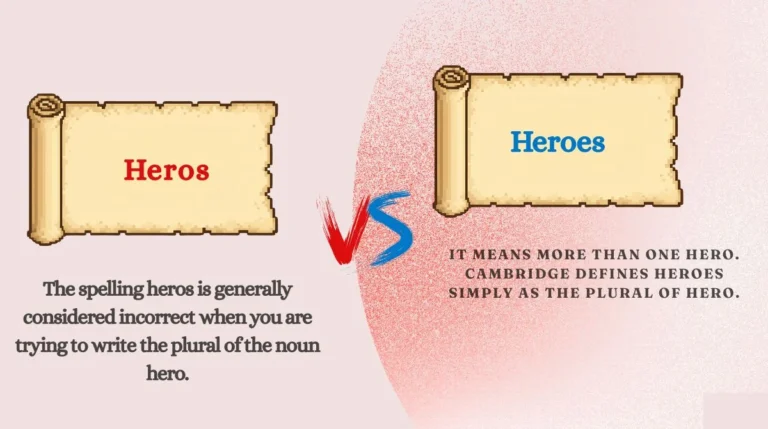
The spelling heros is generally considered incorrect when you are trying to write the plural of the noun hero.
A hero is a person who is admired because they have done something brave, helpful, or impressive. The word can also describe the main male character in a story, novel, film, or play. Cambridge gives heroes as the plural of hero, while Oxford also lists the plural as heroes.
So, when you need to talk about more than one hero, you should not simply add -s.
The correct form is:
hero → heroes
Not:
hero → heros
Is “Heros” ever correct?
For normal English writing, heros is not the standard plural spelling of hero. It is usually a spelling mistake.
For example:
- ❌ The movie has several heros.
- ✅ The movie has several heroes.
The mistake usually happens because learners know the common plural rule:
singular noun + s = plural noun
That rule works for many words, but English has several nouns that need a different plural ending. Hero is one of them.
Grammar Rule for “Hero”
Hero is a singular countable noun. It normally refers to one person or one character.
You can say:
- He is a hero.
- My father is my hero.
- The main character is a hero.
- She called the firefighter a hero.
When you mean more than one, use heroes:
- They are heroes.
- The firefighters became heroes.
- The story has many heroes.
Example Sentences
Here are some simple examples with the singular form hero:
- The firefighter is a hero.
- My grandfather was a war hero.
- That athlete is a national hero.
- The boy wanted to become a superhero.
- Batman is a famous comic-book hero.
- She considers her mother a hero.
- The hero saved the village in the story.
- He became a hero after rescuing the child.
Notice that every sentence above refers to one person or character.
Why Do Learners Write “Heros”?
The most common reason is simple: learners apply the regular plural rule automatically.
They see:
- car → cars
- teacher → teachers
- student → students
- book → books
Then they assume:
- hero → heros
But spelling rules are not always completely regular in English. Some nouns ending in -o take -es in the plural, and hero is one of the familiar examples.
This is why it is useful to learn the plural form as a pair:
hero — heroes
rather than trying to create the plural from memory every time.
What Does “Heroes” Mean?
Heroes is the correct plural form of hero.
It means more than one hero. Cambridge defines heroes simply as the plural of hero.
A hero can be someone admired for bravery, achievement, kindness, or another important quality. A hero can also be the main male character in a story, book, film, or play.
For example:
- One person: The firefighter is a hero.
- Several people: The firefighters are heroes.
The change from hero to heroes tells the reader that we are talking about more than one.
When Should You Use “Heroes”?
Use heroes when you are referring to two or more people or characters who can be called heroes.
For example:
- The rescue workers were heroes.
- The film’s heroes worked together.
- Children often look up to sports heroes.
- The firefighters were praised as heroes.
The noun can refer to real people or fictional characters.
Grammar Rule for “Heroes”
The basic rule is:
hero = one
heroes = more than one
This is a normal singular-and-plural distinction.
Compare:
| Singular | Plural |
|---|---|
| hero | heroes |
| one hero | two heroes |
| a hero | many heroes |
| this hero | these heroes |
| that hero | those heroes |
For example:
One hero saved the town.
Three heroes saved the town.
The verb may also change because the subject changes from singular to plural:
- The hero is brave.
- The heroes are brave.
This is an important grammar point. The spelling changes, and the grammar around the noun can change too.
Example Sentences
Here are eight examples using heroes:
- The firefighters were treated as heroes.
- The children dressed up as superheroes and heroes.
- Many people consider doctors to be everyday heroes.
- The heroes of the movie fought against the enemy.
- These athletes became national heroes.
- The villagers thanked the heroes for saving them.
- My childhood heroes taught me valuable lessons.
- The book tells the stories of several great heroes.
Heroes in Stories and Movies
You will often see heroes when people discuss books, movies, games, and legends.
For example:
- The heroes of the story travel to a distant land.
- The movie has two heroes instead of one.
- The heroes work together to solve the problem.
In these examples, heroes refers to multiple important characters.
The word does not always mean perfect people. A story can have heroes who make mistakes, feel afraid, or face difficult choices. The exact meaning depends on the story.
Difference Between Heros and Heroes
The most important point is very easy:
Heroes is correct. Heros is incorrect as the standard plural of hero.
There is not really a difference in meaning between the two forms because heros is not the standard plural spelling. The real choice is between the incorrect form heros and the correct form heroes.
Comparison Table
| Feature | Heros | Heroes |
|---|---|---|
| Standard English? | ❌ No | ✅ Yes |
| Singular or plural? | Intended as plural | Plural |
| Singular form | Hero | Hero |
| Correct plural | No | Yes |
| Meaning | Usually intended to mean more than one hero | More than one hero |
| Suitable for formal writing? | ❌ No | ✅ Yes |
| Suitable for school writing? | ❌ No | ✅ Yes |
| Example | ❌ The heros arrived. | ✅ The heroes arrived. |
1. Spelling Difference
The two forms differ by just two letters:
heros
heroes
The correct spelling includes -es at the end.
That extra e is important. It is not optional.
Write:
heroes
Do not write:
heros
2. Meaning Difference
There is no normal meaning difference between heros and heroes. A person who writes heros almost always intends to write heroes, the plural of hero.
The important meaning difference is actually between:
hero = one
heroes = more than one
For example:
Ali is a hero.
This tells us about one person.
Ali and Omar are heroes.
This tells us about two people.
3. Grammar Difference
The grammar is based on number.
Hero is singular.
Heroes is plural.
This can affect articles and verbs:
- A hero is respected by many people.
- Heroes are respected by many people.
Notice the difference between is and are.
You normally use a/an with a singular countable noun:
- a hero
You do not use a directly before a normal plural noun:
- ❌ a heroes
- ✅ heroes
- ✅ many heroes
- ✅ the heroes
4. Sentence Structure
Both forms may appear in sentences in similar positions, but only heroes is correct when the noun is plural.
Correct:
The heroes entered the room.
Incorrect:
The heros entered the room.
Correct:
Many heroes are remembered for their courage.
Incorrect:
Many heros are remembered for their courage.
The sentence structure may be identical, but the noun spelling must be correct.
5. Pronunciation
The singular word hero and plural heroes are also slightly different in pronunciation.
In common English pronunciation, hero has two syllables:
HE-ro
The plural heroes is usually pronounced with an additional syllable:
HE-ro-ees
The ending -es is therefore not just a spelling detail. It is part of the plural form.
Grammar Rules You Must Remember
Rule 1: The Plural of “Hero” Is “Heroes”
This is the main rule to remember.
When you have more than one hero, write:
heroes
Example:
The heroes returned home after the rescue.
Do not write:
❌ The heros returned home after the rescue.
English dictionaries consistently list heroes as the plural.
Rule 2: Use “Hero” for One Person
When you are talking about one person or one character, use hero.
Examples:
The young man became a hero.
My father has always been my hero.
The hero of the novel is a brave soldier.
You can often recognize the singular form because words such as a, one, this, or that appear before it.
- a hero
- one hero
- this hero
- that hero
Rule 3: Use “Heroes” for Two or More
Use heroes when the meaning is plural.
Common words that can signal a plural noun include:
- many
- several
- two
- three
- these
- those
- our
- their
Examples:
Many heroes are forgotten over time.
These heroes helped their community.
Several heroes appear in the film.
Our heroes inspired us to work harder.
Because heroes is plural, plural verbs are normally used with it:
The heroes are ready.
Not:
❌ The heroes is ready.
Rule 4: Do Not Assume Every Plural Takes Only “-s”
English has many regular plurals that are formed by adding -s, but some words use -es or other spelling changes.
For example:
- box → boxes
- bus → buses
- class → classes
- dish → dishes
- hero → heroes
This is an important lesson for English learners. You cannot always create a plural by simply adding s.
When you learn a new noun, it can help to learn its plural form at the same time.
For this word, remember:
hero → heroes
Common Mistakes Students Make
The biggest mistake is writing heros instead of heroes.
Mistake 1: Adding Only “S”
Wrong:
The heros saved the town.
Correct:
The heroes saved the town.
Why does this happen? Students often know that many English plurals take -s. They apply that rule without checking whether the noun has a special plural spelling.
Easy correction tip:
Memorize hero together with heroes.
Mistake 2: Using “A” Before “Heroes”
Wrong:
He is a heroes.
Correct:
He is a hero.
Or:
They are heroes.
Remember:
a hero = one
heroes = more than one
Mistake 3: Using a Singular Verb with “Heroes”
Wrong:
The heroes is ready.
Correct:
The heroes are ready.
Since heroes is plural, use a plural verb such as are, were, or have, depending on the sentence.
Examples:
- The heroes are here.
- The heroes were honored.
- The heroes have arrived.
Mistake 4: Confusing “Heroes” with “Heroine”
Some learners think heroes means both male and female heroes in every situation. In modern English, the word can be used more broadly depending on context, but heroine is also a traditional noun for a female hero or main female character. Cambridge lists heroine as the related female form.
For everyday learning, the spelling point remains simple:
- hero → heroes
- heroine → heroines
Do not spell the plural of hero as heros.
Mistake 5: Forgetting the “E”
The most common spelling problem is simply leaving out the second e.
Wrong:
heros
Correct:
heroes
A useful visual method is to look for hero + es:
hero + es = heroes
This makes the spelling easier to remember.
Easy Trick to Remember the Difference
Here is a simple memory trick:
A hero needs an extra “e” to become many heroes.
Think of it like this:
HERO + ES = HEROES
The word already ends in o. When it becomes plural, add -es, not just -s.
You can write this in your notes:
One hero → Many heroes
Try saying it aloud:
“One hero, two heroes.”
Repeat it a few times. Hearing the difference can help the spelling stay in your memory.
Another Easy Trick
Think of the ending as:
O + ES
The word hero ends in o.
For the plural, add es:
hero + es = heroes
Do not think:
hero + s = heros
That mental habit is what causes the common mistake.
Real-Life Memory Example
Imagine a superhero movie with one main character.
You say:
The hero saved the city.
Now imagine five characters saved the city together.
You say:
The heroes saved the city.
So remember:
ONE = HERO
MANY = HEROES
This tiny rule is enough to solve most spelling questions about this word.
Daily Life Examples
The word heroes appears in many kinds of everyday English. You may see it in school writing, news stories, movie reviews, sports discussions, social media, and conversations.
Here are some natural examples.
Example 1: Talking About Firefighters
A: Did the firefighters rescue everyone?
B: Yes. They were real heroes.
Here, heroes refers to several firefighters.
Example 2: Talking About Parents
A: Who is your biggest inspiration?
B: My parents. They are my heroes.
The speaker is talking about two people.
Example 3: Talking About a Movie
A: Did you enjoy the new movie?
B: Yes. I really liked the heroes in it.
There are several heroic characters.
Example 4: Talking About Sports
A: Who were the stars of the final match?
B: The whole team. They were the heroes of the day.
The word describes several admired players.
Example 5: Talking About History
A: Why are these people remembered?
B: They became national heroes because of their courage.
The noun is plural because more than one person is being discussed.
Example 6: Talking About School
A: Who are your favorite characters in the book?
B: The three heroes who protect the village.
Three clearly tells us that the plural form is needed.
Example 7: Talking About Rescue Workers
A: Who helped during the flood?
B: Many local volunteers became heroes that week.
Again, many requires a plural noun.
Example 8: Talking About Childhood
A: Who were your childhood heroes?
B: I loved several famous athletes and actors.
The word heroes refers to more than one person the speaker admired.
Example 9: Talking About a Story
A: How many heroes are there in the story?
B: There are two main characters.
Because the question asks about more than one possible hero, the plural form is used.
Example 10: A Simple Compliment
A: We finally finished the project.
B: Great job, guys! You are heroes.
Here, heroes is used in a friendly and informal way to praise people.
Practice Section
Choose the correct word: hero or heroes.
1. The firefighter became a national ______.
A. hero
B. heroes
2. The two soldiers were called ______.
A. hero
B. heroes
3. My grandfather is one of my biggest ______.
A. hero
B. heroes
4. The main ______ of the movie is very brave.
A. hero
B. heroes
5. The rescue workers were praised as ______.
A. heros
B. heroes
Answers
1. A — hero
Only one firefighter is mentioned, so the singular form is correct.
2. B — heroes
The sentence says two soldiers, so we need the plural form.
3. B — heroes
The phrase one of my biggest is followed by a plural noun: one of my biggest heroes.
4. A — hero
The phrase the main refers to one main character here, so hero is correct.
5. B — heroes
The correct plural spelling is heroes, not heros.
FAQs
What is the difference between heros and heroes?
Heroes is the correct plural of hero. Heros is not the standard spelling used for the plural. Use hero for one person and heroes for two or more people. Major dictionaries list heroes as the plural form.
Is “heros” a correct spelling?
No, heros is not the standard plural spelling of hero. In normal English writing, use heroes. For example, write The heroes saved the village, not The heros saved the village.
Why is the plural of hero “heroes” and not “heros”?
English plurals are not always formed by simply adding -s. The word hero takes -es, giving heroes. A useful way to remember it is hero + es = heroes.
Can we use “heroes” for people in real life?
Yes. Heroes can describe real people who have done something brave, helpful, or important. For example, firefighters, rescue workers, or volunteers may be called heroes. The word can also describe fictional characters.
Is “heroes” singular or plural?
Heroes is plural. The singular form is hero. Compare: The hero is brave and The heroes are brave. Notice that the plural noun normally takes the plural verb are.
What is the plural of hero in English?
The plural of hero is heroes. This spelling is used in standard English in both British and American dictionaries. Oxford and Cambridge both list heroes as the plural form.
Conclusion
The correct answer is simple: heroes is the correct plural spelling of hero, while heros is a spelling mistake in standard English.
Use hero when you are talking about one person or character. Use heroes when you are talking about two or more. The extra e in heroes may look small, but it is an important part of the correct spelling.
The easiest way to remember it is:
One hero → many heroes
You can also remember:
hero + es = heroes
This rule will help you avoid mistakes in schoolwork, essays, stories, emails, and everyday writing. When you see or write the word often, the spelling will soon feel natural.
Do not worry if you have written heros before. It is a very understandable mistake because many English plurals simply take -s. Just build the correct form into your memory now. With a little practice, heroes will become the spelling you naturally choose.
Remember: HERO is one. HEROES are many.

Evan Rellmont is a writer who turns thoughtful ideas into meaningful words, creating stories and reflections that connect, inspire, and leave a lasting impression.