
Many English learners stop for a moment when they need to write thier or their.
The two spellings look very similar, and the letters are almost in the same order.
This makes the mistake very common, especially when typing quickly or writing from memory.
The correct spelling is their. The word thier is a common spelling mistake and is not the standard English word used to show possession.
Although this looks like a small spelling issue, it matters in emails, school assignments, messages, social media posts, and professional writing.
A single misplaced letter can change the appearance of your writing and make a sentence look careless.
The good news is that this confusion is easy to fix once you understand the word and remember a simple spelling trick.
You also need to know how their works in a sentence because it is more than just a word to memorize. It has a clear grammatical job.
By the end of this guide, you will know what their means, why thier is incorrect, how to use the correct word in everyday sentences, and how to avoid this spelling mistake in the future.
What Does “Thier” Mean?
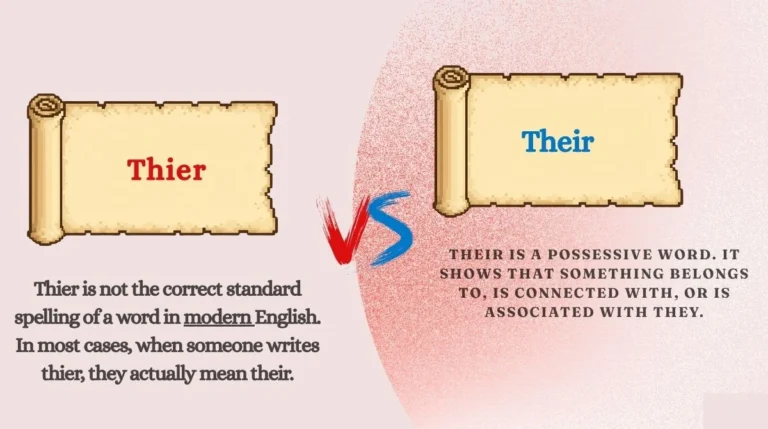
Thier is not the correct standard spelling of a word in modern English. In most cases, when someone writes thier, they actually mean their.
So, if you see thier in a sentence such as:
They left thier bags at school.
the intended sentence is:
They left their bags at school.
The error happens because the letters i and e are easily placed in the wrong order. This is a spelling mistake, not a different grammatical form.
When should you use “thier”?
You should not use thier in standard English writing. It should normally be corrected to their.
For schoolwork, business writing, emails, applications, essays, websites, and other formal or informal communication, the correct spelling is their.
Grammar rule
There is no normal grammar rule that allows thier as a possessive word. It is simply a misspelling of their.
For example:
Incorrect:
The students finished thier homework.
Correct:
The students finished their homework.
Why do people write “thier”?
This mistake is common because thier looks very close to their. When people type quickly, they may remember the letters but put them in the wrong order.
The problem can become even more common when someone learns pronunciation before spelling. Since thier and their are normally pronounced the same way, listening does not help you decide which spelling is correct.
Here are a few examples showing the mistake:
- Incorrect: The children packed thier lunch.
Correct: The children packed their lunch. - Incorrect: They sold thier old car.
Correct: They sold their old car. - Incorrect: The players wore thier new uniforms.
Correct: The players wore their new uniforms. - Incorrect: We visited thier house yesterday.
Correct: We visited their house yesterday. - Incorrect: The workers completed thier task.
Correct: The workers completed their task. - Incorrect: The students opened thier books.
Correct: The students opened their books. - Incorrect: The birds returned to thier nest.
Correct: The birds returned to their nest. - Incorrect: Everyone brought thier own water bottle.
Correct: Everyone brought their own water bottle.
The important point is simple: thier is a spelling error, while their is the correct English word.
What Does “Their” Mean?
Their is a possessive word. It shows that something belongs to, is connected with, or is associated with they.
For example:
They lost their keys.
Here, their shows that the keys belong to them.
We use their before a noun.
When do we use “their”?
We commonly use their when talking about something that belongs to or is connected to:
- two or more people
- a group of people
- people already mentioned
- a person when using singular they
For example:
Sarah and Tom brought their books.
The books belong to Sarah and Tom.
Another example:
The company changed their website.
Here, their refers to the company as an associated group or organization in everyday usage.
We also use their with singular they:
Every student should bring their own pencil.
In this sentence, “every student” is singular, but their can be used because the person’s gender is unknown, irrelevant, or intentionally not specified.
Grammar rule
The basic pattern is:
their + noun
Examples:
their house
their teacher
their car
their children
their idea
their school
You can think of their as a word that answers the question:
“Whose?”
For example:
Whose books are these?
They are their books.
Example sentences with “their”
- The children are playing with their toys.
- My parents are visiting their friends tonight.
- The students submitted their assignments on time.
- James and Ali forgot their tickets.
- The workers are cleaning their office.
- The birds returned to their nest.
- The players changed their clothes after the match.
- Every customer should check their receipt before leaving.
In each sentence, their comes before a noun and shows possession or association.
A common learner confusion
Many students confuse their, there, and they’re because the three words sound the same or very similar.
Compare them:
- Their = shows possession
- There = refers to a place or introduces something
- They’re = short form of “they are”
Examples:
Their house is large.
The house is over there.
They’re waiting outside.
This is another reason why their needs careful attention. When you hear the word, you cannot depend on sound alone. You need to understand the meaning and spelling.
Difference Between Thier and Their
The difference is actually very simple:
Their is correct.
Thier is incorrect.
There is no normal meaning difference between the two. They are not two words with different uses. Instead, one is the correct spelling and the other is a common spelling mistake.
Comparison Table
| Word | Correct? | Meaning | Use |
|---|---|---|---|
| their | Yes | Shows possession or connection | Before a noun |
| thier | No | No standard English meaning | Usually a spelling mistake |
Usage difference
There is no real usage difference because thier should not normally be used.
For example:
The boys forgot their shoes.
This is correct.
Writing:
The boys forgot thier shoes.
is incorrect.
Grammar logic
The word their is a possessive determiner. It tells us who owns something or who something is connected to.
Look at this sentence:
The girls finished their project.
Girls is the group that the word their refers to.
Project is the thing connected to the girls.
The structure is:
subject + verb + their + noun
For example:
They + brought + their + bags.
The same pattern appears in thousands of everyday English sentences.
Sentence structure difference
Because thier is not a standard English word, it does not have a valid sentence structure.
The correct structure uses their:
They washed their car.
The students cleaned their classroom.
The family sold their house.
The players practiced their skills.
Meaning comparison
There is no separate dictionary meaning for thier that you should learn.
When a writer uses thier, the reader usually understands that they meant their. However, the spelling is still wrong.
This distinction is important for learners because some English word pairs really do have different meanings. Thier and their are not one of those pairs.
Grammar Rules You Must Remember
Rule 1: Use “their” to show possession
Use their when something belongs to or is connected with people represented by they.
Example:
The students opened their books.
The books belong to the students.
Another example:
They parked their car outside.
The car belongs to them.
Rule 2: Put “their” before a noun
In normal use, their comes before the noun it describes.
Examples:
their house
their teacher
their school
their friends
their decision
In a sentence:
They invited their friends to dinner.
Here, friends is the noun, and their tells us who the friends are connected with.
Rule 3: Do not spell “their” as “thier”
This is the key spelling rule.
Correct:
They finished their work.
Incorrect:
They finished thier work.
The letters must appear in this order:
T-H-E-I-R
Not:
T-H-I-E-R
A single letter order can make the spelling incorrect.
Rule 4: Remember that “their,” “there,” and “they’re” are different
These words can sound alike, so grammar and meaning must guide you.
Their = possession
Their dog is friendly.
There = place
The dog is over there.
They’re = they are
They’re very happy.
A useful way to check their is to ask:
“Does this word show ownership or connection?”
If yes, their is often the right choice.
Common Mistakes Students Make
Mistake 1: Writing “thier” because it looks natural
This is probably the most common mistake.
Many learners remember the word visually but accidentally place i before e.
Wrong:
They brought thier children.
Correct:
They brought their children.
The best correction is to train yourself to remember the exact order:
the + ir = their
Mistake 2: Choosing “there” instead of “their”
Some students know that the word sounds like there, so they choose it automatically.
Wrong:
The boys took there bags.
Correct:
The boys took their bags.
The question “Whose bags?” helps here.
The answer is “the boys’ bags,” so their is correct.
Mistake 3: Using “they’re” to show possession
They’re means they are, so it cannot normally replace their.
Wrong:
The students brought they’re books.
Expand “they’re”:
The students brought they are books.
That clearly does not work.
Correct:
The students brought their books.
Mistake 4: Thinking “thier” is an alternative spelling
Some learners see the spelling often enough online that they begin to think it might be a British, American, old-fashioned, or informal version.
It is not normally treated as a standard alternative spelling.
For standard English, choose:
their
not:
thier
Mistake 5: Relying only on pronunciation
The pronunciation of their, there, and they’re can be very similar in everyday speech.
That means listening alone cannot always solve the problem.
For writing, think about the sentence’s meaning.
For example:
They left their phones at home.
Ask:
Whose phones?
Answer:
Their phones.
That makes the correct spelling much easier to choose.
Easy Trick to Remember the Difference
The easiest trick is to remember the correct letter order:
THEIR = T-H-E-I-R
Notice that E comes before I.
You can mentally break the spelling into two parts:
THE + IR = THEIR
It may help to say the letters slowly:
T-H-E-I-R
Another useful trick is to connect their with they.
Look at these words:
They → Their
The spelling begins with the-, and then adds -ir.
You can also remember this little sentence:
They have their things.
The word they can remind you how to begin their.
A real-life memory trick
Imagine two students standing outside a classroom.
One says:
“They have their books.”
The books belong to them.
Whenever you want to write the possessive word, think:
They → their
This is more useful than trying to memorize a long spelling rule.
What about “i before e”?
You may have heard the common spelling phrase:
“I before E except after C.”
However, English has many exceptions, and their is one of the words that does not fit neatly into that simple rule.
So do not depend on that rhyme here. Learn their as one fixed spelling.
Write it several times:
their
their
their
their
After enough practice, the correct spelling starts to look normal and thier starts to look wrong.
Daily Life Examples
The word their appears constantly in everyday English. Here are natural examples you might hear at school, work, home, or in casual conversation.
1. At school
Teacher: Did the students bring their notebooks?
Student: Yes, they have their notebooks with them.
2. At home
Mom: Where are the kids?
Dad: They are in their room.
Here, their refers to the kids.
3. At work
Manager: Did the employees finish their report?
Assistant: Yes, they sent their report this morning.
4. Talking about friends
My friends are planning their trip for next month.
The trip belongs to or is organized by the friends.
5. At a restaurant
The customers are waiting for their food.
The food is associated with the customers.
6. Talking about a family
The family invited us to their home.
The home is connected with the family.
7. About a student
Every student should bring their ID card.
Here, their is used with singular they because the student’s gender is not specified.
8. Talking about a team
The players celebrated their victory.
The victory is connected with the players.
9. At the airport
The passengers collected their bags and left.
The bags belong to the passengers.
10. In everyday conversation
Ali: Where are Sarah and Emma?
John: They went back to their house.
This is a simple example, but it shows exactly how the word works in normal spoken English.
Practice Section
Choose the correct option in each sentence: their or thier.
1. The boys forgot ___ jackets.
A. thier
B. their
2. The students finished ___ homework.
A. thier
B. their
3. They invited us to ___ house.
A. their
B. thier
4. The players packed ___ bags.
A. thier
B. their
5. The children cleaned ___ room.
A. their
B. thier
Answers
1. B — their
The jackets belong to the boys.
2. B — their
The homework is connected with the students.
3. A — their
The house belongs to or is connected with them.
4. B — their
The bags belong to the players.
5. A — their
The room belongs to or is used by the children.
A good habit is to check the spelling every time you type their until the correct form becomes automatic.
FAQs
What is the difference between thier and their?
Their is the correct standard English spelling. It is a possessive word used to show that something belongs to or is connected with people represented by they. Thier is a common spelling mistake and should normally be corrected to their.
Is thier a correct English word?
No. Thier is not the standard spelling of the possessive word. In ordinary English writing, use their instead. You may see the incorrect spelling online, but frequent use does not make it a correct standard form.
Why do people spell their as thier?
The mistake happens because their and thier contain almost the same letters. People often remember the word but reverse the positions of e and i. Fast typing can also cause this error, especially when someone is writing without checking their spelling.
Can we use their in a question?
Yes. Their can appear in questions whenever the sentence refers to possession or connection.
For example:
Did they bring their books?
Where is their car?
The word still has the same job: it shows who something belongs to or is connected with.
Is their formal or informal?
Their is standard English and can be used in both formal and informal writing. You can use it in school assignments, business emails, reports, conversations, and casual messages. It is a normal and widely accepted English word.
Is there a difference between their and there?
Yes. Their shows possession, while there usually refers to a place or helps introduce information.
For example:
Their house is beautiful.
The house is over there.
A simple question can help: “Whose?” usually points you toward their.
Conclusion
The confusion between thier or their is mainly a spelling problem, but it is an easy one to fix. The correct word is their, and it is used to show possession or a connection with people represented by they.
For example, we say:
They brought their books.
We do not normally write:
They brought thier books.
Remember the spelling carefully: T-H-E-I-R. The E comes before the I. It can also help to connect the word with they, as in “They have their books.”
Do not worry if you have made this mistake before. Many learners and even fast typists make it. The best solution is simple practice. Read the word, write it correctly, and pay attention when you type it. Soon, their will feel natural, and thier will immediately look wrong.

Evan Rellmont is a writer who turns thoughtful ideas into meaningful words, creating stories and reflections that connect, inspire, and leave a lasting impression.