
Have you ever written ageing and wondered whether you should write aging instead? You are not alone.
These two words look slightly different, but they have the same meaning and the same pronunciation.
The real difference is mainly connected to British English and American English, which is why learners often see both spellings in books, websites, emails, and everyday writing.
The word describes the process of getting older or something becoming older. You may see it in phrases such as the ageing process, an ageing population, or anti-aging products.
Both spellings are correct, but the spelling you choose can depend on which variety of English you are following.
Cambridge Dictionary identifies ageing as the UK spelling of aging, while Oxford describes ageing as the usual British form and aging as especially common in North American English.
This can be confusing because English spelling changes in many words when we compare British and American English.
For example, we commonly see colour/color, centre/center, and travelling/traveling.
The good news is that ageing and aging do not have different meanings.
Once you understand where each spelling is normally used, choosing the right one becomes easy.
What Does “Ageing” Mean?
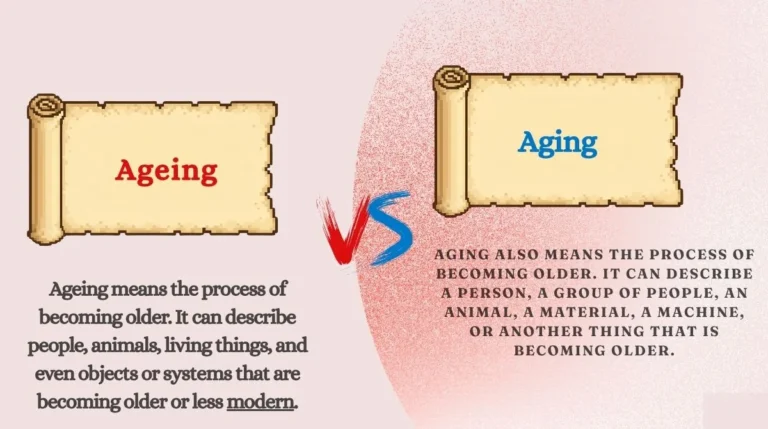
Ageing means the process of becoming older. It can describe people, animals, living things, and even objects or systems that are becoming older or less modern.
For example, when we say “the ageing process,” we mean the natural process of getting older. When we say “an ageing building,” we mean a building that is getting old.
The spelling ageing is especially common in British English. Cambridge labels it as the UK spelling of aging, and Oxford gives ageing as the British English form.
When should you use “ageing”?
Use ageing when you are writing in British English or when your school, workplace, publication, or audience normally follows British spelling.
This is particularly useful for writers in countries where British English is widely taught or used. If your audience expects British spelling, ageing will usually look more natural.
You can use it as a noun:
- Ageing is a natural part of life.
- The study looks at healthy ageing.
You can also use it as an adjective:
- We have an ageing population.
- They are replacing some ageing equipment.
Oxford lists ageing as a noun meaning the process of growing old and also as an adjective for someone or something becoming older.
Grammar rule for “ageing”
The word ageing comes from the verb age.
When -ing is added to age, the final e is normally kept in this spelling:
age + ing = ageing
This is one reason some learners expect the spelling to be ageing even when they are using American English. However, American English commonly uses aging, so regional spelling matters here.
Examples of “ageing”
- Ageing is a natural process that happens to everyone.
- The doctor explained that healthy ageing depends on many factors.
- The country has an ageing population.
- They need to replace the ageing computer system.
- She is studying the effects of ageing on memory.
- These products are designed to protect skin from signs of ageing.
- The company is dealing with an ageing workforce.
- Regular exercise can support healthy ageing.
Notice that the basic meaning does not change from one sentence to another. The word can refer to people, populations, machines, systems, or the process itself.
A common confusion about “ageing”
A common mistake is thinking that ageing and aging describe two different processes. They do not.
Another mistake is thinking that ageing is more correct because it contains the e from age. That is not true in every type of English. In American English, aging is the standard spelling, even though the pronunciation is the same.
So remember this simple point:
Ageing is a correct spelling, especially in British English.
What Does “Aging” Mean?
Aging also means the process of becoming older. It can describe a person, a group of people, an animal, a material, a machine, or another thing that is becoming older.
The important point is that aging and ageing mean the same thing when they are used in this sense.
The spelling aging is especially common in American English. Cambridge calls it the US spelling of ageing, and Oxford says aging is especially common in North American English.
When should you use “aging”?
Use aging when you are following American English spelling.
This is common in American books, websites, newspapers, school materials, and business writing.
For example:
- The aging population needs better healthcare services.
- Scientists are studying the aging process.
- The company is replacing its aging computers.
Grammar rule for “aging”
The word aging is also formed from the verb age plus the -ing ending, but American English commonly drops the final e:
age + ing = aging
This same spelling pattern appears in other American English words, depending on the base word and pronunciation. The important thing here is not to treat the different spelling as a different grammar form.
Aging can work as a noun:
- Aging is a natural part of human life.
It can also work as an adjective:
- The factory has an aging machine.
Cambridge gives aging as both a noun in some uses and an adjective meaning becoming older or appearing old.
Examples of “aging”
- Aging is a natural part of life.
- Scientists are studying the aging process.
- The city has an aging population.
- The company is replacing its aging equipment.
- She is interested in healthy aging.
- Some aging buildings need major repairs.
- The program was created to support aging adults.
- Researchers are examining how exercise affects aging.
A common confusion about “aging”
Some students think aging is an incorrect spelling because the word age ends in e. Others think ageing is incorrect because they have mostly seen American websites.
Neither idea is right.
Aging is correct in American English.
The spelling difference does not create a different meaning. It simply reflects a difference in English spelling conventions.
Difference Between Ageing and Aging
The most important fact is this:
Ageing and aging have the same meaning.
The main difference is regional spelling, not grammar or meaning.
| Point | Ageing | Aging |
|---|---|---|
| Meaning | Becoming older | Becoming older |
| Main variety | British English | American English |
| Pronunciation | Same | Same |
| Part of speech | Noun / adjective | Noun / adjective |
| Meaning difference | None in ordinary use | None in ordinary use |
| Best choice | British-style writing | American-style writing |
| Example | an ageing population | an aging population |
Cambridge directly identifies ageing as the UK spelling of aging, while its American English entry identifies aging as the US spelling.
Usage difference
The biggest difference is where the spelling is normally used.
In British English, you are more likely to see:
- ageing
- anti-ageing
- an ageing population
- the ageing process
In American English, you are more likely to see:
- aging
- anti-aging
- an aging population
- the aging process
Oxford also notes that ageing is British English and aging is especially common in North American English.
Grammar logic
There is no separate grammar rule that says one spelling should be used after a particular noun or verb.
For example, these are both grammatically correct:
- Ageing is a natural process.
- Aging is a natural process.
And both are correct:
- The hospital helps ageing patients.
- The hospital helps aging patients.
The choice is mainly based on the variety of English being used.
Sentence structure difference
There is no sentence structure difference between the two.
You can replace one with the other without changing the grammatical structure:
British English:
The country has an ageing population.
American English:
The country has an aging population.
The word population remains a noun in both sentences, and ageing/aging works as an adjective describing it.
Similarly:
British English:
She is interested in healthy ageing.
American English:
She is interested in healthy aging.
The sentence pattern stays exactly the same.
Meaning comparison
The meanings are essentially identical.
Both words can refer to:
- becoming older
- the natural process of getting older
- something becoming old
- something becoming less modern
- changes connected with increasing age
For example:
The country has an ageing population.
and
The country has an aging population.
Both sentences communicate the same idea.
Grammar Rules You Must Remember
Rule 1: Both spellings are correct
Do not think that one is a spelling mistake.
Ageing and aging are both established English spellings. Merriam-Webster’s entry for the verb age lists aging or ageing among its forms.
Example:
Aging is a natural process.
Ageing is a natural process.
Both are correct.
Rule 2: Use “ageing” for British English
When your writing follows British English conventions, ageing is the usual choice.
Example:
Britain has an ageing population.
This spelling fits the standard British form listed by major learner dictionaries.
Rule 3: Use “aging” for American English
When you are writing for an American audience or using American spelling throughout your work, choose aging.
Example:
The United States has an aging population.
The spelling aging is especially associated with North American English.
Rule 4: Be consistent
One of the most useful writing rules is to choose one variety of English and stay consistent.
For example, if your article uses American spellings such as:
- color
- center
- traveling
then aging will usually fit better.
If your article uses British spellings such as:
- colour
- centre
- travelling
then ageing will usually fit better.
Consistency makes your writing look more polished and professional.
Common Mistakes Students Make
Students often make mistakes with these words because they learn English from different sources. A learner may study British English at school but read American English online every day.
That means both spellings can feel familiar.
Mistake 1: Thinking “aging” is wrong
Wrong idea:
“Aging” is not a real English word.
Correct idea:
“Aging” is a standard spelling, especially in American English.
Cambridge and Oxford both recognize the American form.
Mistake 2: Thinking “ageing” is old-fashioned or incorrect
Some learners see ageing less often and assume it must be an unusual or incorrect form.
But ageing is the normal British spelling.
Example:
The country has an ageing population.
This is perfectly natural in British English.
Mistake 3: Mixing spelling styles
Consider this sentence:
The centre is studying the aging population and plans a program for healthy ageing.
There is nothing grammatically wrong with the sentence, but the spelling style is mixed.
A more consistent British version would be:
The centre is studying the ageing population and plans a program for healthy ageing.
A more American version would be:
The center is studying the aging population and plans a program for healthy aging.
The key lesson is simple: consistency matters.
Mistake 4: Choosing a spelling because it “looks better”
English spelling is not always based on what looks logical.
A student may think:
age + ing = ageing
so aging must be wrong.
But spelling conventions differ across varieties of English. The best choice is not the one that looks more logical. It is the one that matches the English style you are using.
Easy correction tip
Before choosing the word, ask yourself:
“Am I writing British English or American English?”
If the answer is British English, use ageing.
If the answer is American English, use aging.
Easy Trick to Remember the Difference
Here is a simple memory trick:
UK = AGEING
US = AGING
Think of the extra e as staying in the British spelling:
British → ageing
And think of American spelling as the shorter form:
American → aging
You do not need to memorize a complicated grammar rule.
A very easy way to remember it is to connect the words with other familiar spelling differences:
- British colour → American color
- British centre → American center
- British travelling → American traveling
- British ageing → American aging
The important thing is not to think that one form is right and the other is wrong.
Think:
Same meaning, different regional spelling.
That one sentence can help you remember the whole topic.
Daily Life Examples
These examples show how both spellings can appear naturally in everyday English.
1. Talking about a population
British English:
The country has an ageing population.
American English:
The country has an aging population.
Both mean that the average age of the population is becoming higher.
2. Talking about parents
British English:
She worries about her ageing parents.
American English:
She worries about her aging parents.
Both sentences are natural.
3. Talking about health
British English:
Exercise is important for healthy ageing.
American English:
Exercise is important for healthy aging.
The meaning does not change.
4. Talking about technology
British English:
The company needs to replace its ageing computers.
American English:
The company needs to replace its aging computers.
Here, the word describes equipment that has become old.
5. In a classroom
Student: Is ageing spelled with an “e”?
Teacher: In British English, yes. In American English, aging is common.
6. Talking about beauty products
British English:
She bought an anti-ageing cream.
American English:
She bought an anti-aging cream.
Both forms are widely understood.
7. Talking about buildings
British English:
The city has many ageing buildings.
American English:
The city has many aging buildings.
The adjective tells us that the buildings are getting old.
8. Talking about workers
British English:
The business is planning for an ageing workforce.
American English:
The business is planning for an aging workforce.
Again, only the spelling changes.
9. Talking about science
British English:
Scientists are researching the effects of ageing.
American English:
Scientists are researching the effects of aging.
The meaning is exactly the same.
10. A simple conversation
Ali: Which is correct, ageing or aging?
Sara: Both are correct.
Ali: So how do I choose?
Sara: Use ageing for British English and aging for American English.
Ali: That is much easier than I thought!
Practice Section
Choose the correct word for each sentence. Remember that in some cases both forms are grammatically possible, but the question asks which spelling best matches the stated English variety.
1. British English
The country has an _____ population.
A. aging
B. ageing
2. American English
The city is preparing for an _____ population.
A. ageing
B. aging
3. British English
Regular exercise can support healthy _____.
A. aging
B. ageing
4. American English
Scientists are studying the _____ process.
A. ageing
B. aging
5. General English
Which statement is correct?
A. Only ageing is correct.
B. Only aging is correct.
C. Both are correct, depending on the English variety.
Answers
1. B — ageing
British English normally uses ageing.
2. B — aging
American English normally uses aging.
3. B — ageing
The sentence asks for British English spelling.
4. B — aging
American English uses aging.
5. C — Both are correct.
The difference is mainly regional spelling, not meaning.
FAQs
What is the difference between ageing and aging?
Ageing and aging have the same basic meaning: becoming older or the process of getting older. The main difference is spelling. Ageing is especially common in British English, while aging is especially common in American English.
Is ageing British or American English?
Ageing is mainly associated with British English. Cambridge identifies it as the UK spelling of aging, and Oxford lists it as the British English form. If your writing follows British spelling, ageing is the usual choice.
Is aging grammatically correct?
Yes. Aging is grammatically correct and is especially common in American English. Major dictionaries recognize it as the American spelling of ageing. It can be used as both a noun and an adjective, depending on the sentence.
Can I use ageing in American English?
You may see ageing in American contexts, and readers will understand it. However, aging is the standard American spelling and will usually look more natural in writing that consistently follows American English conventions.
Is ageing or aging more formal?
Neither spelling is automatically more formal. The difference is mainly regional. Ageing is associated with British English, while aging is associated with American English. Formality depends on the sentence and context, not on the extra e.
Do ageing and aging have the same pronunciation?
Yes. In ordinary use, ageing and aging are pronounced the same. The difference is in spelling, not pronunciation. This is one reason learners can hear the word many times before realizing that English speakers may spell it differently.
Conclusion
So, ageing or aging? The good news is that you do not need to choose between a correct word and an incorrect word. Both spellings are correct. The main difference is the variety of English you are using.
Use ageing when you are following British English spelling. Use aging when you are following American English spelling. Both words describe the process of becoming older, and they can be used in the same kinds of sentences.
For most learners, the best habit is to focus on consistency. If your writing uses British spellings, keep using British spellings. If you are writing for an American audience, use American spellings.
Once you remember UK = ageing and US = aging, this common spelling question becomes much easier. Keep noticing the word in real books, websites, and conversations, and soon the correct spelling will feel natural.

Evan Rellmont is a writer who turns thoughtful ideas into meaningful words, creating stories and reflections that connect, inspire, and leave a lasting impression.