
Have you ever written a sentence like “I dreamed about my old school” and then wondered whether you should have written “I dreamt about my old school” instead? You are not alone.
Dreamed and dreamt often confuse English learners because both forms come from the verb dream, and both can be correct.
The confusion becomes even stronger when you read English from different countries. American English normally uses dreamed, while British English commonly uses dreamt as well as dreamed.
Major learner dictionaries list both forms as correct past forms of dream.
The good news is that there is usually no big difference in meaning. Both words can describe something you experienced in your sleep, or something you strongly hoped for in the future.
The main difference is often regional preference and style, not grammar.
Once you understand this small difference, sentences such as “I dreamed about you,” “She dreamt of becoming a doctor,” and “They have dreamed of traveling abroad” become much easier to understand.
By the end, you will know when to use dreamed, when to use dreamt, how they work as past tense and past participle forms, and which choice is safest for your own writing.
What Does “Dreamed” Mean?
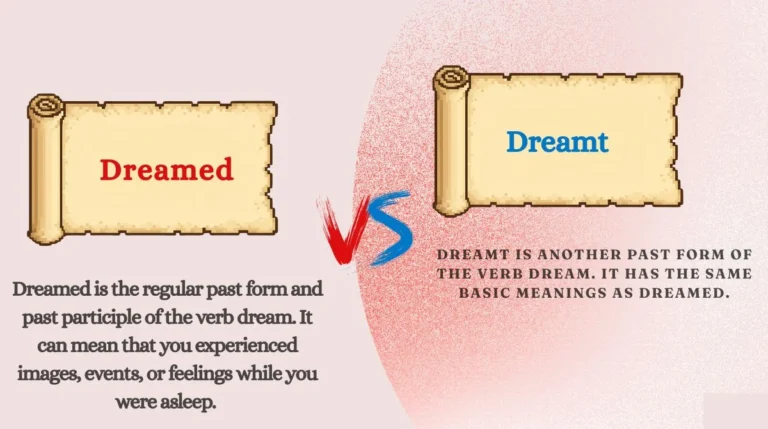
Dreamed is the regular past form and past participle of the verb dream. It can mean that you experienced images, events, or feelings while you were asleep. It can also mean that you imagined or hoped for something that you wanted to happen.
The base form is:
dream → dreamed
For example:
- I dream about strange places sometimes.
- I dreamed about a beautiful beach last night.
In the second sentence, dreamed tells us that the dreaming happened in the past.
When Should You Use “Dreamed”?
You can use dreamed when talking about a dream that happened during sleep:
I dreamed that I was flying.
You can also use it when talking about a hope, goal, or wish:
She dreamed of becoming a famous singer.
This form is especially common in American English, and it is widely understood around the English-speaking world. Oxford lists both dreamed and dreamt as past simple and past participle forms, while American English dictionaries also recognize both forms.
Grammar Rule for “Dreamed”
Use dreamed as the simple past form when the action happened in the past:
Subject + dreamed + rest of sentence
For example:
We dreamed about the same place.
You can also use dreamed after helping verbs that need a past participle:
I have dreamed about this many times.
Here, have dreamed is the present perfect tense.
Examples of “Dreamed”
- I dreamed about my childhood home last night.
- She dreamed that she was walking through a forest.
- He dreamed of becoming a pilot when he was young.
- We dreamed about living near the sea.
- They dreamed that they had won the competition.
- I have always dreamed of visiting London.
- My brother dreamed about his old school yesterday.
- She dreamed of owning her own business.
These sentences show that dreamed can be used for both sleeping dreams and hopes for the future.
A Common Learner Confusion
Some students think dreamed is always American and dreamt is always British. That is too simple.
British English accepts both forms, and dreamed is also very common there. Oxford gives both dreamt and dreamed as accepted past forms.
So writing dreamed does not automatically mean your English is wrong or that you must be using American English.
What Does “Dreamt” Mean?
Dreamt is another past form of the verb dream. It has the same basic meanings as dreamed.
The form is:
dream → dreamt
Unlike dreamed, which simply adds -ed, dreamt is a shorter form. It belongs to a group of English verbs that can have both regular and irregular-looking past forms.
For example:
- dream → dreamed
- dream → dreamt
Both are accepted forms.
When Should You Use “Dreamt”?
Use dreamt when you want to use this alternative past form of dream. It is particularly common in British English and can sound natural in British-style writing and speech. It is also used outside Britain, although dreamed is generally more common in American English.
For example:
I dreamt about my grandfather last night.
You can also use it for hopes and wishes:
She dreamt of becoming a writer.
Grammar Rule for “Dreamt”
Just like dreamed, dreamt can function as both:
- the simple past
- the past participle
Simple past:
He dreamt about his old job.
Past participle:
He had dreamt about that place before.
Oxford specifically lists dreamt as both the past simple and past participle form, alongside dreamed.
Examples of “Dreamt”
- I dreamt about my childhood last night.
- She dreamt that she was flying over the mountains.
- He dreamt of becoming a professional footballer.
- We dreamt about a better future.
- They dreamt that they were lost in a huge city.
- I have dreamt about that place several times.
- She had dreamt of opening a restaurant for years.
- He never dreamt that he would win.
A Common Learner Confusion
Some learners think dreamt has a different meaning from dreamed. In most everyday sentences, it does not.
Compare:
I dreamed about you last night.
and:
I dreamt about you last night.
Both can mean exactly the same thing.
The choice is generally about variety of English, personal preference, and style rather than a different basic meaning.
Difference Between Dreamed and Dreamt (Detailed)
The easiest thing to remember is this:
Dreamed and dreamt are both correct past forms of “dream.”
You usually do not choose one because the meaning changes. You choose one because of the kind of English you are writing or the style you prefer.
Dreamed vs Dreamt Comparison Table
| Point | Dreamed | Dreamt |
|---|---|---|
| Base verb | dream | dream |
| Simple past | dreamed | dreamt |
| Past participle | dreamed | dreamt |
| Meaning | To experience a dream or imagine a goal | Same meaning |
| American English | Very common | Less common |
| British English | Common | Common |
| Grammar status | Correct | Correct |
| Writing style | Neutral and widely used | Often associated with British English |
| Example | I dreamed about you. | I dreamt about you. |
Oxford Learner’s Dictionaries list both forms as valid past simple and past participle forms. Cambridge also lists dreamed and dreamt as past forms.
Usage Difference
The most noticeable difference is frequency.
If you read American websites, textbooks, newspapers, or social media, you are more likely to see:
I dreamed about it.
In British English, you may often see:
I dreamt about it.
However, British speakers can also use dreamed, so the difference is not a strict British-versus-American rule. Dreamed is widely accepted in both varieties.
Grammar Logic
There is no special grammar rule saying that one form must be used for sleeping dreams and the other must be used for wishes.
Both can work in both situations.
Sleeping dream:
I dreamed about my old house.
I dreamt about my old house.
Future hope:
She dreamed of becoming a doctor.
She dreamt of becoming a doctor.
The meaning stays almost the same.
Sentence Structure
Both forms can appear in the same sentence patterns.
With “that”:
I dreamed that I was late.
I dreamt that I was late.
With “about”:
He dreamed about his childhood.
He dreamt about his childhood.
With “of” + noun:
She dreamed of success.
She dreamt of success.
With “of” + -ing form:
They dreamed of traveling the world.
They dreamt of traveling the world.
Notice that the grammar around the verb does not change. Only the past form changes.
Meaning Comparison
For most everyday uses:
dreamed = dreamt
There can sometimes be a small difference in style. Some writers feel that dreamt sounds more British, traditional, or literary. Some people use it because it is shorter and fits the style of their writing.
But learners should not try to create a strict meaning difference that does not really exist.
Grammar Rules You Must Remember
Rule 1: Both “dreamed” and “dreamt” can be simple past forms.
Use either form to describe a completed dreaming experience in the past.
Example:
I dreamed about my old teacher last night.
or
I dreamt about my old teacher last night.
Both are grammatically correct.
Rule 2: Both forms can be past participles.
After have, has, or had, you can use either form.
Examples:
I have dreamed about this many times.
I have dreamt about this many times.
She had dreamed of that day for years.
She had dreamt of that day for years.
Oxford lists both forms as past participles.
Rule 3: Choose “dreamed” for a safe, widely familiar form.
If you are learning English and are unsure which word to choose, dreamed is an easy choice, especially in international or American English contexts.
It is clear, correct, and widely understood.
Example:
I dreamed about my future last night.
This will sound natural to English speakers in many regions.
Rule 4: Remember that “dream” has more than one common meaning.
A dream is not only something that happens while you sleep.
It can also mean a strong hope, goal, or wish.
Compare:
I dreamed about my grandmother last night.
Here, dreamed refers to sleep.
I dreamed of becoming a teacher.
Here, dreamed refers to a goal or hope.
The same distinction works with dreamt:
I dreamt about my grandmother last night.
I dreamt of becoming a teacher.
Common Mistakes Students Make
The biggest mistakes usually happen because learners try to find a difference that is not really there.
Mistake 1: Thinking “dreamt” is wrong
Some learners see dreamt and assume it is a spelling mistake.
That is incorrect. Dreamt is a standard English form of the verb dream.
Oxford lists it as a past simple and past participle form.
Wrong idea:
Dreamt is not a real English word.
Correct understanding:
Dreamt is a correct alternative to dreamed.
Mistake 2: Thinking “dreamed” is wrong in British English
British English uses dreamt, but that does not make dreamed incorrect.
Example:
She dreamed of becoming a nurse.
This is perfectly acceptable.
British English has more than one accepted form here.
Mistake 3: Using the base form after “did”
After did, use the base form dream, not dreamed or dreamt.
Incorrect:
Did you dreamed about me?
Incorrect:
Did you dreamt about me?
Correct:
Did you dream about me?
Why? Because did already carries the past tense.
The pattern is:
Did + subject + base verb
So:
Did she dream about it?
not:
Did she dreamed about it?
Mistake 4: Using “dreaming” after “have”
After have/has/had in the perfect tense, use a past participle.
Correct:
I have dreamed about this before.
Correct:
I have dreamt about this before.
Not:
I have dream about this before.
Easy Correction Tip
When you are checking your sentence, ask yourself two questions:
Is there “did”?
Use dream.
Is it simple past without a helping verb?
Use dreamed or dreamt.
For example:
Did you dream about me? ✅
You dreamed about me. ✅
You dreamt about me. ✅
This little check can prevent many common mistakes.
Easy Trick to Remember the Difference
Here is a very simple memory trick:
“Dreamed” has ED. “Dreamt” is the short form.
Think of them like two roads leading to the same place.
dreamed → longer form
dreamt → shorter form
Neither changes the basic meaning of the verb.
You can remember the everyday choice this way:
When in doubt, “dreamed” is a safe choice.
That does not mean dreamt is wrong. It simply means that dreamed is very widely recognized and especially common in American English.
Now connect the forms with the time:
Today:
I dream about traveling.
Yesterday:
I dreamed about traveling.
or:
I dreamt about traveling.
Perfect form:
I have dreamed about traveling.
or:
I have dreamt about traveling.
There is also a useful real-life memory trick: listen to the kind of English around you. If your school, workplace, books, or audience mostly follows British English, you will probably see dreamt more often. If your materials are mostly American English, dreamed will probably appear more often.
The important point is consistency. Once you choose a style for a piece of writing, you do not need to switch back and forth without a reason.
Daily Life Examples
Here are natural sentences you might hear in everyday conversations.
1. Talking about last night
A: What did you dream about last night?
B: I dreamed about my school days.
2. Talking about a strange dream
A: You looked tired this morning.
B: I am. I dreamt about being chased all night.
3. Talking about a childhood goal
When I was a child, I dreamed of becoming a pilot.
4. Talking about a long-term hope
She always dreamed of having her own house.
5. Talking about a surprise
I never dreamed that I would meet him here.
6. Talking about repeated dreams
I have dreamed about this place many times.
7. Talking about travel
We dreamed of traveling around Europe.
8. Talking about success
He dreamed of winning the championship.
9. Asking about someone’s sleep
A: Did you dream last night?
B: Yes, I did. I dreamed about the ocean.
10. Talking about an unexpected event
I never dreamt that everything would change so quickly.
All of these examples use dreamed or dreamt naturally. You can see that the surrounding grammar stays the same.
Practice Section
Choose the correct option. In some sentences, both answers are possible.
1. I ______ about my old school last night.
A. dreamed
B. dreamt
2. Did you ______ about the trip?
A. dreamed
B. dream
3. She has always ______ of becoming a doctor.
A. dreamed
B. dreamt
4. He ______ that he was flying over the city.
A. dreamt
B. dreamed
5. We have ______ about this opportunity for years.
A. dream
B. dreamed
Answers
1. A or B — Both dreamed and dreamt are correct.
2. B — After did, use the base form dream.
3. A or B — Both forms can work as past participles.
4. A or B — Both are correct past forms.
5. B — After have, use the past participle: dreamed or dreamt. Therefore, dreamed is correct here. Dreamt would also be correct.
FAQs
What is the difference between dreamed and dreamt?
Both are past forms of the verb dream, and both can also be past participles. They normally have the same meaning. The main difference is regional and stylistic: dreamed is especially common in American English, while dreamt is commonly used in British English.
Is “dreamt” correct English?
Yes. Dreamt is a correct English word. Oxford lists dreamt as both the past simple and past participle of dream. It can be used for sleeping dreams as well as hopes or ambitions.
Is dreamed or dreamt more common in American English?
Dreamed is generally the more common choice in American English. Dreamt is understood, but it is much less common in everyday American usage. Cambridge’s American dictionary lists both forms, while usage references note the strong preference for dreamed in American English.
Is dreamt more formal than dreamed?
Not necessarily. Dreamt is often associated with British English and can sometimes sound a little more traditional or literary, but it is not simply the “formal” version of dreamed. Both are standard forms.
Can I use dreamed and dreamt in questions?
Yes, but be careful with did.
Say:
Did you dream about me?
Do not say:
Did you dreamed about me?
or:
Did you dreamt about me?
After did, the main verb returns to its base form dream.
Which one should I use: dreamed or dreamt?
Both are correct, so the best choice depends on your audience and the variety of English you are using. For a broad international audience, dreamed is a simple and widely familiar choice. If you normally use British English, dreamt is completely natural.
Conclusion
The good news is that dreamed and dreamt are not two completely different words. They are two accepted past forms of the verb dream.
You can use either one to talk about something you experienced while sleeping:
I dreamed about my friend.
I dreamt about my friend.
You can also use either one when talking about a hope, wish, or goal:
She dreamed of becoming a doctor.
She dreamt of becoming a doctor.
The main difference is usage by region. Dreamed is especially common in American English, while dreamt is widely used in British English. Neither form is automatically wrong.
One rule is especially important: after did, use dream, not dreamed or dreamt.
The best way to remember these forms is to see them in real sentences and use them yourself. After a little practice, choosing between dreamed and dreamt will feel natural instead of confusing.

Evan Rellmont is a writer who turns thoughtful ideas into meaningful words, creating stories and reflections that connect, inspire, and leave a lasting impression.