
Many English learners stop when they need to write the word tries. They often wonder whether the correct spelling is tries or trys.
The confusion is understandable because many English verbs simply take -s when we use them with he, she, or it.
For example, we say plays, works, and helps. So, when learners see the verb try, they may naturally think that trys should be correct.
However, English has a special spelling rule for verbs that end in consonant + y.
The correct spelling is tries, not trys, when you need the third-person singular form of the verb try. The same spelling is also used when try is a noun and you are talking about more than one attempt.
This small spelling difference matters in school writing, emails, messages, essays, and everyday English.
A single missing letter can make your writing look incorrect.
By the end of this guide, you will understand what tries means, why trys is normally incorrect, how the -y to -ies spelling rule works, and how to use the correct form naturally in real sentences.
What Does “Tries” Mean?
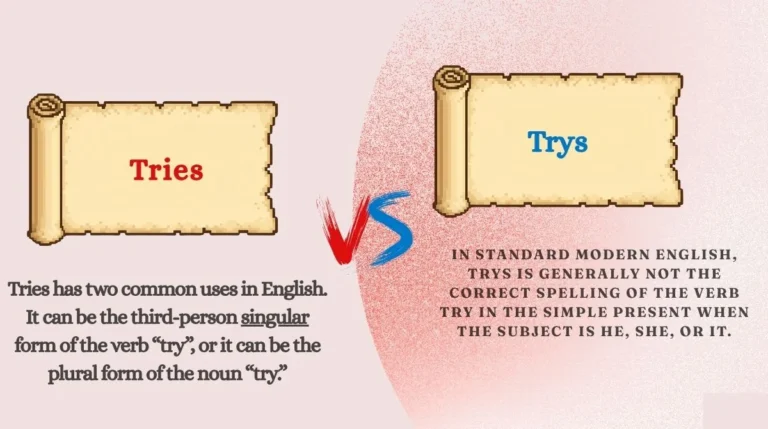
Tries has two common uses in English. It can be the third-person singular form of the verb “try”, or it can be the plural form of the noun “try.”
First, let us look at tries as a verb.
The verb try means to make an effort to do something, to attempt something, or to see whether something works. When the subject is he, she, or it in the simple present tense, try changes to tries.
The basic pattern is:
I/You/We/They try
He/She/It tries
This is an important spelling rule. Because try ends in consonant + y, the y changes to i and -es is added.
So:
try → tries
Not:
try → trys
Here are some examples:
- She tries to wake up early every day.
- He tries his best at school.
- My brother tries to help our mother.
- The teacher tries to explain the lesson clearly.
- This machine tries to save energy.
- Sarah tries a new recipe every weekend.
- He always tries to arrive on time.
- My dog tries to open the door.
In each sentence, tries is a verb because the subject is singular and is doing the action.
There is another use of tries. It can also be the plural noun form of try.
A try can mean an attempt or an effort to do something. When there is more than one attempt, we use tries.
For example:
- She made three tries before she opened the jar.
- After several tries, he finally solved the problem.
- I gave it two tries, but it still did not work.
Here, tries is not a verb. It is a noun that means attempts.
This is one reason the word can sometimes seem confusing. The same spelling can have different grammatical jobs depending on the sentence.
When Should You Use “Tries”?
Use tries as a verb when:
- The subject is he, she, or it.
- You are using the simple present tense.
- The meaning is “makes an effort” or “attempts.”
Use tries as a noun when you mean more than one attempt.
For example:
She tries to call him every day.
Here, tries is a verb.
She made several tries to call him.
Here, tries is a plural noun.
Common Confusion About “Tries”
A common mistake is to think that every third-person verb simply takes -s.
That is not always true. English spelling changes with some verbs.
Compare:
- play → plays
- clean → cleans
- work → works
- try → tries
- carry → carries
- study → studies
The key is the letter before the final y.
In try, the letter before y is r, a consonant. Therefore, the y changes to i before -es is added.
What Does “Trys” Mean?
In standard modern English, trys is generally not the correct spelling of the verb try in the simple present when the subject is he, she, or it.
For example, this sentence is incorrect:
She trys to learn English every day.
The correct sentence is:
She tries to learn English every day.
The problem happens because English learners often apply the simple rule “add s to the verb.”
That rule works for many verbs:
- run → runs
- eat → eats
- read → reads
- help → helps
- jump → jumps
But verbs ending in consonant + y follow a different spelling pattern.
The correct rule is:
Change y to i and add -es.
Therefore:
- try → tries
- study → studies
- carry → carries
- worry → worries
- copy → copies
- hurry → hurries
The spelling trys may appear in informal writing, typing errors, or learner mistakes, but it is not the standard spelling you should use in correct English.
Why Do People Write “Trys”?
The mistake is usually caused by pronunciation and by a very common grammar pattern.
Learners know that the third-person singular form often ends in -s, so they add only s:
try + s = trys
But English spelling does not always work by simply attaching letters. Some words change their spelling when endings are added.
The same thing happens with study:
Incorrect: He studys at night.
Correct: He studies at night.
It also happens with carry:
Incorrect: She carrys the bag.
Correct: She carries the bag.
So, trys should normally be treated as a spelling mistake, not as an alternative standard form.
Difference Between Tries and Trys
The main difference is simple:
Tries is correct.
Trys is normally incorrect.
The word tries follows the standard English spelling rule for words ending in consonant + y. The form trys does not.
| Word | Correct? | Main Use | Example |
|---|---|---|---|
| Tries | ✅ Yes | Third-person singular verb or plural noun | She tries to help. |
| Trys | ❌ No | Not standard spelling for the verb | She trys to help. |
Usage Difference
There is not really a meaning difference between tries and trys. The issue is correctness.
When you want to say that one person makes an effort, use tries:
He tries to understand.
Do not write:
He trys to understand.
When you want to talk about several attempts, use tries:
After many tries, she succeeded.
Again, trys is not the correct plural spelling.
Grammar Logic
The spelling depends on the ending of the base verb.
For a verb ending in consonant + y, change y to i and add -es for the third-person singular simple present form.
The formula is:
consonant + y → i + es
Examples:
- try → tries
- cry → cries
- fly → flies
- marry → marries
- reply → replies
But there is an important second rule.
If a verb ends in vowel + y, we do not change the y. We simply add -s.
Examples:
- play → plays
- enjoy → enjoys
- stay → stays
- obey → obeys
This gives you a useful comparison:
try → tries
play → plays
The difference is the letter immediately before y.
Sentence Structure Difference
Because tries can be a verb or noun, its position in a sentence can change.
As a verb:
She tries to cook dinner.
The structure is:
Subject + tries + infinitive
As a noun:
She made three tries.
The structure is:
Subject + verb + number/adjective + plural noun
Understanding this difference can make the word much easier to recognize.
Meaning Comparison
As a verb, tries means makes an effort or attempts.
He tries to fix the computer.
As a noun, tries means attempts.
He made three tries to fix the computer.
Trys, however, does not have a standard meaning in normal English grammar. When students use it, they usually mean tries.
Grammar Rules You Must Remember
Rule 1: Try Becomes Tries With He, She, or It
When try is used in the simple present tense with he, she, or it, change y to i and add -es.
Example:
She tries to finish her homework before dinner.
Not:
She trys to finish her homework before dinner.
This is the most important rule to remember.
Rule 2: Do Not Change “Try” After I, You, We, or They
The base form try stays the same after I, you, we, and they in the simple present.
Examples:
I try to stay positive.
You try very hard.
We try to help new students.
They try to arrive early.
Notice that none of these sentences uses tries.
A common mistake is to write tries with every subject. That is also incorrect.
Rule 3: Consonant + Y Changes to I + ES
When a verb ends in a consonant followed by y, change the y to i and add -es.
Examples include:
try → tries
study → studies
carry → carries
worry → worries
hurry → hurries
For example:
My sister studies English every evening.
Not:
My sister studys English every evening.
This rule is useful far beyond the word tries.
Rule 4: Vowel + Y Usually Takes Only S
Do not change the y when the letter before it is a vowel.
For example:
play → plays
enjoy → enjoys
stay → stays
Compare these carefully:
He tries to help.
He plays football.
The first verb ends in r + y, so the y changes. The second ends in a + y, so the y stays.
Remembering this small difference will help you spell many English verbs correctly.
Common Mistakes Students Make
One of the biggest mistakes is writing trys because the student remembers only the basic third-person rule.
They think:
try + s = trys
But English spelling requires a change.
Mistake 1: Using “Trys”
❌ He trys to call me every night.
✅ He tries to call me every night.
The correction is simple: change y to i and add -es.
Mistake 2: Using “Tries” With “They”
❌ They tries to solve the problem.
✅ They try to solve the problem.
Remember that tries is used with singular third-person subjects such as he, she, and it.
Mistake 3: Using “Tries” After “Does”
❌ She does tries to help.
✅ She does try to help.
After does, use the base form of the verb.
This is a very useful rule:
does + try, not does + tries
For example:
He does try his best.
Not:
He does tries his best.
Mistake 4: Forgetting the Spelling Change in Similar Words
Students who write trys may also make mistakes with words such as study, carry, and worry.
For example:
❌ She studys every night.
✅ She studies every night.
❌ He worrys too much.
✅ He worries too much.
The same spelling pattern is working in all these words.
Easy Correction Tip
When you are unsure, ask yourself two questions:
Who is doing the action?
What letter comes before the final y?
If the subject is he, she, or it, and the verb ends in consonant + y, use -ies.
That gives you:
He tries.
She studies.
It carries.
Easy Trick to Remember the Difference
Here is a very easy memory trick:
“Consonant + Y says goodbye to Y.”
When a verb ends in consonant + y, the y changes to i before -es is added.
Think:
TRY → TRIES
The Y goes away, and IES takes its place.
You can also connect the spelling to words you already know:
cry → cries
fly → flies
try → tries
All three follow the same pattern.
Now compare:
play → plays
stay → stays
enjoy → enjoys
Here, the y stays because there is a vowel before it.
A quick classroom test can help:
Is there a consonant before y?
Yes → change y to i and add es.
try → tries
No, there is a vowel before y → keep y and add s.
play → plays
This little trick can save you from many spelling errors.
Daily Life Examples
The best way to remember grammar is to see it in normal conversation. Here are some easy examples that you may hear or use in daily English.
1. Talking About Studying
Ali: Does Sara study every day?
Hina: Yes, she tries to study for two hours every evening.
Here, tries is used because the subject is she.
2. Talking About Cooking
Mom: How is your new recipe going?
Daughter: I try a new recipe every weekend.
Mom: That sounds fun!
Notice that I try uses the base form, not I tries.
3. Talking About a Friend
He always tries to make everyone laugh.
This means he regularly makes an effort to make people laugh.
4. Talking About Work
My manager tries to keep the team motivated.
The subject is my manager, which is singular, so tries is correct.
5. Talking About Technology
This app tries to make learning easier.
The subject is this app, so the verb becomes tries.
6. Talking About Children
The little boy tries to tie his shoes by himself.
The boy is making an effort, so tries is the correct form.
7. Talking About Repeated Attempts
I gave the game three tries before I finally won.
Here, tries is a noun meaning attempts.
8. Talking About Fixing Something
She tries to fix the printer before calling a technician.
The word tries describes her effort.
9. Talking About a Team
They try different methods to solve the problem.
Because the subject is they, use try, not tries.
10. Talking About Personal Effort
I always try to speak English with my friends.
This is a natural everyday sentence for English learners.
These examples show why paying attention to the subject is so important. Try and tries are both correct words, but they are used in different grammatical situations.
Practice Section
Choose the correct word in each sentence.
1. She ___ to finish her work before lunch.
A. try
B. tries
C. trys
2. They ___ to help their teacher.
A. try
B. tries
C. trys
3. He ___ to wake up early every morning.
A. try
B. tries
C. trys
4. I gave the puzzle three ___ before I solved it.
A. try
B. tries
C. trys
5. My sister ___ to learn a new word every day.
A. try
B. tries
C. trys
Answers
1. B — tries
2. A — try
3. B — tries
4. B — tries
5. B — tries
A useful way to practice is to make your own sentences with different subjects.
Try writing:
I try…
You try…
They try…
He tries…
She tries…
It tries…
This will help the pattern become automatic.
FAQs
What is the difference between “tries” and “trys”?
Tries is the correct standard spelling. It can be the third-person singular form of try, or the plural noun form meaning attempts. Trys is normally an incorrect spelling.
Is “trys” a word?
In standard English, trys is not normally used as the correct form of try. When you mean the third-person singular verb, use tries. For example, write “She tries to help,” not “She trys to help.”
Why does try change to tries?
The verb try ends in consonant + y. In the third-person singular simple present, the y changes to i and -es is added. Therefore, try becomes tries.
Can we use “tries” in a question?
Yes, but the form depends on the helping verb. With does, use the base verb try:
Does she try hard?
Do not say:
Does she tries hard?
Is “tries” formal or informal?
Tries is standard English and can be used in both formal and informal writing. You can use it in school assignments, emails, conversations, reports, and everyday messages.
Is “tries” the plural of “try”?
Yes. As a noun, tries is the plural of try when try means an attempt.
For example:
I made three tries.
Here, tries means three attempts. It is different from tries as a verb.
Conclusion
The correct choice between tries or trys is easy once you know the spelling rule. Tries is the standard and correct form, while trys is normally a spelling mistake.
Use tries when try is used with he, she, or it in the simple present:
He tries.
She tries.
It tries.
Use try with I, you, we, and they:
I try.
We try.
They try.
Also remember that tries can be a plural noun meaning attempts, as in “I gave it several tries.”
The most useful spelling trick is simple: when a verb ends in consonant + y, change y to i and add -es. So try becomes tries, just like study becomes studies and carry becomes carries.
A little practice with these patterns will make the correct spelling feel natural. Keep writing, keep reading, and do not be afraid of small grammar mistakes. They are part of learning.

Evan Rellmont is a writer who turns thoughtful ideas into meaningful words, creating stories and reflections that connect, inspire, and leave a lasting impression.