
Have you ever seen the words cubical and cubicle and wondered whether they mean the same thing? You are not alone.
These two words look and sound very similar, so English learners often mix them up.
The problem becomes even bigger because both words are connected to the idea of a cube.
However, cubical and cubicle do different jobs in a sentence. One mainly describes the shape or form of something, while the other names a small separate space.
Merriam-Webster defines cubical as an adjective meaning “cubic,” especially something shaped like a cube. Cubicle, on the other hand, is a noun for a small partitioned space, such as a work area in an office.
This small difference matters in everyday English. You may need cubicle when talking about your office, a shower, or a changing area.
You may need cubical when describing an object that has the shape of a cube.
The good news is that the difference is quite easy once you focus on meaning and grammar, rather than simply looking at the spelling.
By the end of this guide, you will know exactly when to use each word, how they fit into sentences, what mistakes to avoid, and how to remember the difference without having to think too hard.
What Does “Cubical” Mean?
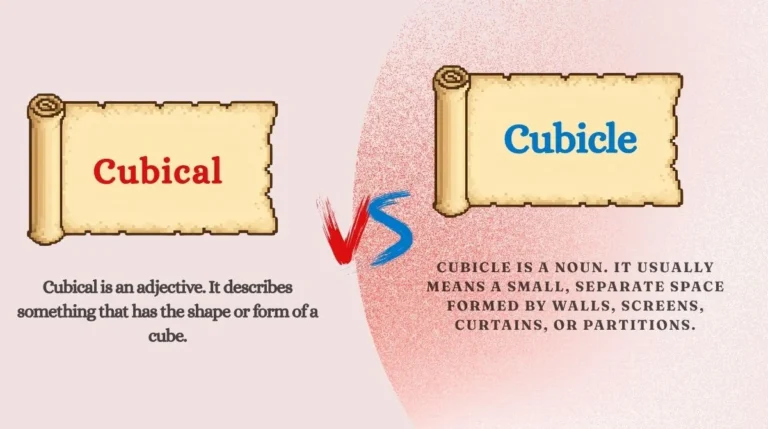
Cubical is an adjective. It describes something that has the shape or form of a cube. Merriam-Webster lists cubical as meaning “cubic,” especially something shaped like a cube.
A cube is a solid shape with six equal square sides. Think about a normal dice, an ice cube, or a small square box. When something looks like or has the form of a cube, you can describe it as cubical.
The important point is that cubical describes something. It does not normally name a place or object by itself.
When Should You Use “Cubical”?
Use cubical when you want to talk about the shape, structure, or form of something.
For example:
- The artist created a cubical sculpture.
- The building has a strange cubical design.
- We found a cubical box in the storage room.
- The machine has a large cubical metal part.
- The toy has a simple cubical shape.
- The container is almost cubical.
- The laboratory uses several cubical tanks.
- The architect designed a cubical house.
Notice what happens in these examples. The word cubical gives us information about another noun. It tells us what something looks like.
In “a cubical box,” box is the noun, while cubical is the adjective describing the box.
Grammar Rule for “Cubical”
The basic pattern is:
cubical + noun
Examples:
- a cubical structure
- a cubical object
- a cubical container
- a cubical room
- a cubical shape
You can also use cubical after a linking verb such as is, looks, or seems.
For example:
- The building is cubical.
- The object looks cubical.
- The container seems cubical.
This is a useful clue. When you are describing the shape of something, cubical may be the word you need.
A Common Learner Confusion
Many students see the ending -ical and think cubical must be the name of a place. It is not.
For example:
I work in a cubical.
This sentence may be understood by some readers because cubical resembles cubicle, but it is not the standard word when you mean a small office space.
The natural sentence is:
I work in a cubicle.
Compare that with:
I work in a cubical office.
Here, cubical describes the shape or design of the office. It does not name the office space itself.
So remember: cubical describes; cubicle names a space.
What Does “Cubicle” Mean?
Cubicle is a noun. It usually means a small, separate space formed by walls, screens, curtains, or partitions.
It can refer to different kinds of small spaces. For example, a work cubicle is a small office area separated from other workers. A shower cubicle is a small enclosed shower area. Cambridge Dictionary describes a cubicle as a small space with walls or curtains around it, while its business definition describes it as a small office space made by using low walls in a larger room.
Merriam-Webster likewise defines cubicle as a small partitioned space, especially one with a desk used for work in a business office.
When Should You Use “Cubicle”?
Use cubicle when talking about a small enclosed or separated area.
Here are some examples:
- My cubicle is next to the window.
- She decorated her cubicle with pictures.
- There are twenty cubicles in this office.
- He works in a small cubicle.
- I need to clean my cubicle before the meeting.
- The nurse asked me to wait in a cubicle.
- The shower cubicle was very small.
- She went into a changing cubicle.
In all these sentences, cubicle is a thing or place that you can point to. It is a noun.
Grammar Rule for “Cubicle”
Because cubicle is a countable noun, you can normally use it with a, an, or the, depending on the sentence.
Examples:
- I have a cubicle.
- She entered the cubicle.
- There are five cubicles upstairs.
- This is my cubicle.
The plural form is:
cubicles
For example:
The company has several cubicles for employees.
This noun form is one of the easiest ways to separate cubicle from cubical.
Different Types of Cubicles
The word is not limited to offices.
You may hear:
- office cubicle
- work cubicle
- shower cubicle
- changing cubicle
- dressing cubicle
- hospital cubicle
- study cubicle
The exact meaning depends on the context, but the basic idea stays the same: a small separated space.
Difference Between Cubical and Cubicle
The biggest difference is simple:
Cubical = describes shape
Cubicle = names a small separate space
Although the words look almost identical, their grammatical roles are different.
| Feature | Cubical | Cubicle |
|---|---|---|
| Part of speech | Adjective | Noun |
| Basic meaning | Shaped like a cube | Small partitioned space |
| Main use | Describes shape or form | Names a room, area, or compartment |
| Can describe a noun? | Yes | No, normally |
| Can be plural? | Normally no | Yes: cubicles |
| Example | a cubical box | an office cubicle |
Usage Difference
Imagine that you enter an office.
You might say:
I sit in a cubicle.
You are naming the small workspace.
Now imagine you are describing the shape of something inside that office:
There is a cubical storage box on my desk.
Here, you are describing its shape.
The two words can even appear close together in a sentence:
The office has small cubicles with cubical storage containers.
In this sentence, cubicles are the separate work areas, while cubical describes the shape of the containers.
Grammar Logic
Think about the question each word answers.
Cubical answers:
What is it like?
Example:
What is the shape of the building?
It is cubical.
Cubicle answers:
What is that small space called?
It is a cubicle.
This simple question-and-answer method can help you make the correct choice quickly.
Sentence Structure Difference
Because cubical is an adjective, it often comes before a noun:
a cubical building
a cubical object
a cubical room
It can also appear after a linking verb:
The object is cubical.
Because cubicle is a noun, it can act as the subject or object of a sentence:
The cubicle is clean.
She entered the cubicle.
I decorated my cubicle.
That grammatical difference is just as important as the difference in meaning.
Meaning Comparison
A cubical thing has a shape similar to a cube.
A cubicle is a small area separated from a larger area.
A cubicle does not have to be cube-shaped. This is an important point for learners.
For example, an office cubicle may be rectangular rather than perfectly cube-shaped. The word refers to the partitioned workspace, not necessarily its exact geometric shape. Cambridge specifically describes office cubicles as small office spaces made using low walls in a larger room.
Grammar Rules You Must Remember
Rule 1: Use “cubical” as an adjective
Use cubical to describe something that has the form or shape of a cube.
Example:
The sculpture has a cubical shape.
Here, cubical describes shape.
Rule 2: Use “cubicle” as a noun
Use cubicle when you mean a small separated area.
Example:
I work in a cubicle.
Here, cubicle is the name of the workspace.
Rule 3: “Cubicles” is the plural of “cubicle”
When you are talking about more than one small space, use cubicles.
Example:
There are ten cubicles on this floor.
Do not use cubicals when you mean several office spaces.
Rule 4: Do not choose by sound alone
Both words are pronounced very similarly, which is one reason learners get confused.
Instead of listening only to the pronunciation, look at the job the word is doing.
Ask yourself:
Am I describing a shape?
Use cubical.
Ask:
Am I naming a small separate space?
Use cubicle.
This method works much better than trying to memorize the spelling without understanding the meaning.
Common Mistakes Students Make
One common mistake is using cubical when talking about an office workspace.
Mistake 1
❌ I left my laptop in my cubical.
✅ I left my laptop in my cubicle.
Why? Because you are talking about a small office area.
Mistake 2
❌ We bought a cubicle box because it has a cube shape.
✅ We bought a cubical box because it has a cube shape.
Why? Here you are describing the shape of the box, so the adjective cubical is appropriate.
Mistake 3
❌ There are twenty cubicals in our office.
✅ There are twenty cubicles in our office.
Why? The word for an individual partitioned workspace is cubicle. Its plural is cubicles.
Mistake 4
❌ The sculpture is cubicle.
✅ The sculpture is cubical.
Why? You are describing the sculpture’s shape.
Mistake 5
❌ She entered a cubical to change clothes.
✅ She entered a cubicle to change clothes.
Why? A changing area is called a cubicle.
Why Do These Mistakes Happen?
The words are close in spelling:
cubical
cubicle
They also sound similar. Both begin with cubi-, and their final sounds are easy to mix up when speaking quickly.
English has many pairs like this. The best solution is not to memorize the spelling alone. Learn the meaning + part of speech + example together.
A simple correction tip is to replace the word with a very basic phrase.
For cubical, think:
cube-shaped
For cubicle, think:
small separate space
If “cube-shaped” fits your sentence, choose cubical. If “small separate space” fits, choose cubicle.
Easy Trick to Remember the Difference
Here is a very simple memory trick:
Cubical = Cube + Shape
The word cubical contains the idea of cube.
Think:
cubical = cube-like
A cubical object has a shape similar to a cube.
For example:
The building is cubical.
You are talking about its shape.
Cubicle = Place
Think of cubicle as a little place.
You can sit in it, enter it, work in it, or stand inside it.
For example:
My desk is inside a cubicle.
This is a physical space.
Another helpful trick is to remember the endings:
-ical often appears in adjectives.
For example:
- logical
- musical
- physical
- cubical
This does not mean every word ending in -ical is an adjective, but it is a useful clue here.
On the other hand, cubicle is a noun naming a thing or space.
A One-Line Memory Sentence
Try memorizing this:
A cubical thing looks like a cube; a cubicle is a place.
That one sentence can save you from many mistakes.
Daily Life Examples
Here are some natural examples you might hear or use in real conversations.
1. Talking about an office
A: Where do you work?
B: I work in the cubicle near the entrance.
The word cubicle refers to the workspace.
2. Talking about shape
A: What does the new building look like?
B: It has a large cubical design.
Here, cubical describes the design.
3. At a workplace
A: Where is Sara?
B: She is sitting in her cubicle.
Again, cubicle is a place.
4. Describing a box
A: What shape is the container?
B: It is almost cubical.
The word describes the container’s form.
5. In a clothing store
A: Where can I try this jacket on?
B: There is an empty changing cubicle over there.
The word refers to a private changing space.
6. At a gym or swimming pool
The shower cubicles are on the left.
This means the small separate shower areas are on the left.
7. Talking about a sculpture
The museum has a large cubical sculpture near the entrance.
The sculpture has a cube-like form.
8. Talking to a coworker
Can you send the report to my cubicle?
The speaker means their office workspace.
9. Describing a building
The architect designed a simple cubical structure.
Here, cubical describes the structure.
10. Talking about several workspaces
Our new office has fewer cubicles but more open space.
Here, cubicles means partitioned work areas.
These examples show why the context matters. Once you understand what you are talking about, the correct word becomes much easier to choose.
Practice Section
Choose the correct word: cubical or cubicle.
1.
I keep my files in my office ________.
2.
The sculpture has a strange ________ shape.
3.
There are fifteen ________ on this floor.
4.
The box is almost ________.
5.
She went into a changing ________.
Answers
1. cubicle
A cubicle is a small office workspace.
2. cubical
Cubical describes the shape of the sculpture.
3. cubicles
This is the plural form of cubicle.
4. cubical
You are describing the box’s shape.
5. cubicle
A changing cubicle is a small private changing area.
A useful way to check your answer is to ask whether you mean “cube-shaped” or “small separate space.”
FAQs
What is the difference between cubical and cubicle?
Cubical is mainly an adjective that means shaped like a cube or relating to a cube. Cubicle is a noun that means a small partitioned or separate space, such as an office workspace or changing area.
Is “cubical” a noun or an adjective?
Cubical is an adjective. It describes the shape or form of something.
For example:
The building has a cubical shape.
You can also say:
The building is cubical.
Is “cubicle” a noun or an adjective?
Cubicle is a noun. It names a small separate space.
For example:
I work in a cubicle.
Its plural form is cubicles.
Can I say “office cubical”?
Usually, no, not when you mean the small workspace divided from other workers.
The standard expression is office cubicle or simply cubicle. Cubical describes shape, while cubicle names the workspace.
Is a cubicle always shaped like a cube?
No. A cubicle does not have to be a perfect cube.
The word normally refers to a small space separated from a larger room by partitions, walls, screens, or curtains. An office cubicle, for example, may be rectangular rather than cube-shaped.
Is “cubical” the same as “cubic”?
They are very close in meaning when talking about shape. Merriam-Webster lists cubical as a synonym of cubic, especially in the sense of being shaped like a cube.
However, cubic is much more common in expressions involving mathematics, measurement, and volume, such as cubic meter or cubic centimeter.
Which word should I use for a workplace?
Use cubicle.
For example:
I have a small cubicle at work.
A cubicle is the small workspace. Use cubical only when you are describing the shape or design of something.
Conclusion
The difference between cubical and cubicle is easier than it first appears.
Cubical is an adjective. It describes something that is shaped like a cube or has a cube-like form. You might talk about a cubical building, a cubical box, or a cubical sculpture.
Cubicle is a noun. It refers to a small separate or partitioned space. You might work in an office cubicle, use a shower cubicle, or change clothes in a changing cubicle.
The easiest memory trick is:
Cubical = cube-shaped.
Cubicle = small space.
When you are unsure, stop and ask yourself what you are trying to say. Are you describing the shape of something? Choose cubical. Are you naming a small separate place? Choose cubicle.
A few simple practice sentences will make this difference feel natural. Once you stop focusing on their similar spelling and start focusing on their grammar and meaning, you will be much less likely to confuse them.

Evan Rellmont is a writer who turns thoughtful ideas into meaningful words, creating stories and reflections that connect, inspire, and leave a lasting impression.
1 thought on “Cubical vs Cubicle: What’s the Difference? (2026 Guide)”