
Have you ever written “move forwards” and then wondered whether “move forward” would be better? Or perhaps you have seen both forms in books, websites, movies, and everyday conversations and thought, “Which one is actually correct?”
You are not alone. Forward and forwards are confusing because both can describe movement toward the front. In many sentences, they can even be used without changing the basic meaning.
Major learner dictionaries such as Cambridge and Oxford list forwards as an alternative form of forward when talking about direction.
The small difference becomes more noticeable when you look at style and regional usage. Forward is very common in both American and British English, while forwards is especially common in British English.
This matters because English learners often assume that one form must be correct and the other must be wrong.
That is not the case here. Both can be correct, but forward is usually the safer choice when you are not sure which form to use.
By the end of this guide, you will understand what each word means, when to use it, how they differ, which form sounds more natural in different varieties of English, and how to avoid common mistakes.
You will also see simple examples from everyday English, so the difference becomes easy to remember.
What Does “Forward” Mean?
Forward means toward the front, toward the direction you are facing, or toward a later point in time.
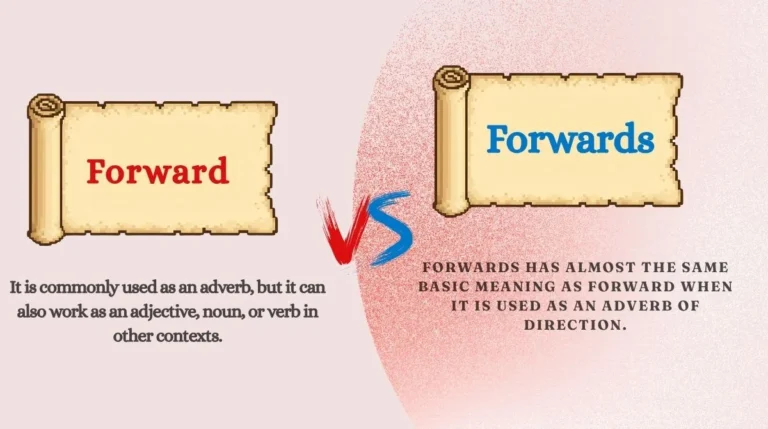
It is commonly used as an adverb, but it can also work as an adjective, noun, or verb in other contexts. In the comparison between forward and forwards, however, we are mainly interested in its use as an adverb. Cambridge defines it as movement in the direction that is in front of you, and Oxford gives a similar meaning.
When should you use “forward”?
Use forward when you want to describe movement or position toward the front.
For example:
- Please step forward.
- She leaned forward to hear him.
- The car suddenly moved forward.
- He took one step forward.
- The children ran forward when the door opened.
- Move forward slowly.
- The bus lurched forward.
- We need to push forward with the plan.
In all these examples, forward shows direction or progress.
“Forward” can also talk about progress
The word does not always describe physical movement. It can describe improvement, development, or progress.
Consider these examples:
The project is moving forward.
This does not mean the project is physically moving somewhere. It means the project is continuing or making progress.
Similarly:
We need to take a step forward.
Here, forward means progress toward a better or more advanced situation. Oxford lists this use as movement toward a good result or progress.
“Forward” can refer to the future
Another important meaning is toward the future.
For example:
- From that day forward, things changed.
- Looking forward, we expect better results.
- We need to think forward, not backward.
- The company is planning forward for the next few years.
A very common expression is look forward to.
I look forward to meeting you.
Here, look forward to means to feel happy or excited about something that will happen in the future. Cambridge and Oxford both recognize this future-related use.
Common learner confusion with “forward”
Some students think forward must always be followed by to. That is not true.
Compare:
Walk forward.
and:
I look forward to the holiday.
The first sentence uses forward as a direction word. The second is part of the fixed expression look forward to.
Also remember that forward and for are not the same thing. A sentence such as “Move for” does not replace “Move forward.”
What Does “Forwards” Mean?
Forwards has almost the same basic meaning as forward when it is used as an adverb of direction.
It means toward the front or in the direction ahead.
Cambridge lists forwards as another form of forward, while Oxford notes that forwards is especially common in British English.
Here are some examples:
- She leaned forwards to pick up the book.
- He took two steps forwards.
- The car rolled forwards slowly.
- The children moved forwards.
- Please come forwards when your name is called.
- The crowd pushed forwards.
- The boat moved forwards through the water.
- He bent forwards to look under the table.
Notice that each example describes direction.
Is “forwards” grammatically correct?
Yes.
This is one of the most important points to remember.
Forwards is not a spelling mistake. It is a standard English adverb. The problem is that some learners are taught mainly the form forward, so they may think the version ending in -s is incorrect.
It is not.
Oxford explicitly gives forwards as an alternative to forward, especially in British English.
Why does “forwards” have an -s?
English has several direction words that behave in a similar way:
- backward / backwards
- forward / forwards
- toward / towards
- upward / upwards
- downward / downwards
The ending -s does not automatically make a word plural. In these cases, it is part of the adverbial form.
That is why:
He moved forwards.
is completely normal English.
Is “forwards” used for the future too?
It can be, but forward is more common and more natural in many fixed expressions.
For example, from this day forward is a very familiar phrase. You are much less likely to hear from this day forwards in ordinary modern English.
Similarly, expressions such as:
going forward
and
moving forward
are extremely common, especially in business and formal communication. Oxford lists going/moving forward as an expression meaning from now into the future.
So while forwards is perfectly acceptable for physical direction, forward is generally the better choice for many common expressions about time, progress, and future plans.
Difference Between Forward and Forwards
The easiest way to understand the difference is this:
Forward and forwards often have the same meaning when they describe physical direction.
The main difference is usage preference, especially between British and American English.
| Feature | Forward | Forwards |
|---|---|---|
| Basic meaning | Toward the front or ahead | Toward the front or ahead |
| Grammar | Adverb | Adverb |
| Physical movement | Very common | Very common, especially British English |
| American English | Extremely common | Less common |
| British English | Very common | Also very common |
| Future/progress expressions | Very common | Less common |
| Can be correct? | Yes | Yes |
| Safe choice for learners | Usually yes | Yes, when clearly describing direction |
The meaning is often the same
Look at these two sentences:
She stepped forward.
She stepped forwards.
There is no important difference in the basic meaning. In both sentences, the woman moved toward the front.
The same is true here:
The car moved forward.
The car moved forwards.
Both tell us that the car moved ahead.
The main difference is style and variety of English
British English commonly uses both forms. Oxford specifically describes forwards as especially common in British English.
American English strongly favors forward, although forwards is also recognized and can appear. Oxford’s American dictionary still lists forwards as an alternative form.
This means that a British speaker might naturally say:
He leaned forwards.
while an American speaker is very likely to say:
He leaned forward.
Neither speaker is making a grammatical mistake.
Sentence structure
Both words usually work after a verb of movement or position:
Subject + verb + forward/forwards
Examples:
She moved forward.
She moved forwards.
He stepped forward.
He stepped forwards.
They can also appear after another phrase:
She bent slightly forward.
She bent slightly forwards.
The sentence structure does not change simply because you add or remove the -s.
Meaning comparison
When the meaning is physical direction:
forward = forwards
When the expression is about progress, future time, or a fixed phrase, forward is usually the natural choice.
For example:
The team moved forward with the project.
This means the team continued with the project.
You would not normally replace it with forwards in this kind of expression.
Likewise:
We are looking forward to your reply.
This is the standard phrase.
So the real lesson is not “one is correct and one is wrong.” The better lesson is:
Both are correct, but forward has wider and more flexible use.
Grammar Rules You Must Remember
Rule 1: Use “forward” for movement toward the front
Forward is always a safe choice when you are describing movement ahead.
Walk forward until you reach the door.
The dog jumped forward.
You can use forwards in the same physical-direction situations, especially in British English.
Walk forwards until you reach the door.
Both are grammatical.
Rule 2: “Forwards” is especially common in British English
British speakers often use forwards naturally in sentences about physical movement.
Take two steps forwards.
Oxford identifies forwards as especially common in British English.
American English generally prefers forward:
Take two steps forward.
This is a preference, not a strict grammar rule.
Rule 3: Prefer “forward” in many expressions about progress
When forward means progress or development, it is usually the better choice.
We need to move forward.
This is a big step forward.
The company is moving forward with its plans.
Oxford and Cambridge both give examples of forward used to express progress.
Rule 4: Learn fixed phrases with “forward”
Some expressions are normally learned with forward, so do not change them just because you know forwards exists.
Common examples include:
- look forward to
- from this day forward
- moving forward
- going forward
- step forward
- come forward
- push forward
For example:
I look forward to hearing from you.
Not:
I look forwards to hearing from you.
Although variants can occasionally be found, learners should use the standard form look forward to.
Common Mistakes Students Make
The first common mistake is assuming that forwards is wrong.
A student might see:
He walked forwards.
and change it automatically to:
He walked forward.
The second sentence is certainly correct, but the first one is also correct. The important point is that forwards can be a normal adverb of direction, especially in British English.
Mistake 1: Thinking “forwards” is plural
Wrong idea:
“Forward” is singular and “forwards” is plural.
That is not how these words work.
In this use, forwards is an adverb, not a plural noun.
Correct:
She moved forwards.
Mistake 2: Using “forwards” in every expression
A learner may think:
look forwards to
is automatically better because the person is thinking about the future.
Standard English strongly favors:
look forward to meeting you.
Remember the whole expression instead of changing it word by word.
Mistake 3: Thinking American and British English must use the same form
English has regional preferences. The word forwards is particularly common in British English, while forward is widely preferred in American English.
Neither variety is “more correct.”
Mistake 4: Assuming the spelling changes the meaning completely
Compare:
The ball rolled forward.
The ball rolled forwards.
The meaning is almost identical.
Do not waste time looking for a large difference where there usually is none.
Easy correction tip
When you are unsure, ask yourself:
Am I simply talking about moving toward the front?
If yes, forward is an excellent choice.
Am I using a common fixed phrase about the future or progress?
Again, choose forward.
This simple habit will keep your English natural in most situations.
Easy Trick to Remember the Difference
Here is a very simple memory trick:
“Forward” is the all-purpose choice.
Think of forward as the basic form you can use for:
movement + progress + future
For example:
Move forward.
Move the project forward.
Look forward to Friday.
“Forwards” strongly suggests physical direction
When you see forwards, picture someone physically moving ahead.
He walked forwards.
She leaned forwards.
The car rolled forwards.
This is not a strict rule, but it is a useful learning trick.
Another way to remember it is to think about American English. American English strongly favors forward, so choosing forward will often give you the safest international form.
The key message is simple:
You do not need to fear “forwards.” It is correct. You just do not need to use it everywhere.
Daily Life Examples
These examples show how native speakers might use the two forms naturally.
1. Giving directions
“Take two steps forward, then turn left.”
This is natural and easy to understand.
2. Talking about movement
“The little boy suddenly ran forward.”
The word describes physical movement.
3. British-style usage
“Please move forwards so everyone can fit.”
Here, forwards is perfectly natural in British English.
4. Talking about a project
“We need to move forward with the new plan.”
Here, forward means progress. Forwards would sound less natural.
5. Talking about the future
“From this day forward, I will be more careful.”
This is a fixed expression meaning from this point in time onward.
6. Sending an email
“I’ll forward the message to Sarah.”
Notice something important here: this is a completely different use of forward. Here it is a verb, meaning to send a received message to another person. Oxford lists this meaning for emails and other information.
7. Looking toward the future
“I’m really looking forward to the weekend.”
This is one of the most common expressions in everyday English.
8. Talking about physical posture
“He leaned forward to hear the answer.”
9. Using the British-preferred directional form
“She bent forwards and picked up the bag.”
Again, forwards is perfectly acceptable.
10. Talking about progress at work
“We have made good progress, and the project is moving forward.”
Here, forward sounds natural because the sentence is about progress rather than simple physical direction.
Practice Section
Choose forward or forwards in each sentence.
1.
Please take one step ______.
2.
I am looking ______ to seeing you.
3.
The car moved slowly ______.
4.
We need to move ______ with the plan.
5.
She leaned ______ to hear what he was saying.
Answers
1. forward / forwards — Both are correct because this is physical movement.
2. forward — The standard expression is look forward to.
3. forward / forwards — Both are possible for physical movement.
4. forward — This is about progress, so forward is the natural choice.
5. forward / forwards — Both can describe physical movement or position.
A useful exercise is to read the examples aloud. When you hear both forms in real sentences, the choice starts to feel natural instead of something you have to calculate every time.
FAQs
What is the difference between forward and forwards?
The basic meaning is usually the same when both words describe movement toward the front. Forwards is especially common in British English, while forward is more widely preferred, especially in American English.
Is “forwards” grammatically correct?
Yes. Forwards is a correct English adverb. It can describe movement toward the front or ahead. Major learner dictionaries list it as an alternative form of forward.
Which is more common: forward or forwards?
Forward is generally the safer and more widely used choice, particularly in American English. British English commonly uses both forms, with forwards appearing frequently in descriptions of physical movement.
Can I say “look forwards to”?
For learners, it is best to use look forward to. This is the standard and very common expression for saying that you are pleased or excited about something in the future.
I look forward to meeting you.
Is “move forward” correct or should I say “move forwards”?
Both can be correct when you mean physical movement. Move forward is especially common and is also used when you mean making progress.
The car moved forward.
The car moved forwards.
Is forward only used as an adverb?
No. Forward can also be an adjective, noun, and verb. For example, as a verb, it can mean to send an email or piece of information to another person.
Conclusion
The difference between forward and forwards is much smaller than many English learners expect. When they describe physical movement toward the front, both forms can be correct.
The main difference is often regional or stylistic rather than a difference in meaning.
Forward is the safest general choice. It is common in American and British English and works naturally when talking about movement, progress, and the future.
Forwards is also correct and is particularly common in British English when describing physical direction.
Remember three simple points: use forward freely for movement, progress, and future-related expressions; understand that forwards is a correct alternative for direction; and learn common expressions such as look forward to as complete phrases.
Once you notice these patterns in conversations, books, films, and emails, the choice will become much easier. Do not worry about the extra -s. The important thing is understanding how the word works in the sentence.

Evan Rellmont is a writer who turns thoughtful ideas into meaningful words, creating stories and reflections that connect, inspire, and leave a lasting impression.
2 thoughts on “Forward vs Forwards: Difference, Meaning, and Correct Usage in 2026”