
Have you ever written a sentence like “She layed the book on the table” and then wondered whether layed is correct? You are not alone.
Many English learners make this mistake because English verbs do not always form their past tense in the same simple way.
When we see a verb such as “play,” we normally add -ed to make the past tense: played. So, it feels natural to write layed.
However, standard English does not use layed as the past tense of lay. The correct form is laid. Cambridge Dictionary and Merriam-Webster both list laid as the past tense and past participle of lay.
This small spelling difference matters because lay, laid, and lie are closely connected, but they do different jobs. That is why even confident English speakers sometimes mix them up.
Once you understand the basic idea, the difference becomes much easier.
You will learn why layed is usually incorrect, when to use laid, how lay and lie are connected, and how to choose the right word in everyday conversations.
The goal is not to memorize a complicated grammar chart. Instead, think about what the subject is doing.
Is someone putting something somewhere? Or is someone simply resting in a flat position? That simple question can help you choose the correct verb.
What Does “Layed” Mean?
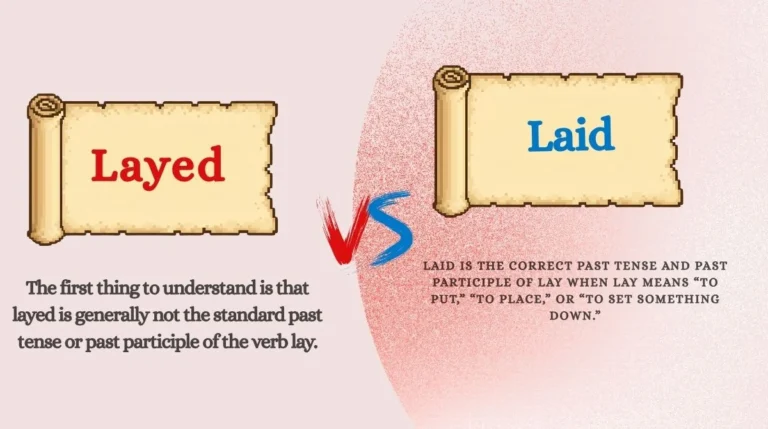
The first thing to understand is that layed is generally not the standard past tense or past participle of the verb lay.
For the common meaning “to put something down” or “to place something in a particular position,” the correct past form is laid, not layed. Cambridge specifically notes that laid, not layed, is the correct past form of lay.
So, if you want to say that someone placed a book on a desk yesterday, you should write:
She laid the book on the desk.
Not:
She layed the book on the desk.
Why does layed look tempting? The reason is simple. Many English verbs form their past tense by adding -ed:
- play → played
- clean → cleaned
- open → opened
- work → worked
Because learners know this pattern, they may naturally think:
- lay → layed
But lay is an irregularly formed verb in this use. Its past tense is laid. Merriam-Webster also gives the verb forms as lay, laid, laying.
Here are some examples:
- She laid the keys on the kitchen table.
- He laid the baby gently in the crib.
- We laid the papers beside the computer.
- Maria laid her phone on the sofa.
- They laid the books in a neat pile.
- Dad laid the tools on the floor.
- The workers laid new tiles in the bathroom.
- I laid my jacket on the chair.
In every example, someone or something is being placed somewhere.
A common learner confusion happens when people hear the pronunciation of laid. It sounds like “layd,” so some learners write layed because they are spelling the word the way it sounds. But English spelling does not always follow pronunciation.
There is another important point. Lay normally takes an object. An object is the person or thing receiving the action.
For example:
She laid the book on the table.
Here, she performs the action, and the book is the object.
That object is one of the easiest clues that you are dealing with lay → laid rather than lie → lay.
What Does “Laid” Mean?
Laid is the correct past tense and past participle of lay when lay means “to put,” “to place,” or “to set something down.”
The basic pattern is:
lay → laid → laid
For example:
- Today: I lay the documents on the desk.
- Yesterday: I laid the documents on the desk.
- Present perfect: I have laid the documents on the desk.
Merriam-Webster defines laid as the past tense and past participle of lay.
The word can be used for many different situations. You can lay a book on a table, lay a baby in a crib, lay tiles on a floor, or lay clothes on a bed. The central idea is placement.
Here are some examples:
- She laid the baby down for a nap.
- I laid my notebook on the desk.
- He laid the cards on the table.
- They laid the carpet in the living room.
- We laid the plates on the dining table.
- The builder laid the bricks carefully.
- She has laid her clothes on the bed.
- The farmer laid the seeds in the soil.
Notice that laid is often followed by a noun or pronoun:
laid the book
laid the baby
laid the clothes
laid them
This is because lay is normally a transitive verb in this meaning. In simple terms, that means it acts on something. Cambridge explains that lay must have an object.
There is also a useful phrase you may hear often:
lay the table
This does not mean putting the whole table somewhere. It means putting plates, glasses, knives, forks, and other things on the table so it is ready for a meal.
For example:
My mother laid the table before dinner.
Another common use is related to eggs:
The hen laid an egg.
Here again, the past tense is laid.
So whenever the verb means “put,” “place,” or “produce an egg,” laid is the form you need for the past.
Difference Between Layed and Laid
The simplest answer is this:
Laid is correct. Layed is not the standard past form of lay.
But understanding why helps you avoid the same mistake later.
| Word | Standard use | Meaning | Example |
|---|---|---|---|
| lay | Correct | Put or place something | Lay the book here. |
| laid | Correct | Past form of lay | She laid the book here. |
| layed | Usually incorrect | Not the standard past form of lay | ❌ She layed the book here. |
The grammar difference is mainly about verb form.
Present tense
Use lay when the action happens now or is a general instruction.
Please lay the papers on my desk.
I usually lay my clothes on the chair.
Past tense
Use laid when the action happened in the past.
I laid my clothes on the chair last night.
She laid the baby in bed an hour ago.
Past participle
Use laid after helping verbs such as has, have, and had.
She has laid the books on the table.
They had laid the foundation before winter.
So you never need to create the form layed just because the action happened in the past.
There is an additional source of confusion: lay is also the past tense of another verb, lie. Cambridge gives these forms: lay for the past of lie, while laid is the past and past participle of lay.
That gives us this useful pattern:
lay → laid → laid
means put something down
lie → lay → lain
means be in a flat position
For example:
I lay the book on the desk.
Here, lay means “put.”
Yesterday, I laid the book on the desk.
Here, laid is the past form of lay.
But:
I lie on the sofa every evening.
Here, lie means “rest in a flat position.”
Yesterday, I lay on the sofa.
Here, lay is the past tense of lie.
This is where English learners often get frustrated. The spelling looks similar, but the grammar changes depending on the verb.
Merriam-Webster also explains that lay requires an object, while lie does not.
Grammar Rules You Must Remember
Rule #1: The past tense of “lay” is “laid”
Never form the normal past tense by adding -ed.
Correct:
She laid the book on the desk.
Incorrect:
She layed the book on the desk.
Think of laid as a complete verb form that you need to remember.
Rule #2: “Lay” usually needs an object
Ask yourself, “What is being placed?”
He laid the phone on the table.
What was placed? The phone.
She laid the baby in the crib.
What was placed? The baby.
This object test is very helpful when you are unsure whether to use lay or lie. Cambridge notes that lay must have an object.
Rule #3: “Lie” means to rest or be in a flat position
When the person or thing is simply in a position, use lie.
I lie on the bed when I feel tired.
There is no object after lie. You are not placing something else. You are describing your own position.
The past tense becomes:
I lay on the bed yesterday.
That unusual change is one reason this verb pair causes so many mistakes.
Rule #4: “Layed” is not the standard form you want
For normal modern English, use:
lay → laid
Not:
lay → layed
If you are writing an email, school assignment, website article, business message, or formal document, laid is the safe and correct choice.
Common Mistakes Students Make
One of the most common errors is treating lay like a regular verb.
Students learn:
walk → walked
talk → talked
clean → cleaned
Then they assume:
lay → layed
That logic works for many verbs, but English has many irregular verbs. The form has to be learned separately.
Mistake 1: “She layed the book there.”
Correct:
She laid the book there.
The verb means “put,” so its past form is laid.
Mistake 2: “I layed down after lunch.”
This sentence contains a second problem. If you mean that you rested or moved yourself into a flat position, standard English uses lay down only in the past, but lie down in the present.
Correct present sentence:
I lie down after lunch.
Correct past sentence:
I lay down after lunch.
Merriam-Webster and Cambridge both explain this tense difference.
Mistake 3: “The book layed on the desk.”
Correct:
The book lay on the desk.
Here, the book is not being placed by someone in the sentence. It is simply resting on the desk.
Mistake 4: “I lied on the sofa yesterday.”
This one is particularly confusing because lied is a real English word. But lied normally means “said something that was not true.”
For example:
He lied to me.
When you mean “rested in a flat position,” use:
I lay on the sofa yesterday.
Cambridge distinguishes these two verbs clearly: lie → lay → lain for position, and lie → lied → lied for telling something untrue.
Easy correction tip
When you see layed, stop and ask:
Am I trying to use the past form of “lay”?
If yes, change layed to laid.
If you mean “rest,” check whether you actually need lie, lay, or lain instead.
Easy Trick to Remember the Difference
Here is a simple memory trick:
Lay = put something.
Laid = put something in the past.
Think:
Lay the phone down.
Laid the phone down yesterday.
The word laid belongs to the action of putting something somewhere.
Now remember:
Lie = rest yourself.
Lay = rested in the past.
For example:
I lie on the sofa every afternoon.
Yesterday, I lay on the sofa.
This may look strange at first, but it becomes much easier after a few examples.
Another trick is to look for an object.
If the sentence has something being placed, lay/laid is often the right family:
She laid the blanket on the bed.
If no object is being placed and the subject is simply resting, think about lie:
She lay on the bed.
A tiny phrase can also help:
Lay something.
Lie down.
You can lay something down, but you lie down yourself in the present tense.
This is a practical way to remember the difference without trying to memorize a long grammar lesson.
Daily Life Examples
Here are some examples you may hear or use in real conversations.
1. At home
A: Where did you put the keys?
B: I laid them on the kitchen counter.
The keys are the object, so laid is correct.
2. Before sleeping
A: What did you do after work?
B: I lay on the sofa and watched TV.
Here, the speaker is describing their position, so lay is the past tense of lie.
3. Cleaning the room
A: Why are the books on the floor?
B: I laid them there while I was cleaning the shelf.
The books are being placed somewhere.
4. Taking a break
A: You look tired.
B: I think I’ll lie down for a few minutes.
This is present or future meaning, so lie is correct.
5. Talking about yesterday
A: Did you sleep well?
B: Not really. I lay awake for hours.
Again, lay is the past form of lie.
6. Setting the table
A: Is dinner ready?
B: Almost. I’ve laid the plates and glasses.
The plates and glasses have been placed on the table.
7. Taking care of a child
A: Where is the baby?
B: I laid her in the crib.
Someone placed the baby somewhere, so laid is correct.
8. Talking about eggs
A: Why are you checking the chicken coop?
B: I want to see whether the hen has laid any eggs.
Laid is also used for producing eggs. Merriam-Webster lists this meaning under lay.
9. At the beach
A: Where were you this afternoon?
B: I lay on the beach and read my book.
The speaker was resting, so lay is the past form of lie.
10. Moving furniture
A: What happened to the new rug?
B: We laid it on the floor this morning.
The rug was placed on the floor, so laid is correct.
Practice Section
Choose the correct word in each sentence: layed, laid, lay, or lie.
1.
She ___ the phone on the table before she went outside.
2.
I usually ___ down for a short rest after lunch.
3.
Yesterday, I ___ on the bed for an hour.
4.
They ___ the carpet in the living room last weekend.
5.
The hen ___ three eggs yesterday.
Answers
1. laid
She laid the phone on the table.
2. lie
I usually lie down for a short rest after lunch.
3. lay
Yesterday, I lay on the bed for an hour.
4. laid
They laid the carpet in the living room last weekend.
5. laid
The hen laid three eggs yesterday.
Notice how lay can appear in two different ways:
I lay the book down. → present form of lay
I lay on the bed yesterday. → past form of lie
The meaning and sentence structure tell you which verb you are using.
FAQs About Layed or Laid
1. Is “layed” a correct English word?
For the normal past tense of the verb lay, no. The standard form is laid. For example, write “She laid the book on the table,” not “She layed the book on the table.” Cambridge specifically gives laid as the correct past and -ed form of lay.
2. What is the difference between “layed” and “laid”?
Laid is the standard past tense and past participle of lay. Layed is not the standard form used for this meaning. So, when you mean “put” or “placed,” use laid for the past.
3. Is “laid” the past tense of “lay”?
Yes. The basic forms are lay – laid – laid. For example, “I lay the book on the desk” is present, while “I laid the book on the desk yesterday” is past.
4. What is the past tense of “lie”?
When lie means “to rest or be in a flat position,” its past tense is lay, and its past participle is lain. For example: “I lie down every evening,” “I lay down yesterday,” and “I have lain here for an hour.”
5. Should I say “I lay down” or “I laid down”?
It depends on the tense and meaning. In standard English, “I lie down” is present, while “I lay down” is past. “I laid down the book” is correct when an object such as the book follows the verb.
6. Why do people say “layed” when it is incorrect?
The mistake usually happens because learners expect verbs to take -ed in the past tense. Since play becomes played and clean becomes cleaned, layed may seem logical. However, laid is the established past form of lay, so it must be learned as an irregular form.
Final Conclusion
The most important thing to remember is simple: layed is not the standard past form of lay. The correct word is laid.
Use laid when someone or something is placed somewhere:
She laid the book on the desk.
They laid the carpet on the floor.
He laid the baby in the crib.
At the same time, do not forget about lie. When someone or something is resting in a flat position, you normally use lie in the present and lay in the past:
I lie on the sofa every evening.
Yesterday, I lay on the sofa.
The difference looks confusing because the forms overlap, but the pattern becomes much easier with practice. Watch for the object in the sentence, think about whether something is being placed or simply resting, and pay attention to the tense.
Most importantly, do not worry if these verbs feel strange at first. Even experienced English speakers have been known to mix up lay, lie, and laid. Keep using them in real sentences, and the correct forms will start to feel natural.

Evan Rellmont is a writer who turns thoughtful ideas into meaningful words, creating stories and reflections that connect, inspire, and leave a lasting impression.