
Have you ever looked at the stars in the night sky and wondered what they can tell us? Some people study stars, planets, and distant galaxies to understand how the universe works.
Others read horoscopes to learn what the positions of planets and stars might mean for their lives. Although both activities involve the sky, they are not the same.
The words astronomy and astrology often confuse English learners because they look and sound similar. Both words begin with “astro,” which is connected to stars.
However, their meanings, purposes, and uses are very different. Mixing them up can lead to confusion when you are reading a science book, talking about space, or discussing zodiac signs with friends.
Understanding these words is useful for everyday English, school assignments, general knowledge, and clear communication.
It also helps you choose the correct word when writing sentences or searching for information online.
The easiest way to understand the difference is to remember that astronomy is a science that studies space, while astrology is a belief system that connects the positions of celestial objects with human life and events. Astronomy uses observations, mathematics, and scientific evidence. Astrology uses ideas about zodiac signs, horoscopes, and the supposed influence of celestial positions.
By the end of this guide, you will understand the meaning of each word, learn how to use it correctly, recognize common mistakes, and practice with simple examples.
You will also discover an easy memory trick that can help you remember the difference whenever these words appear in conversation or writing.
What Does Astronomy Mean?
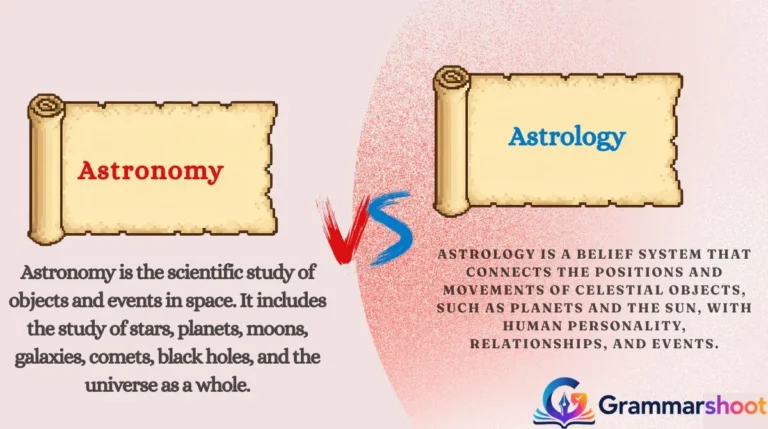
Astronomy is the scientific study of objects and events in space. It includes the study of stars, planets, moons, galaxies, comets, black holes, and the universe as a whole.
Astronomers observe the sky, collect information, use telescopes, and develop scientific explanations for what they discover. They may study how planets move, how stars form, or how the universe changes over time.
In simple English, astronomy means studying space to understand how it works.
When Should You Use Astronomy?
Use astronomy when you are talking about space science, planets, stars, galaxies, or scientific research about the universe.
For example, if a student wants to learn why the Moon changes its appearance during the month, the student can study astronomy. If a scientist wants to understand how a distant planet moves around its star, that research also belongs to astronomy.
Astronomy is a recognized scientific field. Its explanations are tested against observations and evidence. When new evidence becomes available, scientists may improve or change their explanations.
Grammar Rules for Astronomy
The word astronomy is a noun. It names a subject or field of study.
It is usually an uncountable noun when referring to the subject in general. Therefore, we normally say “study astronomy,” not “study an astronomy.”
Common sentence patterns include:
- Study + astronomy: I study astronomy at college.
- Learn about + astronomy: We learned about astronomy in class.
- Interested in + astronomy: My sister is interested in astronomy.
- Astronomy + verb: Astronomy helps us understand the universe.
The adjective form is astronomical. It can describe something related to astronomy, such as an astronomical observation. It can also mean extremely large in expressions such as “an astronomical cost.”
Examples of Astronomy in Sentences
- My brother wants to study astronomy at university.
- Astronomy helps scientists understand the planets and stars.
- We watched a documentary about astronomy last night.
- Our science teacher introduced us to astronomy.
- She bought a telescope because she is interested in astronomy.
- Astronomy explains many things we observe in the night sky.
- The school opened an astronomy club for students.
- Modern astronomy uses powerful telescopes to study distant galaxies.
Common Learner Confusion About Astronomy
Some learners think astronomy is the study of zodiac signs because both astronomy and astrology involve stars and planets. This is incorrect.
Astronomy focuses on the physical universe. Astronomers investigate questions such as how stars produce energy, how planets form, and how galaxies move.
Astrology, by contrast, connects the positions of celestial objects with personality traits or possible future events. These are different activities, even though they share some historical background.
Remember that a person who studies astronomy is called an astronomer. A person who practices astrology is called an astrologer.
What Does Astrology Mean?
Astrology is a belief system that connects the positions and movements of celestial objects, such as planets and the Sun, with human personality, relationships, and events.
People who practice astrology may interpret birth charts, zodiac signs, and horoscopes. A birth chart is based on the positions of celestial objects at a person’s birth. An astrologer may use that chart to offer interpretations about a person’s character or life.
In simple English, astrology is the practice of interpreting the positions of stars and planets as signs of what might happen in human life.
Astrology has a long history in different cultures. Many people read horoscopes for entertainment, personal reflection, or cultural reasons. However, astrology has not been shown by reliable scientific evidence to predict personality or future events accurately.
When Should You Use Astrology?
Use astrology when talking about horoscopes, zodiac signs, birth charts, or beliefs about how celestial positions relate to human life.
For example, if someone reads a horoscope to find out what the day might bring, that person is engaging with astrology. Similarly, a discussion about zodiac compatibility or astrological birth charts belongs to astrology rather than astronomy.
The word is also useful when discussing history, culture, or people’s personal beliefs.
Grammar Rules for Astrology
The word astrology is a noun. Like astronomy, it is usually uncountable when referring to the subject or practice in general.
You can say:
- Study + astrology: She studies astrology as a cultural tradition.
- Interested in + astrology: He is interested in astrology.
- Believe in + astrology: Some people believe in astrology.
- Read + a horoscope: I read my horoscope every morning.
- Practice + astrology: The writer practices astrology.
Notice that astrology and horoscope are not interchangeable. Astrology is the broader practice, while a horoscope is an interpretation or forecast associated with a particular time or astrological chart.
The adjective form is astrological. For example, “The magazine published an astrological forecast.”
Examples of Astrology in Sentences
- My friend enjoys reading about astrology.
- Astrology is popular in many cultures.
- She reads her horoscope for fun.
- He became interested in astrology after learning about zodiac signs.
- The book explains the history of astrology.
- Some people use astrology when thinking about relationships.
- The website publishes daily astrological predictions.
- We discussed astrology during our conversation about ancient beliefs.
Common Learner Confusion About Astrology
A common mistake is to describe astrology as a branch of astronomy. Although the two subjects have historical connections, modern astronomy is a science, while astrology is a belief system that interprets celestial positions as meaningful for human life.
Another mistake is to assume that everyone who enjoys looking at stars believes in astrology. This is not true. A person can enjoy observing the night sky, study astronomy, and have no interest in horoscopes.
It is also important to understand that saying “I am interested in astrology” does not necessarily mean “I believe astrology is scientifically accurate.” Someone may study it for historical, cultural, or personal reasons without accepting its predictions as facts.
Difference Between Astronomy and Astrology (Detailed)
The main difference is their purpose. Astronomy studies the universe using scientific methods, while astrology interprets celestial positions in relation to people and events.
The words are similar, but they describe different fields. Knowing their differences will help you use them correctly in speaking and writing.
Astronomy vs Astrology: Comparison Table
| Feature | Astronomy | Astrology |
|---|---|---|
| Basic meaning | Scientific study of space | Belief system linking celestial positions with human life |
| Main purpose | Understand the universe | Interpret personality or possible life events |
| Approach | Scientific observation and testing | Astrological traditions and interpretations |
| Evidence | Uses measurable evidence and testable explanations | Its predictive claims lack reliable scientific support |
| Main topics | Planets, stars, galaxies, black holes | Zodiac signs, horoscopes, birth charts |
| People involved | Astronomers | Astrologers |
| Common tools | Telescopes, cameras, scientific instruments | Birth charts, astrological tables, zodiac systems |
| Example | Studying how Mars moves around the Sun | Reading a horoscope based on a zodiac sign |
1. Difference in Meaning
Astronomy is concerned with what exists in space and how it behaves. It explores the physical properties of celestial objects and the forces that affect them.
For example, an astronomer may study the distance between Earth and the Sun. Another may investigate how a black hole affects nearby matter. These questions can be explored through observations, calculations, and scientific models.
Astrology has a different goal. It interprets the positions of celestial objects as having a relationship with human personality or life events.
For example, an astrologer might interpret a person’s birth chart to discuss relationships or career choices. That interpretation belongs to astrology, not astronomy.
2. Difference in Purpose
Astronomy aims to increase scientific knowledge about the universe. It helps us understand natural processes, discover distant objects, and explain events such as eclipses.
Astrology aims to provide interpretations about human life based on celestial positions. Some people use it as a source of entertainment or personal reflection, while others treat it as a meaningful belief system.
Their purposes are therefore different. One investigates the physical universe; the other interprets supposed connections between the sky and human affairs.
3. Difference in Evidence
Astronomy depends on scientific evidence. Scientists compare observations, test explanations, perform calculations, and allow other researchers to examine their findings.
For example, astronomers can measure a planet’s orbit and compare their calculations with later observations. If the results do not match, they can investigate why and improve their models.
Astrology also uses information about celestial positions, but its claims about predicting personality or future events have not gained reliable scientific support. This is an important difference between studying the sky and assigning personal meaning to its positions.
4. Difference in Grammar and Sentence Structure
Both astronomy and astrology are nouns. They commonly appear after verbs such as study, learn about, and discuss, or after expressions such as interested in.
Examples:
- I study astronomy.
- I study astrology.
- She is interested in astronomy.
- She is interested in astrology.
The grammar is almost identical. The meaning changes because the noun changes.
You should not usually add a or an before either word when referring to the field in general.
Incorrect: I study an astronomy.
Correct: I study astronomy.
Incorrect: She is interested in an astrology.
Correct: She is interested in astrology.
However, you can use articles with related countable nouns: “an astronomer,” “an astrologer,” “a horoscope,” and “an astronomical discovery.”
5. Difference in Everyday Use
In daily conversation, context often tells you which word is correct.
If someone says, “I want to know why Saturn has rings,” the subject is astronomy because the question concerns a physical feature of a planet.
If someone says, “My horoscope says today is a good day to start something new,” the subject is astrology because the statement is based on a horoscope.
You may hear both words in conversations about stars, planets, or zodiac signs. Instead of focusing on the shared vocabulary, ask yourself what the person is trying to understand or explain.
That simple question usually makes the correct choice clear.
Grammar Rules You Must Remember
Although these words have different meanings, they follow similar grammar rules. Learning the rules below will help you use both words naturally in English.
Rule #1: Use Both Words as Nouns
Astronomy and astrology are nouns. They name subjects or fields of study.
When you talk about either subject in general, you normally do not need an article such as a or an.
Examples:
- Correct: Astronomy is an interesting subject.
- Correct: Astrology is an interesting topic.
- Incorrect: An astronomy is an interesting subject.
- Incorrect: An astrology is an interesting topic.
Remember that you can use an article before a person who studies either subject: “An astronomer studies space” and “An astrologer practices astrology.”
Rule #2: Use “Interested in” Before Either Word
The expression interested in is followed by a noun or a noun phrase. Since astronomy and astrology are nouns, both fit this sentence pattern.
Examples:
- I am interested in astronomy.
- My cousin is interested in astrology.
- Are you interested in astronomy?
- She is interested in learning about astrology.
Do not say “interested on astronomy.” The correct preposition is in.
Rule #3: Use the Correct Person’s Name
The people associated with these subjects have different names.
- Astronomer: A person who studies the universe scientifically.
- Astrologer: A person who practices astrology.
Examples:
- The astronomer studied a distant galaxy.
- The astrologer prepared a birth chart.
- My teacher invited an astronomer to speak about space.
- The magazine interviewed an astrologer about zodiac signs.
A helpful tip is to connect astronomer with science and astrologer with horoscopes.
Rule #4: Learn the Related Adjectives
The adjective forms are astronomical and astrological. Use them when you want to describe something connected with the relevant subject.
Examples:
- The researchers made an astronomical observation.
- We read an astrological forecast.
- The museum displayed astronomical photographs.
- She explained the meaning of an astrological birth chart.
Be careful with the word astronomical. It can also mean extremely large, especially when describing numbers, prices, or costs.
For example, “The company faced astronomical costs” means its costs were extremely high. It does not necessarily mean the costs were related to space.
Common Mistakes Students Make
Many English learners confuse these words because they have similar spellings and share the same beginning. The problem becomes easier to solve when you focus on meaning instead of appearance.
Here are some common mistakes and simple ways to correct them.
Mistake 1: Using Astrology When You Mean Astronomy
Incorrect: My brother studies astrology to understand how planets move.
Correct: My brother studies astronomy to understand how planets move.
Why is the first sentence confusing?
The movement of planets is a scientific topic. Astronomy investigates planetary motion using observations and mathematical models. Astrology interprets celestial positions in relation to human life.
Correction tip: If the question is about how space works, use astronomy.
Mistake 2: Using Astronomy When You Mean Astrology
Incorrect: My daily astronomy says I will have good luck today.
Correct: My daily horoscope says I will have good luck today.
You could also say, “I read about astrology because I enjoy horoscopes.”
Why is the first sentence wrong?
Astronomy is not a daily personal forecast. A horoscope is the more appropriate word for a prediction based on astrological traditions.
Correction tip: Think of zodiac signs, birth charts, and personal forecasts when choosing astrology or horoscope.
Mistake 3: Confusing Astronomers with Astrologers
Incorrect: The astronomer prepared my zodiac birth chart.
Correct: The astrologer prepared my zodiac birth chart.
An astronomer may study the actual positions of planets, but preparing an astrological interpretation is associated with an astrologer.
Correction tip: An astronomer studies the universe scientifically; an astrologer interprets celestial positions according to astrological beliefs.
Mistake 4: Adding an Unnecessary Article
Incorrect: She wants to study an astronomy.
Correct: She wants to study astronomy.
Incorrect: He is learning an astrology.
Correct: He is learning astrology.
Both words usually work as uncountable nouns when referring to the subject in general. That is why we do not normally put a or an before them in these examples.
Correction tip: Say “study astronomy” and “learn astrology,” without an article.
Mistake 5: Thinking Astronomy and Astrology Are the Same
Incorrect: Astronomy and astrology are two names for the same science.
Correct: Astronomy is a science, while astrology is a belief system.
The two subjects have historical connections, but their modern purposes and methods differ. Astronomy relies on scientific evidence, while astrology’s claims about human personality and future events are not supported by reliable scientific evidence.
Correction tip: Remember the difference between studying physical objects and interpreting their supposed influence on people.
Mistake 6: Choosing a Word Only Because It Mentions Stars
Incorrect: Anything about stars must be astrology.
Correct: The correct word depends on the subject being discussed.
A telescope photograph of a star belongs to astronomy. A horoscope that interprets a person’s zodiac sign belongs to astrology.
Correction tip: Ask yourself, “Is this about scientific space research or astrological interpretations?” Your answer will usually guide you to the right word.
Easy Trick to Remember the Difference
Here is a simple trick you can use whenever you forget which word to choose.
<box border radius=”lg” padding={4} gap={3}> <row align=start gap={3}> <box background=”#E7F0FF” radius=”lg” padding={3} align=center justify=center> <icon name=”telescope” size=”2xl” color=”#2457A7″/> </box> <box flex=”1″ gap={1}> **Astronomy = Astronomers + Science**
  Think of telescopes, planets, galaxies, space missions, and scientific discoveries.

  <text color="secondary" size="sm">Example: An astronomer studies the Moon.</text>
</box>
</row> <divider color=”subtle”/> <row align=start gap={3}> <box background=”#F2E8FF” radius=”lg” padding={3} align=center justify=center> <icon name=”orbit” size=”2xl” color=”#7543A6″/> </box> <box flex=”1″ gap={1}> **Astrology = Astrologers + Horoscopes**
  Think of zodiac signs, birth charts, astrological readings, and predictions.

  <text color="secondary" size="sm">Example: An astrologer interprets a birth chart.</text>
</box>
</row> </box>
You can also remember the words through their endings:
- Astronomy is a scientific field, like biology or chemistry.
- Astrology is a belief system associated with horoscopes and zodiac signs.
This is a memory aid, not a strict grammar rule. The meanings are what matter most.
Imagine two students sitting in a classroom. One asks, “How far away is Jupiter?” The other asks, “What does my zodiac sign say about my personality?” The first question relates to astronomy; the second relates to astrology.
Once you connect each word with its purpose, you are much less likely to mix them up.
Daily Life Examples: Astronomy vs Astrology
The following examples show how these words appear in natural English. Read each sentence and notice the context.
Examples in Everyday Conversations
1. Talking about a school subject
Ali: What subject do you enjoy most?
Sara: I enjoy astronomy because I love learning about planets.
Here, astronomy is correct because Sara is talking about studying space.
2. Talking about a horoscope
Mina: Why are you reading that magazine?
Hina: It has my horoscope for today.
The word horoscope is correct because Hina is reading an astrological forecast.
3. Discussing a future career
Ahmed: What do you want to become?
Bilal: I want to become an astronomer and study distant galaxies.
An astronomer studies the universe scientifically.
4. Discussing zodiac signs
Ayesha: Why do you read about zodiac signs?
Noor: I find astrology interesting, although I do not take its predictions as scientific facts.
The word astrology refers to the practice connected with zodiac signs.
5. Planning a school activity
Teacher: What should we do for Science Week?
Student: We could organize an astronomy night and observe the Moon.
An astronomy night may include observing celestial objects and learning about space.
6. Talking about a book
Hamza: What is your new book about?
Usman: It explains the history of astrology in different cultures.
The discussion concerns astrology as a historical and cultural practice.
7. Asking about a planet
Friend A: Why does Mars look red?
Friend B: We can learn about its surface and minerals through astronomy.
Astronomy helps scientists investigate the physical properties of planets.
8. Discussing relationships
Friend A: Why is your cousin reading a birth chart?
Friend B: She is exploring astrology and its ideas about compatibility.
The reference to a birth chart and compatibility makes astrology the appropriate word.
9. Talking about a documentary
Mother: What are you watching?
Son: A documentary about astronomy and the discovery of new planets.
The documentary is about scientific research into space.
10. Talking about a daily prediction
Friend A: Your horoscope says today will be a lucky day.
Friend B: That is interesting, but I will make my decisions based on the facts.
The horoscope belongs to astrology. The response also shows that someone can read a prediction without treating it as reliable evidence.
What Do These Examples Teach Us?
Notice that the sentence structure is not what separates the two words. You can use both in similar grammatical patterns:
- I enjoy astronomy.
- I enjoy astrology.
- She is studying astronomy.
- She is studying astrology.
The difference lies in the meaning and context. Astronomy concerns the scientific study of space, while astrology concerns interpretations that connect celestial positions with human affairs.
When you read or hear either word, pay attention to what the speaker is talking about. This is one of the best ways to build vocabulary and improve your understanding of English.
Practice Section: Choose the Correct Word
Test your understanding with these five short questions. Choose astronomy or astrology to complete each sentence.
{@body const questions = [{q:”1. My sister uses a telescope to study planets. She is interested in ____.”,opts:[“astronomy”,”astrology”],answer:”astronomy”,why:”A telescope used to study planets relates to astronomy.”},{q:”2. Bilal reads his horoscope every morning. He enjoys learning about ____.”,opts:[“astronomy”,”astrology”],answer:”astrology”,why:”Horoscopes are associated with astrology.”},{q:”3. Scientists investigate how stars form. Their research belongs to ____.”,opts:[“astronomy”,”astrology”],answer:”astronomy”,why:”The formation of stars is a scientific astronomy topic.”},{q:”4. A person interprets zodiac signs and birth charts. This person practices ____.”,opts:[“astronomy”,”astrology”],answer:”astrology”,why:”Interpreting birth charts is associated with astrology.”},{q:”5. Our school invited a scientist to discuss galaxies and black holes. The topic was ____.”,opts:[“astronomy”,”astrology”],answer:”astronomy”,why:”Galaxies and black holes are studied through astronomy.”}]}
{@body const [answers,setAnswers] = DIL.useState({})}
{@body const [checked,setChecked] = DIL.useState(false)}
<box border radius=”xl” padding={4} gap={4}>
{#each questions as question,i}
<box key={i} gap={2}>
<text weight=”medium”>{question.q}</text>
<radio-group value={answers[i] || “”} onChange={v=>{setAnswers(p=>({…p,[i]}));setChecked(false)}} direction=”col”>
{#each question.opts as opt}
<radio key={opt} value={opt}>{opt}</radio>
{/each}
</radio-group>
{#if checked}
<text color={answers[i]===question.answer?”success”:”danger”} size=”sm”>{answers[i]===question.answer?”Correct!”:”Correct answer: “+question.answer+”. “} {question.why}</text>
{/if}
</box>
{#if i<questions.length-1}
<divider color=”subtle”/>
{/if}
{/each}
{#if checked}
<title size=”lg”>Your score: {questions.filter((q,i)=>answers[i]===q.answer).length} / {questions.length}</title>
<button block variant=”outline” onClick={()=>{setAnswers({});setChecked(false)}}>Try again</button>
{}
<button block onClick={()=>setChecked(true)}>Check answers</button>
{/if}
</box>
If you answered all five questions correctly, you understand the main difference. If you made a mistake, read the sentence again and look for clues such as telescope, galaxies, horoscope, or birth chart. These clues help you identify the subject.
<text color=”secondary” size=”sm”>Practice tip: Try writing one original sentence with each word before moving on. Creating your own examples helps you remember vocabulary for longer.</text>
FAQs
What is the difference between astronomy and astrology?
Astronomy is the scientific study of stars, planets, galaxies, and other objects in space. Astrology is a belief system that connects the positions of celestial objects with human personality or future events. Astronomy relies on scientific evidence, while astrology’s predictive claims lack reliable scientific support.
Is astronomy a science or a belief system?
Astronomy is a science. Astronomers use observations, mathematics, and scientific models to understand the universe. Their explanations can be tested against evidence and improved when new discoveries are made. Astronomy is taught in schools and universities as a scientific subject.
Is astrology a branch of astronomy?
No, modern astrology is not a branch of astronomy. The two have historical connections, but they have different purposes and methods. Astronomy investigates physical objects and events in space, while astrology interprets celestial positions in relation to human life.
Can I use astronomy and astrology in the same sentence?
Yes, you can use both words in one sentence when discussing their differences. For example, “Astronomy studies the universe scientifically, while astrology connects celestial positions with human affairs.” Both words are nouns, so they can appear in similar sentence structures.
What is the difference between an astronomer and an astrologer?
An astronomer is a person who studies the universe using scientific methods. An astrologer is a person who practices astrology and interprets birth charts, zodiac signs, or other celestial positions. The first studies space scientifically, while the second follows astrological traditions.
Are astronomy and astrology formal or informal words?
Both words are standard English nouns and can be used in formal or informal communication. You can use astronomy in a school assignment, scientific discussion, or everyday conversation. You can use astrology when discussing horoscopes, cultural traditions, personal interests, or beliefs. The level of formality depends on the sentence and situation.
Conclusion
Understanding the difference between astronomy and astrology is easier than it first appears. Although the words look similar and both relate to stars and planets, they have different meanings. Astronomy is the scientific study of the universe, including planets, stars, galaxies, and other celestial objects. Astrology is a belief system that connects the positions of celestial objects with human personality and life events.
Remember that astronomers use scientific observations and evidence to investigate space, while astrologers interpret celestial positions through astrological traditions. Their names, purposes, and methods are different, even though their vocabulary sometimes overlaps.
For English learners, the most important point is to choose the word that matches your meaning. Use astronomy when discussing space science, telescopes, or scientific discoveries. Use astrology when discussing zodiac signs, birth charts, or horoscopes.
Keep practicing with simple sentences, everyday conversations, and the examples in this guide. You do not need to memorize every definition at once. Focus on the main difference, and the correct word will become easier to recognize.
The next time you see these two words, ask yourself one simple question: Am I talking about the science of space or beliefs about its influence on human life? That question will help you choose correctly.

Evan Rellmont is a writer who turns thoughtful ideas into meaningful words, creating stories and reflections that connect, inspire, and leave a lasting impression.