
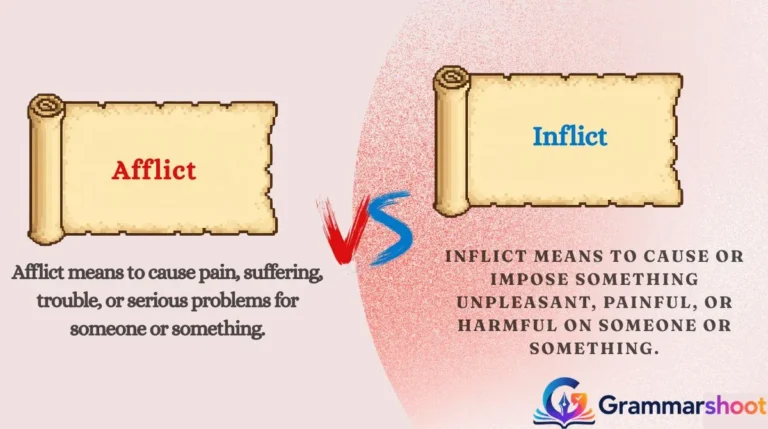
English has many words that look similar but have different meanings. Sometimes, two words are so close in meaning that even good students use them incorrectly.
Afflict vs inflict is one such confusing pair. Both words are connected with pain, suffering, and problems, but they are not used in exactly the same way.
For example, you might read that a disease afflicts a person or that someone inflicts pain on another person.
Both sentences describe suffering, yet the words focus on different things.
If you switch these words, your sentence may sound unnatural or give the reader the wrong idea.
This confusion is common among students, English learners, and even people who use English every day. The problem becomes more noticeable in school assignments, professional writing, news reports, and everyday conversations.
Understanding the difference can help you speak more clearly and write better sentences.
The good news is that the difference is easier to remember than it first appears. Afflict usually describes a person or group suffering from a problem, disease, or difficult condition.
Inflict usually describes someone or something causing pain, damage, or harm to another person or thing.
Once you understand who suffers and who causes the suffering, choosing the correct word becomes much easier.
You will also learn the grammar rules, common mistakes, practical examples, and simple memory tricks that help you use both words naturally.
What Does “Afflict” Mean?
Afflict means to cause pain, suffering, trouble, or serious problems for someone or something. It is often used when talking about diseases, poverty, fear, natural disasters, and other difficult conditions.
When something afflicts a person, that person experiences the problem or suffers because of it. The word often describes a condition that affects someone over a period of time, although it can also describe a problem that causes immediate suffering.
For example:
- A serious illness afflicted the young boy.
- Poverty afflicts many families around the world.
- The town was afflicted by a terrible drought.
- Fear of failure afflicts some students.
- A rare disease afflicts people in several countries.
- The region has been afflicted by repeated floods.
- Loneliness can afflict people of any age.
- Financial problems afflicted the family for years.
Notice that the person or group experiencing the problem is the one being afflicted. The word does not usually focus on a person deliberately hurting someone else. Instead, it highlights the suffering or difficulty experienced by the affected person.
When Should You Use Afflict?
Use afflict when you want to describe a problem, disease, condition, or hardship that affects someone negatively.
It is especially common in formal writing, health reports, news stories, academic discussions, and descriptions of social problems. However, it can also appear in ordinary English when someone wants to express a serious difficulty.
Consider these examples:
- Many children are afflicted by hunger.
- The village is afflicted with a shortage of clean water.
- His family has been afflicted by financial difficulties.
- The country was afflicted by a deadly epidemic.
In these sentences, the focus is on the people or places experiencing hardship.
You can also use the word when discussing emotional or mental struggles in a general sense. For example, “She was afflicted by constant worry” means that constant worry caused her distress.
However, afflict is not usually the best choice for small, temporary inconveniences. If you have a minor headache, you would normally say, “I have a headache,” rather than “I am afflicted by a headache.” The second sentence is possible, but it sounds more formal or dramatic.
Grammar Rule for Afflict
The most common sentence pattern is:
Problem + afflicts + person or group
Examples:
- The disease afflicts older adults.
- Poverty afflicts rural communities.
- Anxiety afflicts many teenagers.
You can also use the passive form:
Person or group + be + afflicted + by/with + problem
Examples:
- Many people are afflicted by this disease.
- The region was afflicted by a severe drought.
- He is afflicted with a painful condition.
Both by and with can appear in passive constructions, depending on the sentence and the writer’s preferred expression.
Remember that afflict is a regular verb. Its forms are afflict, afflicts, afflicted, and afflicting.
For example:
- Present: The disease afflicts many people.
- Past: The disease afflicted many people.
- Present perfect: The disease has afflicted many people.
- Continuous: The disease is afflicting more people.
Common Confusion About Afflict
Some learners think that afflict means to hurt someone intentionally. That is not its main use.
For example, “The illness afflicted him” does not mean that the illness made a conscious decision to hurt him. It simply means that he suffered from the illness.
Similarly, “Poverty afflicts the community” means that poverty causes hardship for the community. The sentence does not suggest that poverty is a person acting deliberately.
Think of afflict as a word that connects a problem with the person or group experiencing its effects.
What Does “Inflict” Mean?
Inflict means to cause or impose something unpleasant, painful, or harmful on someone or something. It is commonly used with words such as pain, injury, damage, punishment, suffering, and harm.
Unlike afflict, which often focuses on an ongoing problem or difficult condition, inflict emphasizes the act of causing something unpleasant.
For example:
- The attacker inflicted serious injuries on the victim.
- The storm inflicted heavy damage on the buildings.
- The punishment inflicted unnecessary suffering on the prisoner.
- His careless words inflicted emotional pain on his friend.
- The accident inflicted lasting damage on the vehicle.
- The soldiers inflicted heavy losses on the enemy.
- The judge refused to inflict an unfair punishment.
- The harsh criticism inflicted deep emotional wounds.
In these examples, the subject causes harm, damage, pain, or another unpleasant result.
The subject does not always have to be a person. A storm, accident, policy, or decision can also inflict damage or suffering.
When Should You Use Inflict?
Use inflict when you want to emphasize that someone or something causes harm, pain, punishment, or damage.
It is especially useful when describing an action and its negative result.
For example:
- The careless driver inflicted damage on the parked car.
- His rude comments inflicted emotional pain on his sister.
- The earthquake inflicted enormous damage on the city.
- The coach did not want to inflict unnecessary pressure on the players.
The word is often associated with deliberate actions, especially when a person hurts another person. However, inflict does not always mean that the harm was intentional.
A natural disaster can inflict damage without having any intention. Likewise, an accident can inflict injuries even though nobody meant to cause them.
This is an important point for English learners. Do not assume that every use of inflict describes deliberate cruelty. The main idea is that harm or suffering is caused.
Grammar Rule for Inflict
The most common pattern is:
Person or thing + inflicts + harm or suffering + on/upon + recipient
Examples:
- The attacker inflicted pain on the victim.
- The storm inflicted damage on the coast.
- His words inflicted emotional suffering upon her.
The prepositions on and upon are both possible. Upon often sounds more formal, while on is common in everyday English.
Another useful pattern is:
Person or thing + inflicts + injury, damage, or punishment
Examples:
- The accident inflicted serious injuries.
- The storm inflicted considerable damage.
- The court may inflict a penalty for the offense.
You can also use the passive voice:
Recipient + be + inflicted with/on + harmful result
However, the preposition depends on the construction. Compare these natural examples:
- The victim was inflicted with serious injuries.
- Serious injuries were inflicted on the victim.
The second construction is generally more natural and widely preferred. In everyday and formal writing, it is often better to write, “The victim suffered serious injuries,” or “Serious injuries were inflicted on the victim.”
The forms of the verb are inflict, inflicts, inflicted, and inflicting.
Examples:
- Present: The storm inflicts damage.
- Past: The storm inflicted damage.
- Present perfect: The storm has inflicted damage.
- Continuous: The storm is inflicting damage.
Common Confusion About Inflict
Some learners use inflict whenever they want to talk about suffering. However, the word usually needs a clear connection to the harm being caused.
For example:
Incorrect: “She inflicted from a serious illness.”
Correct: “She suffered from a serious illness.”
Another correct sentence is: “A serious illness afflicted her.”
The key difference is that inflict normally describes causing a harmful result, while suffer from describes experiencing a problem.
Difference Between Afflict and Inflict (Detailed)
The main difference between these two words is the relationship between the problem, the cause, and the person experiencing the harm.
Afflict usually describes a problem that affects someone and causes suffering. Inflict usually describes a person or thing causing pain, injury, damage, or another unpleasant result.
Compare these sentences:
- A serious disease afflicts the village.
- The disease inflicts suffering on the villagers.
Both sentences can describe the same situation, but they present it differently. The first focuses on the disease affecting the village. The second focuses on the suffering caused by the disease.
Comparison Table
| Feature | Afflict | Inflict |
|---|---|---|
| Basic meaning | To affect someone with suffering or hardship | To cause or impose harm, pain, or damage |
| Main focus | The person or group experiencing a problem | The harmful result being caused |
| Common subjects | Diseases, poverty, fear, problems | People, accidents, storms, decisions |
| Common objects | People, communities, regions | Pain, injury, damage, punishment |
| Common pattern | A disease afflicts a person | A person inflicts pain on someone |
| Common passive pattern | People are afflicted by a disease | Pain is inflicted on people |
| Intentional action required? | No | No |
| Common writing style | Formal, descriptive, and academic | Formal, descriptive, and action-focused |
1. Difference in Usage
The verb afflict is often used to describe problems that affect people or communities. These problems may continue for days, months, or years.
For example:
“Unemployment afflicts the small town.”
This means that unemployment is a serious problem for the people living there.
The verb inflict, on the other hand, emphasizes the harm or damage caused.
For example:
“The economic crisis inflicted heavy losses on local businesses.”
This sentence focuses on the losses that businesses experienced because of the crisis.
Both words can describe serious problems, but they direct the reader’s attention toward different parts of the situation.
2. Difference in Grammar
A simple way to understand the grammar is to look at the object of each verb.
With afflict, the object is often the person, group, or place experiencing the problem.
- Anxiety afflicts many students.
- The disease afflicts older people.
- Poverty afflicts the region.
With inflict, the object is often the pain, injury, damage, punishment, or suffering being caused.
- The injury inflicted severe pain.
- The storm inflicted heavy damage.
- The court inflicted a penalty.
When you use inflict with a person receiving the harm, the sentence commonly includes on or upon.
- The attacker inflicted pain on the victim.
- The decision inflicted hardship upon workers.
This difference in sentence structure is one of the easiest ways to choose the correct word.
3. Difference in Meaning
Consider a family dealing with a serious illness.
“The illness afflicted the family” describes the illness as a problem affecting the family.
“The illness inflicted great suffering on the family” emphasizes the suffering that the illness caused.
The difference is small but meaningful. The first sentence identifies the condition and its effect on the family. The second highlights the harmful result.
Here is another example:
- Hunger afflicts many children.
- Hunger inflicts suffering on many children.
The first sentence is direct and natural. The second is also possible, but it gives more attention to the suffering itself.
4. Can the Same Subject Use Both Words?
Yes. The same subject can be used with both verbs if the sentence structure and meaning are appropriate.
For example:
- The disease afflicts thousands of people.
- The disease inflicts severe suffering on thousands of people.
Both sentences are grammatically possible. The first focuses on the people affected by the disease, while the second emphasizes the suffering caused.
Similarly:
- Poverty afflicts the community.
- The economic crisis inflicted serious hardship on the community.
Notice that the subjects in these examples do not need to be human. Conditions and events can cause suffering without having intentions or emotions.
Grammar Rules You Must Remember
Learning the basic rules will help you use these verbs correctly in schoolwork, conversations, and professional writing.
Rule 1: Use Afflict When a Problem Affects Someone
The basic pattern is:
Problem + afflict + person or group
Examples:
- The disease afflicts many children.
- Fear afflicts the young student.
- Poverty afflicts several communities.
Ask yourself: What is the problem, and who is affected by it?
If the sentence focuses on a condition affecting someone, afflict is often the right choice.
Rule 2: Use Inflict When Something Causes Harm
The basic pattern is:
Person or thing + inflict + harm or damage
Examples:
- The storm inflicted heavy damage.
- The attacker inflicted serious injuries.
- His words inflicted emotional pain.
Ask yourself: What harmful result was caused?
If the sentence focuses on causing pain, injury, punishment, or damage, inflict is usually the better choice.
Rule 3: Remember the Prepositions
The most common patterns are:
- Afflict someone with a disease.
- Be afflicted by a problem.
- Inflict pain on someone.
- Inflict damage on something.
Examples:
- She was afflicted with a rare disease.
- The town was afflicted by a severe drought.
- The bully inflicted pain on the younger child.
- The fire inflicted serious damage on the building.
These are useful patterns to memorize because the correct preposition can make your sentence sound more natural.
Rule 4: Do Not Assume That Inflict Always Means Intentional Harm
Although inflict often appears in sentences about deliberate actions, it can also describe accidental or natural damage.
Examples:
- The earthquake inflicted severe damage on the city.
- The accident inflicted serious injuries on the passengers.
- The storm inflicted heavy losses on farmers.
An earthquake, storm, or accident has no intention to hurt anyone. The verb describes the harmful result, not necessarily the intention behind it.
Likewise, afflict does not require the problem to last forever. It can describe a temporary or long-term difficulty.
Common Mistakes Students Make
Even students with good English skills sometimes confuse these words. Most mistakes happen because both verbs are connected with pain and suffering.
Understanding the sentence structure is the best way to avoid these errors.
Mistake 1: Using Inflict With “From”
Incorrect: “He inflicted from a painful disease.”
Correct: “He suffered from a painful disease.”
You can also say, “A painful disease afflicted him.”
Why is the first sentence wrong? The phrase suffer from is used to describe experiencing a disease or problem. Inflict usually describes causing harm rather than experiencing it.
Correction tip: When you want to say that someone experiences a problem, use suffer from or consider be afflicted by/with.
Mistake 2: Using Afflict When You Mean to Cause Damage
Incorrect: “The storm afflicted heavy damage on the houses.”
Correct: “The storm inflicted heavy damage on the houses.”
Why? The sentence focuses on the damage caused by the storm. English normally uses the expression inflict damage on something.
You could also write, “The storm damaged the houses.”
Correction tip: Remember the common expression inflict damage. It is a useful phrase in news reports and formal writing.
Mistake 3: Confusing the Person Affected With the Harm Caused
Incorrect: “The attacker inflicted the victim.”
Correct: “The attacker inflicted serious injuries on the victim.”
Another natural option is: “The attacker hurt the victim.”
The original sentence does not clearly identify the harm being caused. In the usual pattern, inflict is followed by a harmful result, with the recipient introduced by on or upon.
Correction tip: After inflict, think of words such as pain, injury, damage, or punishment.
Mistake 4: Using Afflict for Every Type of Suffering
Incorrect: “The judge afflicted a punishment on the criminal.”
Correct: “The judge imposed a punishment on the criminal.”
Depending on the context, you might also say, “The punishment inflicted suffering on the criminal.”
Although afflict is connected with suffering, it does not replace every verb related to pain or punishment. English has more natural expressions for specific situations.
Correction tip: Learn common word combinations rather than memorizing definitions alone.
Mistake 5: Assuming That Inflict Always Requires a Human Subject
Incorrect: “A storm cannot inflict damage because it has no feelings.”
Correct: “The storm inflicted serious damage on the coastal town.”
A subject does not need to be a person to inflict harm. Natural events, accidents, and decisions can all cause harmful results.
Correction tip: Focus on what caused the harm, not whether the cause has feelings or intentions.
Mistake 6: Choosing a Formal Word for a Simple Situation
Awkward: “My little brother was afflicted by a tiny paper cut.”
More natural: “My little brother got a small paper cut.”
The first sentence is grammatically possible, but it sounds overly formal for a minor problem. Afflict usually fits better when describing serious or ongoing difficulties.
Correction tip: Match the word to the situation. Use simple words for everyday problems and stronger, more formal words when the context calls for them.
Easy Trick to Remember the Difference
Here is a simple memory trick:
Afflict = Affect someone with a problem.
Inflict = Impose or cause harm.
The words afflict and affect are not identical, but their similar beginnings can help you remember that afflict often focuses on the person experiencing a problem.
For inflict, think of the word impose. When someone imposes a punishment or causes damage, the action brings something unpleasant to another person or thing.
Try this example:
“A disease afflicts the patient.”
The disease is affecting the patient, and the patient is experiencing the problem.
“The disease inflicts pain on the patient.”
The sentence focuses on the pain caused by the disease.
Here is another way to remember the difference. Ask yourself two questions:
- Who is experiencing the problem? If you are describing a person or group affected by a hardship, afflict may be the right word.
- What harm is being caused? If you are describing pain, injury, or damage that someone or something causes, inflict may be the right word.
This trick is helpful, but remember that word choice also depends on natural expressions and sentence structure.
For example, “The disease afflicts many people” is a common and direct expression. “The disease inflicts pain on many people” is also possible, but it emphasizes the pain.
With a little practice, you will begin to recognize these patterns without stopping to think about every sentence.
Daily Life Examples of Afflict vs Inflict
The best way to understand confusing words is to see how people use them in real situations. The following examples show the difference in simple, natural English.
Example 1: Talking About an Illness
Ali: Why has Ahmed missed so many classes?
Sara: A serious illness has afflicted him recently.
Here, afflicted means that the illness has affected Ahmed and caused him to suffer.
Example 2: Talking About an Accident
Ali: Is the car badly damaged?
Sara: Yes. The accident inflicted serious damage on it.
The verb inflicted emphasizes the damage caused by the accident.
Example 3: Talking About Exam Stress
Student: I cannot sleep because I keep worrying about my exams.
Friend: Exam anxiety afflicts many students. Try making a simple study plan.
The sentence describes anxiety as a problem experienced by students.
Example 4: Talking About Hurtful Words
Ayesha: Why is your friend upset?
Mariam: Someone’s rude comments inflicted emotional pain on her.
The comments caused emotional harm, so inflicted is appropriate.
Example 5: Talking About Poverty
Reporter: What is the biggest challenge in this area?
Resident: Poverty afflicts many families here, and some children cannot attend school.
The sentence focuses on poverty as a condition affecting families.
Example 6: Talking About a Storm
Newsreader: The storm inflicted heavy damage on farms and homes last night.
This sentence emphasizes the damage caused by the storm.
Example 7: Talking About Fear
Teacher: Why is Bilal afraid to speak in class?
Student: A fear of making mistakes afflicts him.
The sentence means that fear is a problem Bilal experiences. In casual conversation, you could simply say, “Bilal is afraid of making mistakes.”
Example 8: Talking About Unfair Treatment
Employee: The new rules have made life difficult for our team.
Manager: We should not inflict unnecessary hardship on our workers.
The verb inflict emphasizes the hardship that the rules or decisions might cause.
Example 9: Talking About a Natural Disaster
Reporter: How badly was the coastal region affected?
Official: The region was afflicted by repeated flooding, which inflicted serious damage on roads and homes.
Both verbs work naturally here. Afflicted describes the region’s experience of repeated flooding, while inflicted describes the damage caused by the floods.
Example 10: Talking About Family Problems
Hassan: Why has your family been so worried lately?
Usman: Financial problems have afflicted us for months.
This sentence describes an ongoing hardship. If Usman wanted to emphasize the result, he could say, “The financial crisis has inflicted serious hardship on our family.”
Practice Section: Test Your Understanding
Choose the correct word in each sentence. Decide whether the sentence focuses on a problem affecting someone or on harm being caused.
- Poverty can (afflict / inflict) families for many years.
- The earthquake (afflicted / inflicted) severe damage on the buildings.
- A rare disease (afflicts / inflicts) several children in the village.
- The attacker (afflicted / inflicted) serious injuries on the victim.
- Anxiety (afflicts / inflicts) many students before important exams.
Answers and Explanations
1. Afflict — Poverty is a condition that affects families and causes hardship.
2. Inflicted — The sentence emphasizes the damage caused by the earthquake.
3. Afflicts — The disease affects the children. The present simple tense describes a general situation.
4. Inflicted — Serious injuries are the harmful results caused by the attacker.
5. Afflicts — Anxiety is a problem experienced by students.
If you answered all five correctly, you understand the main difference. If you missed one, review the comparison table and pay attention to the object of each verb.
FAQs
What is the difference between afflict and inflict?
Afflict usually means to affect someone with a problem, illness, or hardship. Inflict usually means to cause pain, injury, damage, or suffering. For example, a disease afflicts a patient, while an accident inflicts injuries on a person.
Can we use afflict in a question?
Yes, afflict can be used in questions. For example, “What problems afflict this community?” asks which problems affect the community. Another example is, “Does this disease afflict children more often than adults?” The verb follows normal English question rules.
Is inflict formal or informal?
Inflict is more common in formal or serious contexts, such as news reports, essays, and discussions of injury or damage. However, it can also appear in everyday conversation. For example, “His words inflicted a lot of pain on me” is understandable, although “His words really hurt me” sounds more casual.
Can a disease both afflict and inflict?
Yes. A disease can afflict a person and inflict suffering on that person. For example, “The disease afflicts thousands of people” focuses on those affected. “The disease inflicts severe pain on thousands of people” emphasizes the harm it causes.
Does inflict always mean to hurt someone intentionally?
No. Inflict can describe intentional harm, but intention is not required. A storm can inflict damage on a town, and an accident can inflict injuries on passengers. The verb focuses on the harmful result rather than the cause’s intention.
What are the most common phrases with afflict and inflict?
Common expressions with afflict include afflict a person, be afflicted by a disease, and be afflicted with a condition. Common expressions with inflict include inflict pain on someone, inflict damage on something, inflict injuries on someone, and inflict punishment. Learning these phrases will help you choose the right word naturally.
Conclusion
Understanding afflict vs inflict becomes much easier when you focus on the role each word plays in a sentence. Both words are related to suffering, but they emphasize different parts of a situation.
Use afflict when you want to describe a disease, problem, fear, or hardship that affects a person or group. For example, “Poverty afflicts many families” shows that poverty is a serious problem for those families.
Use inflict when you want to describe the pain, injury, damage, or suffering that someone or something causes. For example, “The storm inflicted heavy damage on the town” highlights the harmful result of the storm.
Remember the simple trick: afflict focuses on the problem affecting someone, while inflict focuses on the harm being caused.
Pay attention to common expressions such as be afflicted by a disease and inflict damage on a building. These patterns will help you avoid common grammar mistakes.
You do not need to memorize every example at once. Start by making a few sentences of your own, read them aloud, and check whether the verb matches your intended meaning. With regular practice, you will be able to use both words confidently in everyday English and formal writing.

Evan Rellmont is a writer who turns thoughtful ideas into meaningful words, creating stories and reflections that connect, inspire, and leave a lasting impression.