
English has many words that look similar but have different meanings. Anyone else, someone else, and everyone else are three common expressions that often confuse English learners.
They all refer to people, but they are not used in the same way.
For example, imagine you are in a classroom and want to know if another student has a question.
You might ask, “Does anyone else have a question?” If you need help with your homework, you might say, “Can someone else help me?” And if you want to talk about all the other students in the room, you could say, “Everyone else has finished the test.”
These sentences are all correct, but each expression gives a different message.
The confusion usually comes from the words anyone, someone, and everyone. Learners may think they can use these words in the same situations because they all refer to people.
However, the choice depends on whether you are asking about another person, talking about an unspecified person, or referring to all the other people in a group.
Understanding these expressions will help you speak more naturally, write clearer sentences, and avoid common grammar mistakes.
By the end, you will know when to use each expression, how to form correct sentences, and how to choose the right words in everyday conversations.
What Does “Anyone Else” Mean?
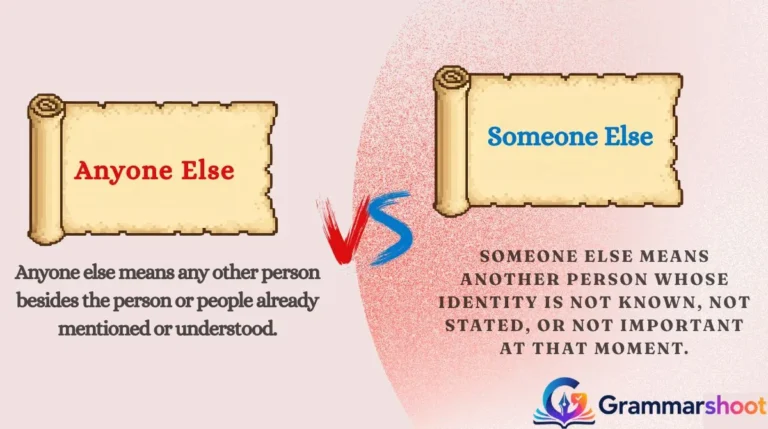
Anyone else means any other person besides the person or people already mentioned or understood.
We often use it when asking whether another person has a particular quality, wants something, or can do something. It is also common in negative sentences.
The word anyone refers to a person without identifying who that person is. The word else means “other” or “additional.”
Together, they help us talk about another possible person.
When Should You Use “Anyone Else”?
There are three common situations where this expression is useful.
1. Asking whether another person is involved
Use anyone else when you want to know if another person shares an opinion, has a question, or wants to join an activity.
Examples:
- Does anyone else want to come with us?
- Is anyone else coming to the party?
- Does anyone else have an idea?
- Is anyone else waiting outside?
In each sentence, the speaker wants to know whether there is another person who meets the condition.
2. Talking about other possible people
You can also use this expression in negative sentences to say that no other person is involved.
Examples:
- I don’t know anyone else in this town.
- She didn’t invite anyone else to the meeting.
- We couldn’t find anyone else to help us.
- He doesn’t trust anyone else with this job.
In these examples, anyone else refers to other possible people, but the negative verb tells us that no such person was found, invited, or trusted.
3. Asking about alternatives
Sometimes, anyone else helps you ask whether another person can take someone’s place.
Examples:
- Can anyone else drive the car?
- Could anyone else answer this question?
- Is anyone else available to work tomorrow?
- Does anyone else know how to fix this computer?
The speaker is asking whether another person has the required ability or availability.
Grammar Rules for “Anyone Else”
The expression anyone else is grammatically singular. Although it can refer to any person in a group, it takes a singular verb in the present simple.
For example:
- Anyone else is welcome to join us.
- Does anyone else know the answer?
- Is anyone else interested in the job?
Notice that we say does anyone else know, not does anyone else knows.
After does, use the base form of the main verb.
Also, anyone is written as one word. The correct spelling is anyone else, not any one else when you mean an unspecified person.
More Examples of “Anyone Else”
Here are eight examples showing how this expression works in everyday English.
- Did anyone else hear that strange noise?
- Is anyone else hungry?
- I don’t think anyone else understands the problem.
- Has anyone else seen my keys?
- Would anyone else like a cup of tea?
- Nobody else was there, and I couldn’t contact anyone else.
- If anyone else calls, please take a message.
- Can anyone else explain this rule in simple English?
Common Confusion About “Anyone Else”
Some learners believe that anyone else can only appear in questions. This is not true.
It is common in questions, but it also works in statements, negative sentences, and conditional sentences.
For example:
- I don’t want anyone else to know.
- If anyone else asks, tell them I’m busy.
- Anyone else can apply for the position.
The important point is the meaning. Use anyone else when you are referring to any other possible person, rather than one particular person or every person in a group.
What Does “Someone Else” Mean?
Someone else means another person whose identity is not known, not stated, or not important at that moment.
We use it when we are talking about one unspecified person. The person exists in the situation, or the speaker believes that a particular person is needed, but the speaker does not name them.
For example:
“Someone else took my seat.”
This means another person took the seat. The speaker either does not know who it was or does not identify that person.
When Should You Use “Someone Else”?
1. When you need another person
Use someone else when you want help, advice, or support from a person other than the one already mentioned.
Examples:
- Can someone else help me with this?
- I need someone else to check my work.
- Please ask someone else to carry these boxes.
- We should find someone else to lead the team.
Here, the speaker is looking for one other person who can perform a particular task.
2. When another person did something
This expression is useful when you know that another person performed an action but do not mention their identity.
Examples:
- Someone else ate my lunch.
- Someone else left this bag here.
- Someone else answered the phone.
- Someone else has taken my notebook.
The focus is on the action, not on the person’s name.
3. When another person is a better choice
Sometimes, someone else is used to suggest a different person.
Examples:
- Maybe someone else can explain it better.
- You should talk to someone else about this problem.
- I think someone else would be better for the job.
- Let’s ask someone else for directions.
In these sentences, the speaker suggests another person without naming them.
Grammar Rules for “Someone Else”
Like anyone else, the expression someone else is grammatically singular.
Use a singular verb with it.
Examples:
- Someone else is using my computer.
- Someone else has the key.
- Someone else wants to speak to you.
Do not use plural verbs such as are, have, or want when someone else is the subject of a present-tense sentence.
The word someone refers to one person, even when that person’s identity is unknown.
More Examples of “Someone Else”
Here are eight examples to help you understand the expression.
- Someone else is sitting in my usual seat.
- I think someone else can solve this problem.
- Could someone else please answer the door?
- She wants someone else to make the decision.
- Someone else has already booked the room.
- If you cannot help me, I’ll ask someone else.
- He gave the invitation to someone else.
- We need someone else to take care of the children.
Common Confusion About “Someone Else”
A common mistake is thinking that someone else is only used in positive statements.
Although it is very common in positive sentences, it can also appear in questions, especially when making requests or suggesting an alternative.
For example:
- Could someone else help me?
- Would someone else like to volunteer?
- Can someone else take my place?
These questions are grammatically correct.
However, there is a difference in meaning between someone else and anyone else in many questions.
“Can someone else help me?” often expresses a hope or request for a person to volunteer.
“Can anyone else help me?” asks whether there is any other person who is able to help.
The difference is small in some situations, but it can affect the speaker’s intention.
What Does “Everyone Else” Mean?
Everyone else means all the other people in a particular group, apart from the person or people already mentioned or understood.
The word everyone refers to every person in a group. When we add else, we exclude the person or people already being discussed.
For example:
“Everyone else went home.”
This means all the other people went home. Depending on the context, the speaker may be the only person who stayed behind.
When Should You Use “Everyone Else”?
1. When talking about all the other people in a group
Use everyone else when the statement applies to every remaining person.
Examples:
- Everyone else is ready.
- Everyone else has finished the test.
- Everyone else went to the meeting.
- Everyone else agrees with the decision.
The expression refers to the whole remaining group, not just one person.
2. When comparing yourself with other people
This is especially common in everyday conversations.
Examples:
- Everyone else seems to understand the lesson.
- Everyone else is wearing a uniform.
- Everyone else has already left.
- Everyone else knows what to do.
These sentences compare one person or a smaller group with all the other people.
3. When describing what all other people did
You can use everyone else to describe a shared action or situation.
Examples:
- Everyone else stayed until the end.
- Everyone else enjoyed the movie.
- Everyone else brought their own lunch.
- Everyone else was waiting outside.
The expression makes it clear that the action applies to all the other people in the relevant group.
Grammar Rules for “Everyone Else”
Although everyone else refers to many people, it is grammatically singular.
This is an important rule for English learners.
Use is, has, does, and other singular verb forms when appropriate.
Examples:
- Everyone else is here.
- Everyone else has arrived.
- Everyone else wants to leave.
- Does everyone else agree?
Do not say “Everyone else are here” in standard English. The correct sentence is “Everyone else is here.”
The word everyone treats the group as a collection of individual people but takes a singular verb.
More Examples of “Everyone Else”
- Everyone else has gone home.
- Everyone else was laughing at the joke.
- Everyone else wants to watch a different movie.
- Everyone else is waiting for the bus.
- Everyone else received an email.
- Everyone else knows about the surprise.
- Everyone else has completed the assignment.
- Everyone else is welcome to join us.
Common Confusion About “Everyone Else”
The biggest mistake is using a plural verb because the expression refers to many people.
For example:
Incorrect: Everyone else are coming.
Correct: Everyone else is coming.
Another common confusion is forgetting that else creates a comparison with the person or people already mentioned.
If a teacher says, “Everyone else passed,” the teacher means all the other people passed. The sentence does not automatically include the person being discussed.
The exact group depends on the context.
Difference Between Anyone Else, Someone Else, and Everyone Else
These expressions all refer to people, but they communicate different ideas. The easiest way to understand them is to focus on how many people are involved and whether the speaker is asking about possibilities, referring to one person, or including an entire group.
Comparison Table
| Expression | Main meaning | Typical use | Example |
|---|---|---|---|
| Anyone else | Any other person | Questions, negatives, possibilities | Does anyone else agree? |
| Someone else | One other person, not identified | Requests, statements, alternatives | Someone else can help. |
| Everyone else | All the other people | Groups and comparisons | Everyone else has left. |
1. Difference in Meaning
The main difference is the number or range of people being considered.
Anyone else leaves the choice open. It asks whether there is at least one other person who meets a condition.
“Does anyone else want pizza?”
The speaker wants to know if at least one additional person wants pizza.
Someone else points toward one unspecified person.
“Someone else wants pizza.”
The speaker says that another person wants pizza, but does not identify them.
Everyone else includes all the remaining people in the group.
“Everyone else wants pizza.”
The speaker says that all the other people want pizza.
These expressions are not interchangeable because they do not communicate the same information.
2. Difference in Questions
All three expressions can appear in questions, but the meaning changes.
- Does anyone else know the answer?
- Does someone else know the answer?
- Does everyone else know the answer?
The first question asks whether any additional person knows the answer.
The second asks whether another person knows it. Depending on the context, it may suggest that the speaker expects or hopes that somebody does.
The third asks whether all the other people know the answer.
Notice how changing just one word changes the meaning of the entire question.
3. Difference in Negative Sentences
Anyone else is especially common in negative sentences.
For example:
“I don’t know anyone else here.”
This means the speaker does not know any other person here.
Someone else can also appear in negative sentences, but the meaning is different.
“I don’t want someone else to do it.”
This means the speaker does not want another person to do the task. The sentence does not mean that no other person is available.
Everyone else can appear in negative sentences too.
“Not everyone else agreed with me.”
This means that at least one other person did not agree. It does not mean that nobody agreed.
Compare these sentences carefully:
- I didn’t invite anyone else. — I invited no additional people.
- I didn’t invite someone else. — I did not invite a particular other person, or I chose not to invite another person, depending on context.
- I didn’t invite everyone else. — I did not invite all the other people; some may have been invited.
The position of not and the choice of expression can change the meaning.
4. Difference in Sentence Structure
All three expressions can be subjects or objects in a sentence.
As subjects:
- Anyone else is welcome.
- Someone else is calling.
- Everyone else is ready.
As objects:
- I didn’t see anyone else.
- Please ask someone else.
- I invited everyone else.
They can also appear before an infinitive phrase:
- I need anyone else to help. (Possible in a special context, but not natural for most requests.)
- I need someone else to help.
- I want everyone else to help.
For ordinary requests, someone else is usually the natural choice when you need one person. Everyone else is used when the request applies to the whole remaining group.
5. Difference in Everyday Use
Imagine you are organizing a school project.
You ask, “Does anyone else want to join our group?”
You are checking whether another student wants to join.
Then you say, “We need someone else to prepare the slides.”
You need one additional person for a particular task.
Finally, you say, “Everyone else should bring their notebooks tomorrow.”
You are talking about all the other students in the group.
This simple situation shows why the expressions are useful. Each one helps you describe a different situation clearly.
Grammar Rules You Must Remember
Rule 1: Use “Anyone Else” for Open Possibilities
Use anyone else when asking whether any other person has a quality, wants something, or can do something.
Example:
“Can anyone else speak French?”
The speaker is asking whether there is at least one other person who can speak French.
It is also common in negative sentences.
Example:
“I haven’t told anyone else about the plan.”
This means the speaker has not told any other person.
Rule 2: Use “Someone Else” for One Unspecified Person
Use someone else when referring to another person whose identity is not given.
Example:
“Someone else left their phone on the table.”
The sentence refers to one other person, but we do not know who that person is.
It is also useful when asking for help.
Example:
“Could someone else check this answer?”
The speaker is asking another person to do the task.
Rule 3: Use “Everyone Else” for All Remaining People
Use everyone else when the statement applies to every other person in a group.
Example:
“Everyone else has submitted the form.”
This means all the other people have submitted it.
Remember that the expression is singular for grammar purposes.
Correct: Everyone else is ready.
Incorrect: Everyone else are ready.
Rule 4: Use a Singular Verb with All Three Expressions
Anyone, someone, and everyone are singular indefinite pronouns.
Adding else does not change their grammatical number.
Examples:
- Anyone else is welcome.
- Someone else has arrived.
- Everyone else wants to leave.
In questions, use does with the base form of the main verb.
Correct: Does anyone else know?
Incorrect: Does anyone else knows?
This rule is simple, but remembering it will help you avoid many common mistakes.
Common Mistakes Students Make
English learners often confuse these expressions because they all contain the word else. The best way to avoid mistakes is to focus on the meaning of the complete expression rather than translating each word separately.
Mistake 1: Using “Everyone Else” When You Mean “Anyone Else”
Incorrect: Does everyone else want to join us?
This sentence is not always wrong, but it asks whether all the other people want to join.
If you only want to know whether another person wants to join, use:
Correct: Does anyone else want to join us?
Tip: Use anyone when one or more possible people may be involved. Use everyone when you mean the entire remaining group.
Mistake 2: Using “Someone Else” When You Mean “Everyone Else”
Incorrect for the intended meaning: Someone else has finished the exam.
If you mean that all the other students have finished, say:
Correct: Everyone else has finished the exam.
The first sentence says that another person has finished. It does not tell us that the whole group has finished.
Tip: Ask yourself, “Am I talking about one person or all the other people?”
Mistake 3: Using a Plural Verb
Incorrect: Everyone else are waiting outside.
Correct: Everyone else is waiting outside.
Incorrect: Someone else have my book.
Correct: Someone else has my book.
Tip: Remember that these expressions take singular verbs in standard English.
Mistake 4: Adding an “S” to the Verb After “Does”
Incorrect: Does anyone else wants tea?
Correct: Does anyone else want tea?
When you use does, the main verb stays in its base form.
The same rule applies to someone else and everyone else.
- Does someone else need help?
- Does everyone else agree?
Tip: Once you use does, do not add -s to the next verb.
Mistake 5: Confusing “Else” with “Other”
The word else usually follows an indefinite pronoun, such as someone, anyone, or everyone.
Correct: Someone else called me.
Correct: I spoke to another person.
Incorrect: Else someone called me.
Tip: Use else after words like someone, anyone, everyone, somewhere, and anything.
Easy Trick to Remember the Difference
Here is a simple memory trick:
ANYONE ELSE = Any other person?
Think of a question or an open possibility.
Does anyone else need help?
SOMEONE ELSE = One other person
Think of an unnamed person.
Someone else can help you.
EVERYONE ELSE = All other people
Think of the whole remaining group.
Everyone else is ready.
You can also remember the words this way:
- Any means an open choice.
- Some means one or an unspecified number, depending on the expression.
- Every means the whole group.
When you see else, think “other.” Then combine the two ideas.
For example, if you are looking for one person to help you, choose someone else. If you are asking whether any other person can help, choose anyone else. If all the remaining people must help, choose everyone else.
This trick works well in both speaking and writing.
Daily Life Examples
The following conversations show how these expressions sound in natural English.
Example 1: In the Classroom
Teacher: Does anyone else have a question?
Student: No, I think everyone understands.
The teacher is asking whether another student has a question.
Example 2: Asking for Help
Ali: Can you help me move this table?
Hamza: Sorry, I’m busy. Ask someone else.
Hamza suggests finding one other person.
Example 3: At a Party
Sara: Is anyone else coming to the party?
Mina: Yes, two more friends are on their way.
Sara wants to know whether additional people will come.
Example 4: At Work
Manager: Everyone else has submitted the report.
Employee: I’ll send mine before lunch.
The manager is talking about all the other employees.
Example 5: Looking for a Seat
Ayesha: Someone else is sitting in my seat.
Friend: You can take that seat near the window.
Ayesha does not identify the person occupying her seat.
Example 6: Choosing a Restaurant
Bilal: Does anyone else want to try this restaurant?
Usman: I’d prefer the Italian place.
Bilal is asking whether another person wants to try the restaurant.
Example 7: During a Meeting
Team Leader: Does everyone else agree with this plan?
Team Member: Yes, we all agree.
The question concerns the views of the whole remaining group.
Example 8: Asking for Advice
Nadia: I don’t know how to solve this problem.
Friend: Maybe someone else in your class can explain it.
The friend suggests asking one other person.
Example 9: At School
Teacher: Everyone else is going to the library.
Student: Can I come with them?
The teacher is describing what all the other students are doing.
Example 10: At Home
Mother: Has anyone else eaten the cake?
Daughter: I think Dad had a piece.
The mother is asking whether another person has eaten some cake.
Practice Section: Choose the Correct Option
Test your understanding by choosing the correct expression for each sentence.
1. ______ want to come to the cinema?Anyone elseSomeone elseEveryone else
2. I need ______ to help me carry these bags.anyone elsesomeone elseeveryone else
3. ______ has finished the test except me.Anyone elseSomeone elseEveryone else
4. I don’t know ______ at this school.anyone elsesomeone elseeveryone else
5. Does ______ agree with the decision?anyone elsesomeone elseeveryone else
Check answers
FAQs
What is the difference between anyone else and someone else?
Anyone else refers to any other possible person and is common in questions and negative sentences. Someone else refers to one unspecified person. For example, “Does anyone else know?” asks about possible people, while “Someone else knows” says that another person knows.
Can we use “anyone else” in positive sentences?
Yes, you can use anyone else in positive sentences. For example, “Anyone else can join the team” means any other person is allowed to join. It is also common in conditional sentences, such as “If anyone else calls, tell them I’m busy.”
Is “someone else” singular or plural?
Someone else is singular because someone refers to one person. Use singular verbs such as is, has, and wants. For example, “Someone else is waiting outside” is correct, while “Someone else are waiting outside” is incorrect in standard English.
Why do we say “everyone else is” instead of “everyone else are”?
The word everyone is grammatically singular, even though it refers to many people. Adding else does not change this rule. Therefore, say “Everyone else is ready” and “Everyone else has arrived,” not “Everyone else are ready.”
Can “someone else” be used in a question?
Yes. You can say, “Could someone else help me?” or “Would someone else like to volunteer?” These questions often express a request or invite another person to take action. Anyone else is also possible, but it often asks more openly whether another person is available or willing.
What is the difference between “everyone else” and “anyone else”?
Everyone else means all the other people in a group. Anyone else means any other person who might meet a condition. “Everyone else came” means all the other people came, while “Did anyone else come?” asks whether at least one additional person came.
Conclusion
Understanding the difference between anyone else, someone else, and everyone else becomes much easier when you focus on the meaning of each expression.
Use anyone else when asking about any other possible person or when talking about other people in negative sentences. Choose someone else when you mean one other person whose identity is not stated. Use everyone else when you are talking about all the remaining people in a group.
Remember that all three expressions take singular verbs in standard English. You should say “Anyone else is welcome,” “Someone else has arrived,” and “Everyone else is ready.”
The best way to remember these expressions is to use them in everyday conversations. Try making your own sentences about your family, classmates, friends, or coworkers.
With a little practice, you will be able to choose the right expression naturally. Keep paying attention to how people use these words, and soon the difference will feel simple.

Evan Rellmont is a writer who turns thoughtful ideas into meaningful words, creating stories and reflections that connect, inspire, and leave a lasting impression.