
May vs can is a common grammar question for English learners. Both words are modal verbs, and both can be used to ask for permission or talk about what is possible.
However, they do not always have the same meaning. Understanding when to use each word will help you speak and write English more naturally.
Have you ever wondered whether you should say, “May I come in?” or “Can I come in?” Both sentences are common in English, and both can be correct.
But if you have learned English in school, you may have heard that may is used for permission while can is used for ability.
This traditional rule can make English confusing, especially when you hear native speakers using both words in everyday conversations.
The good news is that the difference is easier to understand than it seems. You do not need to memorize many difficult grammar rules. You only need to understand what each word usually means and how people use it in real situations.
May is often used to ask for permission, express possibility, or give permission in a polite way. Can is commonly used to talk about ability, ask for permission in everyday English, and describe things that are possible.
For example, you might say, “Can you swim?” when asking about someone’s ability. You might say, “May I borrow your pen?” when politely asking for permission.
You can also say, “It may rain today” to describe something that is possible.
After understanding these examples, you will find it easier to choose the correct word.
You will also learn the main grammar rules, common mistakes, everyday conversations, and simple practice questions that can help you use both words confidently.
What Does “May” Mean?
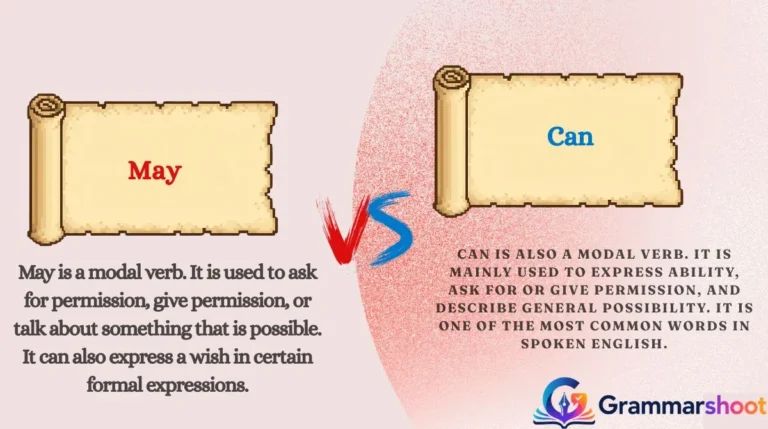
May is a modal verb. It is used to ask for permission, give permission, or talk about something that is possible. It can also express a wish in certain formal expressions.
The meaning of may depends on the sentence. When you understand the situation, choosing the correct meaning becomes much easier.
1. May for Permission
We often use may when asking for permission in a polite or formal way. It is especially common in classrooms, offices, formal conversations, and situations where you want to sound respectful.
For example, a student might ask a teacher, “May I leave the classroom?” This sounds polite and respectful. Similarly, an employee might ask, “May I speak with the manager?”
Here are some more examples:
- May I come in, please?
- May I use your phone?
- May I sit here?
- May I ask you a question?
- May we begin the meeting?
- May I borrow your book?
- May I leave a little early?
- May I open the window?
In these sentences, the speaker is asking whether something is allowed. The word may makes the request sound polite.
2. May for Possibility
We also use may to say that something is possible. It does not mean that the event will definitely happen. It means there is a chance that it will happen.
For example:
- It may rain this evening.
- She may come to the party.
- We may visit our grandparents tomorrow.
- He may be at home right now.
- The teacher may give us a test.
- They may arrive late.
- I may buy a new laptop next month.
- The shop may be closed today.
Notice that these sentences describe possibilities, not certain facts. If you say, “It may rain this evening,” you mean rain is possible, but you do not know for sure whether it will rain.
3. May for Giving Permission
Although may is often used to ask for permission, it can also be used to give permission.
For example:
- You may leave now.
- You may use my computer.
- Students may enter the classroom.
- You may choose any book you like.
These sentences tell someone that an action is allowed. This use is common in formal instructions, schools, offices, and official notices.
4. May in Wishes
The word may can express a wish or hope. This use is more formal and often appears in greetings, speeches, and written messages.
Examples include:
- May you have a wonderful day!
- May all your dreams come true.
- May you always be happy.
- May peace be with you.
These sentences express good wishes rather than permission or possibility.
Grammar Rule for May
The basic structure is:
Subject + may + base form of the verb
Examples:
- She may come.
- They may win.
- He may need help.
- We may travel tomorrow.
After may, use the base form of the verb. Do not add to, -s, or -ing directly after it.
Correct: She may go.
Incorrect: She may goes.
Incorrect: She may to go.
For questions, place may before the subject:
May + subject + base verb?
Example: May I enter the room?
For negative sentences, use may not:
- You may not park here.
- He may not attend the meeting.
Be careful with negative meanings. Depending on the context, may not can mean that something is possibly not true, or that an action is not permitted. The surrounding sentence helps make the meaning clear.
What Does “Can” Mean?
Can is also a modal verb. It is mainly used to express ability, ask for or give permission, and describe general possibility. It is one of the most common words in spoken English.
You will hear can in conversations at home, at school, at work, and in public places. It is useful because it allows you to talk about what people are able to do and what actions are allowed.
1. Can for Ability
The most common use of can is to talk about ability. We use it when someone knows how to do something or is able to perform an action.
For example:
- I can swim.
- She can speak English.
- He can drive a car.
- My brother can cook.
- They can play football.
- We can solve this problem.
- Birds can fly.
- My little sister can read simple stories.
These sentences describe skills or abilities. When you ask, “Can you swim?” you want to know whether the person has the ability to swim.
For past ability, we often use could. For a specific successful action in the past, another structure may be needed. For example, “I could swim when I was six” describes a past ability.
2. Can for Permission
In everyday English, can is commonly used to ask for permission. It sounds natural in conversations with friends, family members, classmates, and coworkers.
Examples:
- Can I use your pen?
- Can I sit next to you?
- Can we go outside?
- Can I borrow your charger?
- Can I open the door?
- Can I take a short break?
- Can I ask something?
- Can we start now?
These sentences are all requests for permission. Although some traditional grammar lessons recommend may for permission, using can this way is normal in modern spoken English.
For example, a student can ask a teacher, “Can I go to the bathroom?” This is a common everyday request. If the student wants to sound especially formal or polite, “May I go to the bathroom?” is also suitable.
3. Can for Possibility
We use can to talk about general possibilities, things that sometimes happen, or situations that are possible under certain conditions.
Examples:
- Winters can be very cold here.
- Learning a new language can be difficult.
- Too much sugar can harm your teeth.
- Accidents can happen at any time.
- This road can become busy in the evening.
- A small mistake can cause a big problem.
- Strong winds can damage trees.
- Exercise can improve your health.
These sentences do not usually describe one specific event that might happen tomorrow. Instead, they describe something that is generally possible or can happen in certain circumstances.
Compare these two sentences:
“It may rain tomorrow.”
“Rainy weather can make driving difficult.”
The first sentence talks about a possible event on a particular day. The second describes a general possibility or effect.
Grammar Rule for Can
The basic structure is:
Subject + can + base form of the verb
Examples:
- I can help.
- She can dance.
- He can read.
- They can understand English.
For questions, place can before the subject:
Can + subject + base verb?
Examples:
- Can you help me?
- Can she drive?
- Can they come today?
For negative sentences, use cannot or can’t:
- I cannot swim.
- She can’t attend the meeting.
- We cannot enter this room.
Can’t is the common contracted form used in everyday speech. Cannot is also correct and may be preferred in more formal writing.
Remember that can does not take to before the next verb.
Correct: He can speak English.
Incorrect: He can to speak English.
Also, do not add -s to the verb after can.
Correct: She can sing.
Incorrect: She can sings.
Difference Between May and Can (Detailed)
The difference between may and can depends on the meaning and situation. Both are modal verbs, but they often perform different jobs.
Traditionally, may is associated with permission and possibility, while can is associated with ability and practical possibility. In modern English, however, both words are used for permission, and both can express possibility in different ways.
May vs Can Comparison Table
| Feature | May | Can |
|---|---|---|
| Main use | Permission and possibility | Ability, permission, and possibility |
| Asking permission | Often polite or formal | Common in everyday speech |
| Ability | Not normally used for ordinary skills | Commonly used for skills and ability |
| Specific future possibility | Often used | Sometimes possible, depending on context |
| General possibility | Possible | Very common |
| Question example | May I come in? | Can I come in? |
| Ability example | Less natural for ordinary ability | Can you swim? |
| Negative form | May not | Cannot or can’t |
| Verb after it | Base form | Base form |
1. Difference in Permission
Both words can be used to ask permission, but the tone may be different.
May I borrow your book?
This sounds polite and slightly formal.
Can I borrow your book?
This sounds natural and conversational.
Neither sentence is automatically wrong. The best choice depends on the situation and the tone you want.
In a formal meeting, a student speaking to a teacher, or a conversation with someone you do not know well, may can be a good choice. With a friend or family member, can is often the more natural choice.
However, can is also acceptable in many polite situations. The word itself does not make a request rude; your tone and the words around it also matter.
2. Difference in Ability
When you talk about someone’s skill or ability, can is usually the correct choice.
For example:
- Can you ride a bicycle?
- I can speak two languages.
- She can play the piano.
In these sentences, you are talking about what someone is able to do.
Using may to ask about ordinary ability would usually sound unnatural. For example, “May you swim?” is not the normal way to ask whether someone knows how to swim.
Instead, say, “Can you swim?”
3. Difference in Possibility
Both words can express possibility, but their usual patterns are different.
Use may when you want to describe a particular event that is possible.
Examples:
- She may visit us tomorrow.
- The train may be late.
- I may need your help.
Use can when describing general possibilities, abilities of things, or events that can happen under certain conditions.
Examples:
- Trains can be late during bad weather.
- This medicine can cause side effects.
- Children can learn quickly with regular practice.
The distinction is not absolute. Context matters, and some sentences can use either word with a slight change in meaning or emphasis.
4. Difference in Sentence Structure
Both may and can follow the same basic grammar pattern.
Positive: Subject + may/can + base verb.
- He may come.
- He can come.
Negative: Subject + may not/cannot + base verb.
- He may not come.
- He cannot come.
These negative sentences do not necessarily mean the same thing.
“He may not come” often means there is a possibility that he will not come.
“He cannot come” usually means he is unable to come or is not allowed to come, depending on the context.
Question: May/Can + subject + base verb?
- May I enter?
- Can I enter?
Both questions ask about permission, but may often sounds more formal.
5. Difference in Meaning
Consider these three sentences:
- I can go to the party.
- I may go to the party.
- I cannot go to the party.
The first sentence usually means that going is possible for me, or that I am able or free to go. The exact meaning depends on the context.
The second sentence means that going is a possibility, but I have not necessarily decided to go.
The third sentence usually means that I am unable to go or that something prevents me from going.
These small differences can change the meaning of a conversation. That is why it is useful to learn the meaning of the whole sentence instead of memorizing one simple rule.
Grammar Rules You Must Remember
Four basic rules can help you use both modal verbs correctly.
Rule 1: Use Can for Ability
When you want to talk about a person’s skills or ability, use can.
Examples:
- I can cook rice.
- She can speak French.
- They can play cricket.
Do not use may to ask about ordinary skills. For example, say, “Can you drive?” rather than “May you drive?”
Easy tip: If you are asking whether someone knows how to do something, can is usually the right choice.
Rule 2: Use May for Polite Permission Requests
Use may when you want to ask permission in a polite or formal way.
Examples:
- May I come in?
- May I speak to you?
- May we leave now?
You can also use can in these situations, especially in everyday conversations. The choice depends on how formal you want to sound.
Easy tip: When asking permission in a formal setting, consider using may.
Rule 3: Use May for a Specific Possibility
Use may to describe something that could happen but is not certain.
Examples:
- It may rain tonight.
- He may call you later.
- We may travel next week.
You are not saying that the event will definitely happen. You are saying that it is possible.
Easy tip: If you are talking about something that might happen in a particular situation, may is often a useful choice.
Rule 4: Always Use the Base Verb After May and Can
Both words are modal verbs. A modal verb is followed by the base form of the main verb, without to.
Correct examples:
- She may come.
- He can run.
- They may win.
- We can help.
Incorrect examples:
- She may comes.
- He can runs.
- They may to win.
- We can to help.
Easy tip: After may or can, use the plain verb. Do not add -s, -ing, or to directly after the modal.
Common Mistakes Students Make
English learners often confuse these words because they learn simple grammar rules at school and then hear people speaking differently in everyday life. The solution is to understand the purpose of each sentence.
Mistake 1: Thinking Can Is Always Wrong for Permission
Some students believe that can must only describe ability.
Incorrect idea: “Can I sit here?” is always wrong.
Correct understanding: “Can I sit here?” is a normal way to ask permission in everyday English.
You can also say, “May I sit here?” when you want a more formal or polite tone.
Correction tip: Remember that modern English uses can for permission, not only for ability.
Mistake 2: Using May to Ask About Ability
Some learners say, “May you speak English?” when they want to know whether someone can speak the language.
Incorrect: May you speak English?
Correct: Can you speak English?
The first sentence is not the normal way to ask about language ability. Use can for skills, knowledge, and abilities.
Correction tip: Ask yourself, “Am I asking whether someone is able to do something?” If the answer is yes, can is usually the right choice.
Mistake 3: Adding “To” After a Modal Verb
Learners sometimes use the same structure they use with other verbs.
Incorrect: I may to visit my aunt.
Correct: I may visit my aunt.
Incorrect: She can to dance.
Correct: She can dance.
Correction tip: Remember the pattern: modal verb + base verb. Do not put to between them.
Mistake 4: Adding “S” to the Main Verb
In the present simple tense, we often add -s to a verb after he, she, or it. But this rule does not apply when a modal verb comes before the main verb.
Incorrect: He can speaks English.
Correct: He can speak English.
Incorrect: She may comes tomorrow.
Correct: She may come tomorrow.
Correction tip: Once you use may or can, keep the next verb in its base form.
Mistake 5: Confusing May Not With Cannot
These expressions can communicate different meanings.
“She may not come” means that perhaps she will not come.
“She cannot come” usually means that she is unable to come or is not permitted to come.
Correction tip: Before choosing a negative form, decide whether you mean uncertainty, inability, or lack of permission.
Mistake 6: Thinking May Is Always More Correct
Some learners believe that may is always better than can when asking for permission. This is too strict for modern English.
Both sentences are correct:
- May I use your phone?
- Can I use your phone?
The first may sound more formal, while the second is common in everyday conversation.
Correction tip: Choose the word that fits your situation, rather than assuming one is always correct and the other is always wrong.
Easy Trick to Remember the Difference
Here is a simple memory trick:
Can = ability. May = permission or possibility.
Think about what you want to say before choosing the word.
If you want to ask whether someone has a skill, use can.
- Can you swim?
- Can she cook?
- Can they speak English?
If you want to ask permission politely, may is a good choice.
- May I come in?
- May I borrow your pen?
- May we leave now?
If you want to talk about something that might happen, use may.
- It may rain tomorrow.
- He may arrive late.
- We may win the match.
For general possibilities, can is also common.
- Driving at night can be difficult.
- This road can become dangerous in winter.
Imagine that you are in a classroom. You want to know whether your classmate knows how to use a computer. You ask, “Can you use a computer?” You are asking about ability.
Now imagine that you want to open a window in the classroom. You ask, “May I open the window?” You are asking for permission politely.
This simple difference will help you choose the correct word in many everyday situations. Remember that it is a useful guide, not an absolute rule for every sentence.
Daily Life Examples of May vs Can
Real conversations are one of the easiest ways to learn grammar. Read these examples aloud and notice why the speaker chooses each word.
Example 1: Asking a Teacher for Permission
Student: May I come into the classroom?
Teacher: Yes, you may. Please take your seat.
The student uses may to ask permission politely. The teacher uses may to grant permission.
Example 2: Asking a Friend About Ability
Ali: Can you play cricket?
Ahmed: Yes, I can. I play every weekend.
Ali asks about Ahmed’s ability. Therefore, can is the natural choice.
Example 3: Borrowing a Phone
Sara: Can I use your phone for a minute?
Ayesha: Sure. Here you go.
Sara uses can to ask permission in a casual conversation. This is natural everyday English.
Example 4: Talking About the Weather
Hamza: Should we take an umbrella?
Bilal: Yes, it may rain this evening.
Bilal uses may because he is talking about a possible event in the near future.
Example 5: Asking for Help
Mina: Can you help me with this question?
Hira: Of course. Let me see it.
Mina asks whether Hira is able and willing to help. In this situation, can is a natural way to make a request.
Example 6: Talking About a Future Plan
Usman: Are you visiting your cousin tomorrow?
Saad: I am not sure. I may visit him if I finish my work.
Saad uses may because the visit is possible, but he has not made a definite decision.
Example 7: Giving Permission at Home
Mother: You may watch television after finishing your homework.
Child: Okay, Mom. I will finish it first.
The mother uses may to say that watching television is allowed under a condition.
Example 8: Describing a General Possibility
Teacher: Why should we study regularly?
Student: Because a small mistake can change the meaning of a sentence.
The student uses can to describe something that is generally possible.
Example 9: Asking to Leave Early
Employee: May I leave a little early today?
Manager: Please finish your report first.
The employee uses may to make a polite request in a workplace. The manager has not yet given permission.
Example 10: Talking About a Possible Visit
Nadia: Is your brother coming to dinner?
Sana: He may come, but he has not confirmed yet.
Sana uses may to express uncertainty about a particular event.
These conversations show that grammar depends on meaning and context. Once you understand what the speaker wants to express, choosing the right modal verb becomes easier.
Practice Section: Choose the Correct Word
Test your understanding by choosing may or can for each sentence. Think about the meaning before checking the answers.
- _____ you swim across the pool?
- _____ I come in, please?
- It _____ rain later today.
- She _____ speak three languages.
- _____ I borrow your notebook?
Answers and Explanations
- Can you swim across the pool? — This asks about ability.
- May I come in, please? — This is a polite request for permission.
- It may rain later today. — This describes a specific possibility.
- She can speak three languages. — This describes ability.
- May I borrow your notebook? — This is a polite permission request. “Can I borrow your notebook?” would also be correct in everyday English.
Remember that some questions can accept both words depending on the intended meaning and tone. The purpose of this exercise is to practice the most common patterns.
FAQs
What is the difference between may and can?
May is commonly used for permission and possibility, while can is commonly used for ability, permission, and general possibility. For example, “May I enter?” is a polite permission request, while “Can you swim?” asks about ability. Both words can be used to ask permission in modern English.
Can we use can to ask for permission?
Yes, can is commonly used to ask for permission in everyday English. For example, “Can I use your phone?” is a natural sentence. You do not need to avoid it in normal conversation. Use may when you want your request to sound more formal or traditionally polite.
Is may more formal than can?
In many situations, may sounds more formal or polite when asking for permission. For example, “May I speak with you?” may sound more formal than “Can I speak with you?” However, both forms are correct. The situation, tone, and relationship between the speakers also affect how polite a sentence sounds.
Can may and can be used for possibility?
Yes, both words can express possibility, but they are often used in different ways. May commonly describes a particular event that might happen, as in “She may arrive late.” Can often describes general possibilities, as in “Roads can become slippery in winter.” Context can affect the choice.
Which is correct: “May I go” or “Can I go”?
Both sentences can be correct when you are asking permission. “May I go?” often sounds more formal, while “Can I go?” is common in everyday conversation. Choose the sentence that fits the situation. In ordinary spoken English, you will hear both expressions frequently.
What verb form comes after may and can?
Use the base form of the verb after both may and can. For example, say “She may come” and “He can drive.” Do not say “She may comes” or “He can drives.” You should also avoid putting to directly after these modal verbs.
Conclusion
Understanding the difference between may and can will help you speak English more clearly and naturally. Although these two modal verbs sometimes have similar meanings, each has common uses that are worth learning.
Remember the basic rule: can is commonly used to talk about ability, while may is often used to ask for permission politely or express a possibility. You can also use can to ask permission in everyday conversations, and it is frequently used to describe general possibilities.
Pay attention to the meaning of each sentence instead of following a rule without considering the situation. For example, use “Can you drive?” to ask about ability, “May I come in?” to make a polite request, and “It may rain tomorrow” to talk about a possible event.
Also, remember the grammar pattern: place the base form of the verb after both words. Avoid adding to or -s directly after them.
Keep practicing with simple sentences, classroom conversations, and everyday situations. The more you use these words, the easier the difference will become. You do not need perfect English on your first try. Learn the basic rules, notice how people speak, and build your confidence one sentence at a time.

Evan Rellmont is a writer who turns thoughtful ideas into meaningful words, creating stories and reflections that connect, inspire, and leave a lasting impression.