
English has many spelling rules that seem easy at first but become confusing when a word does not follow the pattern we expect. Potatoes or potatos is a good example.
Many learners know that we often make a plural noun by adding -s, so they naturally write potatos.
However, the correct plural form is potatoes. Major learner dictionaries, including Cambridge and Oxford, list potatoes as the plural of potato.
This small spelling difference matters because potato is a very common word. You may see it in recipes, shopping lists, school exercises, menus, food labels, and everyday conversations.
A spelling mistake in such a simple word can make your writing look less accurate.
The good news is that the difference is easy to understand once you learn the pattern.
You also need to know that English has several words ending in -o, and they do not all form their plurals in exactly the same way.
After reading this guide, you will know why potatoes is correct, why potatos is incorrect in standard English, how to use both singular and plural forms naturally, and how to remember the spelling without having to stop and think every time.
What Does “Potatoes” Mean?
Potatoes is the plural form of potato.
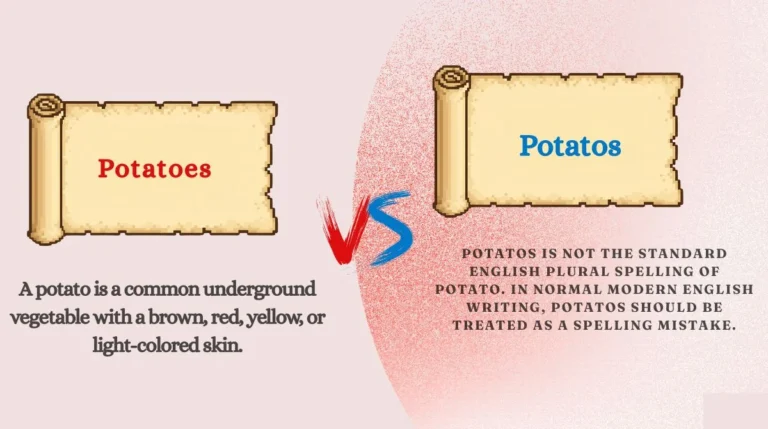
A potato is a common underground vegetable with a brown, red, yellow, or light-colored skin. It is used in many kinds of food, including fries, mashed potatoes, roasted potatoes, soups, curries, and salads. Cambridge and Oxford both give potatoes as the standard plural.
So, the basic rule is:
One potato → two potatoes
The word changes from potato to potatoes because the plural is formed with -es, not just -s.
When do we use “potatoes”?
Use potatoes when you are talking about more than one potato.
For example:
- I bought five potatoes from the market.
- The soup needs three potatoes.
- We planted some potatoes in the garden.
- These potatoes are ready to cook.
- She peeled the potatoes before dinner.
- The farmer grows potatoes every year.
- I added two potatoes to the curry.
- The roasted potatoes smell delicious.
Notice that the word refers to multiple individual vegetables. Because potato is a countable noun, you can use numbers with it:
one potato
two potatoes
ten potatoes
Oxford also treats potato as a countable and uncountable noun depending on how it is used. For example, we can talk about a potato as one vegetable, while mashed potato can refer to the food more generally.
The grammar rule
The correct plural spelling is:
potato + es = potatoes
Not:
potato + s = potatos
This is one of those cases where adding only -s does not give the standard plural form.
You may remember a basic spelling pattern:
Some nouns ending in -o take -es in the plural.
Examples include:
- potato → potatoes
- tomato → tomatoes
- hero → heroes
- echo → echoes
However, English is not perfectly regular. Some words ending in -o take only -s, such as:
- photo → photos
- piano → pianos
- radio → radios
That is why it is helpful to learn common words individually as well as remembering the general pattern. Oxford grammar guidance also notes that some nouns ending in -o add -es, while English has exceptions.
Common learner confusion
The most common problem is simple:
potato → potatos ❌
potato → potatoes ✅
Learners often write potatos because they apply the familiar plural rule:
book → books
car → cars
apple → apples
That rule works for many nouns, but not for every noun ending in -o.
There is another reason this spelling can feel strange. In speech, the final sound does not clearly remind you that there is an e before the s. As a result, learners sometimes spell the word exactly as they think it sounds.
The safest habit is to remember the written form:
P-O-T-A-T-O-E-S
The E is part of the plural spelling.
What Does “Potatos” Mean?
Potatos is not the standard English plural spelling of potato. In normal modern English writing, potatos should be treated as a spelling mistake.
When you want to talk about more than one potato, write:
potatoes ✅
not:
potatos ❌
Cambridge lists potatoes as the plural form of potato, and Oxford does the same.
When do people use “potatos”?
You may still see potatos online, in social media posts, informal messages, school writing, or user-generated content. That does not make it the correct standard spelling.
Think of it this way:
Potatos = a common misspelling
Potatoes = the standard spelling
The word potatos does not have a different meaning. It is simply an incorrect spelling of the plural form.
Examples of the wrong form
Here are some sentences with the incorrect spelling:
- I bought some potatos. ❌
- The potatos are in the kitchen. ❌
- We need four potatos for dinner. ❌
- These potatos are very fresh. ❌
- She planted potatos last spring. ❌
- Put the potatos in the oven. ❌
Each sentence should use potatoes instead.
Common learner confusion
A student may think:
“The singular is potato, so I just add s.”
That seems logical, but English has many spelling patterns that require a little more care.
For example:
- potato → potatoes
- tomato → tomatoes
- bus → buses
- box → boxes
- church → churches
The plural ending may be -s or -es, depending on the word.
So, do not judge the spelling only by the last letter. Learn the complete plural form.
Difference Between Potatoes and Potatos
The main difference is not one of meaning. It is a difference between a correct spelling and an incorrect spelling.
| Word | Correct? | Meaning | Use |
|---|---|---|---|
| Potatoes | ✅ Yes | More than one potato | Standard English |
| Potatos | ❌ No | Intended to mean more than one potato | Misspelling |
1. Usage difference
There is no real usage choice between these two words.
You should use potatoes whenever you mean more than one potato.
For example:
We bought six potatoes.
You should not write:
We bought six potatos. ❌
So this is not like word pairs such as affect/effect or their/there. The two forms do not have separate meanings.
2. Grammar logic
The singular noun is:
potato
The standard plural is:
potatoes
The added -es is part of the plural formation.
This is similar to several common nouns ending in -o. In many cases, especially with older or commonly used words, English uses -es:
- potato → potatoes
- tomato → tomatoes
- hero → heroes
- echo → echoes
But there are exceptions, which is why students sometimes become unsure.
Compare:
- photo → photos
- radio → radios
- piano → pianos
- video → videos
This shows why the rule should not be stated as “every word ending in o takes -es.” That would be too simple and would create more mistakes.
3. Sentence structure difference
Because potatoes is the correct plural noun, it can be used after numbers and plural determiners.
Correct:
- two potatoes
- several potatoes
- many potatoes
- some potatoes
- these potatoes
- those potatoes
Incorrect spelling:
- two potatos ❌
- several potatos ❌
- many potatos ❌
The grammar around the noun is normal. The problem with potatos is spelling.
4. Meaning comparison
Both forms are usually intended to refer to the same thing: more than one potato.
But only potatoes is accepted as the standard spelling.
That distinction is important. Sometimes learners see an incorrect form often enough that they begin to believe it is another valid English variant. Frequent mistakes on the internet do not automatically become standard grammar or spelling.
Grammar Rules You Must Remember
Rule 1: Use “potatoes” for more than one potato
When you are talking about two or more of the vegetable, use potatoes.
Example:
We need three potatoes for the recipe.
Not:
We need three potatos. ❌
This is the most important rule to remember.
Rule 2: Add “-es,” not only “-s”
The plural spelling follows this pattern:
potato + es = potatoes
The e is not optional.
Example:
She bought ten potatoes.
A useful spelling habit is to break the word into parts:
potato + es
This can help you remember the extra letter.
Rule 3: “Potato” is singular and “potatoes” is plural
Use potato with one item.
Use potatoes with two or more.
Compare:
I ate a potato.
I ate two potatoes.
Also compare:
There is one potato on the table.
There are four potatoes on the table.
The noun changes because the number changes.
Rule 4: Do not assume every “-o” word follows the same plural rule
This is an important advanced point for beginners because it prevents another mistake.
Some -o words take -es:
- potato → potatoes
- tomato → tomatoes
- hero → heroes
Some take only -s:
- photo → photos
- piano → pianos
- radio → radios
So the best approach is to learn common plural forms as vocabulary rather than trying to force every word into one rule.
Common Mistakes Students Make
Mistake 1: Writing “potatos”
This is by far the most common mistake.
Wrong:
I need two potatos.
Correct:
I need two potatoes.
Why does this happen? Usually because the learner knows the general rule “make a plural by adding s” but has not learned that potato takes -es.
Mistake 2: Thinking “potatoes” is pronounced with a strong extra syllable because of the spelling
The spelling includes -es, but pronunciation should be learned separately.
American and British dictionaries both give pronunciation information for potato and list potatoes as its plural.
Do not try to create the pronunciation only from the written letters. Listen to reliable pronunciation models and practice saying the word naturally.
Mistake 3: Using “potatoes” for one item
Some learners become so focused on the plural form that they use it everywhere.
Wrong:
I ate a potatoes. ❌
Correct:
I ate a potato. ✅
After a/an, use the singular countable noun:
a potato
After numbers greater than one, use the plural:
two potatoes
Mistake 4: Thinking “potatos” is an informal version
It is better not to think of potatos as a casual alternative.
In standard English writing, use potatoes. That includes schoolwork, emails, websites, essays, reports, recipes, and professional writing.
Mistake 5: Applying one plural rule to every “-o” word
A student may learn:
“Words ending in O always take ES.”
That is not correct.
For example:
potato → potatoes
but
photo → photos
English has patterns and exceptions. The goal is not to memorize hundreds of complicated rules. Learn the common forms you use often.
Easy Trick to Remember the Difference
Here is a simple classroom trick:
Think: Potato needs “E” before “S”
Say this to yourself:
Potato needs an E → potatoes.
You can also remember the word as:
POTATO + ES = POTATOES
The visual difference is useful:
POTATOES ✅
POTATOS ❌
Look at the middle:
-TOES
Many students find it easier to remember toes because it is also a familiar English word.
So think:
potato has TOES
That may sound funny, but funny memory tricks often work well. When you see potatoes, notice the ending:
potatoes → toes
You do not need to use a complicated grammar formula every time. A small memory connection can be enough.
Another useful comparison is:
tomato → tomatoes
potato → potatoes
These two words behave in the same way, so learning them together can strengthen your memory.
Daily Life Examples
The word potatoes appears often in normal conversation. Here are some examples you might actually hear or use.
Example 1: At the grocery store
A: Do we have enough potatoes?
B: No, we need another bag.
Example 2: Cooking dinner
A: How many potatoes should I peel?
B: Peel four. That should be enough.
Example 3: Talking about lunch
A: What are we having for lunch?
B: Chicken and roasted potatoes.
Example 4: Asking a family member
A: Did you wash the potatoes?
B: Yes, they are ready to cook.
Example 5: At a restaurant
A: What comes with the steak?
B: It comes with potatoes and vegetables.
Example 6: Shopping for ingredients
A: Please buy some potatoes on your way home.
B: Sure. How many do you need?
Example 7: Talking about a recipe
A: This recipe uses five potatoes.
B: Great. We have exactly five.
Example 8: Gardening
A: Are you growing potatoes this year?
B: Yes, we planted them in the spring.
Example 9: Describing food
A: These potatoes are really crispy.
B: I baked them at a high temperature.
Example 10: Comparing meals
A: I prefer mashed potatoes to fries.
B: I like both!
These examples show an important point: once the spelling is correct, the word is very easy to use.
Practice Section
Choose the correct word in each sentence.
1. We bought three ______ for dinner.
- A) potatos
- B) potatoes
2. She peeled one ______.
- A) potato
- B) potatoes
3. The recipe needs six ______.
- A) potatos
- B) potatoes
4. There is a ______ on the plate.
- A) potatoes
- B) potato
5. Are these ______ fresh?
- A) potatoes
- B) potatos
Answers
1. B) potatoes
There are three, so we need the plural.
2. A) potato
The sentence refers to one vegetable.
3. B) potatoes
Six means more than one, so the plural is needed.
4. B) potato
The sentence says “a,” which takes a singular countable noun.
5. A) potatoes
The question asks about several vegetables, and potatoes is the correct plural spelling.
FAQs
What is the difference between potatoes and potatos?
Potatoes is the correct plural spelling of potato. Potatos is a common spelling mistake. When talking about more than one potato, always write potatoes.
Why is the plural of potato “potatoes” instead of “potatos”?
The standard plural is formed with -es, giving potato + es = potatoes. This follows a common pattern found in some nouns ending in -o, although not every word ending in -o follows it.
Can I write “potatos” in informal English?
It is best not to. Even in informal writing, potatoes is the standard spelling. Seeing potatos in online posts or messages does not make it an accepted alternative spelling.
Is “potatoes” singular or plural?
Potatoes is plural. The singular form is potato.
For example:
I ate a potato.
I ate three potatoes.
The number tells you which form to use.
Is there a grammar rule for words ending in “o”?
There is a general pattern, but it has exceptions. Some nouns take -es, such as potato → potatoes and tomato → tomatoes. Others take -s, such as photo → photos and piano → pianos.
Which is correct: “2 potato” or “2 potatoes”?
2 potatoes is correct because a number greater than one normally takes the plural form of a countable noun.
You would write:
I bought 2 potatoes.
For one, write:
I bought 1 potato.
Conclusion
The correct spelling is simple once you see the pattern: potato is singular, and potatoes is plural. The form potatos is a spelling mistake, not a second accepted plural form.
The easiest way to remember it is to think:
potato + es = potatoes
You can also connect the ending -toes with the familiar word “toes” as a small memory trick. Just remember that English spelling has exceptions, so not every word ending in -o forms its plural with -es.
When you write about food, recipes, shopping, cooking, or everyday life, you will often need this word. A little attention to the extra e will keep your writing accurate.
So the next time you wonder, “Potatoes or potatos?”, choose potatoes. That is the standard and correct spelling.

Evan Rellmont is a writer who turns thoughtful ideas into meaningful words, creating stories and reflections that connect, inspire, and leave a lasting impression.