
Have you ever seen the words bazaar and bizarre and wondered why they look so similar but have completely different meanings? You are not alone.
Many English learners mix them up because they share almost the same letters and sound very similar when spoken.
However, using the wrong word can change the meaning of your sentence. A bazaar is a market or a place where people buy and sell things.
Bizarre is an adjective that describes something strange, unusual, or unexpected.
For example, you might visit a busy bazaar to buy clothes, spices, or fresh fruit. But if you see someone wearing a coat covered in hundreds of tiny plastic spoons, you might call that coat bizarre!
Both words are useful in everyday English. You may find bazaar in conversations about shopping, travel, culture, and local markets.
You may hear bizarre when people talk about strange events, unusual behavior, funny situations, or surprising experiences.
The good news is that learning the difference is simple once you understand what each word means and how to use it correctly.
By the end of this guide, you will know the definitions, grammar rules, sentence patterns, and common mistakes related to these words. You will also learn easy memory tricks and practice with everyday examples.
Let’s make these two confusing words easy to remember so you can use them confidently in speaking and writing.
What Does “Bazaar” Mean?
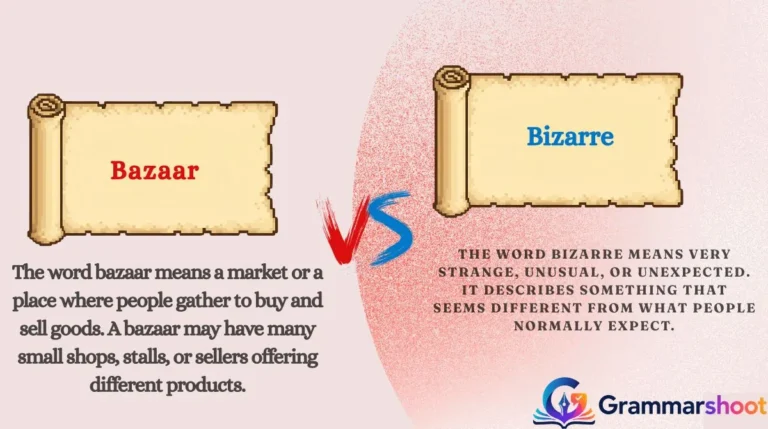
The word bazaar means a market or a place where people gather to buy and sell goods. A bazaar may have many small shops, stalls, or sellers offering different products.
You can find clothes, shoes, jewelry, food, spices, handmade crafts, household items, and many other things in a bazaar.
In many countries, including Pakistan, India, Iran, and other parts of Asia and the Middle East, bazaars are an important part of daily life. They may be found in busy city streets, traditional shopping areas, or special event spaces.
A bazaar can also be organized as a temporary event. For example, a school may arrange a charity bazaar where students sell handmade items and snacks to raise money.
When Should You Use “Bazaar”?
Use bazaar when you are talking about a market, shopping place, or event where people sell things.
Here are some common situations in which you can use this word:
- When talking about a traditional market.
- When describing a place with many sellers and stalls.
- When discussing shopping in a busy town or city.
- When talking about a school or charity selling event.
- When describing a market that offers different types of goods.
For example, if you go to a local market to buy vegetables, you might say, “I went to the bazaar this morning.”
If your school organizes an event where students sell cakes, books, and handmade cards, you can call it a school bazaar.
Grammar Rules for “Bazaar”
Bazaar is a noun. A noun is a word used to name a person, place, thing, or idea.
Because a bazaar is a place or market, you can use it as the subject or object of a sentence.
You can use bazaar with articles such as a and the.
- A bazaar: One market that is not yet specifically identified.
- The bazaar: A particular market that the speaker and listener know about.
- Bazaars: More than one market.
For example:
- We visited a bazaar near our hotel.
- The bazaar closes at sunset.
- The city has several traditional bazaars.
You can also use the word after prepositions such as in, at, and to.
For example:
- My mother is shopping at the bazaar.
- We walked through the bazaar.
- I am going to the bazaar after lunch.
Remember that bazaar names a place or event. It does not describe something strange.
8 Example Sentences with “Bazaar”
- My mother bought fresh vegetables from the bazaar.
- The bazaar is crowded on Friday evenings.
- We visited a traditional bazaar during our trip.
- My sister bought a beautiful dress at the bazaar.
- The school organized a charity bazaar to help poor families.
- You can find colorful spices in this old bazaar.
- Tourists enjoy walking through the bazaar and buying local crafts.
- The bazaar near our house opens early in the morning.
Each sentence uses bazaar to refer to a market or a market-style selling event.
Common Confusion About “Bazaar”
Some learners think bazaar means something unusual because they have seen it next to bizarre in word lists or spelling exercises.
That is incorrect.
A bazaar may look unusual, colorful, or crowded, but those qualities are not part of the word’s basic meaning. The word simply refers to a market or selling event.
For example:
Correct: We bought handmade bags at the bazaar.
Incorrect: His bizarre behavior at school surprised everyone. (Using bazaar instead of bizarre would be incorrect here.)
The second sentence needs an adjective that describes behavior, not a noun that names a market.
What Does “Bizarre” Mean?
The word bizarre means very strange, unusual, or unexpected. It describes something that seems different from what people normally expect.
You can use bizarre to describe a person’s behavior, an event, an idea, an object, a situation, or even a dream.
For example, imagine that you wake up one morning and remember a dream in which your teacher was riding a flying elephant through your classroom. You might describe it as a bizarre dream because it was strange and unexpected.
Similarly, if someone arrives at a wedding wearing a huge costume shaped like a refrigerator, you might call the outfit bizarre.
The word does not always mean something bad. Sometimes, a bizarre situation can be funny, surprising, interesting, or even wonderful. It simply means that something is far outside what people normally consider ordinary.
When Should You Use “Bizarre”?
Use bizarre when you want to describe something strange, unusual, or difficult to understand.
Common situations include:
- Describing unusual behavior.
- Talking about a strange dream.
- Explaining an unexpected event.
- Describing an unusual appearance or outfit.
- Discussing a surprising story or experience.
- Reacting to something that seems almost unbelievable.
For example, if your friend tells you that a chicken followed them onto a bus and sat beside them, you might say, “That is a bizarre story!”
If you see a house built upside down, you might describe it as a bizarre building.
Grammar Rules for “Bizarre”
Bizarre is an adjective. An adjective describes a noun by giving more information about it.
You can use bizarre before a noun.
Examples:
- A bizarre dream.
- A bizarre idea.
- A bizarre incident.
- A bizarre costume.
- A bizarre experience.
You can also use it after linking verbs such as be, seem, look, and become.
Examples:
- The situation was bizarre.
- His explanation seems bizarre.
- That building looks bizarre.
- The story became even more bizarre.
Unlike bazaar, bizarre does not usually take a or the directly before it on its own. Instead, the article normally belongs to the noun that follows it.
For example:
Correct: It was a bizarre experience.
Incorrect: It was a bizarre.
The second sentence is incomplete in ordinary use because the adjective needs a noun or another suitable structure.
You can also use comparative and superlative forms in suitable contexts, although more bizarre and most bizarre are often more natural than adding endings.
Examples:
- That dream was more bizarre than the first one.
- It was the most bizarre event of the year.
8 Example Sentences with “Bizarre”
- I had a bizarre dream last night.
- His bizarre behavior made everyone uncomfortable.
- We heard a bizarre story about a missing bicycle.
- That is a bizarre way to solve a simple problem.
- The artist created a bizarre sculpture from old shoes.
- Something bizarre happened while we were driving home.
- She wore a bizarre costume to the party.
- The movie has a bizarre ending that nobody expected.
In each example, bizarre describes something that is unusual or unexpected.
Common Confusion About “Bizarre”
Many learners confuse bizarre with bazaar because their spelling and pronunciation are very similar.
However, bizarre does not mean a market. It describes something strange.
For example:
Correct: The magician performed a bizarre trick.
Incorrect: The magician performed a bazaar trick.
The correct word is bizarre because the sentence describes a strange trick. It does not refer to a market.
Remember that an adjective gives information about a noun, while a noun can name a place or thing. This basic grammar difference will help you choose the right word.
Difference Between Bazaar and Bizarre (Detailed Explanation)
The main difference between bazaar and bizarre is their meaning and grammatical role.
Bazaar is a noun that refers to a market or selling event.
Bizarre is an adjective that describes something strange, unusual, or unexpected.
Although the words look and sound similar, they are not interchangeable. Choosing the correct one depends on what you want to say.
Comparison Table
| Feature | Bazaar | Bizarre |
|---|---|---|
| Meaning | A market or selling event | Strange or unusual |
| Part of speech | Noun | Adjective |
| Main purpose | Names a place or event | Describes a person, thing, or situation |
| Example phrase | A busy bazaar | A bizarre story |
| Common use | Shopping, markets, selling goods | Strange behavior, unusual events |
| Article use | A bazaar, the bazaar | A bizarre event, the bizarre idea |
| Plural form | Bazaars | Usually remains bizarre |
| Example sentence | We visited the bazaar. | We heard a bizarre story. |
This table shows why the words cannot replace each other. One names a market, while the other describes something unusual.
1. Difference in Meaning
The clearest difference is what each word tells the reader.
Bazaar tells you where people buy and sell things.
Bizarre tells you that something is strange or unexpected.
Consider these examples:
- We visited the bazaar after breakfast.
- We saw a bizarre painting at the museum.
In the first sentence, bazaar identifies a place. In the second sentence, bizarre describes the painting.
Now imagine that you visit a market filled with unusual objects. You could use both words in one sentence:
“We visited a bazaar and found a bizarre clock shaped like a dancing fish.”
Here, bazaar names the market, while bizarre describes the clock.
This example is a helpful reminder that the two words can appear in the same sentence but perform different jobs.
2. Difference in Grammar
The second major difference is their part of speech.
A noun can be the subject or object of a sentence. Since bazaar is a noun, you can say:
- The bazaar is busy.
- I visited the bazaar.
- The bazaar sells handmade goods.
In these sentences, the word names the market being discussed.
An adjective describes a noun. Since bizarre is an adjective, you can say:
- The bizarre story surprised me.
- His behavior was bizarre.
- We saw a bizarre object.
In the first and third examples, bizarre comes before a noun. In the second, it follows the linking verb was.
Understanding this difference makes it easier to use both words correctly, even when you have never seen a particular sentence before.
3. Difference in Sentence Structure
The words often appear in different sentence patterns.
Common patterns for bazaar include:
- Article + bazaar: A bazaar is nearby.
- Verb + the bazaar: We visited the bazaar.
- Preposition + the bazaar: She is at the bazaar.
Common patterns for bizarre include:
- Bizarre + noun: It was a bizarre event.
- Linking verb + bizarre: The event was bizarre.
- More/most + bizarre: The second story was more bizarre.
Notice that bazaar can stand as the main noun in a sentence. By contrast, bizarre commonly modifies another noun or follows a linking verb.
These patterns are useful when you are writing essays, answering grammar questions, or speaking English in everyday situations.
4. Difference in Everyday Use
You will often hear bazaar when people discuss shopping, travel, culture, and local markets.
For example:
“My uncle took us to a famous bazaar in the old part of the city.”
The sentence is about a place where people buy and sell goods.
You will hear bizarre when people discuss unusual events, strange behavior, or unexpected experiences.
For example:
“My uncle told us a bizarre story about a cat that opened the kitchen door.”
The sentence is about a strange story, not a market.
The topic of the conversation can help you choose the right word. If you are talking about shopping, bazaar may fit. If you are describing something unusual, bizarre may be the right choice.
Grammar Rules You Must Remember
Learning a few simple rules can help you avoid most mistakes with these words.
Rule 1: Use “Bazaar” for a Market
Whenever you mean a place where people buy and sell things, use bazaar.
Examples:
- We went to the bazaar to buy shoes.
- The bazaar is full of small shops.
- My father visited the bazaar after work.
Do not use bizarre when you mean a market.
Easy reminder: If people are shopping there, think of bazaar.
Rule 2: Use “Bizarre” to Describe Something Strange
Use bizarre when something is unusual, unexpected, or difficult to explain.
Examples:
- That was a bizarre dream.
- He told me a bizarre story.
- The strange machine made a bizarre noise.
Do not use bazaar to describe strange behavior or unusual objects.
Easy reminder: If something seems strange, think of bizarre.
Rule 3: Remember That “Bazaar” Is a Noun
Because bazaar is a noun, you can use it with articles and describe it with adjectives.
Examples:
- A crowded bazaar.
- The old bazaar.
- Several busy bazaars.
You can also use it as the object of a verb:
“We visited the bazaar.”
The word names a place, so it works like other nouns such as market, shop, and school.
Rule 4: Remember That “Bizarre” Is an Adjective
Because bizarre is an adjective, it usually describes a noun or follows a linking verb.
Examples:
- A bizarre idea.
- A bizarre experience.
- The idea sounds bizarre.
You can make comparisons using more bizarre and most bizarre.
For example:
“That was the most bizarre dream I have ever had.”
Do not treat bizarre as the name of a place or use it as a direct replacement for bazaar.
Common Mistakes Students Make
Even students who understand the meanings may make mistakes when writing quickly. These mistakes often happen because the words have similar spellings and sounds.
Let’s look at the most common errors and how to correct them.
Mistake 1: Using “Bazaar” Instead of “Bizarre”
Wrong: I saw a bazaar bird in the garden.
Correct: I saw a bizarre bird in the garden.
The correct word is bizarre because the speaker is describing an unusual bird. The sentence does not mention a market.
Correction tip: Ask yourself whether you are naming a market or describing something strange.
Mistake 2: Using “Bizarre” Instead of “Bazaar”
Wrong: We bought fresh fruit from the bizarre.
Correct: We bought fresh fruit from the bazaar.
Here, the sentence refers to a place where fruit is sold. Therefore, bazaar is the correct noun.
Correction tip: If the sentence mentions buying or selling goods at a market, use bazaar.
Mistake 3: Treating “Bizarre” as a Noun
Wrong: We visited a bizarre near our hotel.
Correct: We visited a bazaar near our hotel.
The word bizarre is an adjective, so it does not name a market. The noun bazaar is needed in this sentence.
You could say, “We visited a bizarre market,” but that would mean the market itself was strange or unusual.
Mistake 4: Forgetting the Noun After “Bizarre”
Wrong: My friend told me a bizarre.
Correct: My friend told me a bizarre story.
In the correct sentence, bizarre describes the noun story.
You could also say, “My friend told me something bizarre.” In that sentence, the word something provides the structure needed after the adjective.
Correction tip: When using bizarre before a noun, check that the noun is present.
Mistake 5: Choosing the Word by Spelling Alone
Some learners try to remember the words only by looking at their letters. This can be difficult because the spellings are so similar.
Instead, focus on meaning and grammar.
For example:
- “The bazaar was crowded.” This names a market.
- “The crowd behaved in a bizarre way.” This describes unusual behavior.
Read the entire sentence before choosing the word. The sentence’s meaning will usually make the correct choice clear.
Mistake 6: Assuming “Bizarre” Always Means Bad
Bizarre means strange or unusual, but it does not always mean dangerous, terrible, or unpleasant.
For example:
“The artist made a bizarre but beautiful sculpture.”
The sculpture is unusual, yet the speaker likes it.
Similarly, a bizarre dream may be funny rather than frightening. The word describes how unusual something is, not whether it is good or bad.
Easy Trick to Remember the Difference
Here is a simple way to remember these two words without studying complicated grammar terms.
Trick 1: Think of Shopping When You See “Bazaar”
Imagine a busy market with shops, colorful clothes, food stalls, and people buying things.
That picture should remind you of bazaar.
You can connect it with sentences such as:
- We went to the bazaar.
- The bazaar sells fresh vegetables.
- My mother bought a bag at the bazaar.
Whenever you think about a market or a place to shop, remember this word.
Trick 2: Think of Something Strange When You See “Bizarre”
Imagine a dog wearing sunglasses and riding a bicycle through a supermarket.
That is an unusual sight, so you might describe it as bizarre.
You can connect the word with sentences such as:
- That is a bizarre sight.
- I had a bizarre dream.
- His bizarre idea made us laugh.
Whenever you want to describe something strange, remember bizarre.
Trick 3: Use the Noun-and-Adjective Test
Ask yourself one quick question: “Am I naming a place, or describing something?”
If you are naming a market, choose bazaar.
If you are describing something strange, choose bizarre.
For example:
“The bazaar was full of bizarre objects.”
In this sentence, bazaar names the place and bizarre describes the objects.
This trick is useful because it helps you understand the words rather than simply memorizing their spellings.
Daily Life Examples: Bazaar vs Bizarre
The best way to learn confusing words is to see how people use them in normal conversations.
Here are ten examples that show the difference.
Example 1: Shopping With a Friend
A: Where are you going this afternoon?
B: I’m going to the bazaar to buy some clothes.
Here, bazaar means a market where the speaker plans to shop.
Example 2: Talking About a Dream
A: You look tired. Did you sleep well?
B: Not really. I had a bizarre dream about flying over my school.
The word bizarre describes the unusual dream.
Example 3: Visiting a New City
A: Did you enjoy your trip?
B: Yes! We visited an old bazaar and bought some beautiful handmade gifts.
The word bazaar refers to a traditional market.
Example 4: Discussing a Movie
A: What did you think of the movie?
B: It was good, but the ending was bizarre.
The ending was strange or unexpected, so bizarre is the correct choice.
Example 5: Buying Food
A: Where did you get these fresh dates?
B: I bought them at the bazaar near our house.
The word bazaar names the place where the dates were purchased.
Example 6: Talking About Clothes
A: Have you seen Ahmed’s new jacket?
B: Yes! It has lights all over it. What a bizarre design!
The word bizarre describes the jacket’s unusual design.
Example 7: Planning a School Event
A: What is happening at school on Saturday?
B: We are organizing a charity bazaar to collect money for children in need.
Here, bazaar means an event where goods are sold to raise money.
Example 8: Sharing a Strange Experience
A: Why are you laughing?
B: Something bizarre happened at the bus stop. A man was trying to teach his parrot to sing.
The word bizarre describes an unusual and amusing situation.
Example 9: Asking for Directions
A: How can I find the shoe shop?
B: Walk straight through the bazaar, and you will see it on your left.
The word bazaar refers to a market area.
Example 10: Talking About an Unusual Story
A: Did you believe the story he told you?
B: It sounded bizarre, but I wanted to hear the whole thing.
The word bizarre describes the story as strange or hard to believe.
These examples show that the words may appear in similar conversations, but their meanings remain different.
Practice Section: Choose the Correct Word
Test your understanding by choosing bazaar or bizarre to complete each sentence.
Read each sentence carefully and think about its meaning before checking the answers.
- We went to the ______ to buy fresh vegetables.
- My brother told me a ______ story about a talking cat.
- The old ______ is famous for its handmade carpets.
- She wore a ______ hat shaped like a giant banana.
- Our school is organizing a charity ______ next month.
Answers and Explanations
- Bazaar — The sentence refers to a market where people buy vegetables.
- Bizarre — The story is strange because it involves a talking cat.
- Bazaar — The sentence names a market known for its products.
- Bizarre — The hat has an unusual design.
- Bazaar — A charity bazaar is an event where goods are sold to raise money.
If you answered all five correctly, you understand the main difference. If you made a mistake, review the noun-and-adjective trick and try again.
FAQs
1. What is the difference between bazaar and bizarre?
Bazaar is a noun that means a market or an event where people sell goods. Bizarre is an adjective that means strange, unusual, or unexpected.
For example, you can shop at a bazaar, but you can describe a strange dream as bizarre. Their meanings and grammatical roles are different.
2. Can I use “bazaar” in a question?
Yes, you can use bazaar in both questions and statements. It is a noun, so it works naturally in questions about shopping or markets.
For example: “Where is the nearest bazaar?” You could also ask, “What time does the bazaar close?”
3. Can I use “bizarre” in a question?
Yes. Because bizarre is an adjective, you can use it in questions about something unusual or strange.
For example: “Why is that painting so bizarre?” Another example is, “Have you ever seen such a bizarre animal?”
4. Is “bazaar” formal or informal?
Bazaar is a standard English noun. You can use it in everyday conversation, travel writing, school assignments, and descriptions of traditional markets.
In some situations, market or marketplace may be more common, but bazaar is also correct when it fits the place or event you are describing.
5. Is “bizarre” a positive or negative word?
Bizarre is generally used to describe something unusual or unexpected. It can sound negative when the speaker finds something disturbing, but it can also describe something funny, creative, or interesting.
For example, “The artist created a bizarre and beautiful painting” uses the word in a positive context.
6. Are bazaar and bizarre pronounced the same way?
They are pronounced very similarly in standard English, and many speakers pronounce them as homophones. Both are commonly pronounced with three syllables and stress on the second syllable.
Their meanings are different despite their similar sounds. Remembering the spelling and grammar of each word is the best way to avoid confusion.
Conclusion
The difference between bazaar and bizarre is simple once you understand the meaning of each word. Bazaar is a noun that refers to a market or a selling event. Bizarre is an adjective that describes something strange, unusual, or unexpected.
You might visit a bazaar to buy clothes, food, or handmade gifts. During your visit, you might see a bizarre painting, hear a bizarre story, or notice someone wearing a bizarre outfit. This is a simple way to see how both words can fit naturally into the same situation.
Remember the easiest trick: think of shopping when you see bazaar, and think of something strange when you see bizarre. Also, remember that bazaar names a place, while bizarre describes something.
Try using both words in your own sentences. Write about a market you have visited and something unusual you have seen. With a little practice, you will recognize the difference quickly and use both words correctly in everyday English.

Evan Rellmont is a writer who turns thoughtful ideas into meaningful words, creating stories and reflections that connect, inspire, and leave a lasting impression.