
Many English learners use because and since in the same way. Both words can explain why something happens, so it is easy to think they always mean the same thing.
In many sentences, they can replace each other without changing the main meaning. However, there are some important differences that every English learner should understand.
Both sentences explain why I stayed home. The first sentence uses because to give a clear reason. The second sentence uses since to introduce a reason that the speaker may already know or consider less important.
There is another reason this topic can be confusing. The word since can also talk about time. For example, “I have lived here since 2020” tells us when something started. It does not explain why the person lives there.
These small differences matter in daily English. You may hear these words in conversations, see them in school lessons, or use them in emails and written assignments.
Choosing the right word can make your sentences clearer and more natural.
The good news is that you do not need to learn difficult grammar terms to understand the difference.
With a few simple rules and real-life examples, you can learn when to use each word, how to build correct sentences, and which common mistakes to avoid.
What Does “Because” Mean?
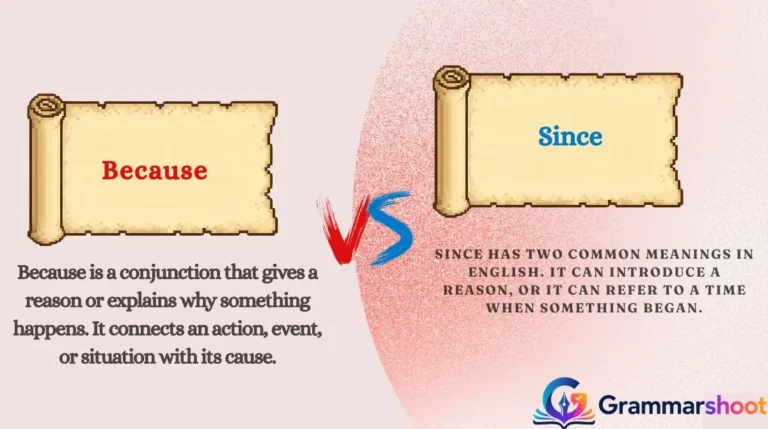
Because is a conjunction that gives a reason or explains why something happens. It connects an action, event, or situation with its cause.
In simple words, use because when you want to answer the question “Why?”
For example:
- Why are you happy?
- Because I passed my exam.
The word because introduces the reason for being happy. It helps the listener understand what caused the feeling.
When Should You Use Because?
Use because when you want to explain a reason clearly. It is especially useful when the reason is important to the main message.
Consider this sentence:
“I took an umbrella because it was raining.”
The main action is taking an umbrella. The reason is the rain. The word because connects these two ideas and makes the relationship clear.
You can use because in everyday conversations, schoolwork, emails, stories, and formal writing. It is a common word that works in almost every type of English.
Grammar Rule for Because
The basic structure is:
Main clause + because + subject + verb
Examples:
- I went to bed early because I was tired.
- She smiled because she heard good news.
- We stayed inside because it was raining.
A clause is a group of words that contains a subject and a verb. In these examples, “I was tired,” “she heard good news,” and “it was raining” are clauses.
You can also put the reason first:
Because + subject + verb, + main clause
Examples:
- Because I was tired, I went to bed early.
- Because she heard good news, she smiled.
- Because it was raining, we stayed inside.
When the because-clause comes first, place a comma after it. When it comes after the main clause, a comma is usually unnecessary.
8 Examples of Because
- I am late because the bus arrived late.
- He is studying because he has an exam tomorrow.
- We canceled the picnic because the weather was bad.
- Sara bought a jacket because it was cold.
- My brother is excited because he got a new phone.
- The baby cried because she was hungry.
- I called the teacher because I needed help.
- They went home early because they felt tired.
Each sentence answers the question “Why?” The word because introduces the cause or reason.
Common Confusion About Because
Some learners think because can only appear at the beginning of a sentence. This is incorrect. It can appear at the beginning or in the middle.
Another common mistake is using because without a complete reason.
For example:
- Incomplete: I stayed home because.
- Correct: I stayed home because I was sick.
The word because normally introduces a clause with a subject and a verb. In informal conversation, people sometimes say only “Because…” as a short answer, but a complete sentence usually needs the reason.
Remember that because focuses directly on the cause of an action or situation.
What Does “Since” Mean?
Since has two common meanings in English. It can introduce a reason, or it can refer to a time when something began.
These meanings are different, so you must use the context of the sentence to understand which meaning is intended.
1. Since as a Word for Giving a Reason
When since gives a reason, it works in a similar way to because. It explains why something happens.
For example:
“Since it was raining, we stayed home.”
The sentence means that we stayed home because it was raining.
However, since often presents the reason as information the speaker expects the listener to know or accept. The reason may be background information rather than the main point of the sentence.
For example:
“Since you are already here, please help me carry these bags.”
The speaker treats the listener’s presence as an existing fact. The main request is to help carry the bags.
2. Since as a Word for Talking About Time
Since can also show when an action or situation started and continued up to a later time.
For example:
“I have lived in this town since 2020.”
This means that I started living in the town in 2020 and still live there now.
In this meaning, since often appears with the present perfect tense, which uses have or has with a past participle.
Examples:
- She has worked here since January.
- I have known him since childhood.
- They have been friends since school.
- It has been raining since morning.
You can also use since with a specific past event.
For example:
“I have felt better since I started exercising.”
The phrase “since I started exercising” identifies the time when the improvement began.
Grammar Rules for Since
When since gives a reason, use this structure:
Since + subject + verb, + main clause
Examples:
- Since it was late, we called a taxi.
- Since you are busy, I will come tomorrow.
- Since the shop was closed, we went somewhere else.
You can also place the since-clause after the main clause:
- We called a taxi since it was late.
- I will come tomorrow since you are busy.
- We went somewhere else since the shop was closed.
When since refers to time, common structures include:
Subject + have/has + past participle + since + starting point
Examples:
- I have lived here since 2019.
- She has worked there since March.
You can also use a clause to describe the starting event:
- I have felt happier since I changed schools.
- He has been more active since he joined the gym.
8 Examples of Since
- Since it was cold, I wore a warm coat. (Reason)
- Since you know the answer, please explain it. (Reason)
- Since we have enough food, we do not need to shop today. (Reason)
- Since the road was blocked, we took another route. (Reason)
- I have lived here since 2021. (Time)
- She has been busy since Monday. (Time)
- We have known each other since childhood. (Time)
- He has felt better since he started resting. (Time)
The first four examples explain reasons. The last four describe a starting point in time or a change that began in the past.
Common Confusion About Since
The biggest problem is that since has more than one meaning.
Look at these sentences:
- Since I was tired, I went to bed.
- I have been tired since I woke up.
In the first sentence, since means “because.” In the second, it means “from the time when.”
Do not choose the meaning based on the word alone. Read the whole sentence and ask yourself what the speaker wants to express.
Difference Between Because and Since (Detailed)
The main difference is that because usually gives a direct, clear reason, while since can give a reason or describe when something began.
When both words express a reason, they can often be used in the same sentence without changing its basic meaning. However, the focus and tone may be slightly different.
Comparison Table
| Feature | Because | Since |
|---|---|---|
| Main use | Gives a reason | Gives a reason or refers to time |
| Meaning as a reason | Directly explains why | Often presents a reason as known or background information |
| Meaning related to time | Does not normally show a starting point | Shows when something started |
| Common question | Why? | Why? or Since when? |
| Grammar | Followed by a clause when used as a conjunction | Followed by a clause when used as a conjunction |
| Sentence position | Beginning or middle | Beginning or middle |
| Formal writing | Common and clear | Common, especially for background reasons and time |
| Example | I left because I was tired. | Since I was tired, I left. |
1. Usage Difference
Use because when the reason needs to be clear or strongly connected to the result.
For example:
“I didn’t attend the meeting because I was ill.”
The speaker clearly explains the reason for missing the meeting. If someone asks why the person was absent, because is a natural choice.
Now consider:
“Since everyone is here, let’s begin the meeting.”
Here, the speaker uses since to introduce a fact that supports the next action. The fact that everyone is present provides the background for beginning the meeting.
You could say “Because everyone is here, let’s begin the meeting,” and the sentence would still be correct. The difference is mainly in emphasis and tone.
2. Grammar Logic
Both words can introduce a dependent clause when they express a reason. A dependent clause has a subject and a verb but does not usually express a complete thought on its own.
For example:
- Because I was hungry…
- Since I was hungry…
These phrases make the reader expect more information. You could complete either one:
- Because I was hungry, I made a sandwich.
- Since I was hungry, I made a sandwich.
The grammar is almost the same. The difference lies in meaning and emphasis, not in a completely different sentence structure.
However, when since refers to time, it follows a different pattern of meaning.
For example:
“I have studied English since 2022.”
Here, since 2022 is a time expression. It tells us the starting point of the study period. Replacing since with because would not preserve the meaning.
3. Sentence Structure Difference
When giving a reason, both words can come before a clause at the beginning or in the middle of a sentence.
Because at the beginning:
“Because the shop was closed, we returned home.”
Since at the beginning:
“Since the shop was closed, we returned home.”
Because in the middle:
“We returned home because the shop was closed.”
Since in the middle:
“We returned home since the shop was closed.”
All four sentences are grammatically correct. When the introductory clause comes first, use a comma to separate it from the main clause. When the reason comes at the end, a comma is generally not needed.
4. Meaning Comparison
Compare these examples:
Example A: “I brought water because the day was hot.”
The sentence highlights the reason for bringing water. The hot weather explains the action.
Example B: “Since the day was hot, I brought water.”
The sentence gives the hot weather as background information and then tells us what the speaker did.
Both sentences express the same basic cause-and-effect relationship. The difference is subtle, and in many everyday situations, the two words are interchangeable.
Now compare a time example:
“I have been waiting since 8 a.m.”
This sentence tells us when the waiting began. You cannot replace since with because without changing or breaking the meaning.
5. When Can You Replace One With the Other?
You can often replace since with because when both words introduce a reason.
For example:
- Since you are tired, you should rest.
- Because you are tired, you should rest.
Both sentences are correct.
However, you cannot always replace since with because when it refers to time.
For example:
- Correct: She has lived here since 2018.
- Incorrect for the intended time meaning: She has lived here because 2018.
The second sentence does not express the intended starting point. This is why understanding the meaning of since is more important than memorizing a simple replacement rule.
Grammar Rules You Must Remember
These four rules will help you use both words correctly in everyday English.
Rule 1: Use Because to Give a Clear Reason
When you want to explain why something happened, because is usually a safe and natural choice.
Examples:
- I missed the bus because I woke up late.
- She is smiling because she received a gift.
- We stayed inside because it was snowing.
Remember: If someone asks “Why?”, because is often the clearest answer.
Rule 2: Use Since to Introduce a Reason or Background Fact
When a reason is already known, easy to understand, or used as background information, since often sounds natural.
Examples:
- Since you have finished your work, you can go home.
- Since it is getting dark, we should leave.
- Since everyone agrees, we can start the project.
These sentences present a fact and then explain what action follows from it.
Rule 3: Use Since for a Starting Point in Time
When you want to show when something began, use since with a time or a clause describing a past event.
Examples:
- I have worked here since 2022.
- She has been awake since six o’clock.
- We have been friends since we were children.
In these examples, since means “from that time until now,” or identifies the point when a continuing situation began.
Rule 4: Use Correct Punctuation
When a reason clause begins with because or since, put a comma after the introductory clause.
Examples:
- Because I was hungry, I made dinner.
- Since it was raining, we stayed home.
When the reason comes after the main clause, a comma is usually unnecessary.
Examples:
- I made dinner because I was hungry.
- We stayed home since it was raining.
This simple punctuation rule will make your writing easier to read.
Common Mistakes Students Make
English learners often make mistakes with these words because their meanings overlap. Some mistakes also happen when learners translate sentences directly from their first language.
Here are the most common problems and how to fix them.
Mistake 1: Thinking Since Always Means Because
Incorrect understanding: “Since” always explains a reason.
Correct understanding: Since can explain a reason or refer to time.
Compare:
- Since I was ill, I stayed home. (Reason)
- I have been ill since Monday. (Time)
Correction tip: Ask whether the sentence answers “Why?” or “Since when?” This question often makes the meaning clear.
Mistake 2: Using Because When Talking About a Starting Time
Incorrect: “I have lived here because 2020.”
Correct: “I have lived here since 2020.”
A year such as 2020 can identify the starting point of a continuing situation. In this sentence, since is the correct word.
Correction tip: Use since before a starting date, day, year, or past event when describing how long something has continued.
Examples:
- since Friday
- since last year
- since I graduated
- since we moved here
Mistake 3: Using Since When Because Is Clearer
Consider this sentence:
“Why did you leave early?”
A natural answer is:
“I left early because I felt sick.”
Using since is also possible in many contexts, but because directly answers the question and makes the reason clear.
Correction tip: When answering a direct question about a cause, choose because unless there is a good reason to use another expression.
Mistake 4: Forgetting the Subject and Verb
Incorrect: “I stayed home because the rain.”
Correct: “I stayed home because it was raining.”
When because introduces a full clause, that clause needs a subject and a verb. “The rain” is a noun phrase, not a complete clause.
However, some short expressions such as “because of the rain” are correct. The phrase because of is followed by a noun or noun phrase rather than a full clause.
Compare:
- We stayed home because it was raining.
- We stayed home because of the rain.
Both sentences are correct, but their grammar is different.
Mistake 5: Forgetting the Comma at the Beginning
Incorrect: “Since I was tired I went to bed.”
Better: “Since I was tired, I went to bed.”
The comma helps separate the introductory clause from the main clause. In short sentences, the meaning may still be clear without it, but using the comma is a good writing habit.
Correction tip: When a sentence begins with a reason clause, check whether you need a comma before the main clause.
Easy Trick to Remember the Difference
Here is a simple way to remember these words without learning complicated grammar terms.
Think of “because” as the direct-reason word and “since” as the two-meaning word.
When you want to answer “Why?”, try because first.
Example:
“Why are you wearing a coat?”
“Because it is cold.”
The answer is clear and direct.
When you use since, ask yourself whether you are giving a reason or talking about time.
Example 1:
“Since it is cold, I am wearing a coat.”
Here, since gives a reason.
Example 2:
“I have worn this coat since last winter.”
Here, since tells us when the situation began.
A second memory trick is to connect since with the phrase “from that time.” If you can replace since with “from the time when” and the sentence still makes sense, it probably has a time meaning.
For example:
“I have known her since we were children.”
This means “I have known her from the time when we were children.”
That trick does not work in the same way for a reason sentence:
“Since we were tired, we went home.”
Here, since means “because,” not “from the time when.”
The easiest habit is to check the meaning before choosing the word.
Daily Life Examples
Real-life sentences make grammar easier to remember. Read these examples aloud and notice whether the word gives a reason or refers to time.
1. Talking About School
Ali: Why didn’t you come to class yesterday?
Sara: I didn’t come because I had a fever.
The word because gives a direct explanation for Sara’s absence.
2. Making Plans
Mina: Should we go for a walk?
Hassan: Since it is raining, let’s stay home.
The speaker uses since to introduce the weather as a reason for staying home.
3. Asking for Help
Teacher: Can you help me carry these books?
Student: Of course. Since I have finished my work, I have time.
The student presents the completed work as background information for offering help.
4. Talking About Work
Manager: How long have you worked at this company?
Employee: I have worked here since 2021.
Here, since identifies the starting year of the employee’s work.
5. Explaining a Late Arrival
Friend: Why are you late?
You: I am late because the traffic was terrible.
The word because clearly explains the reason for arriving late.
6. Discussing Dinner
Mother: Why are you making sandwiches?
Daughter: Because everyone is hungry, and dinner is not ready yet.
The answer explains why the daughter is preparing food.
7. Talking About Friendship
Ayesha: How long have you known your best friend?
Noor: I have known her since we were in primary school.
The word since tells us when the friendship began.
8. Planning a Trip
Brother: Are we leaving now?
Sister: Since everyone is ready, we can leave now.
The fact that everyone is ready supports the decision to leave.
9. Explaining a Phone Call
Friend: Why did you call me last night?
You: I called because I needed your advice.
The word because introduces the reason for making the call.
10. Talking About Learning English
Teacher: Your English has improved a lot. When did you start practicing every day?
Student: I have improved since I started speaking English with my friends.
The word since connects the improvement to the time when regular practice began.
Practice Section: Choose the Correct Word
Test your understanding with these five sentences. Choose because or since for each blank.
- I stayed home ______ I had a headache.
- She has worked at this school ______ 2020.
- ______ you are already here, please help me.
- We canceled the game ______ it was raining heavily.
- I have known him ______ we were children.
Try answering before checking the key below.
Answers and Explanations
- Because — It introduces the reason for staying home.
- Since — It identifies the starting year of her work.
- Since — It introduces a background fact that supports the request. Because could also work, depending on the intended emphasis.
- Because — It gives a clear reason for canceling the game. Since is also grammatically possible.
- Since — It identifies when the friendship or relationship began.
Notice that some sentences allow both words when they express a reason. The time-related sentences require since for the intended meaning.
FAQs
1. What is the main difference between because and since?
Because directly explains why something happens. Since can also introduce a reason, but it often presents that reason as background information. In addition, since can refer to a starting point in time, while because does not normally have that meaning.
2. Can because and since be used in the same sentence?
Yes. When both words introduce a reason, they can often replace each other without changing the basic meaning. For example, “Because it was late, we left” and “Since it was late, we left” are both correct. The best choice depends on the emphasis and context.
3. Can we use because and since in questions?
Yes, both words can appear in questions or in answers to questions. For example, you can ask, “Have you been here since Monday?” You can also ask, “Did you leave because you were tired?” The meaning depends on whether since refers to time or introduces a reason.
4. Is because more formal than since?
Neither word is always more formal than the other. Both are common in speaking and writing. Because is often a clear choice when explaining a reason, while since is frequently used to introduce background information or a starting time.
5. Does since always mean because?
No. Since has two common meanings. It can introduce a reason, as in “Since it was cold, I wore a coat.” It can also refer to time, as in “I have lived here since 2020.” You must look at the whole sentence to understand its meaning.
6. Can I start a sentence with because or since?
Yes. Both words can begin a sentence when they introduce a dependent clause. For example, “Because I was tired, I went to bed” and “Since I was tired, I went to bed” are correct. When the introductory clause comes first, use a comma before the main clause.
Conclusion
Understanding the difference between because and since is easier when you focus on what each word means in a sentence. Both can introduce a reason, and in many situations, they can be used interchangeably. However, because is often the clearest choice when you want to explain why something happened.
Since has an extra use that makes it different. It can refer to the time when an action or situation began, as in “I have lived here since 2020.” In this case, replacing it with because would not express the same meaning.
Remember these simple points: use because for a direct reason, use since for a reason or a starting point in time, and check the full sentence before making your choice. Pay attention to these words when you read books, watch videos, or talk with other English speakers.
You do not need to memorize every example. Start by writing a few sentences of your own each day. With regular practice, choosing the correct word will become easier, and your English will sound more natural and confident.

Evan Rellmont is a writer who turns thoughtful ideas into meaningful words, creating stories and reflections that connect, inspire, and leave a lasting impression.