
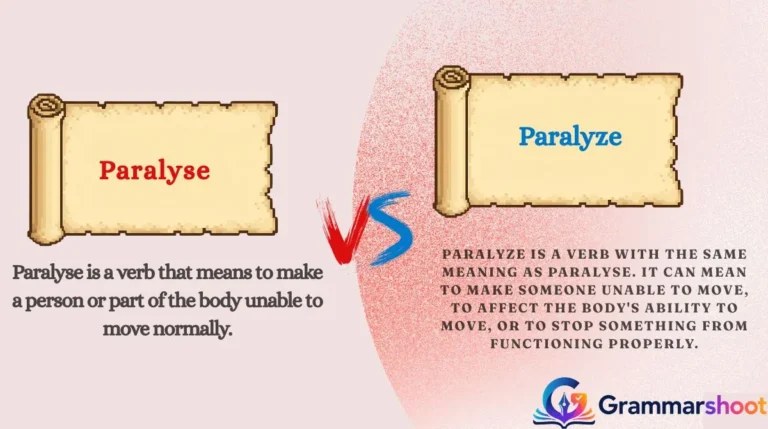
The main difference between paralyse and paralyze is their spelling, not their meaning.
Both words mean to make someone unable to move or to stop something from working normally.
Paralyse is the standard spelling in British English, while paralyze is the standard spelling in American English.
Have you ever written a word in an English assignment and then seen it spelled differently on a website? You may have experienced this with words such as colour and color, centre and center, or paralyse and paralyze.
These differences can make English spelling feel confusing, especially when you are learning the language.
The good news is that you do not need to learn two different meanings for these words. The difference between the two spellings comes from the type of English being used.
British English generally uses paralyse, while American English generally uses paralyze. Both spellings are correct in their respective varieties of English.
This difference matters when you write school assignments, prepare for English exams, create website content, or communicate with people from different countries.
Choosing the spelling that matches your audience can make your writing look more natural and consistent.
Another useful point is that both words have the same grammatical forms and follow the same basic rules.
You can use them as verbs, change them into past-tense forms, and use related words such as paralysis and paralyzed.
By the end of this guide, you will understand what each spelling means, when to use it, how it changes in different sentences, and which common mistakes to avoid. You will also practise choosing the right spelling in everyday situations.
What Does “Paralyse” Mean?
Paralyse is a verb that means to make a person or part of the body unable to move normally. It can also mean to stop an activity, system, or organisation from working effectively.
This is the usual spelling in British English and in many other varieties of English that follow British spelling rules.
When should you use “Paralyse”?
Use paralyse when writing for a British English audience or when following a British English style guide. You may see it in British books, newspapers, school materials, and websites.
The word can describe a physical condition, but it also has a figurative meaning. For example, fear can paralyse a person when it makes them unable to act or make a decision.
Consider these examples:
- The injury could paralyse his legs.
- The disease may paralyse certain muscles.
- Fear can paralyse people during an emergency.
- The sudden news seemed to paralyse the entire team.
- The computer failure could paralyse the company’s operations.
- Heavy snowfall may paralyse traffic across the city.
- She was so frightened that she felt unable to move, as if fear had paralysed her.
- The strike threatened to paralyse public transport.
Notice that the word does not always describe a medical condition. In the last few examples, it means to prevent normal activity or action.
What is the grammar rule for “Paralyse”?
Paralyse is a regular verb. This means you can form its past tense and past participle by adding -d because the word already ends in e.
- Base form: paralyse
- Third-person singular: paralyses
- Present participle: paralysing
- Past tense: paralysed
- Past participle: paralysed
Examples:
- The illness paralyses his muscles.
- The fear is paralysing her.
- The accident paralysed his arm.
- He has been paralysed since the injury.
One important detail is the third-person singular form. We write paralyses when the subject is he, she, it, or a singular noun in the present simple tense.
For example, “Fear paralyses him” is correct. The verb agrees with the singular subject fear.
Common confusion about “Paralyse”
Some learners think paralyse is a misspelling because they have mainly read American English. Others believe it is a completely different word from paralyze.
Neither idea is correct. Paralyse is a recognised spelling used in British English. Its meaning and grammar are the same as those of paralyze.
Also, do not confuse paralyse with paralysis. The first is a verb, while the second is a noun.
- Correct: Fear can paralyse a person.
- Correct: The condition caused temporary paralysis.
The spelling depends on the word’s role in the sentence as well as the variety of English you are using.
What Does “Paralyze” Mean?
Paralyze is a verb with the same meaning as paralyse. It can mean to make someone unable to move, to affect the body’s ability to move, or to stop something from functioning properly.
The main difference is that paralyze is the standard spelling in American English.
When should you use “Paralyze”?
Use paralyze when writing in American English. This spelling is common in American newspapers, books, educational materials, business writing, and online content produced for a US audience.
Like its British counterpart, it can describe physical movement or an inability to act.
For example:
- The disease may paralyze some of the body’s muscles.
- The accident could paralyze his right arm.
- Fear can paralyze someone before an important speech.
- The power failure paralyzed the airport for several hours.
- The storm threatened to paralyze traffic throughout the region.
- Worry can sometimes paralyze people when they must make a difficult choice.
- The computer virus paralyzed the company’s network.
- The unexpected problem nearly paralyzed the entire project.
All these sentences use the American spelling. If you are writing in British English, you would normally replace paralyze with paralyse and adjust the related forms where needed.
What is the grammar rule for “Paralyze”?
Paralyze is also a regular verb. However, because its base form ends in -y after a consonant, its spelling changes in some forms.
Here are its common forms:
- Base form: paralyze
- Third-person singular: paralyzes
- Present participle: paralyzing
- Past tense: paralyzed
- Past participle: paralyzed
Examples:
- The condition paralyzes his legs.
- The situation is paralyzing her with fear.
- The accident paralyzed his left side.
- The illness has paralyzed several muscles.
The spelling change follows a common English rule: when a verb ends in a consonant followed by y, the y usually changes to i before adding -es or -ed. However, it stays as y before -ing.
That is why we write paralyzes, paralyzed, and paralyzing.
Common confusion about “Paralyze”
Some learners use paralyze in British writing because they see it frequently on the internet. Others try to write paralyzation when they need a noun.
Although paralyzation exists, paralysis is often the more familiar noun for the medical condition. The best choice depends on the sentence and the intended meaning.
Remember that paralyze is not more correct than paralyse. It is simply the standard American spelling. Both forms are accepted, but they belong to different spelling conventions.
Difference Between Paralyse and Paralyze (Detailed)
The easiest way to understand the difference is to remember that both words have the same meaning, but their spelling follows different regional conventions.
A British writer will usually choose paralyse, while an American writer will usually choose paralyze. Neither spelling is wrong when it is used according to the relevant English variety.
Comparison table
| Feature | Paralyse | Paralyze |
|---|---|---|
| Main variety | British English | American English |
| Part of speech | Verb | Verb |
| Basic meaning | To stop normal movement or activity | To stop normal movement or activity |
| Present tense | paralyse | paralyze |
| Third-person singular | paralyses | paralyzes |
| Present participle | paralysing | paralyzing |
| Past tense | paralysed | paralyzed |
| Past participle | paralysed | paralyzed |
| Example | Fear can paralyse him. | Fear can paralyze him. |
The sentences in the last row mean exactly the same thing. Only the spelling changes.
1. Difference in spelling
The most noticeable difference is the letter s in paralyse and the letter z in paralyze.
British English commonly uses -ise in words such as organise, realise, and paralyse. American English commonly uses -ize in organize, realize, and paralyze.
However, spelling conventions are not always as simple as one letter changing. Some British dictionaries and publications also accept -ize spellings in certain words. For this particular word, paralyse is the usual British form, while paralyze is the usual American form.
2. Difference in meaning
There is no basic difference in meaning between the two spellings.
Compare these sentences:
- British English: The shock paralysed him.
- American English: The shock paralyzed him.
Both sentences say that the shock made him unable to move or act normally. The context tells you whether the word is being used physically or figuratively.
For example, a medical condition may paralyse or paralyze a person’s muscles. In another situation, fear may paralyse or paralyze someone by making it difficult for them to respond.
3. Difference in pronunciation
The two spellings are generally pronounced the same way in ordinary British and American English speech, although accents can affect the exact sound.
Changing the s to a z in the spelling does not mean that you must pronounce the words differently. The main distinction is written, not a difference in meaning or a separate pronunciation rule.
If you are learning English, focus on recognising the two spellings and using the appropriate one in your writing.
4. Difference in sentence structure
Both words follow the same grammatical patterns because they are forms of the same verb.
You can use either one after a modal verb such as can, could, may, or might:
- British: The illness could paralyse him.
- American: The illness could paralyze him.
You can also use the verb in the past tense:
- British: The accident paralysed his leg.
- American: The accident paralyzed his leg.
The basic sentence structure does not change. The subject, verb position, and other parts of the sentence remain the same.
5. Difference in formal and informal writing
Neither spelling is more formal than the other. Both are suitable for formal and informal writing when they match the chosen variety of English.
For example, a British university assignment should generally follow British spelling conventions. An American business report should generally follow American conventions.
The important point is consistency. If you use paralyse, you would normally also write paralysed and paralysing. If you use paralyze, you would normally write paralyzed and paralyzing.
Mixing these forms without a reason can make your writing look inconsistent, even when each individual spelling is recognised.
Grammar Rules You Must Remember
Understanding the spelling difference is easier when you learn a few simple grammar rules. These rules will help you use both forms correctly in everyday sentences.
Rule 1: Match the spelling to your English variety
Use paralyse for standard British English and paralyze for standard American English.
Examples:
- British: The fear paralysed the child.
- American: The fear paralyzed the child.
Remember: Choose the spelling that suits your audience or the style guide you are following.
Rule 2: Add the correct ending for the present simple tense
When the subject is he, she, it, or a singular noun, the present simple verb normally takes -s or -es.
With these words, the third-person singular forms are paralyses and paralyzes.
Examples:
- British: Fear paralyses him.
- American: Fear paralyzes him.
Do not write “Fear paralyse him” or “Fear paralyze him” when you are using the present simple with this singular subject.
However, after I, you, we, or they, use the base form.
- I fear that the problem may paralyse the team.
- They fear that the problem may paralyze the team.
Rule 3: Use the correct past-tense spelling
The British form becomes paralysed, while the American form becomes paralyzed.
Examples:
- British: The breakdown paralysed the railway network.
- American: The breakdown paralyzed the railway network.
Both are regular past-tense forms. You do not need to memorise an unrelated past-tense word.
The same forms are used as past participles with helping verbs:
- British: The system has been paralysed.
- American: The system has been paralyzed.
Rule 4: Keep the present participle consistent
The form ending in -ing is paralysing in British English and paralyzing in American English.
Examples:
- British: The delay is paralysing the service.
- American: The delay is paralyzing the service.
Use this form after helping verbs such as is, are, was, and were when you need a continuous tense. It can also act as a descriptive word in some sentences.
The main lesson is simple: the spelling convention affects the related verb forms, too. Do not change just the base word and forget its other forms.
Common Mistakes Students Make
Learners often make spelling mistakes because they read different varieties of English. They may study from a British textbook but read American websites, videos, or social media posts every day.
That is completely understandable. The solution is not to memorise one spelling as right and the other as wrong. It is to understand when each form is normally used.
Mistake 1: Calling “Paralyse” incorrect
Incorrect claim: “Paralyse is always a spelling mistake.”
Correct explanation: Paralyse is the standard British spelling.
For example:
- British English: The illness may paralyse the muscles.
- American English: The illness may paralyze the muscles.
Correction tip: Check which English variety you are using before correcting someone’s spelling.
Mistake 2: Mixing British and American forms
Inconsistent sentence: “The accident paralyzed him, and he is still paralysed.”
More consistent British version: “The accident paralysed him, and he is still paralysed.”
More consistent American version: “The accident paralyzed him, and he is still paralyzed.”
Correction tip: When you choose a spelling style, check the base form, past form, and -ing form together.
Mistake 3: Forgetting the third-person singular ending
Incorrect: “Fear paralyse him.”
Correct British English: “Fear paralyses him.”
Correct American English: “Fear paralyzes him.”
Why does this happen? Learners sometimes remember the base form but forget that a singular subject in the present simple needs a different verb form.
Correction tip: Ask yourself who or what performs the action. If the subject is singular and in the third person, check whether the verb needs -s or -es.
Mistake 4: Using the base form after “has”
Incorrect: “The disease has paralyse his muscles.”
Correct British English: “The disease has paralysed his muscles.”
Correct American English: “The disease has paralyzed his muscles.”
Correction tip: After has or have in the present perfect tense, use the past participle, not the base form.
Mistake 5: Thinking the word only describes physical movement
Sentence: “Fear paralysed her during the interview.”
This does not necessarily mean that her body was medically unable to move. It may mean she became so nervous that she could not answer questions or act confidently.
Correction tip: Look at the context. The word can describe physical inability, but it can also describe something that prevents action or progress.
Mistake 6: Changing the spelling without checking the whole sentence
A learner may replace paralyse with paralyze but leave paralysing elsewhere in the same American English paragraph.
Correction tip: Review related spellings together. British English generally uses paralyse, paralysed, and paralysing. American English generally uses paralyze, paralyzed, and paralyzing.
Easy Trick to Remember the Difference
Here is a simple trick you can use whenever you are unsure which spelling to choose.
Think of the country or audience before you think about the word.
- Paralyse = British English
- Paralyze = American English
You can also remember the spelling pattern through familiar examples:
| British English | American English |
|---|---|
| organise | organize |
| realise | realize |
| paralyse | paralyze |
| paralysed | paralyzed |
| paralysing | paralyzing |
These examples show a common spelling pattern. They do not mean that every British word ending in -ise must always use -ise, because some words have different conventions.
A real-life memory trick
Imagine you are writing a school assignment for a teacher who expects British English. You would normally write:
“The sudden news paralysed the whole team.”
Now imagine you are writing an article for an American audience. You would normally write:
“The sudden news paralyzed the whole team.”
The message is the same. Only the spelling changes to suit the audience.
You do not need to learn two definitions or two sets of grammar rules. Learn one meaning, then remember the spelling convention.
If you still feel confused, check the dictionary or style guide used by your school, workplace, or website. Following one clear standard is usually more helpful than trying to decide which spelling is universally better.
Daily Life Examples of Paralyse and Paralyze
These examples show how the two spellings can appear in natural English. The British examples use British spelling, while the American examples use American spelling.
1. Talking about fear
British English
A: Why didn’t you speak during the meeting?
B: I was so nervous that fear paralysed me.
American English
A: Why didn’t you speak during the meeting?
B: I was so nervous that fear paralyzed me.
Here, the word describes how fear stopped someone from acting confidently.
2. Talking about a traffic problem
British English: The heavy snow paralysed traffic across the city.
American English: The heavy snow paralyzed traffic across the city.
In this example, traffic was severely disrupted. The roads did not literally become unable to move; the word describes a serious interruption.
3. Talking about a computer system
British English: The computer failure paralysed our office for two hours.
American English: The computer failure paralyzed our office for two hours.
The word means that the office could not work normally because its computer system had stopped functioning.
4. Talking about a difficult decision
British English: Too many choices can paralyse you.
American English: Too many choices can paralyze you.
Both sentences describe a situation in which someone finds it so difficult to choose that they do nothing.
5. Talking about an injury
British English: The injury could paralyse his arm.
American English: The injury could paralyze his arm.
This example uses the physical meaning of the verb. It describes the possibility that an injury could prevent normal movement.
6. Talking about a public service
British English: The workers’ strike may paralyse public transport.
American English: The workers’ strike may paralyze public transportation.
The sentence means that the strike may stop or seriously disrupt the service.
7. Talking about an important exam
British English: Don’t let fear paralyse you before your exam.
American English: Don’t let fear paralyze you before your exam.
This is advice to a student who feels nervous. The word is used figuratively to describe fear that prevents someone from taking action.
8. Talking about a business
British English: A sudden shortage of supplies paralysed production.
American English: A sudden shortage of supplies paralyzed production.
The shortage stopped the business from producing goods as usual.
9. Talking about worry
British English: Constant worry was paralysing her.
American English: Constant worry was paralyzing her.
The continuous form describes something that was affecting her ability to act over a period of time.
10. Talking about a technical problem
British English: The network has been paralysed since this morning.
American English: The network has been paralyzed since this morning.
The present perfect passive construction tells us that the network stopped functioning earlier and remains affected now.
These examples demonstrate that the choice of spelling depends on the English variety, not the situation. You can discuss fear, injuries, traffic, business, or technology with either spelling.
Practice Section: Choose the Correct Spelling
Test your understanding with these five short questions. Choose the spelling that best matches the English variety mentioned in each sentence.
1. Which spelling is standard in British English?ParalyzeParalyse
2. Which spelling is standard in American English?ParalyseParalyze
3. Choose the British past-tense form.ParalyzedParalysed
4. Choose the American -ing form.ParalysingParalyzing
5. Complete the American English sentence: Fear ___ him.paralyzeparalyzes
0 of 5 answeredTry again
Review any question you missed. The most important point is to recognise the spelling convention and use the correct verb form for the sentence.
FAQs
1. What is the difference between paralyse and paralyze?
Both words have the same meaning: to make someone unable to move normally or to stop something from working effectively. Paralyse is the usual British English spelling, while paralyze is the usual American English spelling. The difference is mainly regional spelling.
2. Is paralyse correct in British English?
Yes, paralyse is the standard spelling in British English. It is commonly used in British writing, including books, newspapers, and educational materials. Its related forms include paralyses, paralysed, and paralysing.
3. Is paralyze correct in American English?
Yes, paralyze is the standard American English spelling. American writers normally use paralyzed for the past tense and past participle, and paralyzing for the present participle. These forms follow common American spelling conventions.
4. Do paralyse and paralyze have different meanings?
No, they do not have different basic meanings. Both can describe the loss of movement or the stopping of normal activity. For example, fear can paralyse or paralyze someone by preventing them from acting. The spelling changes, but the meaning remains the same.
5. Can I use paralyse in American English writing?
You may encounter paralyse in American writing, especially when a writer is following British spelling conventions or quoting British material. However, paralyze is the normal choice for standard American English. For consistent writing, follow the spelling rules required by your audience or style guide.
6. What is the noun form of paralyse and paralyze?
The most common noun for the medical condition is paralysis. It refers to the loss of the ability to move part or all of the body. For example, “The injury caused paralysis in his legs.” The noun paralysis is spelled the same way in standard British and American English.
Conclusion
The difference between paralyse and paralyze is simple once you understand British and American spelling conventions. Both words are verbs, and both mean to make someone unable to move normally or to stop something from working as it should.
Use paralyse when following standard British English spelling. Use paralyze when following standard American English spelling. Remember that the difference continues in related forms: British English generally uses paralysed and paralysing, while American English uses paralyzed and paralyzing.
Neither spelling is universally better or more correct than the other. What matters is choosing the form that suits your audience and using it consistently throughout your writing.
A good way to improve is to practise with short sentences, read English materials from your preferred variety, and check a trusted dictionary when you are unsure. With regular practice, you will recognise these spelling differences more easily and feel more confident when writing in English.
Keep practising, and remember: the spelling may change, but the meaning stays the same!

Evan Rellmont is a writer who turns thoughtful ideas into meaningful words, creating stories and reflections that connect, inspire, and leave a lasting impression.