
English has many words that look almost the same but are used in different ways. Sometimes, the only difference is one small letter at the end of a word.
However, that letter can change how we use the word in a sentence. “Multiple” and “multiples” are good examples of this.
Many English learners feel confused when choosing between these two words. Should you say “multiple choices” or “multiples choices”? Is “multiples” always the plural form of “multiple”? Can both words be used when talking about numbers, people, or things?
These are common questions, especially for beginners and students who want to improve their writing and speaking skills.
The good news is that the difference is easier than it may seem. In most situations, multiple describes something that includes more than one item, while multiples refers to numbers that can be divided evenly by a particular number.
The plural form can also refer to more than one thing called a multiple in a suitable context.
For example, you can say, “I have multiple reasons for leaving early.” Here, multiple describes the word reasons.
However, in mathematics, you might say, “12 and 18 are multiples of 6.” In this sentence, multiples is a noun referring to numbers.
Understanding this difference will help you avoid common grammar mistakes and choose the correct word with confidence.
What Does “Multiple” Mean?
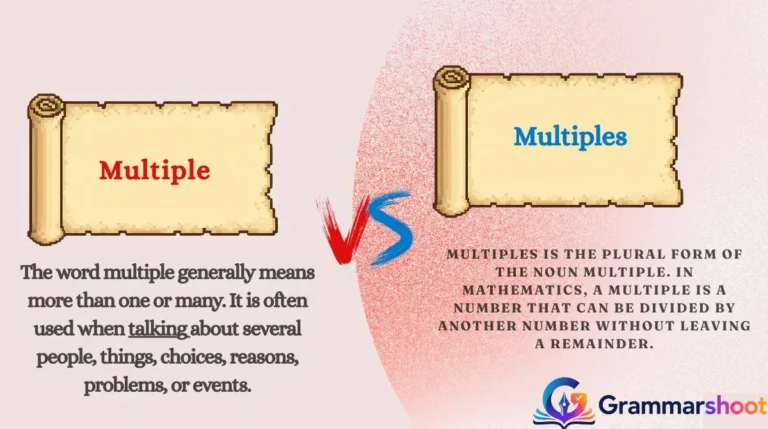
The word multiple generally means more than one or many. It is often used when talking about several people, things, choices, reasons, problems, or events.
In everyday English, multiple is most commonly used as an adjective. An adjective describes a noun, so it gives us more information about a person, place, thing, or idea.
For example:
- She has multiple responsibilities at work.
- We received multiple complaints from customers.
- The teacher gave us multiple examples.
- He has multiple reasons for changing his job.
In each sentence, multiple describes a noun. It tells us that there is more than one responsibility, complaint, example, or reason.
When Should You Use “Multiple”?
Use multiple when you want to describe several items or more than one occurrence of something.
It is especially common in formal writing, professional communication, education, science, and technology. However, people also use it in everyday conversations.
Consider this example:
“I have multiple questions about the homework.”
This means the speaker has more than one question. The exact number is not given.
You could also say, “I have several questions about the homework.” Both sentences are correct, although multiple can sound slightly more formal in some situations.
Loosing vs Losing: What’s the Difference? Easy Guide for 2026
Fourty or Forty: Which Spelling Is Correct in 2026?
Pick up vs Pickup: Meaning, Difference, Rules & Examples (2026)
Cubical vs Cubicle: What’s the Difference? (2026 Guide)
Latter or Ladder: Meaning, Difference, Examples & Easy Trick (2026)v
Excel vs Accel: What’s the Difference? [2026 Grammar Guide]
In Route or En Route? Meaning, Difference, Examples & Correct Usage in 2026
Momma or Mama: Which Is Correct? Meaning, Difference & Usage in 2026
Hustle or Hussle? Which Is Correct in 2026? Meaning, Spelling & Examples
Cacoon or Cocoon: Which Spelling Is Correct in 2026?
Grammar Rule for “Multiple”
When multiple is used as an adjective, it usually comes before a plural countable noun.
Basic structure:
Multiple + plural noun
Examples:
- Multiple students attended the meeting.
- Multiple problems occurred during the test.
- Multiple cars were parked outside.
- Multiple options are available.
Notice that the nouns students, problems, cars, and options are plural.
In ordinary usage, we do not normally say “multiple student” when we mean more than one student. We say “multiple students.”
However, multiple can also appear in other grammatical structures. For example, “The amount was multiplied by three” uses a different word form, while “a multiple of five” uses multiple as a noun.
8 Example Sentences Using “Multiple”
Here are eight simple examples that show how to use this word correctly.
1. I have multiple books in my school bag. The speaker has more than one book.
2. She applied for multiple jobs last week. She applied for several jobs.
3. The phone has multiple useful features. The phone offers several features.
4. We visited multiple places during our holiday. We visited more than one place.
5. The teacher explained the topic using multiple examples. The teacher used several examples to make the topic clear.
6. He made multiple mistakes in his assignment. He made more than one mistake.
7. You can choose from multiple options. Several choices are available.
8. The company operates in multiple countries. The company works in more than one country.
Common Learner Confusion About “Multiple”
One common mistake is assuming that multiple must always be followed by a singular noun. This is usually incorrect when the noun is countable.
For example:
- Incorrect: She has multiple friend.
- Correct: She has multiple friends.
Another confusion occurs because multiple can also be a noun.
For example:
“Twenty is a multiple of five.”
Here, multiple does not describe another noun. It names a mathematical relationship between numbers.
This is why understanding the sentence matters. You should not choose a word simply because it looks familiar. Look at how it works in the sentence.
What Does “Multiples” Mean?
Multiples is the plural form of the noun multiple. In mathematics, a multiple is a number that can be divided by another number without leaving a remainder.
For example, 10 is a multiple of 5 because 10 divided by 5 equals 2, with no remainder.
Similarly, 15, 20, and 25 are also multiples of 5.
When we talk about more than one of these numbers, we use the plural word multiples.
For example:
“10, 15, 20, and 25 are multiples of 5.”
This sentence tells us that all four numbers can be divided evenly by 5.
When Should You Use “Multiples”?
Use multiples when you are talking about two or more numbers that share a mathematical relationship with another number.
This word is particularly common in mathematics lessons, school assignments, number patterns, and arithmetic problems.
For example:
- The multiples of 3 include 3, 6, 9, and 12.
- Find the first five multiples of 7.
- Both 24 and 36 are multiples of 12.
- The teacher asked us to write the multiples of 4.
The word can also be used outside mathematics when referring to several individual items or values described as multiples.
For example, “The report discusses different multiples used to value businesses.” In finance, multiples can refer to valuation ratios, such as a price-to-earnings multiple.
However, for everyday English learners, the mathematical meaning is the most important one to understand first.
Grammar Rule for “Multiples”
When multiples is used as a noun, it can be the subject or object of a sentence.
Basic structure:
Plural noun + verb
Examples:
- Multiples of 2 are easy to identify.
- These numbers are multiples of 4.
- We learned about multiples in class.
- The students found the multiples of 6.
Because multiples is plural, it usually takes a plural verb in the present tense.
For example:
- Correct: Multiples of 5 are easy to find.
- Incorrect: Multiples of 5 is easy to find.
Compare this with the singular form:
– A multiple of 5 is easy to identify.
The verb changes because a multiple is singular, while multiples is plural.
How Do You Find Multiples?
Finding multiples is simple. You multiply a number by 1, 2, 3, 4, and so on.
For example, to find multiples of 4:
- 4 × 1 = 4
- 4 × 2 = 8
- 4 × 3 = 12
- 4 × 4 = 16
- 4 × 5 = 20
Therefore, 4, 8, 12, 16, and 20 are multiples of 4.
The list continues because you can keep multiplying 4 by larger whole numbers.
This mathematical idea explains why multiples is often used in number-related sentences rather than as a simple replacement for the adjective multiple.
8 Example Sentences Using “Multiples”
1. Six and twelve are multiples of three. Both numbers can be divided evenly by three.
2. The teacher asked us to list the multiples of eight. Students must write numbers such as 8, 16, 24, and 32.
3. Twenty-five and fifty are multiples of five. Both numbers are divisible by five.
4. I learned about multiples in my mathematics class. The student studied the topic of multiples.
5. The first four positive multiples of six are 6, 12, 18, and 24. These numbers come from multiplying six by one, two, three, and four.
6. Common multiples of four and six include 12 and 24. Both numbers are multiples of four and six.
7. All these numbers are multiples of ten. Each number can be divided evenly by ten.
8. Please find three multiples of nine. The speaker asks for three numbers from the multiples of nine.
Common Learner Confusion About “Multiples”
The main confusion is thinking that multiples can replace multiple in every sentence.
For example:
- Incorrect: We have multiples choices.
- Correct: We have multiple choices.
Why? Because multiple is an adjective describing choices. The speaker means that several choices are available.
Now consider this sentence:
– Correct: Twelve and eighteen are multiples of six.
Here, multiples is correct because it refers to two numbers.
Remember that the letter s does not simply mean “more things” in every sentence. It changes the grammatical form of the word, and the correct form depends on the meaning and sentence structure.
Ignitor vs Igniter: Which Spelling Is Correct in 2026?
Addition vs Edition: What’s the Difference? Easy Guide for 2026
Forward vs Forwards: Difference, Meaning, and Correct Usage in 2026
Allude vs Elude: What’s the Difference? Easy Guide for 2026
Inclosed vs Enclosed: Which Spelling Is Correct in 2026?
Miner vs Minor: What’s the Difference? Easy Guide With Examples (2026)
Hayday or Heyday: Which Is Correct? Meaning, Difference, and Examples in 2026
Sueing or Suing? Which Spelling Is Correct in 2026?
Inter vs Intra: Simple Difference, Meaning, Rules, and Examples (2026)
Difference Between Multiple and Multiples (Detailed)
The main difference is that multiple is usually an adjective meaning “more than one,” while multiples is usually a plural noun referring to numbers or other things described as multiples.
Although the two words are related, they do not always perform the same job in a sentence.
Comparison Table
| Feature | Multiple | Multiples |
|---|---|---|
| Common grammatical role | Adjective | Plural noun |
| Main everyday meaning | More than one | More than one mathematical multiple |
| Common use | Describing several items | Naming several numbers or values |
| Example | Multiple students arrived. | 12 and 18 are multiples of 6. |
| Noun or adjective? | Usually an adjective | Usually a noun |
| Verb agreement when used as a subject | Depends on the noun it describes | Usually takes a plural verb |
| Common setting | Daily English, work, education | Mathematics, science, finance |
| Singular form | Multiple | Multiple |
1. Difference in Meaning
The word multiple tells us that something involves more than one person or thing.
For example:
“Multiple people called me yesterday.”
This means more than one person called the speaker.
The word multiples, on the other hand, commonly identifies numbers related to another number through multiplication.
For example:
“Six, twelve, and eighteen are multiples of six.”
These numbers are all divisible by six without a remainder.
The difference is not simply that one word has an s and the other does not. The meaning and grammatical role also matter.
2. Difference in Usage
Use multiple before a noun when you want to describe several things.
Examples:
- Multiple students joined the club.
- Multiple answers may be correct.
- Multiple buses arrived late.
Use multiples when you want to refer to several mathematical multiples.
Examples:
- Write the multiples of seven.
- Thirty and forty-five are multiples of fifteen.
- We found three common multiples.
Compare these two sentences:
Sentence A: We have multiple options.
Sentence B: Twelve and twenty-four are multiples of six.
Sentence A uses multiple to describe options. Sentence B uses multiples as a noun to describe the relationship between numbers.
3. Difference in Grammar
Grammar explains why the words cannot always be exchanged.
In “multiple options,” the word multiple modifies the noun options. The noun is plural because the sentence refers to more than one option.
In “the multiples of six,” the word multiples is itself the noun. It can be the subject or object of the sentence.
For example:
- Subject: Multiples of ten are easy to recognize.
- Object: I wrote five multiples of ten.
The word can also appear after a linking verb:
“Twenty and thirty are multiples of ten.”
In this sentence, multiples follows the verb are and identifies what the numbers are.
4. Difference in Sentence Structure
The sentence structure often helps you choose the correct word.
Structure A: Multiple + plural noun
- Multiple students passed the exam.
- Multiple questions were asked.
- Multiple reasons explain the decision.
Structure B: Numbers + are + multiples of + number
- 8 and 16 are multiples of 8.
- 15 and 30 are multiples of 15.
- 21 and 42 are multiples of 7.
Notice that the first structure describes people or things, while the second identifies numbers.
There is another correct structure:
“Twenty is a multiple of five.”
Here, multiple is a singular noun because the sentence identifies one number as a multiple of another number.
This example is important because it shows that multiple is not always an adjective.
5. Can “Multiple” Be a Noun?
Yes. Although it is commonly used as an adjective, multiple can also be a noun.
In mathematics, a number that is evenly divisible by another number is called a multiple of that number.
For example:
“Twenty-four is a multiple of eight.”
Here, multiple is a singular noun.
Its plural form is multiples:
“Twenty-four and thirty-two are multiples of eight.”
Therefore, the relationship is similar to many other singular and plural nouns in English.
- One student → two students
- One book → three books
- One multiple → several multiples
The important point is that multiple can have more than one grammatical role. You need to understand the sentence before deciding which form is correct.
Grammar Rules You Must Remember
Learning a few basic rules will help you use both words naturally.
Rule 1: Use “Multiple” Before a Plural Countable Noun
When multiple means “more than one,” it normally describes a plural countable noun.
Examples:
- Correct: I have multiple assignments.
- Incorrect: I have multiples assignments.
The word assignments is already plural. You do not add an s to multiple when using it as an adjective.
More examples:
- Multiple students attended the event.
- Multiple cars were parked outside.
- Multiple problems need attention.
Rule 2: Use “Multiples” for More Than One Mathematical Multiple
When you are discussing several numbers that are divisible by another number without a remainder, use multiples.
Examples:
- 6, 12, and 18 are multiples of 6.
- The multiples of 4 include 4, 8, 12, and 16.
- Find the first six multiples of 9.
This rule is especially useful in school mathematics and number-related questions.
Rule 3: Match the Verb to the Singular or Plural Noun
When multiple is a singular noun, use a singular verb. When multiples is a plural noun, use a plural verb.
Examples:
- Twenty is a multiple of five.
- Twenty and thirty are multiples of ten.
The first sentence refers to one number, so it uses is. The second refers to two numbers, so it uses are.
Do not let the word multiple confuse you. Always identify the subject and check whether it is singular or plural.
Rule 4: Do Not Add “-s” Just Because the Noun Is Plural
A common mistake is making both the adjective and the noun plural.
For example:
- Incorrect: The company offers multiples services.
- Correct: The company offers multiple services.
In the correct sentence, multiple describes the plural noun services. It does not need an additional s.
However, if you are referring to several mathematical multiples, the plural form is correct:
“The teacher explained the multiples of twelve.”
Skull or Scull? Meaning, Difference, Examples & Grammar Guide 2026
Contractor vs Contracter (2026): Which Spelling Is Correct and Why?
Free Rein or Free Reign? The Correct Choice Explained in Simple English (2026)
Layed or Laid? Which Is Correct? Meaning, Grammar Rules, Examples, and Easy Tips for 2026
Set or Sit? Easy Grammar Rules, Examples, and Differences in 2026
Brake vs Break: Meaning, Difference, Rules, and Examples (2026)
Make Due or Make Do? Correct Usage, Meaning, and Examples in 2026
Tying or Tieing? Which Spelling Is Correct in 2026?
Peace or Piece: Meaning, Difference, Examples, and Easy Rules in 2026
Common Mistakes Students Make
English learners often make mistakes with these words because they focus on the spelling instead of the role each word plays in the sentence.
Here are some common errors and easy ways to correct them.
Mistake 1: Writing “Multiples Choices”
Incorrect: We have multiples choices.
Correct: We have multiple choices.
Why is it wrong?
The speaker wants to say that several choices are available. In this sentence, multiple describes the noun choices, so it stays in its adjective form.
Easy tip: If the word comes directly before a noun and means “several,” try using multiple.
Mistake 2: Using “Multiple” Instead of “Multiples” in Mathematics
Incorrect: Twelve and twenty-four are multiple of six.
Correct: Twelve and twenty-four are multiples of six.
Why is it wrong?
The sentence identifies two numbers as multiples of six. Because more than one number is being described, the plural noun multiples is appropriate.
Easy tip: If you are naming several mathematical multiples, use the plural form.
Mistake 3: Using the Wrong Verb
Incorrect: Multiples of five is easy to find.
Correct: Multiples of five are easy to find.
Why is it wrong?
The subject multiples is plural. Therefore, it normally takes the plural verb are.
Easy tip: Ask yourself, “Am I talking about one multiple or several multiples?”
- One multiple is easy to find.
- Several multiples are easy to find.
Mistake 4: Thinking “Multiple” Is Always an Adjective
Incorrect explanation: The word multiple can never be a noun.
Correct explanation: Multiple is commonly an adjective, but it can also be a noun.
For example, “Thirty is a multiple of ten” is grammatically correct.
Easy tip: Look at how the word functions in the sentence. In “multiple choices,” it describes a noun. In “thirty is a multiple of ten,” it names a mathematical relationship.
Mistake 5: Adding an “S” to Both Words
Incorrect: The school has multiples activities.
Correct: The school has multiple activities.
Why is it wrong?
The noun activities is already plural. The adjective multiple does not become plural to match it.
Easy tip: Remember that adjectives generally do not change form to agree with singular or plural nouns in English.
Easy Trick to Remember the Difference
Here is a simple trick you can use whenever you feel confused.
Think of “multiple” as a describing word and “multiples” as a counting word.
When you want to describe several things, use multiple.
Examples:
- Multiple friends
- Multiple questions
- Multiple websites
- Multiple opportunities
When you want to name several numbers that belong to a multiplication pattern, use multiples.
Examples:
- Multiples of 2: 2, 4, 6, 8, 10
- Multiples of 5: 5, 10, 15, 20, 25
- Multiples of 10: 10, 20, 30, 40, 50
You can also use a quick question to help you decide:
Am I describing several things, or am I naming several multiples?
If you are describing several things, multiple is usually the right choice.
If you are talking about mathematical multiples, multiples is often the correct choice.
For example, imagine that your teacher gives you several questions for homework. You would say, “The teacher gave us multiple questions.”
Now imagine that your teacher asks you to write the numbers in the 4 times table. You might say, “I wrote the first five multiples of four.”
The situations are different, so the words are different.
Daily Life Examples: Multiple vs Multiples
The best way to learn a grammar difference is to see how people use the words in real situations.
The following examples show how the two words appear in conversations, at school, at work, and in everyday life.
Example 1: Talking About Homework
Ali: How much homework did the teacher give us?
Sara: We have multiple exercises to complete.
Here, multiple describes the plural noun exercises.
Example 2: Talking About Mathematics
Teacher: Can you name three multiples of five?
Student: Yes. Fifteen, twenty, and twenty-five are multiples of five.
The student uses multiples because the conversation is about numbers.
Example 3: Talking About Shopping
Customer: Does this shop sell different kinds of bags?
Shopkeeper: Yes, we have multiple styles and colors.
The word multiple describes the available styles and colors.
Example 4: Talking About a Meeting
Manager: Why was the project delayed?
Employee: We faced multiple problems during the first week.
The employee means that more than one problem occurred.
Example 5: Talking About a Number Pattern
Teacher: What are the first three positive multiples of seven?
Student: Seven, fourteen, and twenty-one.
The word multiples refers to the numbers produced by multiplying seven by positive whole numbers.
Example 6: Talking About Travel
Friend A: Did you visit many places on your trip?
Friend B: Yes, we visited multiple cities in five days.
Here, multiple means several. It describes the plural noun cities.
Example 7: Talking About a Test
Student A: Was the exam difficult?
Student B: Yes. Multiple questions were quite challenging.
The word multiple describes the questions. It is not a mathematical term in this sentence.
Example 8: Talking About Common Multiples
Student A: What is a common multiple of four and six?
Student B: Twelve is a common multiple of both numbers.
The singular noun multiple is correct because the student identifies one number.
Example 9: Talking About Work
Colleague A: Why are you so busy today?
Colleague B: I have multiple tasks to finish before lunch.
The speaker has several tasks. Therefore, multiple is used as an adjective.
Example 10: Talking About a Mathematics Assignment
Student A: I found the multiples of eight, but I am not sure about the answer.
Student B: Check whether each number can be divided evenly by eight.
The word multiples refers to numbers in the multiplication pattern of eight.
These examples show that you should pay attention to the meaning of the sentence rather than the spelling alone.
Practice Section: Choose the Correct Word
Test your understanding with these five sentences. Choose either multiple or multiples to complete each sentence.
- The teacher gave us ______ examples of the new grammar rule.
- Twelve and twenty-four are ______ of six.
- Our school offers ______ activities after classes.
- What are the first four positive ______ of five?
- Thirty is a ______ of ten.
Try to answer each question before checking the answers below.
Answers and Explanations
- Multiple — It describes the plural noun examples.
- Multiples — The sentence refers to two numbers that are multiples of six.
- Multiple — It describes the plural noun activities.
- Multiples — The question asks for several numbers in the multiplication pattern of five.
- Multiple — The sentence refers to one number, so the singular noun a multiple is correct.
If you answered all five correctly, you understand the basic difference. If you made a mistake, read the grammar rules again and try creating your own sentences.
FAQs
1. What is the difference between multiple and multiples?
Multiple is commonly used as an adjective meaning “more than one,” as in “multiple choices.” Multiples is the plural form of the noun multiple, often used for numbers such as 6, 12, and 18, which are multiples of 6.
2. Is “multiples” always a noun?
In standard everyday and mathematical usage, multiples is generally a plural noun. It refers to several mathematical multiples or several items described as multiples in a particular field. For example, “The multiples of four are 4, 8, 12, and 16.”
3. Can I say “multiple choices”?
Yes, “multiple choices” is correct. The word multiple describes the plural noun choices. It means that more than one choice is available. You should not write “multiples choices” when you intend this meaning.
4. Is “multiples of five” grammatically correct?
Yes, “multiples of five” is correct. It refers to numbers that can be divided evenly by five. Examples include 5, 10, 15, 20, and 25. You can use this phrase in mathematics lessons, tests, and everyday discussions about numbers.
5. Is “multiple” singular or plural?
It can be a singular noun or an adjective. As a noun, “a multiple of six” refers to one number that is divisible by six without a remainder. As an adjective, it describes more than one item, as in “multiple books.”
6. Should I use “multiple” or “multiples” in formal writing?
Both forms are correct in formal writing, but their uses differ. Write “multiple reasons” when describing several reasons. Write “multiples of eight” when referring to several numbers in the multiplication pattern of eight. Choose the form that matches your intended meaning.
Conclusion
The difference between multiple and multiples becomes much easier when you understand how each word works in a sentence.
Use multiple when you want to describe more than one person, thing, choice, reason, or event. For example, “I have multiple questions about the lesson.” Here, the word describes the questions.
Use multiples when you are talking about several numbers that can be divided evenly by another number. For example, “Six, twelve, and eighteen are multiples of six.” In this sentence, the word names a mathematical relationship.
Remember that multiple can also be a singular noun, as in “Twenty is a multiple of five.” Its plural form is multiples, as in “Twenty and thirty are multiples of ten.”
The easiest way to choose correctly is to check the meaning and grammatical role of the word. Do not add an s simply because the noun after it is plural.
Keep practicing with simple sentences from school, work, and daily conversations. The more you read and write, the more natural these words will become. Before long, you will be able to choose the correct form with confidence.

Evan Rellmont is a writer who turns thoughtful ideas into meaningful words, creating stories and reflections that connect, inspire, and leave a lasting impression.