
Have you ever written a sentence and wondered whether you should use mail or male? You are not alone.
These two English words confuse many students, beginners, and even people who use English every day.
The reason is simple: mail and male sound exactly the same in standard English. Both are pronounced /meɪl/. However, their meanings and uses are completely different.
One small spelling mistake can change the meaning of a sentence and make your message confusing.
For example, look at these two sentences:
- I received an important mail from my teacher.
- The male student received an award.
In the first sentence, mail refers to a message or something sent through the postal system. In the second sentence, male describes a person who is a man or boy.
If you use one word instead of the other, your sentence may not communicate what you want to say.
Understanding this difference is useful in school, at work, while sending emails, and during everyday conversations.
You may need to write a mailing address, describe a person, fill out a form, or talk about a delivery. Knowing the correct spelling helps you express your ideas clearly.
The good news is that the difference is easy to learn. You do not need to memorize complicated grammar rules. You simply need to understand the meaning of each word and notice the context in which it appears.
By the end of this guide, you will know what both words mean, how to use them in sentences, which mistakes to avoid, and how to remember their difference without getting confused again.
What Does “Mail” Mean?
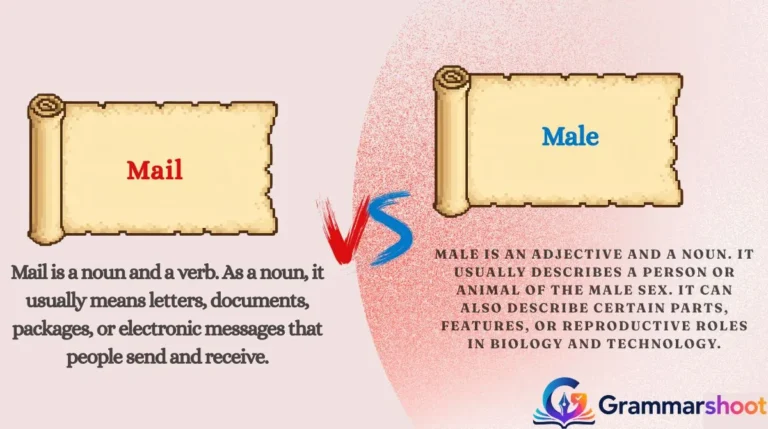
Mail is a noun and a verb. As a noun, it usually means letters, documents, packages, or electronic messages that people send and receive. As a verb, it means to send something through a postal service or, in many contexts, by email.
According to the , the word can refer to letters and packages, the postal system, and electronic messages.
When should you use mail?
Use mail when talking about sending, receiving, reading, or delivering letters and packages. It is also used when talking about electronic messages, especially in expressions such as check your mail or you have mail.
In American English, people commonly use mail for the postal service. In British English, post is often preferred when talking about physical letters and packages. Both words can be understood in many English-speaking places, but local habits differ.
Here are some common expressions:
- Receive mail: Get letters, packages, or messages.
- Send mail: Send a letter, package, or message.
- Check your mail: Look for new letters or electronic messages.
- Mail a letter: Send a letter through the postal system.
- Mail an application: Send an application to an office or organization.
- Junk mail: Unwanted letters or advertising messages.
- Email: A message sent electronically, or the system used to send it.
Grammar rules for mail
As a noun, mail is often uncountable when it means letters and packages in general.
For example:
- I received some mail today.
- There is a lot of mail on the desk.
- She checks her mail every morning.
We normally do not say a mail when referring to a single physical letter in standard everyday English. Instead, say a letter, a package, or an email, depending on what you mean.
However, mail can also be used in the sense of electronic messages, and some speakers use the plural mails when talking about separate email messages. In most everyday situations, emails is the clearer choice for individual electronic messages.
As a verb, mail usually follows this pattern:
Subject + mail + object
For example: I mailed the documents yesterday.
Here are eight examples that show how to use the word correctly.
- I received an important letter in the mail.
- Please check your mail before leaving the office.
- My grandmother sends me a card by mail every year.
- She will mail the documents tomorrow.
- The package arrived in the morning mail.
- I need to mail this application to the university.
- He received an email from his manager.
- The company sends its bills by mail.
Common confusion about mail
Some learners think mail always means a paper letter. That is not completely correct. The word may refer to the postal system, physical letters and packages, or electronic messages, depending on the context.
For example, when someone says, “Check your mail,” they might mean the letters in your mailbox or the messages in your email account.
Always look at the surrounding words to understand the exact meaning.
What Does “Male” Mean?
Male is an adjective and a noun. It usually describes a person or animal of the male sex. It can also describe certain parts, features, or reproductive roles in biology and technology.
For example, a male student is a student who is male, and a male lion is a lion of the male sex.
The explains male as a word used for men and boys, as well as for male animals and some other biological or technical uses.
When should you use male?
Use male when you want to describe or identify sex, particularly in scientific, medical, official, or factual contexts.
For example, a form may ask how many male and female students are in a class. A biology book may describe the male and female parts of a plant. A veterinarian may talk about a male dog.
In everyday conversation, people often use man or boy when referring to a specific person, depending on the person’s age. The word male may sound more formal or factual when used to describe people.
Here are some common expressions:
- Male student: A student who is male.
- Male teacher: A teacher who is male.
- Male lion: A lion of the male sex.
- Male bird: A bird of the male sex.
- Male voice: A voice described as male.
- Male and female: Two categories commonly used when discussing sex.
- Male connector: A connector with a projecting part designed to fit into a corresponding opening.
Grammar rules for male
As an adjective, male usually comes before a noun.
The common sentence structure is:
Male + noun
For example:
- The male student is in my class.
- We saw a male elephant at the zoo.
- The doctor examined the male patient.
As a noun, male refers to a person or animal of the male sex.
For example:
- The male won the competition.
- The zoo has three males and two females in that group.
Although this noun use is grammatically correct, using a more specific word such as man, boy, or male lion may sound more natural when the context allows it.
Here are eight examples of the word male in sentences.
- My brother is a male student at this college.
- The male doctor examined the patient.
- We saw a male peacock in the garden.
- The male bird built a nest near the tree.
- The survey recorded the number of male and female participants.
- A male lion was resting under the tree.
- The team includes both male and female players.
- This device has a male connector that fits into the socket.
Common confusion about male
Some learners think male is another word for mail because both words sound alike. This is incorrect.
Remember that male describes a person, animal, or related feature. It does not mean a letter, parcel, or electronic message.
For example, “The male arrived today” does not normally mean that a letter has arrived. You would need to use mail for that meaning.
Difference Between Mail and Male (Detailed)
The main difference between mail and male is their meaning. Their pronunciation is the same in standard English, but their spellings and grammatical uses are different.
Mail relates to communication and the sending or receiving of items. Male relates mainly to sex or to something classified as male.
Comparison table
| Feature | Male | |
|---|---|---|
| Main meaning | Letters, packages, or messages | A person or animal of the male sex |
| Part of speech | Noun and verb | Adjective and noun |
| Pronunciation | /meɪl/ | /meɪl/ |
| Common use | Communication and delivery | People, animals, biology, and technical descriptions |
| Example as a noun | The mail arrived today. | The male won the race. |
| Example as a verb | I will mail the letter. | Not normally used as a verb |
| Example as an adjective | Not usually used this way | A male student |
| Related words | Email, letter, package, post | Man, boy, male animal, female |
1. Difference in meaning
The easiest way to understand these words is to focus on their meanings.
Use mail when discussing something that is sent or received. It may be a physical letter, a package, or an electronic message.
Example: I am waiting for some mail.
Use male when describing a person or animal of the male sex.
Example: The male horse is standing near the gate.
These meanings do not overlap. A letter cannot be a male, and a person cannot be a mail message.
2. Difference in usage
The word mail is common in offices, homes, post offices, and online communication.
For example, someone might say, “I mailed the form,” when explaining how they sent paperwork to an organization.
The word male is common when describing people or animals, especially in official forms, science, and factual descriptions.
For example, “The survey included 40 male participants” explains something about the participants.
3. Difference in grammar
Mail can work as a noun or a verb.
- Noun: The mail is on the table.
- Verb: Please mail the letter today.
Male can work as an adjective or a noun.
- Adjective: The male student answered the question.
- Noun: The male was larger than the female.
Notice that the grammatical role depends on how the word is used in a sentence, not simply on how it sounds.
4. Difference in sentence structure
When mail is a verb, it normally takes an object that identifies what is being sent.
For example:
Subject + mail + object
- I mailed the package.
- She mailed her application.
When male is an adjective, it usually describes a noun.
Male + noun
- Male student
- Male animal
- Male nurse
When male is a noun, it can stand on its own as the subject or object of a sentence.
For example: “The male was separated from the group.”
5. Difference in spelling and pronunciation
Both words have four letters and are pronounced the same way: /meɪl/. They are examples of homophones, which are words that sound alike but have different meanings and spellings.
The spelling is the clue that helps you choose the correct word.
- Mail: Think about sending a letter or message.
- Male: Think about a male person or animal.
Because pronunciation cannot help you distinguish them, paying attention to meaning is especially important when writing.
Grammar Rules You Must Remember
Learning a few simple rules can help you choose the correct word quickly.
Rule 1: Use mail for letters, packages, and messages
When the sentence refers to sending or receiving communication, mail is usually the correct choice.
Correct: I received some mail from the bank.
Incorrect: I received some male from the bank.
The second sentence suggests the wrong meaning. The bank sends messages or documents, not a person or animal described as male.
Rule 2: Use mail as a verb when something is being sent
When you describe the action of sending a letter, document, or package through the postal service, use mail.
Correct: I will mail the invitation tomorrow.
Incorrect: I will male the invitation tomorrow.
You can remember that mail can describe both the item or system and the action of sending it.
Rule 3: Use male before a noun when describing sex
When the word describes a person, animal, or related feature, use male.
Correct: The male student answered first.
Incorrect: The mail student answered first.
The incorrect example makes it sound as though the student is related to letters or packages. The correct adjective is male.
Rule 4: Check the meaning before checking the sound
Since these two words sound alike, saying the sentence aloud will not help you choose the right spelling.
Instead, ask yourself what you are trying to express.
Correct: The male cat is sleeping.
Correct: I need to collect my mail.
Both words are correct in their own sentences. The important point is the meaning you want to communicate.
Common Mistakes Students Make
Many spelling mistakes happen because English contains words that share the same pronunciation. Students may know the meaning of both words but still select the wrong spelling while writing quickly.
Here are the most common mistakes and easy ways to correct them.
Mistake 1: Writing male instead of mail
Incorrect: I need to check my male.
Correct: I need to check my mail.
Why? The sentence is about checking letters or messages. Therefore, mail is the correct word.
Correction tip: When thinking about an inbox, mailbox, letter, or delivery, check whether mail fits the meaning.
Mistake 2: Writing mail instead of male
Incorrect: The mail teacher explained the lesson.
Correct: The male teacher explained the lesson.
Why? The writer wants to describe the teacher as male, not discuss letters or messages.
Correction tip: If the word comes before a person or animal to describe sex, male may be the intended choice.
Mistake 3: Confusing the two words in official forms
Incorrect: Number of mail employees: 12.
Correct: Number of male employees: 12.
Why? The form is counting employees by sex, so male is needed.
However, when describing workers in general, it is often better to provide context and use inclusive, relevant categories rather than adding unnecessary labels.
Mistake 4: Assuming that one word is more correct because it sounds right
Incorrect: I will male this package tomorrow.
Correct: I will mail this package tomorrow.
Why? Both spellings sound the same, so pronunciation alone cannot tell you which one to write.
Correction tip: Learn each word with a short example instead of learning the sound alone. For example, remember “mail a package” and “male student.”
Mistake 5: Using mail as a countable noun incorrectly
Less natural in most contexts: I received a mail.
More natural: I received a letter.
Also correct: I received an email.
Why? Mail is usually uncountable when it refers to physical letters and packages in general. When you mean one specific item, letter, package, or email is often clearer.
Some speakers use mail differently when talking about individual electronic messages, so usage can vary by region and context.
Mistake 6: Forgetting to check the whole sentence
A word may appear correct when read by itself but be wrong in the sentence.
For example:
- I sent the male yesterday.
- The mail student is absent.
Both sentences contain spelling errors if the intended meanings are sending a letter and describing a student.
Before finishing your writing, read the sentence and ask whether the word matches the situation.
Easy Trick to Remember the Difference
Here is a simple memory trick that works well for beginners.
MAIL = Messages, Items, Letters
Think of a mailbox, an envelope, a parcel, or an email. These are all connected to communication and delivery. When your sentence is about sending or receiving something, use mail.
MALE = Man, Animal, or Male category
Think of a male student, a male dog, or a male lion. These examples all describe a person or animal of the male sex.
You can also remember this contrast:
- Mail goes to an address.
- Male describes a person or animal.
Imagine two real-life situations. First, a delivery worker brings a package to your home. You might say, “My mail has arrived.” Second, you visit a zoo and see a male lion. You might say, “The male lion is sleeping.”
The spelling now has a clear purpose.
One more important point: do not try to remember the difference through pronunciation. Both words sound the same. Instead, connect the spelling to the meaning and the meaning to a familiar example.
With a little practice, choosing the correct word will become much easier.
Daily Life Examples: Mail vs Male
The following examples show how the two words appear in everyday situations and spoken English.
Example 1: At home
Ali: Did anything arrive for me today?
Sara: Yes, your mail is on the table.
Here, mail refers to letters or other items that have been delivered.
Example 2: At school
Teacher: How many students are in your group?
Student: There are six students, including two male students.
Here, male describes the students.
Example 3: At the post office
Customer: Can I mail this package to Lahore?
Clerk: Yes, please write the full address on it.
The customer uses mail as a verb because they want to send a package.
Example 4: At the zoo
Child: Is that a male lion?
Father: Yes, it is a male lion resting in the shade.
The word male describes the lion.
Example 5: In an office
Manager: Did you receive the documents?
Employee: Yes, they came by mail this morning.
The word mail refers to the delivery of documents.
Example 6: During a survey
Researcher: How many male participants joined the study?
Assistant: Twenty male participants completed the survey.
The word male describes a category of participants.
Example 7: Sending an application
Friend A: How will you send your application?
Friend B: I will mail it to the university tomorrow.
Here, mail describes the action of sending the application.
Example 8: Checking an inbox
Hassan: Have you checked your mail?
Usman: Yes, I received a message from my teacher.
In this conversation, mail refers to electronic messages.
Example 9: Talking about a pet
Friend A: Is your new cat male or female?
Friend B: The cat is male.
Here, male is used as an adjective in the question and as a noun in the answer.
Example 10: At work
Employee A: Did the company send the contract?
Employee B: Yes, they mailed it to my home address.
The word mailed is the past-tense form of the verb mail.
These examples show that the correct word becomes easy to choose once you understand the situation.
Practice Section: Choose the Correct Word
Test your knowledge by choosing either mail or male to complete each sentence.
- I received an important ______ from my teacher.
- The ______ bird has bright feathers.
- Please ______ this letter before noon.
- The form asks for the number of ______ students.
- I check my email and other ______ every morning.
Answers and Explanations
- Mail — The sentence refers to a message or letter.
- Male — The word describes the bird.
- Mail — It is a verb meaning to send the letter.
- Male — The sentence describes a category of students.
- Mail — The word refers to messages or correspondence.
If you answered all five correctly, you understand the main difference. If you made a mistake, review the memory trick and try the sentences again.
FAQs
1. What is the difference between mail and male?
Mail refers to letters, packages, the postal system, or electronic messages. It can also be used as a verb meaning to send something. Male usually describes a person or animal of the male sex. The words sound the same but have different meanings and spellings.
2. Do mail and male sound the same?
Yes. In standard English, both words are pronounced /meɪl/. They are homophones, meaning that they have the same pronunciation but different meanings. You usually need to understand the context to choose the correct spelling when writing.
3. Can mail be used as a verb?
Yes. Mail can be a verb meaning to send a letter, document, or package through a postal service. For example, “I will mail the application tomorrow.” Its past-tense form is mailed, as in “She mailed the documents yesterday.”
4. Is male a noun or an adjective?
It can be both. As an adjective, it describes a person, animal, or related feature, as in “a male student.” As a noun, it refers to a person or animal of the male sex, as in “The male was larger than the female.” The sentence determines its grammatical role.
5. Is mail formal or informal?
Mail is a standard English word and can be used in formal or informal situations. You can use it in everyday conversations, business letters, and official instructions. In British English, post is often more common for physical letters and packages, while mail is widely used in American English.
6. How can I remember the difference between mail and male?
Connect mail with messages, letters, and packages. Connect male with a person or animal of the male sex. For example, you mail a letter, but you describe a student or lion as male. This simple connection makes the spelling easier to remember.
Conclusion
The difference between mail and male is simple once you understand their meanings. Although they sound exactly the same, they are used in different situations and cannot replace one another.
Use mail when talking about letters, packages, messages, or the action of sending something. For example, “I received some mail today” and “I will mail the documents tomorrow” are both correct sentences.
Use male when describing a person or animal of the male sex. For example, “The male student won the competition” and “We saw a male lion at the zoo” use the word correctly.
Remember that these words are homophones. Their pronunciation is the same, so you must rely on meaning and context when choosing the spelling.
The easiest trick is to connect mail with messages and delivery, and male with people and animals. Read the examples, practise the exercises, and try using both words in your own sentences.
Keep practising a little every day. Soon, choosing the correct word will feel natural, and you will write more clearly and confidently.

Evan Rellmont is a writer who turns thoughtful ideas into meaningful words, creating stories and reflections that connect, inspire, and leave a lasting impression.