
English has many words that look similar in meaning but are used in different situations. Caretaker and caregiver are two good examples.
Both words describe someone who takes care of another person, a place, or something that needs attention.
However, they do not always mean the same thing.
Many English learners use these words as if they were completely interchangeable. This is understandable because both words are connected to care and responsibility.
For example, a person who looks after an older parent may be called a caregiver. A person who looks after a building while its owner is away may be called a caretaker.
The difference becomes clearer when we look at what is being cared for.
A caregiver usually helps a person who needs support with daily activities, health, or personal needs. A caretaker often looks after a building, property, or place.
In some situations, a caretaker may also look after a person, especially when someone needs temporary care or supervision.
Understanding this difference is useful in everyday conversations, school assignments, job applications, and professional writing. Choosing the right word helps you explain someone’s role more clearly.
By the end of this guide, you will understand the meaning of both words, learn their grammar rules, compare their uses, and see how native English speakers use them in real-life situations.
You will also get simple examples, common mistakes to avoid, and a short practice exercise to test your knowledge.
What Does “Caretaker” Mean?
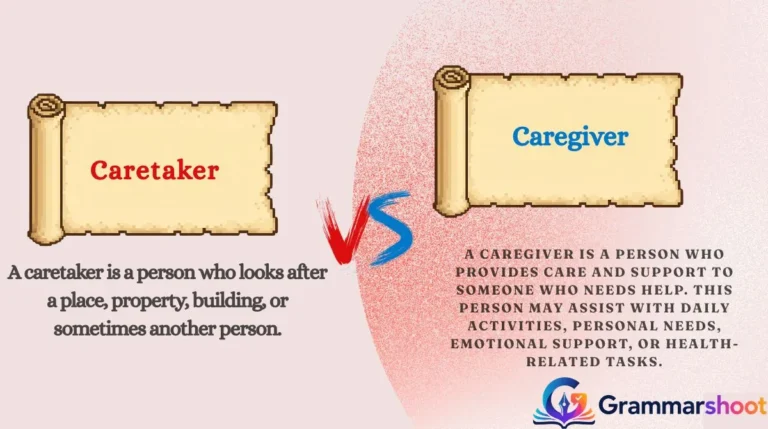
A caretaker is a person who looks after a place, property, building, or sometimes another person. The person’s main job is to keep something safe, clean, working, or in good condition.
The word is especially common when someone is responsible for a house, school, garden, apartment building, or other property. A caretaker may check doors, repair small problems, keep the place clean, and make sure everything is safe.
For example, a school caretaker may open the school building in the morning, check the classrooms, and report problems that need repairs. A caretaker at a large house may look after the property while the owner is away.
The word can also describe someone who looks after a person temporarily. For example, a person may act as a caretaker for an older neighbor or a child for a short time. The exact meaning depends on the situation.
When Should You Use “Caretaker”?
Use caretaker when you want to describe someone who is responsible for looking after a place, property, or person.
Here are some common situations:
- Buildings: Someone who keeps a school, office, or apartment building in good condition.
- Property: Someone who looks after a house or farm when the owner is away.
- Gardens and grounds: Someone who maintains a garden, park, or outdoor area.
- Temporary responsibility: Someone who takes care of a person or place for a limited time.
- Special situations: Someone who provides supervision or basic care, depending on the job.
The word does not always mean that the person provides medical help. A caretaker’s duties may involve maintenance, safety, cleaning, supervision, or general support.
Grammar Rules for “Caretaker”
Caretaker is a countable noun. This means you can use it with a, an, the, or a number.
- One caretaker
- Two caretakers
- A school caretaker
- The caretaker of the building
The plural form is caretakers.
You can also use the word before another noun to describe a role or job, as in caretaker duties or caretaker position.
8 Example Sentences With “Caretaker”
- The caretaker opens the school gates every morning.
- We hired a caretaker to look after our house while we were traveling.
- The apartment caretaker keeps the shared areas clean.
- Our school caretaker reported a broken window to the principal.
- The caretaker checks the garden every evening.
- They need a caretaker for their empty farmhouse.
- My uncle worked as a caretaker at a large office building.
- She acted as a temporary caretaker while the manager was away.
Notice that most of these examples involve a place, building, or property. This is one of the easiest ways to recognize the usual meaning of the word.
Common Confusion About “Caretaker”
Some learners think a caretaker must always look after a building. That is not correct. The word can also refer to a person who provides supervision or temporary care for someone else.
For example, a person who looks after a child for a short period may be described as a caretaker in certain contexts. However, caregiver is usually the clearer choice when the main responsibility is helping someone with personal care or daily living.
The meaning can also change by region. In some English-speaking countries, caretaker is commonly used for jobs involving property maintenance. In others, it may be used more broadly.
What Does “Caregiver” Mean?
A caregiver is a person who provides care and support to someone who needs help. This person may assist with daily activities, personal needs, emotional support, or health-related tasks.
Caregivers often help older adults, people with disabilities, people recovering from illness, or children who need special attention. They may be family members, friends, trained workers, or paid professionals.
For example, a woman who helps her older father get dressed, prepare meals, and attend medical appointments is a caregiver. A trained worker who supports a person with a disability may also be called a caregiver.
A caregiver does not always have to be a medical professional. Many caregivers provide support at home without being nurses or doctors. Their responsibilities depend on the needs of the person they help and their level of training.
When Should You Use “Caregiver”?
Use caregiver when the main focus is caring for a person and helping them manage daily life.
Common situations include:
- older care: Helping an older person with meals, bathing, dressing, or moving around.
- Disability support: Assisting someone who needs help with everyday tasks.
- Family care: Looking after a child, parent, spouse, or other relative who needs support.
- Recovery from illness: Helping someone follow a daily routine after an illness or operation.
- Professional care: Providing personal support as part of a job in a home or care facility.
A caregiver may offer practical help, emotional support, or both. Some caregivers also perform health-related tasks, but they should only do tasks that are appropriate for their training and role.
Grammar Rules for “Caregiver”
Caregiver is also a countable noun. You can use it with articles and numbers.
- One caregiver
- Two caregivers
- A family caregiver
- The caregiver for an older adult
The plural form is caregivers.
You can use it in expressions such as caregiver support, caregiver responsibilities, and caregiver training.
The word is commonly written as one word: caregiver. You may occasionally see care giver, but the one-word form is standard in modern English.
8 Example Sentences With “Caregiver”
- My mother is the main caregiver for my grandmother.
- The caregiver helps the patient with daily activities.
- He works as a caregiver at a residential care facility.
- A family caregiver may need time to rest, too.
- The caregiver prepared lunch for the older man.
- We hired a caregiver to help my father at home.
- Her caregiver reminds her to follow her daily routine.
- The hospital gave the family useful information for caregivers.
In these sentences, the focus is on helping a person rather than maintaining a building or property.
Common Confusion About “Caregiver”
Some learners believe a caregiver must be a nurse or another medical professional. This is not true. A caregiver may be a relative who provides unpaid support at home.
For example, a son who helps his father get dressed, prepares his meals, and takes him to appointments can be a caregiver even if he has no medical training.
Another common mistake is thinking that a caregiver and a caretaker always have different duties. In real life, their duties can overlap. The best word depends on the person’s main responsibility and the language used in that workplace or community.
Difference Between Caretaker and Caregiver (Detailed)
The main difference is the kind of responsibility involved. A caretaker often looks after a place or property, while a caregiver usually looks after a person who needs help.
However, this is a general distinction, not an absolute rule. Some caretakers care for people, and some caregivers may also help maintain a person’s living space.
Comparison Table
| Feature | Caretaker | Caregiver |
|---|---|---|
| Main meaning | Someone who looks after a place, property, or sometimes a person | Someone who provides care and support to a person |
| Common focus | Buildings, houses, gardens, safety, maintenance | Personal needs, daily activities, well-being |
| Typical workplace | Schools, apartment buildings, farms, private properties | Homes, hospitals, care facilities |
| Medical duties | Not usually the main focus | May include certain health-related tasks |
| Family use | Possible, but less common for ongoing personal care | Very common for family members who provide care |
| Temporary use | Often used for temporary responsibility | Can describe both temporary and long-term care |
| Example | The caretaker checks the school building. | The caregiver helps the patient get dressed. |
| Plural form | Caretakers | Caregivers |
1. Difference in Usage
The word caretaker is often connected to maintaining and protecting something. For example, a caretaker may check whether a building is secure, report damage, or keep the grounds clean.
The word caregiver is more strongly connected to a person’s needs. A caregiver may help someone eat, dress, walk, or follow a daily routine.
Compare these sentences:
- The caretaker repairs the school fence.
- The caregiver helps the older woman eat her lunch.
The first sentence focuses on property maintenance. The second focuses on personal care.
2. Difference in Meaning
Both words contain the idea of care, but they usually point to different responsibilities.
A caretaker takes responsibility for the condition, safety, or general supervision of something. A caregiver takes responsibility for supporting someone’s well-being and daily needs.
For example, imagine a family hires two workers. One worker looks after the house, checks the doors, and waters the plants. The other helps the grandfather get dressed and prepares his meals.
The first worker is more naturally called a caretaker. The second is more naturally called a caregiver.
3. Difference in Grammar
There is no major grammatical difference between these words. Both are countable nouns, both can be singular or plural, and both can be used with articles.
Correct examples:
- A caretaker works at the school.
- A caregiver works at the care center.
- The caretakers clean the building.
- The caregivers support the residents.
The grammar stays the same. The difference is mainly in meaning and context.
4. Difference in Sentence Structure
Both words can appear as the subject, object, or part of a longer noun phrase.
As the subject:
- The caretaker locks the doors.
- The caregiver prepares breakfast.
As the object:
- The school hired a caretaker.
- The family hired a caregiver.
In a noun phrase:
- The caretaker’s responsibilities include basic maintenance.
- The caregiver’s responsibilities include personal support.
The word you choose depends on what the person does, not on the sentence structure.
5. Can the Words Be Interchanged?
Sometimes, but not always.
If someone temporarily looks after an older person, both words may be understandable in certain situations. However, caregiver is generally more suitable when the job involves regular personal support.
If someone looks after an empty house, caretaker is usually the better choice. Calling that person a caregiver would sound unusual because the main responsibility is not caring for a person.
Always think about the main duty before choosing a word.
Grammar Rules You Must Remember
Learning a few simple rules will help you use these words correctly in speaking and writing.
Rule 1: Use “Caretaker” Mainly for Places and Property
When someone is responsible for keeping a building, house, or property safe and in good condition, caretaker is usually the right word.
Example: The caretaker checks the school building every evening.
Here, the person is responsible for the building rather than someone’s personal needs.
Rule 2: Use “Caregiver” Mainly for Personal Care
When someone helps another person with daily activities or personal needs, caregiver is usually the clearer choice.
Example: My sister is a caregiver for our older father.
The sentence tells us that the sister supports a person who needs care.
Rule 3: Both Words Are Countable Nouns
You can use a or an before a singular form, depending on the first sound of the following word. Both words begin with a consonant sound, so use a.
Correct:
- A caretaker
- A caregiver
- Three caretakers
- Three caregivers
Incorrect:
- An caretaker
- An caregiver
Remember to add -s when you need the regular plural form.
Rule 4: Choose the Word That Matches the Main Responsibility
A person’s job title may vary between workplaces and countries. Sometimes, the same person performs several duties. In that case, choose the word that best describes the main focus of the role.
Example: The worker looks after an older man and helps him with meals, dressing, and walking. In most situations, caregiver is the clearer word.
If the worker mainly maintains the man’s property while he is away, caretaker may be more appropriate.
Common Mistakes Students Make
English learners often confuse these words because both are linked to the idea of looking after something. Here are some common errors and simple ways to correct them.
Mistake 1: Using “Caretaker” for Every Type of Personal Care
Incorrect or less natural: My grandmother needs a caretaker to help her eat and get dressed.
More natural: My grandmother needs a caregiver to help her eat and get dressed.
The first sentence may be understood, but caregiver is usually a better fit when the focus is personal support.
Correction tip: If the person needs help with daily living, consider using caregiver.
Mistake 2: Calling a Building Worker a “Caregiver”
Incorrect or less natural: The caregiver checks the school doors and repairs broken windows.
More natural: The caretaker checks the school doors and reports broken windows.
The first sentence sounds unusual if the worker’s main responsibility is the building.
Correction tip: If the work involves a property, maintenance, or building safety, consider caretaker.
Mistake 3: Thinking Every Caregiver Is a Nurse
Incorrect idea: Only trained nurses can be caregivers.
Correct idea: A caregiver may be a family member, friend, or paid worker who helps someone with daily needs.
For example, a man who prepares meals for his disabled brother and helps him move around may be a caregiver.
Correction tip: Remember that caregiver describes a caring role, not necessarily a medical qualification.
Mistake 4: Forgetting the Plural Ending
Incorrect: Two caregiver help the residents.
Correct: Two caregivers help the residents.
Incorrect: Three caretaker work at the school.
Correct: Three caretakers work at the school.
Correction tip: Both nouns usually take -s in the plural.
Mistake 5: Assuming the Difference Is Always Exact
Some learners believe a caretaker can never look after a person or that a caregiver can never help with anything around a house.
In reality, responsibilities can overlap. A caregiver may prepare meals and keep a person’s immediate living area tidy. A caretaker may supervise someone temporarily.
Correction tip: Focus on the main duty, but remember that local usage and job titles can vary.
Easy Trick to Remember the Difference
Here is a simple way to remember the two words:
Caretaker = usually takes care of a place.
Caregiver = usually gives care to a person.
Think about a school. The caretaker may unlock the gates, check the rooms, and report damage. Now think about an older person who needs help getting dressed. The person providing that support is usually called a caregiver.
You can also remember the word give inside caregiver. A caregiver gives care, help, and support to someone who needs it.
This trick is not a strict rule for every English-speaking country, but it works well in most everyday situations.
When you are unsure which word to use, ask yourself one question: What is this person mainly looking after?
If the answer is a building, house, garden, or property, caretaker may be the better choice. If the answer is a person’s daily needs and well-being, caregiver is usually more suitable.
Daily Life Examples
Real-life examples make the difference easier to understand. Read these short situations and notice why one word fits better than the other.
Example 1: At School
Principal: Who opens the school gates every morning?
Teacher: The caretaker opens them before the students arrive.
The caretaker is responsible for the school building and its daily upkeep.
Example 2: Looking After a Grandparent
Ali: Who helps your grandfather with his meals?
Sara: His caregiver helps him every day.
The focus is on the grandfather’s personal needs, so caregiver is a natural choice.
Example 3: During a Family Holiday
Nadia: Who will look after your house while you’re away?
Hina: We have hired a caretaker to check the house and water the plants.
The person is looking after the property, not providing personal care.
Example 4: At a Care Facility
Worker: Who helps Mr. Khan get ready in the morning?
Supervisor: His caregiver helps him with dressing and breakfast.
The caregiver provides daily personal support.
Example 5: Looking After a Farm
Owner: Who will check the farm while we visit our relatives?
Neighbor: The caretaker will check the gates, animals, and equipment.
Here, caretaker describes someone who looks after the property and its general needs. If the person has specialized animal-care duties, a more specific job title may also be suitable.
Example 6: Caring for a Parent at Home
Ayesha: Do you work outside the home?
Mariam: Not at the moment. I’m a caregiver for my mother.
Mariam explains that she provides care and support to her mother.
Example 7: An Empty Apartment
Tenant: Who should I contact about the broken light in the hallway?
Neighbor: Contact the building caretaker.
The caretaker is connected to building maintenance and shared property.
Example 8: After an Operation
Hamza: Who is helping your father while he recovers?
Bilal: A caregiver comes to our home every morning.
The worker helps a person who needs support during recovery.
Example 9: A Temporary Arrangement
Teacher: Who will supervise the children during the afternoon?
Parent: Their caretaker will look after them until I return.
In some settings, caretaker can describe temporary supervision. Depending on the exact role, caregiver, babysitter, or childcare worker might be more natural.
Example 10: Choosing a Job
Interviewer: What kind of work are you looking for?
Applicant: I would like to work as a caregiver because I enjoy helping older people with their daily needs.
The applicant uses caregiver because the job involves personal care.
Practice Section: Choose the Correct Word
Test your understanding by choosing caretaker or caregiver for each sentence. Think about the main responsibility before checking the answers.
- The school ______ checks the doors and reports damage to the building.
- My aunt is the main ______ for my older grandfather.
- We hired a ______ to look after our house while we were traveling.
- The ______ helps the patient get dressed and prepare for the day.
- The apartment ______ checks the shared areas and reports maintenance problems.
Answers and Explanations
- Caretaker — The person is responsible for the school building.
- Caregiver — The aunt provides personal support to her grandfather.
- Caretaker — The main responsibility is looking after the house.
- Caregiver — The person helps a patient with daily activities.
- Caretaker — The role focuses on the apartment building and its upkeep.
If you answered all five correctly, you understand the main difference. If you made a mistake, review the memory trick and try again.
FAQs About Caretaker vs Caregiver
1. What is the difference between caretaker and caregiver?
A caretaker usually looks after a building, property, or place, although the word can also describe someone who provides temporary supervision or care. A caregiver usually helps a person with daily activities, personal needs, or well-being. The main difference is the focus of the responsibility.
2. Can we use “caretaker” for a person who looks after an older parent?
Yes, in some situations. However, caregiver is usually the clearer and more common choice when someone regularly helps an older parent with meals, dressing, mobility, or other personal needs. The best word can depend on regional usage and the exact role.
3. Is “caregiver” a formal or informal word?
Caregiver is suitable for both everyday conversation and formal writing. You can use it when speaking about a family member who provides care or when describing a professional role. It is common in healthcare information, job descriptions, and discussions about family support.
4. Is a caretaker the same as a housekeeper?
No. A caretaker may be responsible for a property’s safety, general condition, and maintenance. A housekeeper mainly cleans and organizes a home or other indoor space. Their duties can overlap, but the job titles do not mean exactly the same thing.
5. Can one person be both a caretaker and a caregiver?
Yes. One person may perform both roles. For example, someone who lives with an older relative may help with personal care while also checking and maintaining the house. If you are describing the person’s main responsibility, choose the word that best fits that role.
6. Which word should I use on a job application?
Choose the word that matches the job description. Use caretaker for roles mainly involving property supervision, upkeep, or maintenance. Use caregiver for roles focused on personal support and daily living needs. Always check the employer’s official job title because organizations may use different terms.
Conclusion
The difference between caretaker and caregiver becomes simple when you focus on what the person does. A caretaker usually looks after a place, building, house, or property. A caregiver usually supports a person who needs help with daily activities, personal needs, or well-being.
Both words are nouns, both can be singular or plural, and both are connected to the idea of care. Their grammar is almost the same, but their usual meanings and uses are different.
Remember the easy trick: a caretaker usually takes care of a place, while a caregiver gives care to a person. This will help you choose the right word in most everyday situations.
Also remember that English usage can vary. Some people use caretaker for temporary personal care, and some jobs involve both property maintenance and personal support. Always consider the main responsibility and the context.
The best way to learn these words is to use them in your own sentences. Try describing a school caretaker, a family caregiver, or someone who looks after a house. With a little practice, you will feel more confident using both words in daily English.

Evan Rellmont is a writer who turns thoughtful ideas into meaningful words, creating stories and reflections that connect, inspire, and leave a lasting impression.