
English has many words that sound similar or look almost the same but have completely different meanings.
Paste and paced are two words that can confuse English learners, especially when they hear them in fast conversations or see them in writing.
The good news is that these words are easy to understand once you learn their meanings, grammar rules, and common uses.
Have you ever written a sentence and wondered whether you should use paste or paced? You are not alone. Many English learners mix up these words because their spelling is similar and their pronunciation can sound close in some accents. However, they do not mean the same thing.
The word paste usually refers to a thick, soft substance or the action of putting copied text or information somewhere. For example, you might use toothpaste to clean your teeth or paste a copied sentence into a document. It is also a common word when working with computers and phones.
The word paced, on the other hand, is the past tense and past participle of the verb pace.
It often means walking back and forth, usually because someone is worried, nervous, or waiting for something. It can also describe the speed or rhythm of an activity.
These words appear in different situations in daily life. You might paste a picture into a school project, while your friend paced around the room before an important exam.
Choosing the correct word helps you write clear sentences and express your ideas naturally.
By learning their meanings, grammar rules, and everyday uses, you can avoid common spelling mistakes and feel more confident when speaking or writing English.
What Does “Paste” Mean?
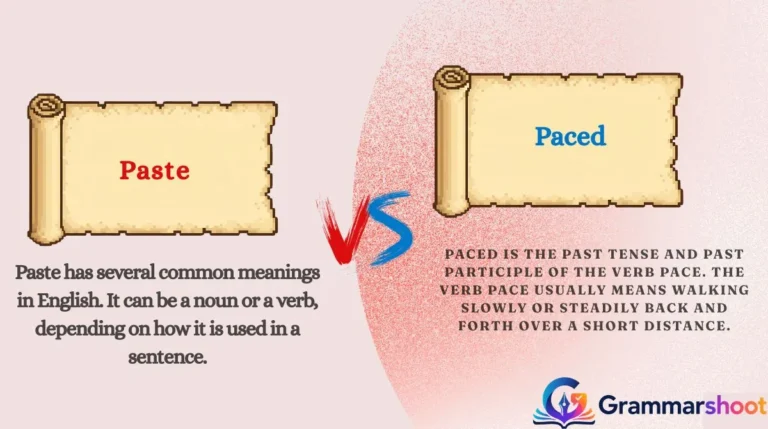
Paste has several common meanings in English. It can be a noun or a verb, depending on how it is used in a sentence.
As a noun, paste usually means a thick, soft mixture made from a liquid and a powder or other material. As a verb, it can mean putting something onto a surface or inserting copied text, pictures, or other information into a document.
1. Paste as a noun
When paste is a noun, it refers to a thick substance that can be spread or applied to something.
For example, toothpaste is a familiar type of paste. Other examples include glue paste and tomato paste. These substances may have different uses, but they share the idea of a thick mixture.
Consider these sentences:
- I need some toothpaste before going to bed.
- She used glue paste to repair the paper.
- Add tomato paste to the sauce for more flavor.
- The child made a paste from flour and water.
- This paste is too thick to spread easily.
- We bought a small tube of cleaning paste.
- The teacher prepared a paste for the art activity.
In all these examples, paste names a substance rather than an action.
2. Paste as a verb
As a verb, paste can mean attaching something to a surface or inserting copied information into a new place.
For example, imagine that you copy a paragraph from a website. When you put that paragraph into your school assignment, you paste it into the document.
Here are some examples:
- Please paste this picture into your project.
- I will paste the label onto the box.
- She pasted the photo into her notebook.
- Can you paste the copied text here?
- He pasted the notice on the classroom door.
- Paste the link into the message before sending it.
- I copied the paragraph but forgot to paste it.
- The student pasted colorful paper onto the card.
Notice that the verb describes an action. The person is doing something with a substance, an object, or copied information.
3. How to use “paste” in grammar
Paste is the base form of a verb. It can be used with different subjects and tenses.
- Present simple: I paste pictures into my notebook.
- Present continuous: I am pasting a picture into my notebook.
- Past simple: I pasted a picture into my notebook.
- Future simple: I will paste a picture into my notebook.
The regular past tense of paste is pasted, not paced.
This is an important rule because both words may appear in sentences about actions, but they come from different verbs.
For example:
- Correct: She pasted the photograph into her album.
- Incorrect for this meaning: She paced the photograph into her album.
The second sentence is wrong because paced does not mean attaching a photograph.
Remember that paste can also be a noun. In that case, it does not need to change into a past-tense form.
What Does “Paced” Mean?
Paced is the past tense and past participle of the verb pace. The verb pace usually means walking slowly or steadily back and forth over a short distance.
People often pace when they feel nervous, impatient, worried, or excited. Someone waiting for important news might walk around a room instead of sitting quietly.
The word can also describe the speed at which something happens. For example, a teacher may pace a lesson carefully so that students have enough time to understand each topic.
1. Paced as the past tense of “pace”
When someone walked back and forth in the past, you can use paced.
For example, imagine that your brother is waiting for his exam results. He feels worried and keeps walking from one side of the room to the other. You could say, “My brother paced around the room while waiting for his results.”
Here are seven more examples:
- The nervous student paced outside the examination hall.
- She paced around the kitchen while talking on the phone.
- He paced back and forth before his job interview.
- The worried father paced in the hospital waiting room.
- I paced around my bedroom because I could not relax.
- The coach paced along the side of the field.
- The manager paced around the office while waiting for the call.
In these sentences, paced describes movement that happened in the past.
2. Paced to describe speed or progress
The word paced can also describe how an activity or process was managed in terms of speed.
For example, a teacher might say, “She paced the lesson well.” This means she controlled the speed of the lesson effectively, giving students a suitable amount of time to learn.
Other examples include:
- The runner paced herself during the long race.
- The teacher paced the lesson according to the students’ needs.
- The team paced its efforts throughout the match.
- He paced his work carefully to avoid becoming tired.
- The speaker paced the presentation so everyone could follow.
- She paced her training over several weeks.
- The writer paced the story slowly to build suspense.
Here, paced does not always mean physically walking. It can refer to controlling speed, effort, or the progress of an activity.
3. How to use “paced” in grammar
Paced is a regular past-tense form of pace. It can also be used as a past participle.
Compare these examples:
- Past simple: He paced around the room.
- Present perfect: He has paced around the room for several minutes.
- Past perfect: He had paced around the room before the interview began.
- Passive voice: The training sessions were carefully paced.
The exact structure depends on the sentence. For example, the present perfect uses has or have followed by paced, while the past perfect uses had followed by paced.
A useful point to remember is that paced comes from pace, not paste. If the action involves walking back and forth or controlling speed, paced may be the correct choice.
Difference Between Paste and Paced (Detailed)
Although paste and paced look similar, they have different meanings and grammatical uses. The easiest way to choose between them is to understand what you want to say.
Use paste when you mean a thick substance or the action of attaching or inserting something. Use paced when you are describing a past action involving walking back and forth or managing speed.
Comparison table
| Feature | Paste | Paced |
|---|---|---|
| Base word | Paste | Pace |
| Main meaning | A thick substance or an action of attaching or inserting | Walked back and forth or controlled speed |
| Part of speech | Noun or verb | Past-tense verb or past participle |
| Present form | Paste | Pace |
| Past tense | Pasted | Paced |
| Common situation | Documents, pictures, glue, and mixtures | Nervous movement, exercise, lessons, and progress |
| Example | I pasted the image into my report. | I paced around the room. |
1. Difference in meaning
The biggest difference is what each word describes.
Paste is connected to a substance or an action involving placement. For example, you can paste a picture into a notebook or apply paste to a surface.
Paced is connected to movement or speed. For example, someone may have paced around a room while waiting for an important phone call.
Compare these sentences:
- I pasted the photograph into my album.
- I paced around the room before the meeting.
The first sentence describes placing a photograph into an album. The second describes walking around a room.
Changing one word changes the meaning of the entire sentence.
2. Difference in grammar
The words also have different grammatical forms.
Paste is the base form of the verb, although it can also function as a noun. Its regular past-tense form is pasted.
Paced is already a past-tense form. Its base form is pace.
Look at the difference:
- I paste pictures into my scrapbook every weekend.
- I pasted a picture into my scrapbook yesterday.
- I pace around the room when I feel nervous.
- I paced around the room last night.
Notice how paste changes to pasted, while pace changes to paced. These changes follow the spelling rules for regular verbs, but they create different words with different meanings.
3. Difference in sentence structure
Both words can appear in sentences with a subject and a verb, but the surrounding words help explain their meaning.
For example:
Subject + paste + object
- She pastes pictures into her diary.
- He pastes copied text into the document.
Subject + paced + place or movement phrase
- She paced around the room.
- He paced back and forth in the hallway.
The word paced can also take an object when it means controlling the speed of something:
- The teacher paced the lesson carefully.
- The runner paced herself during the race.
Therefore, do not decide which word to use based only on sentence structure. Think about the meaning and the tense as well.
4. Difference in everyday use
You will often see paste in schoolwork, office tasks, cooking, crafts, and computer instructions.
For example, someone may say, “Copy the address and paste it into the search box.”
You will often see paced in stories, descriptions of feelings, sports, and discussions about progress.
For example, someone might say, “He paced around the room because he was worried about the interview.”
Understanding the situation makes the choice much easier.
Grammar Rules You Must Remember
Learning a few simple rules will help you use these words correctly in your writing and conversations.
Rule 1: Use “paste” for the present form
When you describe a regular action or give an instruction, use paste.
Examples:
- I paste my homework into the online form.
- Please paste the picture here.
- We paste labels onto the boxes.
For present simple sentences with he, she, or it, use pastes.
Example: “She pastes her photos into a scrapbook.”
Rule 2: Use “pasted” for the past tense of “paste”
If the action of attaching or inserting something happened in the past, use pasted.
Examples:
- I pasted the link into the message.
- She pasted a picture on the wall.
- They pasted the labels onto the packages.
A helpful clue is the word yesterday. If you are talking about yesterday’s action of inserting copied information, pasted is usually the form you need.
Rule 3: Use “paced” as the past form of “pace”
When someone walked back and forth or controlled the speed of an activity in the past, use paced.
Examples:
- He paced around the office yesterday.
- The athlete paced herself during the race.
- The teacher paced the lesson well.
Remember that the present form is pace. For an action that happened in the past, use paced.
Rule 4: Check the meaning before choosing the word
Do not choose a word simply because it looks or sounds right. Ask yourself what the sentence is describing.
- If it describes inserting copied text, use paste or pasted.
- If it describes walking back and forth in the past, use paced.
- If it describes a thick mixture, use the noun paste.
For example:
- I pasted the text into the email.
- I paced around the room while writing the email.
Both sentences are correct, but they describe different actions.
Common Mistakes Students Make
English learners often make spelling mistakes when two words look similar. The best way to avoid these errors is to understand the meaning of each word instead of trying to memorize spelling alone.
Mistake 1: Using “paced” when you mean inserting text
Incorrect: I paced the copied paragraph into the document.
Correct: I pasted the copied paragraph into the document.
Why does this mistake happen?
Both words contain similar letters, and learners may remember the wrong form when typing quickly.
Easy correction tip: If you are using a computer and placing copied information somewhere, think of the familiar instruction “copy and paste.”
Mistake 2: Using “paste” to describe walking
Incorrect: She paste around the room before her exam.
Correct: She paced around the room before her exam.
Why does this mistake happen?
A learner may remember paste but forget that the past form of pace is paced.
Easy correction tip: If someone was walking back and forth in the past, use paced. The present form would be “She paces around the room.”
Mistake 3: Writing “paced” as the past tense of “paste”
Incorrect: He paced the picture into his notebook.
Correct: He pasted the picture into his notebook.
Why does this mistake happen?
The learner knows that the sentence describes a past action but chooses the wrong base verb.
Easy correction tip: First identify the original verb. If it is paste, its past form is pasted. If it is pace, its past form is paced.
Mistake 4: Confusing a noun with a verb
Incorrect: I need some paced to repair the paper.
Correct: I need some paste to repair the paper.
Why does this mistake happen?
The writer may focus on spelling without checking whether the sentence needs a substance or an action.
Easy correction tip: Ask yourself whether the sentence needs a thing or an action. A thick mixture is paste. Walking back and forth in the past is paced.
Mistake 5: Forgetting the base form
Incorrect: Yesterday, I pace around the room for an hour.
Correct: Yesterday, I paced around the room for an hour.
Incorrect: Yesterday, I paced the link into the document.
Correct: Yesterday, I pasted the link into the document.
Easy correction tip: Look for time words such as yesterday, last night, and last week. They often indicate that you need a past-tense verb. Then choose the correct past form for the intended meaning.
Easy Trick to Remember the Difference
Here is a simple way to remember these words without learning long grammar definitions.
Paste = put something in place.
Think about copying text on your phone, adding a picture to a document, or spreading a thick mixture onto a surface. These actions help you remember paste.
Examples:
- Paste the text into the box.
- I pasted the picture into my project.
- The paste is ready to use.
Paced = pace in the past.
Think about someone walking back and forth because they are nervous. The base verb is pace, and its past form is paced.
Examples:
- He paced around the room.
- She paced outside the office.
- The runner paced herself during the race.
You can also remember the spelling difference:
- Paste → Pasted
- Pace → Paced
The first verb keeps the letter t and adds -ed. The second verb drops the final e before adding -ed, giving paced.
One more helpful trick is to imagine two situations. In the first, you are working on your computer and pressing Ctrl+V to paste copied text. In the second, you are waiting nervously for exam results and walking around your room. The first situation uses paste; the second may use paced if you are describing the past.
Daily Life Examples
These examples show how the words appear in ordinary conversations. Read each sentence and notice what the speaker means.
Example 1: Working on a computer
Ali: Did you finish the assignment?
Sara: Almost. I copied the information, but I still need to paste it into the document.
Here, paste means inserting copied information.
Example 2: Waiting for exam results
Mother: Why were you walking around the room last night?
Son: I paced around because I was worried about my exam results.
Here, paced describes walking back and forth in the past.
Example 3: Making a school project
Teacher: How did you attach the pictures to your project?
Student: I pasted them onto the cardboard.
The student used pasted because the action of attaching the pictures has already happened.
Example 4: Sending a message
Ahmed: Can you send me the website address?
Bilal: Sure. I will paste it into our chat.
The verb paste describes putting copied information into the chat.
Example 5: Feeling nervous
Friend A: You look worried. Is something wrong?
Friend B: I paced around my house before the job interview. I could not sit still.
The word paced describes a past action caused by nervousness.
Example 6: Cooking dinner
Mother: What did you add to the tomato sauce?
Daughter: I added tomato paste to make it thicker.
Here, paste is a noun because it names a cooking ingredient.
Example 7: Preparing a presentation
Manager: Did you add the chart to the slides?
Employee: Yes, I pasted it into the presentation this morning.
The speaker uses pasted because the action happened earlier.
Example 8: Waiting for a phone call
Friend A: How did your brother act while waiting for the news?
Friend B: He paced back and forth in the hallway.
The word paced describes movement in the past.
Example 9: Giving computer instructions
Teacher: How do I put this copied paragraph into the form?
Student: Click in the box and paste the paragraph there.
This is an instruction, so the base form paste is correct.
Example 10: Talking about a lesson
Principal: Was the science lesson too difficult for the students?
Teacher: No. I paced the lesson carefully and gave everyone enough time.
In this sentence, paced means controlled the speed and progress of the lesson.
Practice Section: Choose the Correct Word
Test your understanding with these five short questions. Choose the word that makes each sentence correct.
- I copied the address and _____ it into the search box. (paste / pasted / paced)
- The nervous student _____ outside the examination room yesterday. (paste / pasted / paced)
- We need some tomato _____ to make the sauce thicker. (paste / paced)
- Please _____ this picture into your school project. (paste / paced)
- The coach _____ around the field while waiting for the players. (paste / pasted / paced)
Answers and explanations
- Pasted — The action happened in the past, and the speaker inserted copied information.
- Paced — The student walked around outside the room in the past.
- Paste — This is a noun naming a cooking ingredient.
- Paste — The sentence gives an instruction, so the base form is correct.
- Paced — The coach walked around the field in the past.
If you missed any answers, read the meanings again and try the questions one more time. Focus on the action or object in each sentence rather than the spelling alone.
FAQs
1. What is the difference between paste and paced?
Paste can mean a thick substance or the action of inserting or attaching something. Paced is the past tense and past participle of pace, which often means walking back and forth or controlling speed. The correct choice depends on the meaning of the sentence.
2. Is “paced” the past tense of “paste”?
No. The past tense of paste is pasted. The word paced is the past tense of pace. For example, “I pasted the picture” describes attaching a picture, while “I paced around the room” describes walking back and forth.
3. Can we use “paste” in questions?
Yes. You can use paste in questions when asking someone to insert or attach something. For example, “Can you paste the link here?” or “Should I paste this picture into the document?” In these sentences, paste is a verb in its base form.
4. Is “paste” a noun or a verb?
Paste can be both a noun and a verb. As a noun, it can refer to a thick substance, such as toothpaste or tomato paste. As a verb, it describes inserting copied information or attaching something to a surface, as in “Paste the image here.”
5. Can “paced” describe something other than walking?
Yes. Paced can describe controlling the speed or progress of an activity. For example, “The teacher paced the lesson carefully” means the teacher managed the lesson’s speed. “The runner paced herself” means she controlled her effort during the race.
6. How can I remember when to use paste or paced?
Think of paste when you are putting copied text into a document or using a thick substance. Think of paced when describing someone who walked back and forth in the past or managed the speed of an activity. Remember the verb forms: paste → pasted and pace → paced.
Conclusion
The difference between paste and paced becomes simple when you focus on their meanings. Although the words look similar, they come from different base forms and are used in different situations.
Use paste when you mean a thick substance or the action of putting copied text, pictures, or other information into a place. For example, “Please paste the link into the message.” When describing this action in the past, use pasted.
Use paced when you are talking about the past form of pace. It often describes walking back and forth because of nervousness or worry. It can also mean controlling the speed of an activity. For example, “He paced around the room before the interview.”
The most useful rule is to check the meaning before choosing the spelling. If you are inserting something, think of paste. If you are describing past movement or controlled speed, think of paced.
Keep practicing with simple sentences from your daily life. A little practice will help you choose the correct word naturally and write English with greater confidence.

Evan Rellmont is a writer who turns thoughtful ideas into meaningful words, creating stories and reflections that connect, inspire, and leave a lasting impression.