
Have you ever confused seen with scene while writing an English sentence? You are not alone.
These two words sound exactly the same in most English accents, but they have very different meanings.
Using the wrong word can change the meaning of your sentence and make your writing confusing.
The good news is that learning the difference is simple once you understand what each word means and how it works in a sentence.
English has many words that sound the same but have different meanings and spellings. These words are called homophones.
Seen and scene are common examples. When you hear them in a conversation, it can be difficult to know which word the speaker means.
However, when you write them, you must choose the correct spelling according to the meaning of your sentence.
The word seen is related to the action of seeing something with your eyes. It is the past participle of the verb see.
You can use it when talking about something you have watched, noticed, or looked at. For example, you might say, “I have seen that movie before.”
The word scene, on the other hand, is a noun. It usually refers to a place where something happens, a part of a movie or play, or a view that you can see. For example, “The final scene of the movie was exciting.”
These words are important in daily English because people often talk about movies, places, events, and things they have experienced. Choosing the wrong spelling can make an otherwise correct sentence look like a mistake.
By understanding their meanings, grammar rules, and common uses, you will be able to use both words confidently. You will also learn simple memory tricks, everyday examples, and practice questions to help you remember the difference for a long time.
What Does “Seen” Mean?
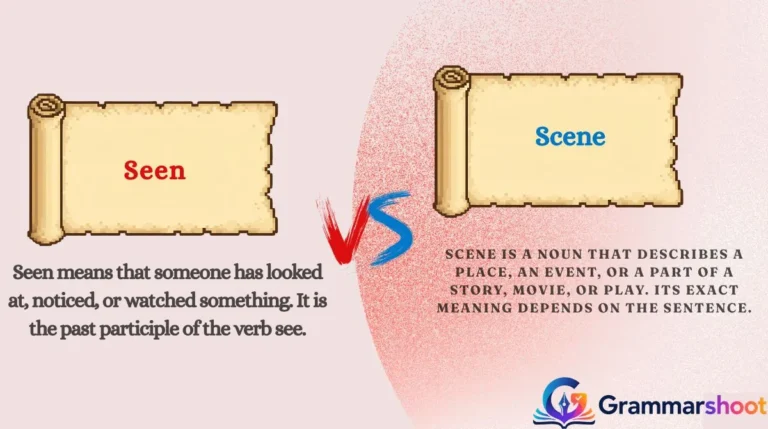
Seen means that someone has looked at, noticed, or watched something. It is the past participle of the verb see.
The three main forms of this verb are:
- See — base form
- Saw — simple past tense
- Seen — past participle
For example:
- I see a bird in the tree.
- I saw a bird yesterday.
- I have seen that bird before.
Notice that we use see for the present, saw for the simple past, and seen with helping verbs in many perfect-tense sentences.
When Should You Use “Seen”?
Use seen when you want to talk about something that has been viewed, noticed, or witnessed. It often appears in sentences with helping verbs such as have, has, and had.
For example, if your friend asks whether you have watched a new movie, you can answer, “Yes, I have seen it.”
You can also use seen in passive sentences. For example, “The accident was seen by several people.” In this sentence, seen tells us that several people witnessed the accident.
Grammar Rules for “Seen”
The most important rule is that seen normally needs a helping verb when it is used as the past participle in a complete verb phrase.
Common patterns include:
- Have/has + seen: I have seen this place before.
- Had + seen: She had seen the message before the meeting.
- Be + seen: The stars can be seen at night.
- Modal verb + have + seen: You might have seen this picture online.
Do not use seen alone as the simple past tense of see in standard English.
Incorrect: I seen him yesterday.
Correct: I saw him yesterday.
Correct: I have seen him before.
There are informal dialects in which people use I seen, but learners should use standard forms in schoolwork, professional writing, and formal communication.
8 Example Sentences Using “Seen”
- I have seen this movie three times.
- Have you seen my keys anywhere?
- She had seen the doctor before lunch.
- We have seen many beautiful places during our trip.
- He has never seen snow in real life.
- The accident was seen by two drivers.
- You may have seen this photo on social media.
- I saw him yesterday, but I have not seen him today.
These examples show that seen often describes an experience or something that has been noticed. It can refer to the past, but the helping verb determines how the complete verb phrase works.
Common Confusion About “Seen”
Many learners confuse seen with saw because both are connected to the verb see. Remember that saw is the simple past form, while seen is the past participle.
For example, “I saw the teacher yesterday” is correct because the sentence uses the simple past tense.
“I have seen the teacher before” is also correct because the sentence uses the present perfect tense.
Another common mistake is confusing seen with scene. If you are describing an action of viewing something, seen is usually the correct choice.
What Does “Scene” Mean?
Scene is a noun that describes a place, an event, or a part of a story, movie, or play. Its exact meaning depends on the sentence.
For example, “The beach scene was beautiful” refers to a view or setting. “The opening scene of the movie was funny” refers to a particular part of a film.
Unlike seen, scene does not describe the action of looking at something. It names a thing, place, event, or part of a performance.
When Should You Use “Scene”?
Use scene when you are talking about a location where something happens, a part of a movie or play, or a situation that people witness.
Here are some common uses:
1. A part of a movie or play
A scene is one section of a film, television show, or stage performance.
Example: The last scene made everyone cry.
2. A view or setting
Scene can describe something beautiful or interesting that someone can look at.
Example: The mountain scene was amazing.
3. The place where an event happens
People often use scene when talking about accidents, crimes, or emergencies.
Example: The police arrived at the scene of the accident.
4. A public display of emotion or unusual behavior
The expression make a scene means to behave in a way that attracts unwanted attention, often by arguing or becoming upset in public.
Example: Please do not make a scene in the restaurant.
Grammar Rules for “Scene”
Scene is a countable noun. This means you can use it in singular and plural forms.
- A scene: We watched a funny scene.
- The scene: The scene was very realistic.
- Scenes: The movie has several exciting scenes.
- A scene of: We saw a scene of great beauty.
- At the scene: The police were at the scene.
Because scene is a noun, it can appear after articles such as a and the. It can also follow adjectives that describe it.
For example, you can say “a beautiful scene,” “a frightening scene,” or “the final scene.”
You should not use scene as a replacement for the verb seen. Saying “I have scene that movie” is incorrect because the sentence needs the past participle of see.
8 Example Sentences Using “Scene”
- The opening scene of the movie was exciting.
- We enjoyed the beautiful scene near the lake.
- The police reached the scene of the accident.
- My favorite scene is at the end of the film.
- The director changed the last scene.
- The mountain scene looked like a painting.
- There were several funny scenes in the show.
- He made a scene when the waiter brought the wrong order.
Each sentence uses scene as a noun. The word identifies a part of a performance, a view, a location, or a public situation.
Common Confusion About “Scene”
The biggest problem is that scene sounds like seen. When people speak, the meaning of the sentence helps listeners understand which word is being used.
For example, “I have seen the movie” describes an experience. “I enjoyed the movie scene” describes a part of the movie.
Another useful clue is the word a. You can say “a scene,” but you cannot normally say “a seen” when you mean the action of seeing. Looking at the words around the blank can help you select the correct spelling.
Difference Between Seen and Scene (Detailed)
The main difference is simple: seen is a verb form, while scene is a noun. They sound alike, but they perform different jobs in a sentence.
Seen comes from the verb see. Scene names a part of a story, a view, or a place where an event happens.
Comparison Table
| Feature | Seen | Scene |
|---|---|---|
| Part of speech | Past participle of a verb | Noun |
| Main meaning | Looked at or witnessed | A place, view, event, or part of a story |
| Base word | See | Scene |
| Simple example | I have seen the film. | I liked the film’s final scene. |
| Helping verbs | Often used with have, has, had, or be | Not needed as a noun |
| Plural form | No plural form as a verb | Scenes |
| Article use | Not normally used with a/an as a noun | A scene, the scene |
| Common expression | Have you seen it? | Make a scene |
| Pronunciation | /siːn/ | /siːn/ |
1. Difference in Meaning
Seen describes the experience or action of viewing something. It is used when talking about something you have watched, noticed, or witnessed.
Example: “I have seen a tiger at the zoo.”
Scene refers to a place, view, event, or part of a performance.
Example: “The zoo scene in the documentary was interesting.”
The first sentence tells us about an experience. The second names a part of a visual story.
2. Difference in Grammar
Seen is a verb form, so it usually works with a helping verb in a complete verb phrase.
Example: She has seen the picture.
The structure is:
Subject + has/have + seen + object
Scene is a noun, so it can be used as the subject or object of a sentence.
Example: The scene was beautiful.
The structure is:
Subject + verb + description
Here, the scene is the subject, and was is the verb.
3. Difference in Sentence Structure
Compare these two sentences:
- I have seen the scene.
- The scene was beautiful.
In the first sentence, seen is part of the verb phrase have seen. The word scene is the object of that verb phrase.
In the second sentence, scene is the subject. It names the thing being described.
You can even use both words in one sentence: “I have seen the scene where the hero saves his friend.”
This example makes their different roles easy to notice. Seen tells us what the speaker has watched, while scene names the part of the story.
4. Difference in Everyday Usage
Seen is common when asking about experiences or checking whether someone has noticed something.
Examples:
- Have you seen my phone?
- I have seen that show.
- Have you seen the new teacher?
Scene is common when discussing movies, plays, views, accidents, and public behavior.
Examples:
- That scene was funny.
- The police examined the scene.
- Please do not make a scene.
Understanding the context is the best way to choose between the two words.
Grammar Rules You Must Remember
You do not need to memorize a long list of difficult rules. A few simple points will help you use these words correctly.
Rule 1: Use “Seen” With the Correct Verb Form
Seen is the past participle of see. In standard English, use saw for the simple past and seen with the appropriate helping verb.
Incorrect: I seen the movie last night.
Correct: I saw the movie last night.
Correct: I have seen the movie before.
The difference depends on the tense and structure of the sentence. Do not choose seen just because the event happened in the past.
Rule 2: Use “Scene” as a Noun
When you mean a part of a movie, a view, or the place where something happens, use scene.
Incorrect: The last seen was amazing.
Correct: The last scene was amazing.
The word last often describes a noun here, so scene is the correct choice. If you are talking about the final part of a movie, play, or story, scene is the word you need.
Rule 3: Check Whether the Sentence Needs an Action or a Thing
Ask yourself what the sentence is trying to express.
If the sentence describes viewing or witnessing something, you may need seen.
Example: I have seen that building before.
If the sentence names a place, event, view, or part of a film, use scene.
Example: The scene outside the building was frightening.
This simple meaning check can prevent many spelling errors.
Rule 4: Remember That Both Words Sound the Same
In most English accents, seen and scene are pronounced alike. You cannot depend on sound alone to spell them correctly.
For example, when someone says, “Have you seen it?” the word is related to seeing. When someone says, “The scene was great,” the word names a part of a movie or a view.
Use the meaning and grammar of the sentence to decide which spelling is correct.
Common Mistakes Students Make
Students often confuse these words because their pronunciation is the same. They may also choose a spelling too quickly without checking the meaning of the sentence.
Here are some common errors and simple ways to correct them.
Mistake 1: Using “Scene” Instead of “Seen”
Incorrect: I have scene that movie.
Correct: I have seen that movie.
Why? The sentence uses the present perfect tense, which requires have + past participle. Seen is the past participle of see.
Correction tip: When you see have, has, or had before a blank that needs the verb see, check whether seen is required.
Mistake 2: Using “Seen” Instead of “Scene”
Incorrect: My favorite seen was the ending.
Correct: My favorite scene was the ending.
Why? The speaker is talking about a part of a movie, not the action of viewing it.
Correction tip: If you can replace the word with “part of a movie” or “view,” scene is probably correct.
Mistake 3: Writing “I Seen” in Formal English
Incorrect: I seen your message yesterday.
Correct: I saw your message yesterday.
Why? Standard English uses saw as the simple past form of see. Seen is normally used with a helping verb or in a passive construction.
Correction tip: Remember the pattern see – saw – seen. Use the form that fits the sentence.
Mistake 4: Forgetting the Plural Form of “Scene”
Incorrect: The movie has three scene.
Correct: The movie has three scenes.
Why? Scene is a countable noun. When you talk about more than one, you normally add -s.
Correction tip: Use scenes after numbers greater than one or words such as many, several, and few.
Mistake 5: Choosing the Word Only by Its Sound
Incorrect: I enjoyed the last seen.
Correct: I enjoyed the last scene.
Why? The sentence names a part of a performance, so it needs a noun.
Correction tip: Read the full sentence and ask what the word means. Sound alone will not help because the two words are homophones.
Mistake 6: Confusing “Seen” With “Saw”
Incorrect: Have you saw this picture?
Correct: Have you seen this picture?
Why? In standard English, the present perfect structure uses the past participle, not the simple past form.
Correction tip: After have or has, use seen in this type of sentence.
Easy Trick to Remember the Difference
Here is a simple way to keep these words apart.
Seen = seeing something.
Think of the verb see. If you are talking about something you have watched, noticed, or witnessed, seen may be the correct word.
Examples:
- I have seen your new car.
- She has seen the news.
- We had seen that place before.
Scene = a section or setting.
Think of a movie scene, a beautiful view, or the place where an event happened. If you are naming one of these things, use scene.
Examples:
- The scene was beautiful.
- I liked the final scene.
- The police arrived at the scene.
A Quick Memory Test
Ask yourself these two questions:
- Am I talking about the action of seeing something? If yes, check whether the sentence needs seen.
- Am I talking about a part of a movie, a view, or the location of an event? If yes, use scene.
You can also remember the phrase “I have seen a scene.” It contains both words and shows their different jobs. Seen describes the action, while scene names the thing that was viewed.
Daily Life Examples
The best way to learn confusing words is to see how people use them in normal conversations. These examples show how seen and scene appear in daily English.
Example 1: Talking About a Movie
Ali: Have you seen the new action movie?
Sara: Yes, I have seen it twice.
Here, seen is correct because Sara is talking about watching the movie.
Example 2: Discussing a Favorite Part
Ali: Which part did you like most?
Sara: I loved the final scene.
Scene is correct because Sara is naming a part of the movie.
Example 3: Looking for a Phone
Brother: Have you seen my phone?
Sister: Yes, I saw it on the table a few minutes ago.
Seen appears after have, while saw is used for a completed action in the simple past.
Example 4: Talking About a Beautiful Place
Friend A: Did you enjoy the trip?
Friend B: Yes! I have never seen such a beautiful scene before.
Here, seen describes the experience of viewing something. Scene names the beautiful view.
Example 5: Watching a Drama
Mother: Why are you laughing?
Daughter: That scene was so funny!
Scene refers to a particular part of the drama.
Example 6: Talking About an Accident
Person A: Where did the accident happen?
Person B: The police are still at the scene.
Scene identifies the place where the accident happened.
Example 7: Asking About a Message
Friend A: Have you seen my message?
Friend B: Yes, I have seen it, but I have not replied yet.
Seen is correct because the conversation is about noticing or reading a message.
Example 8: Discussing a Scary Film
Friend A: Was the horror movie frightening?
Friend B: Yes, especially the scene in the dark room.
Scene names a part of the movie.
Example 9: Talking About a Celebrity
Friend A: Have you seen that actor in person?
Friend B: No, but I have seen him in several films.
Both uses of seen describe experiences of viewing someone.
Example 10: A Public Argument
Friend A: Why was everyone looking at that couple?
Friend B: They were arguing loudly and making a scene.
The expression make a scene means to attract attention through dramatic or disruptive behavior in public.
Practice Section: Seen or Scene?
Test your understanding by choosing the correct word for each sentence. Try to answer all five questions before checking the answers.
- Have you ever _____ a shooting star?
- A. seen
- B. scene
- The final _____ of the play was very emotional.
- A. seen
- B. scene
- I have never _____ this painting before.
- A. seen
- B. scene
- The police arrived at the _____ of the crime.
- A. seen
- B. scene
- Which _____ of the movie made you laugh?
- A. seen
- B. scene
Answers and Explanations
- Seen — “Have you ever seen” uses the present perfect structure.
- Scene — The sentence refers to a part of a play.
- Seen — The sentence describes the experience of viewing a painting.
- Scene — The word names the place where the crime happened.
- Scene — The question asks about a particular part of the movie.
If you answered all five correctly, you understand the basic difference. If you made a mistake, review the grammar rules and try the exercise again.
FAQs
1. What is the difference between seen and scene?
Seen is the past participle of the verb see and describes the experience of looking at or witnessing something. Scene is a noun that refers to a part of a movie or play, a view, or a place where something happens. Their pronunciation is the same, but their meanings and grammatical roles are different.
2. Are seen and scene pronounced the same way?
Yes, in most English accents, these words sound exactly alike. Both are pronounced /siːn/. Because they are homophones, you cannot identify the correct spelling by sound alone. You must understand the sentence and decide whether it needs a verb form or a noun.
3. Can we use seen in questions?
Yes, seen is common in questions that use have or has. For example, “Have you seen my bag?” and “Has she seen the doctor?” are both correct. However, when asking about a completed past action using the simple past, use saw: “Did you see the match?”
4. Is scene a noun or a verb?
Scene is a noun. It names a part of a performance, a view, a location, or an event. For example, “The scene was beautiful” uses scene as the subject of the sentence. The plural form is scenes, as in “The movie contains several exciting scenes.”
5. Is it correct to say “I have scene it”?
No, that sentence is incorrect in standard English. The correct sentence is “I have seen it.” The verb see has three main forms: see, saw, and seen. After have or has in the present perfect tense, use seen rather than scene or saw.
6. What does “make a scene” mean?
The expression make a scene means to behave loudly or dramatically in public in a way that attracts attention. For example, “He made a scene at the restaurant when his order was late.” In this expression, scene is a noun. It does not refer to a part of a movie.
Conclusion
Seen and scene may sound the same, but they have different meanings and uses. The easiest way to remember the difference is to focus on the job each word does in a sentence.
Seen is the past participle of see. Use it when talking about something you have looked at, watched, noticed, or witnessed. For example, “I have seen that movie before.”
Scene is a noun. Use it when talking about a part of a movie or play, a beautiful view, or the place where an event happened. For example, “The final scene was wonderful.”
Remember that seen often appears with helping verbs such as have, has, and had, while scene can be used with articles such as a and the. These small grammar clues can help you choose the right word.
Do not worry if you sometimes mix them up. Read the complete sentence, think about its meaning, and practise with everyday examples. The more you use these words in your writing and conversations, the easier the difference will become.

Evan Rellmont is a writer who turns thoughtful ideas into meaningful words, creating stories and reflections that connect, inspire, and leave a lasting impression.