
English has many words that look or sound similar but have very different meanings. Awed and odd are two such words.
Both are short, common, and useful in everyday English, but using one in place of the other can change the meaning of a sentence.
The key is to remember that awed describes a feeling of wonder or deep respect, while odd describes something strange, unusual, or different from what is expected.
Have you ever looked at a beautiful mountain, watched an amazing performance, or met someone you deeply respect? You might feel full of wonder and admiration.
The word awed can describe that feeling. Now imagine seeing a person wearing shoes of two different colors or hearing a strange noise in the middle of the night. You might describe the situation as odd.
These words may confuse English learners because they are short and have a similar ending sound. However, their meanings are not the same. If you say, “I was awed by his behavior,” you mean his behavior filled you with wonder or respect. If you say, “His behavior was odd,” you mean it seemed strange or unusual.
Understanding this difference is useful in daily conversations, school writing, books, stories, and even professional communication.
The right word helps you explain your thoughts clearly. It also helps you understand what other people mean when they describe a person, an event, or an experience.
Another important point is that awed usually describes how someone feels when they see something impressive or powerful. In contrast, odd usually describes a person, thing, action, or situation that seems unusual.
By the end of this guide, you will understand the meanings of both words, their grammar rules, and the situations in which each word belongs. You will also learn from simple examples, common mistakes, everyday conversations, and a short practice test.
What Does “Awed” Mean?
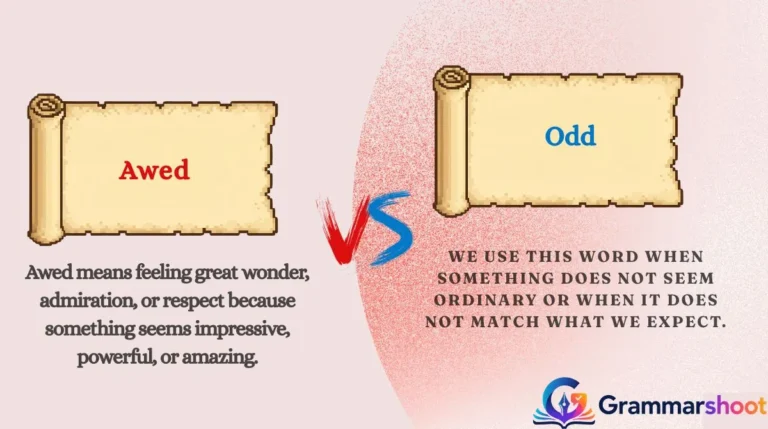
Awed means feeling great wonder, admiration, or respect because something seems impressive, powerful, or amazing.
When you are awed by something, you feel that it is special or remarkable. You may feel amazed by its beauty, size, skill, or importance. Sometimes, you may even feel small in comparison with what you are seeing.
For example, imagine visiting a huge waterfall for the first time. The sound of the water, the height of the waterfall, and the beauty of the view may leave you speechless. You could say, “I was awed by the waterfall.”
Here, awed explains your feeling of wonder and admiration.
When should you use “awed”?
Use awed when you want to describe a feeling caused by something impressive. That feeling may come from nature, a person’s talent, a great achievement, or an important event.
You might feel awed by a skilled musician, a powerful speech, a beautiful painting, or the night sky filled with stars. The word often expresses more than ordinary surprise. It suggests that something has made a strong impression on you.
For example, seeing a famous singer may surprise you, but hearing the singer perform brilliantly might leave you awed.
Grammar rules for “awed”
The word awed is the past form and past participle of the verb awe. It can also be used as an adjective to describe a person’s feeling or expression.
Here are the common sentence patterns:
- Subject + was/were + awed: We were awed by the view.
- Subject + feel/felt + awed: I felt awed during the ceremony.
- Subject + awe + object: The giant statue awed the visitors.
- Awed + noun: She watched the performance with an awed expression.
The phrase “awed by” is especially common. It introduces the person, event, or thing that causes the feeling.
For example, “The students were awed by their teacher’s knowledge.”
You can also use awed at in some contexts, although awed by is often the more natural choice for learners.
Example sentences using “awed”
- I was awed by the beauty of the mountains.
- The children looked awed when the magician performed his final trick.
- We stood silently, awed by the size of the ancient building.
- She felt awed by her mother’s courage.
- The audience was awed by the dancer’s amazing performance.
- He watched the rocket launch with an awed expression.
- The young players were awed by the famous footballer’s skills.
- I felt awed when I saw the stars shining over the desert.
Each sentence describes wonder, admiration, or respect. None of these sentences means that something is simply strange.
Common confusion about “awed”
Some learners think awed means the same as surprised. The words are related, but they are not exact synonyms.
You can be surprised by an unexpected phone call, but you are not necessarily awed by it. You are more likely to feel awed when something makes you admire its beauty, power, or greatness.
Remember that awed focuses on a person’s emotional response. It usually tells us how someone feels about something impressive.
What Does “Odd” Mean?
Odd means strange, unusual, unexpected, or different from what is normal.
We use this word when something does not seem ordinary or when it does not match what we expect. It can describe a person’s behavior, an object, a sound, a situation, or even a number.
For example, imagine that your friend usually arrives at school early. One morning, your friend arrives very late without explaining why. You might say, “That is odd.”
You mean the situation is unusual. You are not necessarily saying that it is wonderful or impressive.
When should you use “odd”?
Use odd when you notice something that seems different from the usual pattern. The situation may be funny, confusing, surprising, or even slightly worrying.
For example, an odd noise might make you curious about what caused it. An odd question might seem unexpected. An odd smell might suggest that something is wrong.
The word does not always have a negative meaning. Sometimes, something odd is interesting or amusing. However, it usually suggests that something is not normal or expected.
Grammar rules for “odd”
Unlike awed, which is the past form of a verb, odd is mainly an adjective. It describes a noun or follows a linking verb such as be, seem, or look.
Common sentence patterns include:
- Subject + be + odd: His answer was odd.
- Subject + seem/look + odd: That idea seems odd.
- Odd + noun: We heard an odd noise.
- It is odd that + clause: It is odd that nobody called.
You can also use odd before nouns such as behavior, feeling, sound, habit, and question.
Another meaning of odd appears in mathematics. An odd number is a whole number that cannot be divided evenly by two. Examples include 1, 3, 5, 7, and 9.
This mathematical meaning is different from the meaning of strange, so the context tells you which meaning is intended.
Example sentences using “odd”
- There was an odd noise coming from the kitchen.
- His sudden silence seemed odd to me.
- She has an odd habit of talking to her plants.
- I thought it was odd that the shop was closed so early.
- The man gave us an odd look and walked away.
- That is an odd question to ask during dinner.
- We found an odd-shaped stone beside the river.
- Seven is an odd number, but eight is an even number.
Notice that these examples describe unusual things, actions, or situations. They do not necessarily express admiration or deep respect.
Common confusion about “odd”
Some learners believe that odd always means bad, frightening, or wrong. That is not true.
An odd hat may simply look unusual. An odd joke may be funny in an unexpected way. An odd sound might be harmless. The word describes something outside the normal pattern, but it does not tell us whether that thing is good or bad in every situation.
For example, “She has an odd sense of humor” means her humor is unusual. It does not automatically mean she has a bad sense of humor.
Difference Between Awed and Odd (Detailed)
The main difference is simple: awed describes a feeling of wonder or admiration, while odd describes something unusual or strange.
Although both words can appear when something unexpected happens, they serve different purposes in a sentence. One focuses on an emotional response, while the other describes a quality or characteristic.
Comparison table
| Feature | Awed | Odd |
|---|---|---|
| Main meaning | Filled with wonder or respect | Strange or unusual |
| Part of speech | Past-tense verb form; also an adjective | Mainly an adjective |
| Usually describes | A person’s feeling or reaction | A person, thing, action, or situation |
| Emotional tone | Often admiration or wonder | Neutral, curious, amusing, or sometimes negative |
| Common patterns | Awed by, felt awed, awed expression | Odd noise, seems odd, odd behavior |
| Example | We were awed by the waterfall. | The waterfall made an odd sound. |
| Related word | Awe | Oddly, oddness |
1. Difference in meaning
The word awed expresses a strong reaction to something impressive. It often suggests admiration, respect, or amazement.
For example:
“The students were awed by the scientist’s discovery.”
This sentence means the students felt great wonder or admiration because the discovery impressed them.
Now consider this sentence:
“The scientist’s explanation sounded odd.”
Here, odd means that the explanation seemed strange or unusual. It does not necessarily mean that the explanation was impressive.
A useful way to understand the difference is to ask yourself what you want to describe. Are you describing someone’s feeling of wonder? Choose awed. Are you describing something unusual? Choose odd.
2. Difference in usage
These words are used in different situations, even when they refer to the same event.
Imagine that you visit a museum and see an enormous statue. You might say:
“I was awed by the statue.”
This tells the reader how you felt when you saw it.
However, if the statue has three heads and bright green wings, you might say:
“The statue looked odd.”
This describes its unusual appearance.
It is also possible to use both words when discussing one experience:
“I was awed by the artist’s skill, although the statue itself looked odd.”
The artist’s skill impressed you, but the statue’s appearance seemed unusual. Both words are correct because they express different ideas.
3. Difference in grammar
The grammar of these words is another important point.
Awed comes from the verb awe. It can describe an action in the past, as in “The view awed us.” It can also act as an adjective, as in “We were awed by the view.”
Odd, however, normally acts as an adjective. It describes a noun or follows a linking verb.
Compare these examples:
- The magician awed the audience.
- The audience was awed by the magician.
- The magician performed an odd trick.
- The trick seemed odd to the audience.
In the first sentence, awed is a verb. In the second, it describes the audience’s feeling. In the third and fourth, odd describes the trick.
You should not use odd as a replacement for awed just because you need a word to describe a reaction.
4. Difference in sentence structure
The phrase “awed by” is commonly used to show what caused a feeling of wonder.
For example:
- We were awed by her courage.
- He was awed by the size of the ship.
The word odd usually comes before a noun or after a linking verb.
For example:
- Her behavior was odd.
- We noticed an odd smell.
- His explanation seemed odd.
You can also say, “I found his behavior odd.” Here, odd describes the behavior, not the speaker’s feeling of admiration.
5. Can something be both awing and odd?
Yes. Something can be unusual and impressive at the same time.
Imagine seeing a huge, strangely shaped building with a beautiful design. You might think its appearance is odd, but you might also feel awed by the architect’s creativity.
For example:
“The building looked odd, but I was awed by its size and design.”
This sentence makes sense because the two words describe different parts of the experience.
The important lesson is that awed and odd are not interchangeable. Choose the word that matches the meaning you want to express.
Grammar Rules You Must Remember
Learning a word’s meaning is important, but knowing how to use it in a sentence is just as useful. These four rules will help you avoid common errors when writing or speaking English.
Rule 1: Use “awed” to describe wonder or admiration
When someone feels deep wonder or respect because of something impressive, use awed.
Correct: We were awed by the beauty of the old castle.
Incorrect for the intended meaning: We were odd by the beauty of the old castle.
The first sentence explains the visitors’ feelings. The second sentence is incorrect because odd is an adjective meaning unusual, and it does not fit the intended sentence structure.
Remember this pattern:
Person + was/were + awed by + something impressive.
Example: “The children were awed by the fireworks.”
Rule 2: Use “odd” to describe something unusual
When a person, object, action, or situation seems strange or different from what you expect, use odd.
Correct: I heard an odd sound outside my window.
Incorrect for the intended meaning: I heard an awed sound outside my window.
The first sentence tells us that the sound was unusual. The second does not express that meaning naturally.
Remember that odd can describe things you see, hear, smell, or notice.
For example, “The soup had an odd smell” means the smell was unusual. It does not mean the soup inspired wonder or admiration.
Rule 3: Remember that “awed” can be a verb or an adjective
The word awed has more than one grammatical use.
As a verb, it describes the effect something had on someone:
“The performance awed the crowd.”
As an adjective, it describes the feeling of a person:
“The crowd was awed by the performance.”
Both sentences are correct, but their structures are different. In the first sentence, the performance causes the feeling. In the second, the audience experiences the feeling.
By contrast, odd normally describes something:
“The performance was odd.”
This means the performance was unusual, not necessarily impressive.
Rule 4: Do not confuse “odd” with “awed” when describing reactions
A person’s reaction may be unusual, or the person may feel admiration. These are two different ideas.
Compare:
- “I was awed by his confidence.” This means his confidence impressed me.
- “I thought his confidence was odd.” This means his confidence seemed unusual to me.
Notice how the same subject can be described in two different ways. The correct word depends on the meaning you want to communicate.
Before choosing a word, ask yourself: Am I describing admiration, or am I describing something unusual? That small question can help you make the right choice.
Common Mistakes Students Make
English learners sometimes confuse words because they have similar spellings, appear in similar situations, or describe reactions to the same event. Here are some mistakes to watch out for.
Mistake 1: Using “odd” when you mean “awed”
Incorrect: I was odd by the beautiful painting.
Correct: I was awed by the beautiful painting.
The speaker wants to express admiration for the painting. Therefore, awed is the right choice.
Correction tip: If you can replace the word with “filled with wonder,” use awed.
Mistake 2: Using “awed” when you mean “odd”
Incorrect: There was an awed smell in the room.
Correct: There was an odd smell in the room.
The speaker is describing an unusual smell, not a feeling of admiration.
Correction tip: If you can replace the word with “strange” or “unusual,” use odd.
Mistake 3: Thinking that both words mean “surprised”
Incorrect idea: “I was awed by the unexpected bill” must mean I was surprised by it.
Better choice: “I was surprised by the unexpected bill.”
You can be awed by something surprising, but awed usually suggests wonder, admiration, or respect. A bill might surprise or shock you without inspiring any admiration.
Correction tip: Think about the type of reaction. Ordinary surprise does not always equal awe.
Mistake 4: Using the wrong sentence structure
Incorrect: The mountain was awed by us.
Correct, if you mean the mountain impressed you: We were awed by the mountain.
The incorrect sentence makes the mountain sound as though it experienced the feeling. Mountains do not normally feel awe. The corrected sentence places the people who experienced the feeling in the right position.
Correction tip: Ask who feels wonder and what causes it. Put the person who feels awe in the subject position when using “was/were awed by.”
Mistake 5: Assuming that “odd” always means bad
Incorrect idea: “Her odd clothes were terrible.”
Better sentence: “Her clothes looked odd, but I liked them.”
The word odd means unusual. It does not automatically mean ugly, wrong, or unpleasant.
Correction tip: Separate the description from your opinion. Something unusual can still be beautiful, funny, or interesting.
Mistake 6: Forgetting the difference between a feeling and a description
Compare these sentences:
- “I was awed by the strange machine.”
- “The machine looked odd.”
Both can be correct. The first describes the speaker’s feeling of wonder. The second describes the machine’s unusual appearance.
Correction tip: Identify the focus of the sentence before choosing the word.
Easy Trick to Remember the Difference
Here is a simple trick that works well for beginners.
Awed = Amazed
Remember that awed is connected to awe, a feeling of wonder or deep respect. Think of a breathtaking view, an amazing performance, or an incredible achievement.
Example: I was awed by the view.
Odd = Out of the Ordinary
Think of something that does not seem normal. It might be a strange sound, an unusual question, or an unexpected action.
Example: That noise sounds odd.
You can also remember the difference by imagining two everyday situations.
First, you visit a place with a beautiful view. You stop, look around, and feel amazed. You are awed.
Second, you hear your phone ring when it is switched off. You wonder how that happened because it seems unusual. That is odd.
Here is the shortest memory rule:
Awed describes your feeling. Odd describes what seems unusual.
This is not a rule that covers every possible sentence, but it is a reliable starting point for most everyday uses.
Daily Life Examples
The easiest way to learn confusing words is to see how people use them in natural conversations. The following examples show how awed and odd fit into daily English.
1. Talking about a beautiful place
Ali: How was your trip to the mountains?
Sara: Amazing! I was awed by the view from the top.
Sara uses awed because the mountain view filled her with wonder.
2. Talking about a strange noise
Hamza: Did you hear something outside last night?
Ayesha: Yes, there was an odd noise near the door.
Ayesha uses odd because the noise was unusual.
3. Talking about a talented person
Teacher: What did you think of the young pianist?
Student: I was awed by how beautifully she played.
The student feels admiration for the pianist’s skill.
4. Talking about unusual behavior
Friend 1: Why did Bilal leave the party without saying goodbye?
Friend 2: I don’t know. His behavior seemed odd.
Here, odd describes behavior that does not match what the speaker expected.
5. Talking about a science experiment
Student 1: Did you see the experiment in the science lab?
Student 2: Yes! I was awed by how quickly the reaction happened.
The experiment impressed the student and created a feeling of wonder.
6. Talking about food
Mother: Do you like this new soup?
Son: The taste is fine, but it has an odd smell.
The son describes the smell as unusual. He is not saying that the smell inspires admiration.
7. Talking about a sports match
Friend 1: Did you watch the final match?
Friend 2: Yes. I was awed by the goalkeeper’s performance.
The goalkeeper’s skill impressed the speaker.
8. Talking about an unexpected message
Friend 1: Why did your manager send that message at midnight?
Friend 2: I’m not sure. The timing was odd.
The speaker finds the timing unusual. The sentence does not express admiration.
9. Talking about a historic building
Visitor 1: What did you think of the old palace?
Visitor 2: I was awed by its size, although some of its decorations looked odd.
This example uses both words correctly. The palace’s size inspires wonder, while some decorations seem unusual.
10. Talking about a child’s question
Father: What did your little brother ask at dinner?
Daughter: He asked whether fish ever get thirsty. It was an odd question, but it made us laugh.
The question is unusual, but it is not necessarily bad. It is simply unexpected and amusing.
These conversations show that the right word depends on what you want to express. If you mean wonder or admiration, choose awed. If you mean unusual or strange, choose odd.
Practice Section: Test Your Understanding
Now it is time to check what you have learned. Read each sentence carefully and choose the correct word: awed or odd.
1. We were _____ by the beauty of the sunset.awedodd
2. I heard an _____ noise coming from the garage.awedodd
3. The audience was _____ by the singer’s amazing voice.awedodd
4. His strange behavior seemed _____ to everyone.awedodd
5. The visitors stood _____ by the size of the ancient temple.awedodd
Check answers
FAQs
1. What is the difference between awed and odd?
Awed describes a feeling of wonder, amazement, or deep respect. Odd describes something strange, unusual, or unexpected.
For example, “I was awed by the view” expresses admiration, while “The view looked odd” suggests that something about it seemed unusual.
2. Is “awed” a verb or an adjective?
Awed can be both a verb form and an adjective. It is the past tense and past participle of awe, as in “The performance awed us.”
It can also describe a feeling, as in “We were awed by the performance.” The sentence structure tells you how the word is being used.
3. Can “odd” describe a person?
Yes, odd can describe a person’s appearance, behavior, habits, or personality. For example, “He is an odd person” means that he seems unusual or different from most people.
However, the word can sound judgmental when applied directly to a person. If you want to sound more polite, you could say, “He has an unusual way of doing things.”
4. Can I use “awed” in a question?
Yes. You can use awed in both direct questions and indirect questions.
For example, “Were you awed by the performance?” asks whether someone felt wonder or admiration. You could also ask, “What awed you the most during your visit?”
Both questions are grammatically correct and natural.
5. Is “awed” formal or informal?
Awed works in both formal and informal English. You can use it in everyday conversation, school assignments, stories, and formal descriptions.
For example, “I was awed by the ceremony” is suitable for general conversation. “The researchers were awed by the discovery” can also fit a more formal piece of writing.
6. Does “odd” always mean something bad?
No. Odd means unusual or different from what is expected, but it does not always mean bad.
An odd question can be funny, an odd design can be creative, and an odd habit can be harmless. The surrounding sentence helps readers understand whether the unusual thing is amusing, worrying, or simply different.
Conclusion
Understanding the difference between awed and odd can make your English clearer and more natural. Although the words may look similar, they have different meanings and grammatical uses.
Remember that awed describes a feeling of wonder, amazement, or respect. You might feel awed by a beautiful landscape, a talented musician, or an impressive achievement. On the other hand, odd describes something strange, unusual, or unexpected. An odd noise, an odd question, or odd behavior does not seem normal or familiar.
Also, remember that awed can function as a verb form or an adjective, while odd is mainly an adjective. Pay attention to the sentence structure and the meaning you want to express.
The best way to remember these words is to practice using them in real situations. When something impresses you, try using awed. When something seems unusual, try using odd.
Keep reading, speaking, and writing in English. With regular practice, choosing the correct word will become easier, and you will feel more confident expressing your thoughts.

Evan Rellmont is a writer who turns thoughtful ideas into meaningful words, creating stories and reflections that connect, inspire, and leave a lasting impression.