
Have you ever wondered why some people have more opportunities than others? For example, imagine two students who want to attend college.
One student has good books, a computer, and a quiet room to study. The other student has no computer, few books, and many family duties.
Both students work hard, but they do not have the same chances of success.
This situation helps us understand two important English words: inequity and inequality.
These words look similar, and people sometimes use them in the same way. Both can describe differences between people, groups, or situations.
However, they do not always express the same idea. The main difference is that inequality usually refers to a difference in amount, level, status, or opportunity, while inequity focuses on unfairness or a lack of justice.
For English learners, understanding this difference is useful in everyday conversations, school assignments, news reports, and formal writing.
You may see these words when people discuss education, healthcare, jobs, income, or social problems.
The good news is that you do not need difficult grammar rules to understand them. Once you learn what each word means and how it is used, choosing the correct word becomes much easier.
By the end of this guide, you will understand the meanings of both words, their grammar rules, their differences, common mistakes, and practical examples. You will also have a chance to test your knowledge with a short exercise.
What Does “Inequity” Mean?
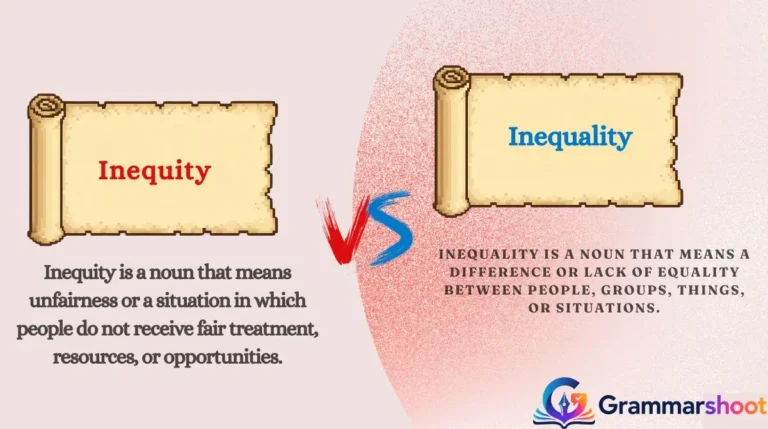
Inequity is a noun that means unfairness or a situation in which people do not receive fair treatment, resources, or opportunities.
When something is unfair, it may be described as an inequity. This word often appears when people discuss problems that affect different groups in different ways.
For example, imagine that two employees do the same job, have the same skills, and work the same hours. However, one employee receives a much lower salary because of discrimination. This situation may be called a workplace inequity.
The important point is not simply that the employees receive different salaries. The problem is that the difference may be unfair.
When Should You Use “Inequity”?
Use inequity when you want to highlight unfairness, unequal treatment, or an unjust system.
It is common in discussions about education, healthcare, employment, public services, and social justice. It also appears in academic writing, government reports, and professional discussions.
For instance, if children in one neighborhood have excellent schools while children in another neighborhood have poorly equipped schools because resources are distributed unfairly, someone might describe this as an educational inequity.
The word can refer to one unfair situation or a broader problem affecting many people.
Grammar Rules for “Inequity”
Inequity is a countable noun. Its plural form is inequities.
You can use it with articles such as an and the. When speaking about one unfair situation, use an inequity. When referring to several unfair situations, use inequities.
Common sentence patterns include:
- An inequity exists in a system.
- There is an inequity between two groups.
- The government is trying to address an inequity.
- The report identifies several inequities.
The adjective related to this word is inequitable, which means unfair. For example, “The policy is inequitable.”
Do not confuse inequity with inequitable. The first is a noun, while the second is an adjective.
Examples of “Inequity” in Sentences
- Educational inequity prevents some children from receiving a good education.
- The report discusses inequity in the healthcare system.
- The company wants to reduce pay inequity among its employees.
- Many families face inequities when trying to access public services.
- The new policy aims to address inequity in the workplace.
- Unequal access to clean water can create serious inequities between communities.
- The teacher noticed an inequity in the way students were treated.
- The organization works to reduce social inequities.
Each example focuses on a situation that is considered unfair. The word is especially useful when you want to explain why a difference is a problem.
Common Confusion About “Inequity”
Some learners think that inequity simply means that two things are different. However, a difference is not always unfair.
For example, one student may choose to study science while another chooses to study art. Their choices are different, but neither choice is automatically unfair.
Now imagine that one student is allowed to use the school library while another student is refused access because of an unfair rule. This situation involves inequity because the students are not receiving fair treatment.
Remember that inequity emphasizes fairness, not just difference.
What Does “Inequality” Mean?
Inequality is a noun that means a difference or lack of equality between people, groups, things, or situations.
It can refer to differences in income, wealth, education, power, rights, opportunities, or other conditions. It may also describe a mathematical relationship in which two values are not equal.
Unlike inequity, the word inequality does not always mean that something is unfair. It simply identifies a difference or a lack of equality. Whether that difference is fair or unfair depends on the situation.
For example, one person may earn more money than another because they work different hours or have different responsibilities. This is an income inequality, but the word alone does not tell us whether the difference is fair.
When Should You Use “Inequality”?
Use inequality when you want to describe differences between people, groups, amounts, or levels.
The word is common in news reports, school essays, social studies, economics, mathematics, and everyday discussions.
You might hear someone talk about income inequality, gender inequality, social inequality, or inequality in access to education.
For example, if one group earns much more money than another group, you can describe the difference as income inequality.
You can also use the word when discussing unequal opportunities. If students from wealthy families have more educational opportunities than students from poor families, this may be described as educational inequality. If the difference is unfair, it may also be an educational inequity.
Grammar Rules for “Inequality”
Inequality is usually an uncountable noun when it refers to a general condition, such as income inequality or social inequality. It can also be used as a countable noun when referring to particular forms or instances of inequality.
Its plural form is inequalities.
Common sentence patterns include:
- Inequality exists in society.
- There is inequality between two groups.
- The government is working to reduce inequality.
- The report examines different inequalities.
The adjective related to this word is unequal. For example, “The two groups have unequal access to education.”
Another related adjective is inequitable, but it has a different focus. Unequal describes a difference, while inequitable describes something unfair.
Examples of “Inequality” in Sentences
- Income inequality is a major topic in economics.
- There is a large inequality in wealth between the two groups.
- Gender inequality can affect people’s opportunities at work.
- The government introduced a plan to reduce economic inequality.
- Differences in school funding can contribute to educational inequality.
- The study examines inequality between rural and urban communities.
- Social inequality can influence people’s access to important services.
- The teacher explained the concept of inequality using simple numbers.
Notice that these examples describe differences in conditions, resources, or opportunities. The word itself does not always explain why those differences exist or whether they are justified.
Common Confusion About “Inequality”
Many learners believe that every inequality is automatically unfair. This is not always correct.
Consider two runners in a race. One runner finishes in ten minutes, while the other finishes in twelve minutes. Their finishing times are unequal. However, this difference does not automatically mean that the race was unfair.
Now imagine that one runner was given a much shorter route because the organizer wanted that person to win. The situation involves inequality, but it also raises a question of inequity because the runners were not treated fairly.
The main lesson is simple: inequality describes a difference, while inequity highlights unfairness.
Difference Between Inequity and Inequality
The words inequity and inequality are closely related, but their meanings are not exactly the same.
Inequality focuses on the fact that people or things are not equal in some way. Inequity focuses on whether that difference is unfair.
In real life, the two ideas often appear together. An unfair difference in salary, education, or healthcare may be described as both an inequality and an inequity. However, the words emphasize different parts of the situation.
Comparison Table
| Feature | Inequity | Inequality |
|---|---|---|
| Basic meaning | Unfairness or injustice | A difference or lack of equality |
| Main focus | Fairness | Difference |
| Always unfair? | Refers to unfairness | No, not necessarily |
| Part of speech | Noun | Noun |
| Plural form | Inequities | Inequalities |
| Common topics | Fair treatment, justice, access | Income, wealth, status, numbers |
| Common phrases | Healthcare inequity, pay inequity | Income inequality, gender inequality |
| Related adjective | Inequitable | Unequal |
| Example | The hiring process showed inequity. | The two groups had different incomes. |
1. Difference in Meaning
The clearest difference is the idea each word emphasizes.
Inequality tells us that a difference exists. Inequity tells us that a situation is unfair.
For example:
- Inequality: One school has more computers than another school.
- Inequity: One school receives fewer computers because its students are unfairly denied resources.
In the first sentence, we only know that the schools have different numbers of computers. We do not know whether the difference is fair.
In the second sentence, the focus is on unfair treatment. That is why inequity is a suitable word.
2. Difference in Usage
The two words are often used in similar areas, but the choice depends on your message.
Use inequality when discussing differences in income, wealth, power, education, or opportunities. Use inequity when you want to emphasize that a difference is unjust or that people are not being treated fairly.
For example:
“Income inequality has increased in the country.”
This sentence describes a difference in income distribution.
“The company is working to correct pay inequity.”
This sentence highlights unfairness in how employees are paid.
Both words can be correct in discussions about salaries. The second sentence simply makes fairness the central issue.
3. Difference in Grammar
There is no major difference in the basic grammar of these words. Both are nouns, and both can be subjects or objects in a sentence.
For example:
- Inequity affects many families.
- Inequality affects many families.
Both sentences are grammatically correct. However, they do not communicate exactly the same idea.
In the first sentence, the focus is on unfairness. In the second, the focus is on differences between people or groups.
You can also use both words after prepositions:
- We need to address inequity in education.
- We need to address inequality in education.
The best choice depends on whether you are emphasizing unfair treatment or unequal conditions.
4. Difference in Sentence Structure
Both words can follow verbs such as reduce, address, study, identify, and measure.
Examples include:
- The organization wants to reduce inequity.
- The organization wants to reduce inequality.
- Researchers studied inequality in income.
- Researchers studied inequity in access to healthcare.
The sentence structure remains the same. The difference lies in the meaning of the noun.
A useful pattern is:
Noun + in + area or system
Examples:
- Inequity in education
- Inequality in income
- Inequity in healthcare
- Inequality in wealth
You can also use these words before another noun:
- Educational inequity
- Income inequality
- Workplace inequity
- Social inequality
These combinations are common in formal writing and everyday discussions.
5. Difference in Meaning in Real-Life Situations
Imagine that two hospitals have different numbers of doctors. One hospital has twenty doctors, while the other has ten.
This is a difference between the hospitals. You could describe it as an inequality in staffing.
However, suppose the hospital with ten doctors serves twice as many patients and receives fewer resources despite having greater needs. This may be an inequity because the distribution of resources could be unfair.
The same idea applies to schools, workplaces, and public services.
A difference does not automatically prove unfairness. To identify inequity, you need to consider the situation, people’s needs, the reasons for the difference, and whether everyone has a fair chance.
6. Can Both Words Be Correct in the Same Sentence?
Yes. Sometimes both words are useful because they describe different parts of one problem.
For example:
“The study found income inequality and explained how unfair pay practices created inequity.”
Here, inequality describes differences in income, while inequity points to unfair practices behind those differences.
You could also write:
“Educational inequality may become an inequity when children are unfairly denied access to quality schools.”
This sentence explains that an unequal situation can also be unfair, but the two terms are not identical.
Grammar Rules You Must Remember
Learning a few simple rules will help you use these words correctly in your writing and speech.
Rule 1: Use “Inequity” When Fairness Is the Main Focus
Choose inequity when you want to highlight unfair treatment, unjust decisions, or an unfair distribution of resources.
Correct: “The investigation revealed inequity in the hiring process.”
This sentence suggests that the hiring process was unfair.
Remember, the important idea is not just that applicants had different results. The concern is whether the process treated them fairly.
Rule 2: Use “Inequality” When Describing a Difference
Choose inequality when you are talking about a difference in amount, level, status, or opportunity.
Correct: “The report examines income inequality in the region.”
This sentence focuses on differences in income. More information may be needed to decide whether those differences are fair.
A simple question can help: Am I mainly describing a difference, or am I pointing to unfairness?
Rule 3: Both Words Are Nouns
Do not use inequity or inequality as adjectives.
Incorrect: “The company has an inequality system.”
Better: “The company has an unequal system.”
Another correct option is: “The company has an inequitable system.”
In the first correction, unequal describes a difference. In the second, inequitable describes unfairness.
Rule 4: Use the Correct Plural Forms
The plural of inequity is inequities. The plural of inequality is inequalities.
Correct: “The report identifies several inequities in public services.”
Correct: “The report identifies several inequalities in income.”
Avoid forms such as inequitys or inequalitys. Both nouns change their endings to form the plural.
Also remember that general concepts are often used in the singular without an article. For example, “Inequality remains a serious concern.”
Common Mistakes Students Make
English learners often confuse these words because they share similar spellings and appear in many of the same discussions. Here are some common mistakes and ways to correct them.
Mistake 1: Treating Every Difference as Unfair
Incorrect: “The two players scored different numbers of goals, so there was inequity.”
Better: “The two players scored different numbers of goals, so there was inequality in their scores.”
Different scores alone do not prove that anyone was treated unfairly. The players may simply have performed differently.
If one player was given an unfair advantage, however, inequity might be suitable.
Correction tip: Before using inequity, ask yourself whether the situation involves unfairness.
Mistake 2: Using “Inequality” When You Mean Unfair Treatment
Incorrect: “The manager showed inequality by refusing to hire qualified women because of their gender.”
Better: “The manager showed inequity by refusing to hire qualified women because of their gender.”
The word inequality could describe a difference in hiring outcomes, but inequity more directly highlights the unfair treatment described in the example.
You could also say, “The decision created gender inequality.”
Correction tip: When your main point is discrimination or unfair treatment, consider inequity.
Mistake 3: Confusing the Nouns With Their Adjectives
Incorrect: “The rules are inequity.”
Correct: “The rules are inequitable.”
You could also write, “The rules create inequity.”
The first correct sentence uses inequitable to describe the rules. The second uses inequity as a noun to describe the result.
Correction tip: Use inequity and inequality to name conditions. Use inequitable and unequal to describe things.
Mistake 4: Assuming the Words Are Always Interchangeable
Incorrect: “The two bags have different weights, which proves inequity.”
Better: “The two bags have different weights, which shows inequality in their weight.”
If there is no reason to think the difference is unfair, inequality is more accurate.
However, if one student is deliberately given a much heavier bag as a punishment while others receive light bags, the situation might involve inequity.
Correction tip: Look at the context, not just the words around the noun.
Mistake 5: Using the Wrong Plural Form
Incorrect: “The school wants to solve educational inequitys.”
Correct: “The school wants to address educational inequities.”
The plural form of inequity ends in -ies. The plural form of inequality also ends in -ies.
Correction tip: Learn the singular and plural forms together: inequity/inequities and inequality/inequalities.
Mistake 6: Thinking Inequality Is Always Negative
Incorrect: “Any inequality between two people is necessarily unfair.”
Better: “Some inequalities are unfair, but others may result from different choices or circumstances.”
For example, people may earn different amounts because they work different hours. That difference does not automatically prove injustice.
Correction tip: Use inequality to identify a difference. Consider the wider situation before deciding whether it is unfair.
Easy Trick to Remember the Difference
Here is a simple trick that can help you remember these words:
Inequality = difference.
Inequity = unfairness.
Think about two students who receive different marks on a test. One student gets 90, while the other gets 70. Their scores show inequality because the numbers are different.
Now imagine that the teacher gives one student extra time but refuses to give the other student the same extra time, even though both students have the same approved need for it. This could be an inequity because the students are not being treated fairly.
You can remember the distinction by asking two questions:
- Are two people or things different in some way? If yes, inequality may fit.
- Is that difference unfair or unjust? If yes, inequity may fit.
Keep in mind that the two ideas can overlap. A situation can involve both a difference and unfairness.
For example, if one community has much less access to clean water because public resources are unfairly distributed, the situation may involve water inequality and water inequity.
You do not need to judge every situation immediately. First, identify the difference. Then consider whether the difference is fair.
Daily Life Examples
These examples show how the two words can appear in everyday discussions. They also help you understand when one word may be more suitable than the other.
Example 1: At School
Ali: Why does one school have a science lab while another school has none?
Sara: That shows inequality in school resources.
Ali: And if the second school is unfairly denied funding?
Sara: Then we can also talk about educational inequity.
The first answer identifies a difference. The second highlights unfairness in the way resources are distributed.
Example 2: At Work
Employee: People in the same position are earning different salaries.
Friend: That sounds like pay inequality.
Employee: Yes, especially if the difference comes from unfair treatment.
Friend: In that case, pay inequity may also be an issue.
This conversation shows that both terms can describe the same situation from different angles.
Example 3: In a Hospital
Patient: Why does the city hospital have more doctors than the rural hospital?
Nurse: There is an inequality in the number of doctors available.
Patient: What if rural patients are unfairly given fewer services?
Nurse: That could be healthcare inequity.
The second part focuses on whether patients have fair access to care.
Example 4: In a Family
Brother: You gave my sister a bigger piece of cake than mine.
Mother: Yes, because she is sharing hers with a younger child.
Brother: So the pieces are unequal, but is it unfair?
This example shows that unequal amounts do not always mean unfair treatment. The reason behind the difference matters.
Example 5: In the News
“The report discusses income inequality and explains why some workers face unfair pay practices.”
Here, income inequality refers to differences in earnings. The mention of unfair pay practices introduces the idea of inequity.
Example 6: In a Community
“Our neighborhood has fewer parks than other neighborhoods. We are concerned about inequality in public facilities.”
If the local government unfairly denies the neighborhood access to resources, residents may also raise concerns about inequity.
Example 7: During a Class Discussion
Teacher: What is the difference between inequality and inequity?
Student: Inequality means people have different conditions or resources. Inequity means those differences involve unfairness.
Teacher: Excellent. Can a situation involve both?
Student: Yes. An unfair difference in school funding can involve both inequality and inequity.
Example 8: In a Job Interview
Interviewer: What workplace problems are you concerned about?
Applicant: I am concerned about pay inequality and inequity in promotion decisions.
The applicant uses inequality to discuss differences in pay and inequity to highlight unfairness in promotion decisions.
Example 9: In a Public Meeting
“We need better public transport in this area because residents have fewer travel options than people in the city center.”
This describes an inequality in access to transport. If residents are unfairly denied suitable public services, the issue may also involve inequity.
Example 10: In an Essay
“Income inequality describes differences in earnings, while income inequity highlights unfairness in how earnings or opportunities are distributed.”
This is a useful sentence for students writing essays about economics, education, or social issues.
Practice Section: Test Your Understanding
Choose the correct word to complete each sentence. In some situations, the context will help you identify whether the main idea is a difference or unfairness.
Questions
1. The report compares the income levels of rich and poor families.
A. Inequity
B. Inequality
2. The manager refuses to promote qualified employees because of their background.
A. Inequity
B. Inequality
3. The two boxes have different weights.
A. Inequity
B. Inequality
4. The school gives resources to some students while unfairly denying them to others.
A. Inequity
B. Inequality
5. The research examines differences in wealth across several countries.
A. Inequity
B. Inequality
Answers and Explanations
1. B — Inequality. The sentence focuses on differences in income. It does not automatically explain whether those differences are unfair.
2. A — Inequity. The manager is treating employees unfairly. The focus is on an unjust decision.
3. B — Inequality. The boxes have different weights. Without more information, there is no reason to call the difference unfair.
4. A — Inequity. The sentence clearly describes unfair treatment in the distribution of resources.
5. B — Inequality. The research compares differences in wealth between countries.
If you answered most questions correctly, you understand the main distinction. If you found some questions difficult, return to the memory trick: inequality means a difference, while inequity highlights unfairness.
FAQs
1. What is the difference between inequity and inequality?
Inequality means a difference or lack of equality between people, groups, or things. Inequity means unfairness or injustice. An unequal situation is not always unfair, but an inequity involves unfairness.
2. Can inequity and inequality be used interchangeably?
Sometimes, but not always. Both words may describe the same situation when a difference is also unfair. However, inequality emphasizes the difference, while inequity emphasizes unfairness. Choose the word that best expresses your meaning.
3. Is inequity more formal than inequality?
Both words are used in formal writing, academic work, reports, and professional discussions. Inequity often appears in discussions about fairness and justice, while inequality is common in economics, mathematics, and social studies. Neither word is limited to formal English.
4. Is inequality always a bad thing?
No. Inequality simply means that two or more things are not equal in some way. Different test scores, salaries, or amounts may be unequal without automatically being unfair. To decide whether a difference is unjust, you need to understand the reasons behind it.
5. What are the plural forms of inequity and inequality?
The plural of inequity is inequities. The plural of inequality is inequalities. For example, “The report identifies several inequities in healthcare” and “The study examines inequalities in income.”
6. What is the difference between inequitable and unequal?
Unequal describes things that are different in amount, size, level, or condition. Inequitable describes something that is unfair. For example, two salaries may be unequal, but they are inequitable when the difference results from unfair treatment.
Conclusion
Understanding the difference between inequity and inequality can make your English clearer and more accurate. Although these words are closely related, they focus on different ideas.
Inequality describes a difference. Inequity highlights unfairness. This is the easiest way to remember their meanings.
For example, when two schools have different amounts of funding, you can describe the situation as an inequality in school resources. If one school is unfairly denied the funding it needs, you may also describe the situation as an educational inequity.
Both words are nouns, and their plural forms are inequities and inequalities. Their related adjectives are inequitable and unequal.
When you are unsure which word to choose, think about the message you want to express. Are you simply describing a difference, or are you explaining why something is unfair? Your answer will usually guide you toward the correct word.
Keep practicing with examples from school, work, and daily life. The more you notice these words in real sentences, the easier it will become to use them naturally and confidently.

Evan Rellmont is a writer who turns thoughtful ideas into meaningful words, creating stories and reflections that connect, inspire, and leave a lasting impression.