
Have you ever wondered whether you should write “backup your files” or “back up your files”? Both forms are common in English, and they look almost the same.
However, they have different grammatical roles. Choosing the correct form can be confusing, especially for students and people learning English as a second language.
The good news is that the difference is easy to understand once you learn one simple rule. “Backup” is usually a noun or an adjective, while “back up” is a verb.
The words are closely related, but they do not always work in the same places in a sentence.
You may see these words when using a computer, saving important documents, talking about your work, or asking someone to support your decision.
For example, you might create a backup of your photos, back up your phone, or ask a friend to back you up during a difficult conversation.
These examples show why the difference matters in everyday English. Using the wrong form may not stop people from understanding you, but it can make your writing less accurate.
By the end of this guide, you will know when to use each form, how to build correct sentences, and which common mistakes to avoid.
You will also learn easy memory tricks, everyday conversations, and practice questions to help you use both forms with confidence.
What Does “Backup” Mean?
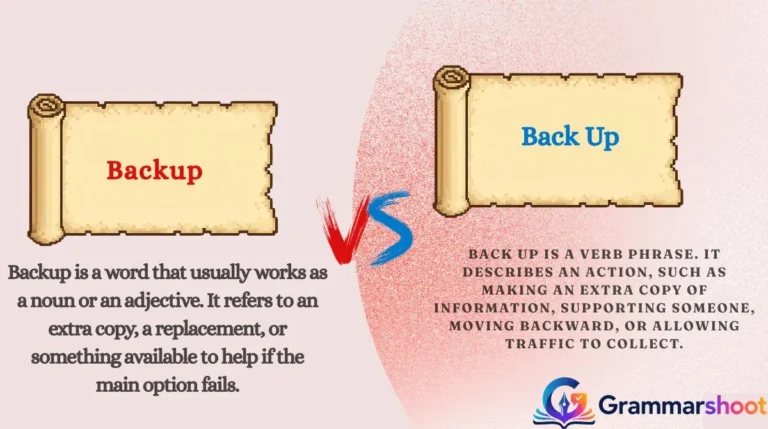
Backup is a word that usually works as a noun or an adjective. It refers to an extra copy, a replacement, or something available to help if the main option fails.
It is especially common in conversations about computers, phones, work plans, and people who can provide support.
1. Backup as a noun
A noun names a person, place, thing, or idea. When you use “backup” as a noun, you are talking about an extra copy, a reserve, or a source of support.
For example, when you save another copy of your important files, that copy is called a backup. If your computer stops working, you can use the backup to recover your information.
Consider these examples:
- I made a backup of all my important documents.
- Keep a backup of your family photos.
- We need a backup in case the first plan fails.
- The police officer called for backup.
- My laptop has a backup of the entire project.
- Always keep a backup of your schoolwork.
- The team has a backup goalkeeper.
- We have a backup plan for the weekend.
In each sentence, “backup” names something. It may be a saved copy, a person who can replace someone else, or another plan that can be used when needed.
2. Backup as an adjective
An adjective describes a noun. “Backup” can also describe something that serves as an extra or replacement.
For example, a “backup plan” is another plan you can use if your original plan does not work.
Here are more examples:
- I brought a backup charger for my phone.
- We need a backup generator for emergencies.
- She is the backup driver for our trip.
- The company hired a backup team for the project.
- Keep your backup battery fully charged.
- He created a backup account for safety.
Notice that “backup” comes before another noun in these examples. It tells you what kind of charger, generator, driver, team, battery, or account is being discussed.
When should you use “backup”?
Use “backup” when you need a noun or an adjective in your sentence.
For instance:
- Correct: I saved a backup of the report.
- Correct: We have a backup plan.
- Correct: She is our backup singer.
In the first sentence, “backup” names a saved copy. In the second and third sentences, it describes the type of plan or singer.
Common learner confusion
Many learners write “backup” whenever they talk about saving files. They may write, “Please backup your documents.”
Although readers will usually understand the message, standard edited English generally uses “back up” as the verb: “Please back up your documents.”
Remember that the word “backup” is not wrong. The important thing is to use it according to its grammatical role.
What Does “Back Up” Mean?
Back up is a verb phrase. It describes an action, such as making an extra copy of information, supporting someone, moving backward, or allowing traffic to collect.
The phrase contains two words: “back” and “up.” Together, they form a verb with several related meanings.
1. Back up means to make an extra copy
This is one of the most common meanings in modern English, especially when talking about computers, mobile phones, and digital information.
When you back up a file, you create an extra copy so you can recover it if the original is lost, damaged, or deleted.
Examples:
- Please back up your files before updating the computer.
- I back up my phone every week.
- She backed up all her photographs to the cloud.
- We need to back up the school database tonight.
- Did you back up your documents before the laptop stopped working?
- He is backing up his work on an external drive.
- Remember to back up your contacts.
- They backed up the files before repairing the computer.
Here, “back up” describes an action. The tense may change depending on when the action happens: “back up” is present, “backed up” is past, and “backing up” is the -ing form.
2. Back up means to support someone
The phrase can also mean to support a person, an idea, or a statement.
Suppose your friend tells the teacher that you completed your assignment on time. If you also explain what happened and support your friend’s statement, you are backing your friend up.
Examples:
- I will back you up during the meeting.
- My sister backed me up when I explained the problem.
- The manager backed up his employee’s decision.
- Can you back me up if anyone questions my answer?
- The evidence backs up her claim.
- Our teacher backed us up when we explained the situation.
In these sentences, the phrase does not mean making a computer copy. It means providing support or evidence.
3. Back up means to move backward
“Back up” can also describe moving a person or vehicle backward.
For example:
- Please back up the car slowly.
- He backed up to make room for the other driver.
- The truck needs to back up before turning.
- She backed up when she saw the dog.
The meaning becomes clear from the surrounding words. If someone is driving a car, “back up” may describe reversing rather than saving information.
4. Back up means to collect or become blocked
The phrase is also used when traffic, water, or work begins to collect because it cannot move forward freely.
Examples:
- Traffic began to back up near the bridge.
- The sink is blocked, so water is backing up.
- Orders backed up during the busy season.
- Cars are backing up outside the school.
In these sentences, something is accumulating or failing to move smoothly.
How do you use “back up” in a sentence?
Because “back up” is a verb phrase, it often appears after a subject and can be followed by an object.
For example:
- I back up my files.
- She backed up her claim.
- Please back up the car.
It can also appear without a direct object:
- The traffic backed up.
- The water is backing up.
The exact sentence structure depends on the meaning you want to express.
Difference Between Backup and Back Up (Detailed)
The main difference is grammatical. “Backup” usually names a thing or describes another noun, while “back up” describes an action.
Both forms are correct, but they are not interchangeable in every sentence.
Comparison table
| Feature | Backup | Back up |
|---|---|---|
| Main grammatical role | Noun or adjective | Verb phrase |
| Basic idea | An extra copy, reserve, or support option | To make a copy, support someone, or move backward |
| Number of words | One | Two |
| Example about files | I made a backup. | I back up my files. |
| Example about plans | We need a backup plan. | We need to back up our original decision with evidence. |
| Example about people | She is the backup singer. | I will back you up. |
| Can show an action? | Not usually by itself | Yes |
| Can name a thing? | Yes | Not in standard use as a noun |
1. The difference in meaning
The words are closely related, but they focus on different things.
“Backup” usually refers to the thing that is kept available. “Back up” refers to the action of creating or providing that extra support.
Compare these sentences:
- I created a backup of my files.
- I backed up my files.
The first sentence focuses on the extra copy. The second focuses on the action of making that copy.
Both sentences can describe the same situation, but the grammatical focus is different.
Here is another comparison:
- We have a backup plan.
- We need to back up our decision with facts.
In the first sentence, “backup” describes a plan that can be used if needed. In the second, “back up” means to support a decision with evidence.
2. The difference in grammar
Grammar tells us how words work together in a sentence.
“Backup” is a noun in “I need a backup.” It is an adjective in “I need a backup computer.”
“Back up” is a verb phrase in “I need to back up my computer.”
Look at the different sentence patterns:
Noun pattern: Subject + verb + a/the + backup
Example: I made a backup.
Adjective pattern: Backup + noun
Example: We bought a backup phone.
Verb pattern: Subject + verb phrase + object
Example: I back up my phone.
These patterns are useful because they help you decide which spelling fits your sentence.
3. The difference in sentence structure
Consider these examples:
- We need a backup.
- We need to back up our data.
In the first sentence, “a” comes before “backup.” This is a strong clue that the word is a noun. The sentence means that we need an extra copy, reserve, or alternative.
In the second sentence, “to” comes before “back up.” The phrase acts as a verb in the infinitive form. The sentence describes an action that needs to be done.
Another useful comparison is:
- The backup is ready.
- Please back up the files.
In the first sentence, “the” introduces the noun “backup.” In the second, “back up” follows the request word “please” and describes an action.
4. Why does one form have a space?
English often combines related words into a single noun or adjective over time. “Backup” is an established closed compound, while “back up” remains a two-word verb phrase.
This pattern is not unusual. Compare “setup” with “set up” and “checkup” with “check up.”
The spelling depends on the grammatical job the words perform, not simply on how closely related their meanings are.
5. Can the two forms appear in the same sentence?
Yes! Using both forms together is an excellent way to understand the difference.
Consider this sentence:
“Make a backup before you back up your phone.”
The first “backup” is a noun. It refers to an extra copy.
The second “back up” is a verb phrase. It describes the action of creating a copy.
Although the sentence sounds repetitive, it can make sense in a situation where someone needs to create one copy before performing another backup action.
A more natural example is:
“Keep a backup drive so you can back up your files whenever necessary.”
Here, “backup” describes the drive, while “back up” tells you what you can do with your files.
Grammar Rules You Must Remember
Four simple rules can help you choose the correct form without guessing.
Rule #1: Use “backup” when you name an extra copy or alternative
When you talk about a saved copy, reserve item, or alternative plan, use the one-word form.
Examples:
- I made a backup of my presentation.
- We need a backup plan.
- The office has a backup generator.
A useful clue is the word before it. Words such as “a,” “the,” “my,” and “your” can come before the noun “backup.”
For example, “my backup” and “a backup” are both correct.
Rule #2: Use “back up” when you describe an action
If the sentence tells someone to save a copy, support another person, or move backward, use the two-word verb phrase.
Examples:
- Back up your files before you leave.
- I will back you up during the discussion.
- Please back up the car.
Ask yourself, “What is the person doing?” If the answer is an action expressed by this phrase, write “back up.”
Rule #3: Change the verb form when the tense changes
The verb phrase changes according to the tense and structure of the sentence. The noun “backup” does not change in the same way.
Examples:
- Present: I back up my files every Friday.
- Past: I backed up my files yesterday.
- Continuous: I am backing up my files now.
- Infinitive: I need to back up my files.
Notice that “backed” and “backing” change, while the space remains between “back” and “up.”
Do not write “I backuped my files.” The correct past form is “I backed up my files.”
Rule #4: Separate the words when another object comes between them
In many sentences, “back up” is a separable phrasal verb. This means that a noun object can appear between “back” and “up.”
For example:
- Back up your files.
- Back your files up.
Both sentences are correct.
However, when the object is a pronoun such as “it,” “them,” or “me,” it must normally go between the two parts of this phrasal verb.
Correct:
- Back it up.
- Back them up.
- I will back you up.
Incorrect in standard English:
- Back up it.
- Back up them.
- I will back up you.
This rule is especially helpful when giving instructions or speaking naturally.
Common Mistakes Students Make
Even learners who know the basic rule sometimes mix up these forms. Most mistakes happen because the words sound related and have similar meanings.
Mistake 1: Using “backup” as a verb
Incorrect: Please backup your photos before deleting them.
Correct: Please back up your photos before deleting them.
Why? The sentence asks someone to perform an action. Therefore, you need the verb phrase “back up.”
Correction tip: If you can replace the phrase with “save a copy of,” use “back up.”
Mistake 2: Writing “back up” as a noun
Incorrect: I made a back up of the report.
Correct: I made a backup of the report.
Why? The sentence names an extra copy. The one-word noun is standard.
Correction tip: If you can put “a,” “the,” or “my” before the word, check whether you need the noun “backup.”
Mistake 3: Using the wrong past tense
Incorrect: She backuped the documents last night.
Correct: She backed up the documents last night.
Why? “Backup” is not the base verb in this sentence. The verb is “back up,” and its past form is “backed up.”
Correction tip: Remember the three forms: back up, backed up, backing up.
Mistake 4: Putting a pronoun in the wrong place
Incorrect: Can you back up it?
Correct: Can you back it up?
Why? With this separable phrasal verb, a pronoun normally goes between “back” and “up.”
Correction tip: Say “back it up,” “back them up,” and “back me up.”
Mistake 5: Confusing a backup plan with backing someone up
Incorrect: I will backup you during the meeting.
Correct: I will back you up during the meeting.
Why? The sentence means “I will support you.” It needs a verb phrase, not the noun or adjective “backup.”
Correction tip: If you mean “support,” write “back up.”
Mistake 6: Thinking that the one-word form is always wrong
Incorrect belief: “Backup” is never correct in a sentence about computers.
Correct examples:
- My backup is stored on an external drive.
- I need a backup copy.
- I will back up my files tonight.
Why? Both forms are correct when used in the right grammatical roles.
Correction tip: Do not choose a spelling based only on the topic. Look at the function of the word in the sentence.
Easy Trick to Remember the Difference
Here is a simple memory trick:
One word names a thing. Two words describe an action.
Think of a phone that contains important photographs.
You create a backup. That is the extra copy.
You back up your phone. That is the action you perform.
This small difference can help you in many situations.
Try another example:
- “I need a backup.” You need an extra option or copy.
- “I need to back up my work.” You need to perform an action.
You can also use a quick substitution test.
If “extra copy” or “alternative” makes sense in the sentence, “backup” may be the right choice.
If “save a copy,” “support,” or “move backward” makes sense, “back up” is probably correct.
For example:
“I need a backup plan.”
You can understand this as “I need an alternative plan.” The noun or adjective form works.
“Please back up your work.”
You can understand this as “Please save an extra copy of your work.” The verb phrase works.
Do not worry if you need a little time to decide at first. With regular practice, you will begin to recognize the correct form naturally.
Daily Life Examples
The best way to learn confusing words is to see them in situations you may experience every day. The following conversations show how both forms work in natural English.
1. Saving schoolwork
Ali: Have you saved your assignment?
Sara: Yes, I made a backup on my USB drive.
Ali: Great! Remember to back up your next assignment, too.
Here, “backup” names the extra copy, while “back up” describes the action.
2. Using a mobile phone
Ayesha: My phone is almost full. What should I do?
Hina: Back up your photos to the cloud and remove the extra copies from your phone if you no longer need them.
Ayesha: Good idea. I’ll make sure I have a backup first.
The verb phrase describes saving the photos elsewhere. The noun refers to the saved copy.
3. Preparing for a meeting
Manager: Do we have another person who can handle the presentation?
Team member: Yes, Ahmed is our backup presenter.
Manager: Good. Please tell him to back up his main points with facts.
The first use describes a replacement person. The second means supporting ideas with evidence.
4. Fixing a computer
Hamza: The computer is not working properly.
Usman: Did you back up your files before the problem started?
Hamza: Yes. I have a backup on my external drive.
The two forms are used naturally because one describes an action and the other names the saved copy.
5. Asking for support
Mariam: I’m worried that nobody will believe my explanation.
Noor: Don’t worry. I’ll back you up because I saw what happened.
Mariam: Thank you. It means a lot.
Here, “back you up” means to support someone.
6. Making travel plans
Bilal: What happens if our bus is canceled?
Danish: We have a backup plan. We can take the train instead.
Bilal: That sounds sensible.
“Backup plan” is a noun phrase describing an alternative arrangement.
7. Reversing a car
Driver: Am I too close to the wall?
Passenger: Yes. Please back up a little.
Driver: Is that better?
Passenger: Yes, that’s perfect.
In this conversation, “back up” means to move the car backward.
8. Protecting work documents
Employee: Can I turn off the computer now?
Supervisor: Not yet. Please back up the report first.
Employee: Okay. I’ll save a backup copy before shutting it down.
The first form is a verb phrase. The second is a noun phrase.
9. Planning an outdoor event
Friend 1: What if it rains during the picnic?
Friend 2: We have a backup location indoors.
Friend 1: Good. I’ll back you up if you need help moving the equipment.
“Backup location” means an alternative place. “Back you up” means provide support.
10. Working with important evidence
Teacher: You have made a strong claim in your essay.
Student: I found some reliable sources to back it up.
Teacher: Excellent. Good evidence makes your argument stronger.
In this example, “back it up” means support the claim with evidence. The pronoun “it” correctly appears between “back” and “up.”
Practice Section: Choose the Correct Form
Test your understanding with these five sentences. Choose either “backup” or “back up” for each blank. Pay attention to the meaning and grammar of the sentence.
- Please ______ your phone before installing the update.
- I keep a ______ copy of my school project.
- Can you ______ me during tomorrow’s meeting?
- Our team needs a ______ plan in case the weather changes.
- She forgot to ______ her files before her laptop stopped working.
Answers and explanations
- Back up — The sentence describes an action: saving an extra copy of the phone’s information.
- Backup — The word names an extra copy, so the noun form is correct.
- Back up — The sentence means “Can you support me?”
- Backup — The word describes the type of plan, so it works as an adjective.
- Back up — The sentence describes an action that she forgot to perform.
If you answered all five correctly, you understand the main difference. If you made a mistake, review the sentence patterns and try the questions again.
FAQs About Backup vs Back Up
1. What is the difference between backup and back up?
“Backup” is usually a noun or an adjective. It names an extra copy, reserve, or alternative, as in “a backup plan.”
“Back up” is a verb phrase that describes an action, such as saving a copy or supporting someone. For example, “Back up your files.”
2. Should I write “backup my phone” or “back up my phone”?
In standard edited English, write “back up my phone” when you mean to save a copy of its data.
For example: “I back up my phone every Sunday.”
Use “backup” when you name the copy or describe an item, as in “my phone backup” or “a backup phone.”
3. Is backup one word or two words?
Both spellings are correct, but they serve different grammatical purposes.
The noun and adjective are normally written as one word: “backup.” The verb phrase is written as two words: “back up.”
Choose the form that fits the sentence rather than assuming one spelling is always correct.
4. Can I use “back up” in questions?
Yes. You can use it in questions about saving information, providing support, or moving backward.
Examples include “Did you back up your files?” and “Can you back me up?”
When using a pronoun as the object, place it between “back” and “up,” as in “Can you back me up?”
5. Is backup formal or informal English?
Both “backup” and “back up” are standard English forms. Neither is limited to formal or informal speech.
You can use them in school assignments, business emails, technical instructions, and everyday conversations. The main concern is choosing the correct grammatical form.
6. Is “back up” the same as “support”?
Sometimes. When you back someone up, you support that person, often by agreeing with them or providing evidence.
For example, “My colleague backed me up during the meeting” means the colleague supported me.
However, “back up” can also mean saving a copy of information or moving backward, so the surrounding sentence determines the meaning.
Conclusion
The difference between “backup” and “back up” is small, but learning it can make your English writing clearer and more accurate. The key is to focus on the job each form does in a sentence.
Use “backup” when you mean an extra copy, a reserve, or an alternative. It can work as a noun, as in “I made a backup,” or as an adjective, as in “We need a backup plan.”
Use “back up” when you describe an action. You might back up your phone, back up a friend’s explanation, or back up a car. Remember that the verb changes to forms such as “backed up” and “backing up” when the tense changes.
One easy rule can help you remember the difference: one word names a thing, while two words describe an action. Keep this rule in mind when writing emails, completing schoolwork, or talking about technology.
Practice with a few sentences each day, and the correct form will soon feel natural. You do not need to memorize every example. Just learn to recognize whether your sentence names something or describes an action.

Evan Rellmont is a writer who turns thoughtful ideas into meaningful words, creating stories and reflections that connect, inspire, and leave a lasting impression.