
Have you ever written “The sun is shining” and wondered why the word son sounds exactly the same? You are not alone.
Many English learners confuse these two words because they have the same pronunciation but completely different meanings.
Although sun and son sound alike, you cannot use them in the same way. One is a bright star that gives Earth light and heat.
The other refers to a male child in relation to a parent.
Learning the difference is important because both words appear in everyday English. You might talk about the weather, describe a sunny day, or tell someone about your family.
Choosing the wrong spelling can change the meaning of your sentence and confuse your reader.
The good news is that you do not need to learn a complicated grammar rule to understand these words. You only need to remember what each word means, when to use it, and how it fits into a sentence.
By the end of this guide, you will understand the meaning of both words, their grammatical uses, and the common mistakes learners make.
You will also find simple examples, everyday conversations, memory tricks, and a short practice exercise to test your knowledge.
Whether you are a beginner, a student, or someone improving your written English, these simple explanations will help you choose the correct word with confidence.
What Does “Sun” Mean?
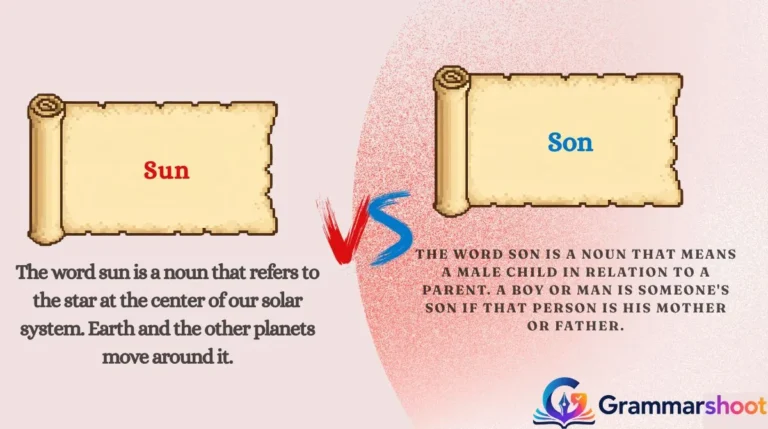
The word sun is a noun that refers to the star at the center of our solar system. Earth and the other planets move around it. The Sun provides the light and heat that make life on Earth possible.
In everyday English, we often use sun when talking about weather, daylight, warmth, outdoor activities, and the sky.
For example, when you say, “The sun is very bright today,” you are talking about the star that lights up the day.
When Should You Use “Sun”?
Use sun when you are talking about the star, its light, its heat, or the sunlight we experience on Earth.
Here are some common situations in which this word is useful:
- Weather: The sun is shining today.
- Temperature: The sun makes the room warm.
- Outdoor activities: We sat in the sun for an hour.
- Nature: The sun rises in the east.
- Sunlight: The plants need the sun to grow.
- Daily routines: I enjoy walking in the morning sun.
In these examples, the word is connected to light, heat, or the star in our solar system.
Grammar Rules for “Sun”
The word sun is a noun. It can act as the subject or object of a sentence.
1. Sun as the subject
When the Sun performs an action or is the main topic of a sentence, it can be the subject.
Examples:
- The sun rises early in summer.
- The sun gives us light and heat.
- The sun disappeared behind the clouds.
2. Sun as the object
When something affects the Sun or a person experiences its light or heat, the word can be used as an object.
Examples:
- We watched the sun set.
- I love the warm sun.
- The clouds covered the sun.
3. Using “the sun”
In ordinary English, we usually say the sun when referring to the star that lights our planet.
Examples:
- The sun is shining brightly.
- The sun looks beautiful at sunset.
- The sun was hidden by thick clouds.
In astronomy, Sun is often capitalized when used as the name of our star. In everyday writing, lowercase sun is also common. Follow the style required by your teacher or publication.
Eight Example Sentences with “Sun”
- The sun is shining through my window.
- We went outside to enjoy the warm sun.
- The sun rises in the east and sets in the west.
- Dark clouds covered the sun in the afternoon.
- Plants need sunlight to grow well.
- My little brother loves drawing a big yellow sun.
- The sun made the playground very hot.
- We watched the sun disappear below the horizon.
Each sentence refers to the star, its light, its heat, or its appearance.
Common Confusion About “Sun”
Some learners think sun and son are interchangeable because they sound identical. However, pronunciation alone does not tell you which spelling to choose.
For example:
- Correct: The sun is very hot.
- Incorrect: The son is very hot. (If you mean the star.)
The second sentence could be grammatically correct in a special context, such as a joke about someone’s child being hot, but it does not express the intended meaning of the star.
Remember that sun is related to nature, daylight, and warmth.
What Does “Son” Mean?
The word son is a noun that means a male child in relation to a parent. A boy or man is someone’s son if that person is his mother or father.
For example, if a woman has a boy, she may say, “He is my son.” A father can use the same word when talking about his male child.
The word is common in family conversations, school discussions, personal stories, and descriptions of relationships.
When Should You Use “Son”?
Use son when you are talking about a male child and his relationship to a parent.
Here are some common situations:
- Family relationships: He is their only son.
- Introducing a child: This is my son, Ali.
- Talking about age: Their son is ten years old.
- School: My son goes to the same school as yours.
- Family achievements: Her son won a prize.
- Personal stories: His son wants to become a doctor.
In all these examples, son refers to a male child in relation to a parent.
A son does not have to be a young boy. An adult man can still be his parents’ son.
For example, “My son is thirty years old” is perfectly correct.
Grammar Rules for “Son”
The word son is a noun. It can be used as a subject, an object, or part of a phrase that describes a family relationship.
1. Son as the subject
The word can be the person doing an action in a sentence.
Examples:
- My son plays football every evening.
- Her son studies English at school.
- Their son lives in another city.
2. Son as the object
The word can also refer to the person receiving an action or being discussed.
Examples:
- I called my son yesterday.
- She loves her son very much.
- We visited their son last weekend.
3. Using “my,” “your,” “his,” and “her”
These words show the relationship between a parent and a child.
Examples:
- My son is very helpful.
- Your son is a good student.
- His son likes reading books.
- Her son works in a hospital.
You can also use the son when the person has already been identified or when you need to distinguish him from other family members.
Example: The son of the village teacher won the competition.
4. Using the plural form “sons”
The plural of son is sons.
Examples:
- They have two sons.
- Both sons attend the same school.
- Her sons helped her in the garden.
Eight Example Sentences with “Son”
- My son is learning how to ride a bicycle.
- Their son wants to become a teacher.
- Her son helped her carry the shopping bags.
- His son is studying for his final exams.
- The proud father hugged his son.
- My youngest son loves playing cricket.
- Their son called them after reaching home.
- She bought a new schoolbag for her son.
Every sentence refers to a male child in relation to a parent.
Common Confusion About “Son”
The most common mistake is writing sun when you mean a male child.
For example:
- Incorrect: My sun is studying in college.
- Correct: My son is studying in college.
The first sentence would usually make readers think of the star, not the person’s child.
A useful point to remember is that an adult man can still be called a son. The word describes a family relationship, not just a person’s age.
Difference Between Sun and Son (Detailed Explanation)
The main difference between these words is their meaning. They sound the same in standard English, but their spellings and uses are different.
Sun refers to the star that provides Earth with light and heat. Son refers to a male child in relation to a parent.
Because they have the same pronunciation, they are examples of homophones. Homophones are words that sound alike but have different meanings and often different spellings.
Comparison Table
| Feature | Sun | Son |
|---|---|---|
| Meaning | The star at the center of our solar system | A male child in relation to a parent |
| Part of speech | Noun | Noun |
| Pronunciation | /sʌn/ | /sʌn/ |
| Spelling | S-U-N | S-O-N |
| Main topic | Nature, light, heat, weather | Family, children, relationships |
| Example | The sun is shining. | My son is smiling. |
| Plural form | Suns | Sons |
| Common phrase | In the sun | My son |
| Related word | Sunlight | Daughter |
1. Difference in Meaning
The easiest way to distinguish the words is to focus on what you want to say.
Use sun when the sentence is about the sky, daylight, warmth, or the star in our solar system.
Example: The sun is shining, so we can play outside.
Use son when the sentence is about a male child or a family relationship.
Example: My son wants to play outside.
Both sentences are correct, but they communicate different ideas.
2. Difference in Usage
The words appear in different situations.
You might use sun when discussing weather, plants, outdoor activities, or astronomy.
Examples:
- The sun makes the garden warm.
- We sat under the sun.
- The sun disappeared behind the mountains.
You might use son when discussing family members, education, or a child’s activities.
Examples:
- Her son is learning English.
- My son has a new bicycle.
- Their son is a talented singer.
The surrounding words usually help you understand which meaning is intended.
3. Difference in Grammar
Both words are nouns, so they can fill similar positions in a sentence. The grammatical structure may be identical even though the meanings differ.
Compare these examples:
- The sun is bright.
- The son is bright.
The first sentence describes the star as bright. The second could describe a male child as intelligent, or physically bright in a particular context. The grammar is similar, but the meaning changes.
Here is another comparison:
- I watched the sun.
- I watched my son.
The first sentence might mean that someone watched the star or observed it during sunset. The second means that someone watched their child.
4. Difference in Sentence Structure
There is no special sentence structure for one word that does not apply to the other. Both can be used as subjects, objects, and parts of noun phrases.
Subject examples:
- The sun rises every morning.
- My son rises early every morning.
Object examples:
- We photographed the sun at sunset.
- We photographed our son at the park.
Possessive examples:
- The sun’s rays warmed the ground.
- My son’s shoes were muddy.
Notice the apostrophe in the last two examples. It shows possession, but the meaning depends on the noun.
5. Difference in Singular and Plural Forms
Both words can be made plural by adding -s, but their meanings remain different.
- Sun → suns
- Son → sons
Examples:
- Some planets in science fiction stories orbit different suns.
- Their sons attend different schools.
The plural form suns is less common in everyday conversation because our solar system has one Sun. However, it is useful when discussing other stars or fictional solar systems.
The plural form sons is common when talking about families with more than one male child.
6. Why These Words Are Easy to Confuse
English has many words that sound alike but are spelled differently. When people speak, they hear the sound, not the spelling. This makes homophones especially confusing for learners who are writing from memory.
The words sun and son share the same pronunciation in standard English. Their vowel sound is the same, even though the letters u and o are different.
The best way to avoid confusion is to think about the meaning of the sentence before writing the word.
If you are talking about light or heat, choose sun. If you are talking about someone’s male child, choose son.
Grammar Rules You Must Remember
You do not need to memorize many complicated rules to use these words correctly. The following four rules cover most everyday situations.
Rule 1: Use “Sun” for the Star
When you are talking about the star that gives Earth light and heat, use sun.
Examples:
- The sun is shining today.
- We watched the sun set.
- The sun gives Earth energy.
Remember: Weather, daylight, warmth, and astronomy usually point to sun.
Rule 2: Use “Son” for a Male Child
When you are talking about someone’s male child, use son.
Examples:
- My son is six years old.
- Her son plays football.
- Their son is learning to drive.
Remember: Parents have sons and daughters. The word son identifies a male child in relation to a parent.
Rule 3: Check the Meaning, Not Just the Sound
Both words sound the same, so pronunciation cannot help you decide which spelling is correct.
Examples:
- Correct: The sun is hot.
- Correct: My son is happy.
The words hot and happy provide clues, but context is what confirms the intended meaning.
Remember: Ask yourself what you are describing before choosing the spelling.
Rule 4: Use the Correct Plural and Possessive Forms
The plural of sun is suns, and the plural of son is sons.
Examples:
- The story describes two suns in the sky.
- They have three sons.
For possession, use an apostrophe and s with a singular noun.
Examples:
- The sun’s rays are powerful.
- My son’s room is clean.
Remember: Spelling, plural forms, and apostrophes matter even when two words sound alike.
Common Mistakes Students Make
Many students understand the meanings of these words but still make spelling mistakes when writing quickly. This happens because both words have the same sound, and the brain may choose the wrong spelling automatically.
The following mistakes are easy to correct once you know what to look for.
Mistake #1: Using “Sun” for a Child
Incorrect: My sun is playing in the garden.
Correct: My son is playing in the garden.
Why does this happen?
The writer remembers the sound but forgets the spelling associated with family relationships.
Easy correction tip: If you can replace the word with my child, use son when you mean a male child.
Mistake #2: Using “Son” for the Star
Incorrect: The son is shining brightly.
Correct: The sun is shining brightly.
Why does this happen?
The words sound identical, so the writer may select the wrong vowel without noticing.
Easy correction tip: Think of sunlight, sunshine, and the weather. These words connect the meaning to sun.
Mistake #3: Confusing “Sons” and “Suns”
Incorrect: They have two suns who study at the same school.
Correct: They have two sons who study at the same school.
The incorrect sentence might be possible in a science-fiction story, but it is wrong if you mean two male children.
Easy correction tip: If you can count family members, use sons for male children.
Mistake #4: Using the Wrong Possessive Form
Incorrect: My suns bicycle is red.
Correct: My son’s bicycle is red.
The apostrophe shows that the bicycle belongs to the son.
Compare this with:
Correct: The sun’s light filled the room.
Here, the apostrophe shows a relationship between the Sun and its light.
Easy correction tip: First choose the correct noun. Then add the apostrophe if you need to show possession.
Mistake #5: Choosing a Word Without Reading the Whole Sentence
Incorrect: I love sitting with my sun on weekends.
Correct: I love sitting with my son on weekends.
A writer may notice only the sound of the word instead of checking the complete meaning.
Easy correction tip: Read your sentence again and ask, “Does this word mean a star or a family member?”
A quick meaning check can prevent many common spelling errors.
Easy Trick to Remember the Difference
Here is a simple memory trick that works well for beginners.
Sun = sky, sunshine, and summer.
Think of the letter u in sun and connect the word with the Sun in the sky. You can also remember related words such as sunlight and sunshine.
Examples:
- The sun is bright.
- I enjoy the summer sun.
- The sunlight comes through the window.
Son = someone in your family.
Think of son as a family word. It is related to daughter because both words describe children in relation to their parents.
Examples:
- My son is at school.
- Her son is a doctor.
- Their son loves reading.
A Simple Question to Ask Yourself
Whenever you are unsure, ask yourself:
Am I talking about the star or someone’s child?
If you mean the star, write sun.
If you mean a male child, write son.
For example:
- “The ___ is setting.” You are talking about the star, so choose sun.
- “My ___ is setting the table.” You are talking about a child, so choose son.
This trick is simple, quick, and useful when writing messages, school assignments, emails, or social media posts.
Daily Life Examples of “Sun” and “Son”
The best way to remember confusing words is to see how people use them in normal conversations. The following examples show both words in situations you might experience every day.
Example 1: Talking About the Weather
Ali: Why is the room so warm?
Sara: The sun is shining directly through the window.
Here, sun refers to the star and its heat.
Example 2: Talking About Family
Ayesha: Who is that little boy?
Hina: He is my son.
Here, son identifies a male child in relation to his parent.
Example 3: Planning an Outdoor Activity
Ahmed: Should we go to the park this afternoon?
Bilal: Yes, but let’s sit in the shade if the sun is too hot.
The word sun refers to the star and its warmth.
Example 4: Discussing School
Teacher: Who helped you with your homework?
Student: My son helped me practice my English.
In this example, the speaker is referring to a male child.
Example 5: Talking About Plants
Mother: Why are these flowers growing so well?
Daughter: They get plenty of sunlight.
The word sunlight is related to sun, not son.
Example 6: Introducing a Family Member
Usman: Is that your child in the photograph?
Hamza: Yes, he is my son.
The correct spelling is son because the speaker is talking about a family relationship.
Example 7: Watching the Evening Sky
Friend A: Look at those beautiful colors!
Friend B: The sun looks amazing as it sets.
The word sun refers to the star as seen near the horizon.
Example 8: Talking About a Birthday
Mariam: Who is the birthday cake for?
Nadia: It is for my son. He is turning eight today.
The word son identifies the child celebrating his birthday.
Example 9: Discussing a Hot Day
Father: Don’t stay outside too long.
Child: Why?
Father: The sun is very strong today, so find some shade.
Here, sun refers to the source of daylight and heat.
Example 10: Talking About a Family Achievement
Neighbor: I heard your son won the school competition.
Parent: Yes, we are very proud of him.
The word son refers to the parent’s male child.
These examples show that the surrounding sentence gives you clues about which word to choose. Pay attention to the meaning, and the correct spelling becomes much easier to remember.
Practice Section: Choose the Correct Word
Test your understanding with these five sentences. Choose either sun or son to complete each sentence.
- The _____ is shining brightly this morning.
- My _____ wants to learn how to swim.
- We sat outside and enjoyed the warm _____.
- Her _____ received an award at school.
- The _____ disappeared behind the clouds.
Try to answer all five before checking the answer key.
Answers and Explanations
- Sun — The sentence is about daylight and the star.
- Son — The sentence refers to someone’s male child.
- Sun — The word refers to the star’s warmth.
- Son — The sentence is about a child receiving an award.
- Sun — The sentence describes the star disappearing from view.
If you answered all five correctly, you understand the main difference. If you made a mistake, read the sentence again and focus on its meaning rather than the sound of the word.
FAQs
1. What is the difference between sun and son?
Sun refers to the star that provides Earth with light and heat. Son means a male child in relation to a parent. Both words have the same pronunciation in standard English, but their spellings and meanings are different.
2. Do sun and son sound the same?
Yes. In standard English, these words are homophones because they share the same pronunciation but have different meanings and spellings. You cannot usually identify the correct spelling by hearing the word alone. You need to understand the context.
3. Can I use “sun” when talking about my child?
No, not if you mean your male child. The correct word is son. For example, write “My son is at school,” not “My sun is at school.” The word sun refers to the star in our solar system.
4. Is “son” only used for young boys?
No. A son can be a child, a teenager, or an adult man. The word describes his relationship with a parent, not his age. For example, “My son is forty years old” is a correct sentence.
5. What are the plural forms of sun and son?
The plural of sun is suns, while the plural of son is sons. The word suns can refer to multiple stars like our Sun, while sons refers to male children in different families or to several male children in one family.
6. How can I remember when to use sun or son?
Use sun when talking about the sky, sunlight, warmth, or weather. Use son when talking about a male child or family relationships. A quick question can help: “Am I talking about a star or someone’s child?” Your answer will guide you to the correct spelling.
Conclusion
The difference between sun and son is simple once you understand what each word means. Although they sound the same, they are not interchangeable.
Use sun when you are talking about the star that gives Earth light and heat. You will often see this word in sentences about weather, sunshine, nature, and the sky.
Use son when you are talking about a male child in relation to a parent. It can describe a young boy or an adult man, because the word refers to a family relationship rather than a particular age.
Remember the easy trick: sun connects with sunshine, while son connects with family. When you are writing, take a moment to think about the meaning of your sentence. This small habit can help you avoid spelling mistakes.
Keep practicing with everyday sentences, family conversations, and short writing exercises. The more you use these words correctly, the easier they will become to remember.
With regular practice, you will be able to choose the right word confidently and write clearer English.

Evan Rellmont is a writer who turns thoughtful ideas into meaningful words, creating stories and reflections that connect, inspire, and leave a lasting impression.