
English has many grammar rules that seem easy at first but become confusing when we try to use them in real conversations.
One common problem for English learners is knowing when to use the present perfect simple and when to use the present perfect continuous.
Both tenses connect the past with the present. They can describe actions that started earlier, recent activities, or situations that matter now.
However, they do not always focus on the same thing. Sometimes, we want to talk about a result.
At other times, we want to explain how long an activity has continued or what someone has been doing.
For example, imagine your friend asks why your hands are dirty. You might say, “I have painted the fence.” This focuses on the work you have completed.
But if you say, “I have been painting the fence,” you focus more on the activity itself. You may still be working, or you may have just stopped.
Both sentences are correct, but they give your listener slightly different information.
Understanding this difference can make your English clearer and more natural. It can help you speak confidently with friends, answer questions at school, write better sentences, and avoid common grammar mistakes.
By the end of this guide, you will understand how to form both tenses, when to use each one, which verbs usually avoid the continuous form, and how to choose the correct tense in everyday situations.
Simple rules, practical examples, and short exercises will help you remember what you learn.
What Does Present Perfect Simple Mean?
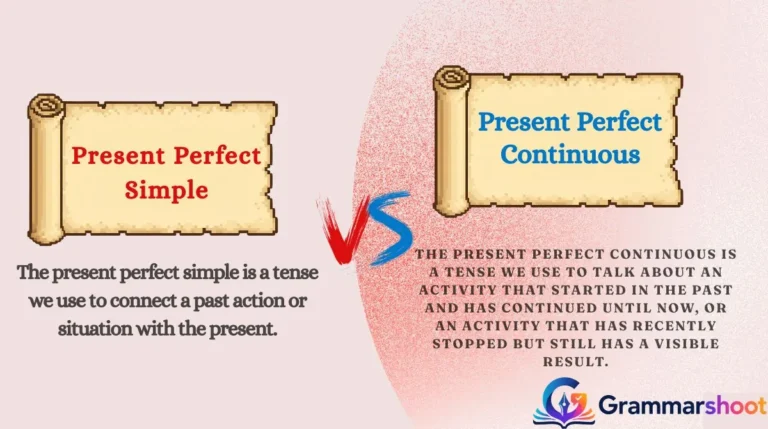
The present perfect simple is a tense we use to connect a past action or situation with the present. It often focuses on a result, a completed amount of work, life experience, or a situation that began in the past and is still true.
The action may be finished, but its result or importance is connected to now.
Grammar rule and sentence structure
The basic structure is:
Subject + have/has + past participle
Use have with I, you, we, and they. Use has with he, she, and it.
| Sentence type | Structure | Example |
|---|---|---|
| Positive | Subject + have/has + past participle | She has finished her homework. |
| Negative | Subject + have/has + not + past participle | She has not finished her homework. |
| Question | Have/Has + subject + past participle? | Has she finished her homework? |
A past participle is the third form of a verb. For example, eat – ate – eaten, write – wrote – written, and finish – finished – finished.
When should you use the present perfect simple?
1. To talk about a result that matters now
Use this tense when a past action has a present result.
- I have lost my keys. (I cannot find them now.)
- She has broken her glasses. (Her glasses are broken now.)
- They have cleaned the kitchen. (The kitchen is clean now.)
The main idea is not simply that something happened. It is that the result matters at the present time.
2. To describe life experiences
Use it to talk about experiences without saying exactly when they happened.
- I have visited Lahore.
- He has never ridden a horse.
- Have you ever tried Japanese food?
If you mention a finished past time, such as yesterday or last year, the past simple is normally needed instead.
3. To talk about a completed amount of work
The present perfect simple often highlights how much work is finished or how many things are complete.
- I have written three emails.
- She has read five chapters.
- We have washed all the dishes.
The number or amount is important in these sentences.
4. To describe a situation that continues until now
Some situations begin in the past and remain true in the present.
- I have known Ahmed for six years.
- She has lived here since 2020.
- We have had this car for a long time.
Notice that know and have in these examples describe states, not activities in progress.
More examples of present perfect simple
- My brother has bought a new phone.
- We have already eaten lunch.
- The teacher has explained the lesson.
- I have never seen snow.
- Have they arrived yet?
- She has worked at this school for ten years.
- He has not called me today.
- Our team has won three matches this month.
A common learner confusion
Learners sometimes think the present perfect simple must describe an action that happened very recently. That is not true. It can describe an experience from many years ago, as long as the sentence connects that experience with the present and does not specify a finished past time.
For example, “I have visited Karachi” describes a life experience. The visit could have happened years ago. The exact time is not the focus.
What Does Present Perfect Continuous Mean?
The present perfect continuous is a tense we use to talk about an activity that started in the past and has continued until now, or an activity that has recently stopped but still has a visible result.
It often focuses on the duration of an activity, the process itself, or repeated activity over a period of time.
For example, if you say, “I have been studying for two hours,” you are telling someone how long you have spent studying. You are not necessarily saying that you have finished your study session.
Grammar rule and sentence structure
The basic structure is:
Subject + have/has + been + verb-ing
Use have with I, you, we, and they. Use has with he, she, and it.
| Sentence type | Structure | Example |
|---|---|---|
| Positive | Subject + have/has + been + verb-ing | He has been running. |
| Negative | Subject + have/has + not + been + verb-ing | He has not been running. |
| Question | Have/Has + subject + been + verb-ing? | Has he been running? |
The word been is always followed by the verb ending in -ing in this tense.
For example, work becomes working, read becomes reading, and run becomes running.
When should you use the present perfect continuous?
1. To describe an activity that started in the past and is still happening
Use this tense when an activity began earlier and has not stopped.
- I have been learning English for three years.
- She has been working here since January.
- They have been waiting for the bus for 20 minutes.
These sentences describe activities that continue up to the present. The speaker is interested in the ongoing activity and its duration.
2. To emphasize how long an activity has continued
This is one of the most common uses of the tense. It often appears with for and since.
- We have been walking for an hour.
- He has been studying since 8 a.m.
- It has been raining all morning.
Use for to give a length of time, such as for an hour or for three days. Use since to give the starting point, such as since Monday or since 2024.
3. To describe a recently stopped activity with a present result
An activity does not have to be happening at the exact moment of speaking. It may have just stopped, but there is evidence of it now.
- You are sweating. Have you been exercising?
- Her eyes are red because she has been crying.
- The ground is wet because it has been raining.
In each case, the present situation gives us a reason to think about the recent activity.
4. To describe repeated activity over a period of time
The tense can also describe something that has happened repeatedly or regularly during a period leading up to now.
- I have been calling the office all morning.
- She has been taking extra classes this month.
- They have been visiting us more often lately.
The emphasis is on the repeated activity over that period, not simply on the number of completed actions.
More examples of present perfect continuous
- I have been reading this book all afternoon.
- My father has been driving for five hours.
- We have been preparing for the exam since Monday.
- Why have you been laughing?
- Has it been snowing?
- She has been learning to cook.
- The children have been playing outside for an hour.
- He has not been sleeping well lately.
A common learner confusion
Some learners believe that the present perfect continuous always means an activity is still happening. However, that is not always true.
Consider this sentence:
“I have been cleaning the house.”
You might still be cleaning, or you might have stopped a few minutes ago. Perhaps you are tired and want to sit down. The sentence focuses on the cleaning activity, but it does not clearly tell us whether the work is completely finished.
If you want to make the completed result clear, you could say, “I have cleaned the house.” That tells the listener more about the result.
Difference Between Present Perfect Simple and Present Perfect Continuous
Both tenses connect the past with the present, but they give different kinds of information. The present perfect simple often focuses on a result, a completed amount, or an experience. The present perfect continuous usually focuses on an activity, its duration, or its recent effects.
Neither tense is always better than the other. The correct choice depends on what you want to communicate.
Comparison table
| Point | Present perfect simple | Present perfect continuous |
|---|---|---|
| Main focus | Result or completed amount | Activity or duration |
| Structure | Have/has + past participle | Have/has + been + verb-ing |
| Completed work | Often highlights what is finished | Highlights the process or effort |
| Duration | Used with certain continuing states | Common with ongoing activities |
| Recent activity | Focuses on the result | Focuses on the activity or its effects |
| Example | I have painted two walls. | I have been painting the walls. |
| Question | How many pages have you written? | How long have you been writing? |
| Common time words | Already, yet, just, ever, never | For, since, all day, lately |
1. Result versus activity
Compare these sentences:
- Present perfect simple: I have repaired the bike.
- Present perfect continuous: I have been repairing the bike.
In the first sentence, the speaker emphasizes the result. The bike has been repaired, or the repair is being presented as completed.
In the second sentence, the speaker emphasizes the repair work. The activity may still be going on, or the speaker may have stopped recently. The sentence does not promise that the bike is fully repaired.
Here is another example:
- She has cooked dinner.
- She has been cooking dinner.
The first sentence suggests that dinner is ready. The second tells us about her activity. Perhaps she is still cooking, or perhaps she has just finished and is taking a break.
2. Completed amount versus duration
Use the present perfect simple when the amount completed is important.
“I have answered ten questions.”
This tells us how many questions are complete. It does not tell us how long the person spent answering them.
Now compare it with:
“I have been answering questions for an hour.”
This sentence focuses on the time spent on the activity. The speaker may have answered many questions, but the exact number is not given.
Both sentences can describe the same general situation. They simply highlight different details.
3. Actions that continue until now
Both tenses can describe activities that began in the past and continue in the present.
For example:
- I have worked here for five years.
- I have been working here for five years.
Both sentences are correct. They communicate that the person started working here five years ago and still works here.
The continuous form puts more attention on the ongoing activity. The simple form presents the situation as a fact or continuing state. In some situations, the difference is very small.
However, with a state verb such as know, we normally use the simple form:
“I have known her for five years.”
We would not normally say, “I have been knowing her for five years.”
4. Temporary activity versus a continuing fact
The continuous form can make an activity sound temporary or focused on a particular period.
Compare:
- He has taught at this school for ten years.
- He has been teaching extra classes this month.
The first sentence presents teaching at the school as a continuing fact. The second highlights an activity during a specific period.
This is a useful difference, but it is not an absolute rule. Both forms can describe long-term activities, and the simple form is not limited to permanent situations.
5. Why the same sentence can change meaning
Consider the question, “Have you read the book?”
This usually asks whether you have completed the book or have the experience of reading it. It does not mainly ask about the reading process.
Now consider, “Have you been reading the book?”
This asks about the activity. Perhaps someone saw you holding the book earlier and wants to know whether you have spent time reading it.
The words are similar, but the speaker’s purpose changes. When you choose a tense, think about the information your listener needs.
Grammar Rules You Must Remember
Learning a few important rules will help you choose the correct tense without memorizing every example. Pay attention to the meaning of the sentence, the type of verb, and whether you want to highlight a result or an activity.
Rule 1: Use the present perfect simple for completed amounts
When you want to tell someone how many things you have completed, the present perfect simple is usually the best choice.
- Correct: I have written four emails.
- Less suitable for the same meaning: I have been writing four emails.
The continuous version is possible in special contexts, but it does not naturally emphasize a completed total in the same way. To ask about a completed amount, use a question such as, “How many emails have you written?”
Rule 2: Use the continuous form to emphasize duration
When you want to focus on how long an activity has been happening, the present perfect continuous is often the natural choice.
- I have been studying for three hours.
- She has been waiting since noon.
- They have been playing all afternoon.
Remember that for tells us the length of time, while since tells us when the activity began.
The simple form can also be used with duration, especially with state verbs and some continuing situations. For example, “I have lived here for ten years” is perfectly correct.
Rule 3: Avoid continuous forms with most state verbs
State verbs describe feelings, thoughts, possession, or conditions rather than activities. Common examples include know, believe, understand, own, belong, and need.
- Incorrect in ordinary use: I have been knowing him for years.
- Correct: I have known him for years.
Another example:
- Incorrect in ordinary use: She has been owning this house since 2018.
- Correct: She has owned this house since 2018.
Some verbs can be both state verbs and action verbs, depending on their meaning. For example, think can describe an opinion (“I have thought about it”) or an activity (“I have been thinking about your suggestion”).
Rule 4: Do not use either tense with a finished past time in the usual way
When you mention a specific, finished time, use the past simple rather than either present perfect form.
- Incorrect: I have finished my homework yesterday.
- Correct: I finished my homework yesterday.
Similarly:
- Incorrect: She has been working there last year.
- Correct: She was working there last year.
Compare this with “She has been working there since last year.” The second sentence is correct because since last year connects the starting point to a situation that continues now.
Common Mistakes Students Make
English learners often mix up these tenses because both can describe events that started in the past. The best way to avoid mistakes is to check the meaning before choosing the verb form.
Mistake 1: Forgetting “been”
The continuous form needs been between have/has and the verb ending in -ing.
- Incorrect: He has working all day.
- Correct: He has been working all day.
Correction tip: Remember the three-part pattern: has/have + been + verb-ing.
Mistake 2: Using the past participle in the continuous form
The simple tense uses a past participle, while the continuous tense uses an -ing form after been.
- Incorrect: I have been written emails all morning.
- Correct: I have been writing emails all morning.
Correction tip: After been, use the -ing form when you are building the present perfect continuous.
Mistake 3: Using the continuous tense with a state verb
Some verbs normally describe a condition rather than an action.
- Incorrect: I have been believing you for years.
- Correct: I have believed you for years.
Correction tip: Ask yourself whether the verb describes an activity or a state. If it describes a state, the simple form is often the right choice.
Mistake 4: Choosing the wrong tense for a finished amount
When a person asks about the number of completed items, the simple form is usually more natural.
- Less suitable: She has been making six cakes.
- Better: She has made six cakes.
The continuous form may be used when discussing a planned or ongoing process, but the simple form clearly communicates the completed total.
Correction tip: If the question is “How many?” or “How much has been completed?”, consider the present perfect simple first.
Mistake 5: Using the present perfect with “yesterday”
A finished past-time expression usually calls for the past simple.
- Incorrect: We have visited our cousins yesterday.
- Correct: We visited our cousins yesterday.
Correction tip: Look for time expressions such as yesterday, last week, and in 2022. When they refer to a finished time, use the past simple.
Mistake 6: Assuming the continuous tense always means “unfinished”
The present perfect continuous can describe an activity that has recently stopped.
– “I have been running.”
This sentence can mean that you have just finished running and are now out of breath. It does not necessarily mean you are still running.
Correction tip: Think about the activity and the situation now. The continuous form emphasizes the activity, not whether it is definitely unfinished.
Easy Trick to Remember the Difference
Here is a simple memory trick:
Present perfect simple = result, total, or experience.
Present perfect continuous = activity, effort, or duration.
Imagine that your friend walks into the kitchen and sees you standing beside a pile of clean dishes.
You could say, “I have washed the dishes.” Your friend understands that the dishes are clean. You are highlighting the result.
Now imagine your friend asks why your hands are wet and why you look tired. You say, “I have been washing the dishes.” You are highlighting the activity and the effort you have spent on it.
Try asking yourself two questions before choosing a tense:
- Do I want to tell someone what has been completed or achieved?
- Do I want to tell someone what activity has been happening or how long it has continued?
If the first question matches your meaning, the present perfect simple may be the better choice. If the second matches your meaning, consider the present perfect continuous.
This is a helpful guide, not an unbreakable rule. Some sentences allow both tenses, and the difference can be small.
Daily Life Examples: Present Perfect Simple vs Present Perfect Continuous
Real conversations are one of the best ways to understand grammar. Read these examples and notice why each speaker chooses a particular tense.
1. Talking about homework
Ali: Have you finished your homework?
Sara: Yes, I have completed all five exercises.
The present perfect simple is used because Sara is talking about completed work. The result matters more than the time she spent doing it.
2. Talking about studying
Mother: Why are you still at your desk?
Son: I have been studying for three hours.
The continuous form emphasizes how long the activity has continued. The son may still have more work to do.
3. Talking about cooking
Friend: Does the food smell good?
You: Yes! I have cooked dinner.
This answer focuses on the result: dinner is ready.
If you said, “I have been cooking dinner,” you would focus more on the activity. You might still be preparing the meal.
4. Talking about the weather
Ayesha: Why is the road so wet?
Hina: It has been raining all morning.
The continuous form highlights the ongoing or recent weather activity and explains the present condition of the road.
5. Talking about work
Manager: How many reports have you completed?
Employee: I have finished four reports.
The manager asks about the completed number, so the present perfect simple is appropriate.
6. Talking about exercise
Friend: You look tired. Are you okay?
You: I have been exercising at the gym.
The continuous form emphasizes the recent activity. It also helps explain why you look tired.
7. Talking about learning English
Teacher: How long have you been learning English?
Student: I have been learning English for two years.
The question asks about duration, so the continuous form is a natural choice.
8. Talking about a book
Friend: Have you read this book?
You: Yes, I have read it twice.
The simple form emphasizes the experience and the number of times the book has been read.
9. Talking about cleaning
Brother: Why is your shirt dirty?
Sister: I have been cleaning the garage.
The continuous form focuses on the activity that caused the dirt. It does not necessarily mean that the garage is completely clean.
10. Talking about living somewhere
Friend: How long have you lived in this town?
You: I have lived here since 2019.
The present perfect simple is natural because live describes a continuing situation here. You could also say, “I have been living here since 2019,” which puts more emphasis on the ongoing experience of living there.
These examples show that tense choice is about meaning. Think about what the speaker wants to highlight, rather than choosing a tense only because a particular time word appears in the sentence.
Practice Section: Choose the Correct Tense
Test your understanding with these five short questions. Choose the option that best fits the meaning of each sentence.
1. I ___ three chapters so far.have readhave been reading
2. She ___ for the bus for 30 minutes.has waitedhas been waiting
3. We ___ each other since childhood.have knownhave been knowing
4. He ___ the kitchen, so it looks clean now.has cleanedhas been cleaning
5. Why are your clothes wet? ___ in the rain?Have you walkedHave you been walking
Check answers
FAQs: Present Perfect Simple vs Present Perfect Continuous
1. What is the difference between present perfect simple and present perfect continuous?
The present perfect simple often emphasizes results, completed amounts, or experiences. The present perfect continuous emphasizes an activity, its duration, or its recent effects. Both tenses connect the past with the present. The correct choice depends on what you want to communicate.
2. Can we use both tenses with “for” and “since”?
Yes. Both tenses can appear with for and since. For example, “I have lived here for five years” and “I have been living here for five years” are both correct. The continuous form emphasizes the ongoing activity, while the simple form presents the continuing situation.
3. Is the present perfect continuous formal or informal?
Neither tense is limited to formal or informal English. Both are common in speaking and writing. The present perfect continuous is especially useful in everyday conversations when explaining what you have been doing or how long an activity has continued.
4. Can we use the present perfect continuous in questions?
Yes. Put have or has before the subject, followed by been and the verb ending in -ing. For example, “Have you been studying?” and “Has she been working all day?” These questions often ask about an activity or its duration.
5. Why do we say “I have known him” instead of “I have been knowing him”?
The verb know normally describes a state rather than an activity. State verbs are generally used in simple forms, not continuous forms. Therefore, “I have known him for years” is the natural choice in standard English.
6. Is the present perfect continuous used for finished actions?
Yes, it can describe activities that have recently stopped. For example, “I have been running” can explain why someone is tired after a run. The tense focuses on the activity, not on whether it is still happening at the moment of speaking.
Conclusion
Understanding the difference between the present perfect simple and the present perfect continuous becomes easier when you focus on the meaning of a sentence. Both tenses connect the past with the present, but they often highlight different things.
Use the present perfect simple when you want to talk about results, completed amounts, life experiences, or continuing situations. For example, “I have finished my work” tells someone about the result.
Use the present perfect continuous when you want to emphasize an activity, how long it has continued, or its recent effects. For example, “I have been working all morning” focuses on the activity and the time spent doing it.
Remember that both tenses can sometimes describe the same situation. The difference may be small, especially when talking about activities that continue over time. Also, avoid continuous forms with most state verbs, and use the past simple with finished past-time expressions such as yesterday.
The best way to improve is to practise with real conversations, read example sentences aloud, and create your own examples every day. With regular practice, choosing the right tense will feel more natural.

Evan Rellmont is a writer who turns thoughtful ideas into meaningful words, creating stories and reflections that connect, inspire, and leave a lasting impression.