
Have you ever wondered why we say “three apples” but not usually “three waters”? Or why “many books” sounds correct while “much books” sounds wrong? These small differences can make English confusing, especially for beginners and people learning English as a second language.
The reason is simple: English nouns are divided into different groups. Two important groups are countable nouns and uncountable nouns.
Knowing the difference helps you choose the right words when speaking, writing, asking questions, and describing things around you.
For example, you can count chairs, pens, students, and oranges one by one.
These are countable nouns. However, you do not normally count milk, sugar, information, or furniture as separate individual units. These are uncountable nouns.
The tricky part is that some words can belong to both groups, depending on their meaning.
You might drink some coffee, but you can also order two coffees at a café. Both sentences are correct because the word is being used in a different way.
Learning this grammar rule does not have to be difficult. Once you understand how these nouns work, you will find it easier to use words such as a, an, some, any, much, many, few, and little correctly.
By the end of this guide, you will understand the main differences, learn common grammar rules, avoid frequent mistakes, and practise using these nouns in everyday English conversations.
What Does “Countable Nouns” Mean?
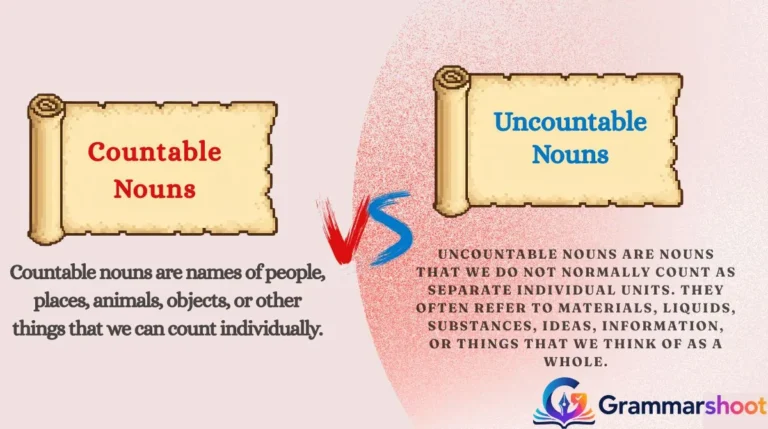
Countable nouns are names of people, places, animals, objects, or other things that we can count individually. They have a singular form and a plural form in most cases.
Think about the things around you. You might see one phone, two pens, three books, or four chairs. Each item can be counted separately, so these words are countable nouns.
When Should You Use Countable Nouns?
Use countable nouns when you can identify and count individual items or people.
For example, you can count:
- People: a teacher, two students, five children
- Animals: one cat, three dogs, six birds
- Objects: a table, four cups, ten pencils
- Places: one house, two shops, three parks
- Food items: an apple, two eggs, five sandwiches
Countable nouns are useful when talking about numbers, quantities, shopping, school, work, and daily activities.
Grammar Rules for Countable Nouns
Rule 1: Countable nouns can be singular or plural.
Use the singular form for one item and the plural form for two or more items.
Examples:
- I have a book.
- She bought two dresses.
- There is one student in the room.
- Five students are waiting outside.
Most countable nouns form their plural by adding -s or -es. For example, pen becomes pens, and box becomes boxes. However, some nouns have irregular plural forms, such as child/children, man/men, and foot/feet.
Rule 2: Singular countable nouns usually need a determiner.
In ordinary sentences, a singular countable noun generally cannot stand alone.
Examples:
- I bought a phone.
- She is an engineer.
- The dog is sleeping.
- My brother has a bicycle.
We usually need words such as a, an, the, my, this, or one before a singular countable noun.
For example, “I bought book” is incorrect in standard English. Say “I bought a book” or “I bought the book.”
Rule 3: Use many or a few with plural countable nouns.
Examples:
- There are many students in this school.
- I have a few questions.
- How many books do you need?
- We saw several birds in the garden.
Use many when referring to a large number. Use a few when referring to a small number that is enough or available.
Eight Examples of Countable Nouns
- I have three notebooks in my bag.
- She bought an orange from the market.
- There are twenty children in the classroom.
- My father owns two cars.
- We need four plates for dinner.
- He has a new computer.
- Several people are waiting for the bus.
- How many eggs should I buy?
Notice that the nouns can be counted as separate units. This is the main idea behind countable nouns.
A Common Confusion About Countable Nouns
Some learners think that every noun that describes a physical object is countable. However, English does not always follow this logic.
For example, furniture refers to physical objects such as tables, beds, and chairs, but it is normally uncountable in English. We say “some furniture” or “three pieces of furniture,” not “three furnitures.”
The important point is to learn how a noun works in English rather than deciding only by its physical meaning.
What Does “Uncountable Nouns” Mean?
Uncountable nouns are nouns that we do not normally count as separate individual units. They often refer to materials, liquids, substances, ideas, information, or things that we think of as a whole.
For example, we usually talk about water, rice, sugar, money, advice, and knowledge without adding a number directly before them.
You can count bottles of water or bags of rice, but the words water and rice are normally uncountable when used in their usual meanings.
When Should You Use Uncountable Nouns?
Use uncountable nouns when talking about something that is not normally divided into separate countable units in the sentence.
Common groups include:
1. Liquids and drinks
- Water
- Milk
- Tea
- Coffee
- Oil
Examples:
- I need some water.
- There is milk in the fridge.
- Would you like some tea?
2. Materials and substances
- Rice
- Sugar
- Salt
- Sand
- Wood
Examples:
- Please add some sugar.
- We bought rice for dinner.
- The children were playing in the sand.
3. Ideas and information
- Advice
- Information
- Knowledge
- Education
- News
Examples:
- She gave me useful advice.
- We need more information.
- The news is surprising.
4. Feelings and abstract ideas
- Happiness
- Love
- Anger
- Honesty
- Patience
Examples:
- Happiness is important.
- I admire her honesty.
- You need patience when learning a language.
5. Groups of things
- Furniture
- Equipment
- Luggage
- Traffic
- Clothing
Examples:
- The furniture is expensive.
- We need new equipment.
- Our luggage is in the car.
Grammar Rules for Uncountable Nouns
Rule 1: Uncountable nouns usually do not have a plural form.
In their ordinary uncountable meanings, these nouns are generally used without -s.
Examples:
- I need some information.
- The furniture is new.
- She gave me good advice.
- There is too much traffic today.
Avoid forms such as informations, furnitures, and advices when using these words in their normal uncountable senses.
Rule 2: Do not normally use a or an directly before an uncountable noun.
Examples:
- Incorrect: I need an information.
- Correct: I need some information.
- Incorrect: She gave me an advice.
- Correct: She gave me a piece of advice.
Remember that a and an are normally used with singular countable nouns, not uncountable nouns.
Rule 3: Use much or a little with uncountable nouns.
Examples:
- We do not have much time.
- There is a little milk left.
- How much money do you need?
- I have little patience for unnecessary delays.
Use much to ask about or describe a large quantity, often in questions and negative sentences. Use a little for a small amount that is available or enough for something.
Eight Examples of Uncountable Nouns
- I drink plenty of water every day.
- There is some sugar in the jar.
- She gave me useful advice.
- We need more information about the exam.
- The furniture looks beautiful.
- I do not have much time today.
- There is too much traffic on this road.
- He has a lot of experience in teaching.
These examples show that uncountable nouns can describe physical substances as well as ideas and experiences.
A Common Confusion About Uncountable Nouns
Learners sometimes assume that an uncountable noun cannot be measured or divided. That is not true.
For example, you can measure water in litres, sugar in grams, and rice in kilograms. However, we normally count the units of measurement rather than the uncountable nouns themselves.
We say:
- Two litres of water
- Three kilograms of rice
- A cup of sugar
- A piece of advice
This is a useful way to talk about the amount of an uncountable noun.
Difference Between Countable and Uncountable Nouns
The main difference is how we treat the noun when we speak or write. Countable nouns refer to things we can count individually, while uncountable nouns are normally treated as amounts, substances, or whole concepts.
Comparison Table
| Feature | Countable Nouns | Uncountable Nouns |
|---|---|---|
| Meaning | Individual items or people | Amounts, substances, or whole ideas |
| Singular form | Usually available | Usually no countable singular/plural contrast |
| Plural form | Usually available | Usually not used in the normal meaning |
| Numbers | Can use numbers directly | Usually need a unit or container |
| A or an | Used with singular nouns | Not normally used directly |
| Many or much | Many | Much |
| Few or little | A few / few | A little / little |
| Examples | Book, chair, student | Water, furniture, advice |
1. Difference in Usage
Countable nouns are used when we want to count separate items. Uncountable nouns are used when we talk about something as an amount or a whole.
Compare these sentences:
- I bought three apples.
- I bought some fruit.
Apples are countable because we can count each apple. Fruit is often uncountable when referring to fruit in general, although it can also be countable in certain contexts, such as different types of fruit or individual fruits.
Another example:
- She has two bags.
- She has some luggage.
We can count the bags, but luggage is normally uncountable.
2. Difference in Grammar
Countable and uncountable nouns use different words to express quantity.
For countable nouns, use:
- Many books
- A few friends
- Several chairs
- Three questions
For uncountable nouns, use:
- Much water
- A little time
- Some advice
- A great deal of information
Some words work with both types. For example, some, any, a lot of, and enough can be used with countable or uncountable nouns.
Examples:
- We have some apples.
- We have some milk.
- There are a lot of people here.
- There is a lot of noise here.
3. Difference in Sentence Structure
Countable nouns can appear in the singular or plural.
Examples:
- A student is waiting outside.
- Two students are waiting outside.
The verb changes according to the noun. A singular countable noun usually takes a singular verb, while a plural countable noun normally takes a plural verb.
Uncountable nouns usually take a singular verb.
Examples:
- The water is cold.
- The information is correct.
- My luggage is heavy.
- The advice was helpful.
Do not say “The information are correct” when information is being used in its normal uncountable sense.
4. Difference in Meaning
Sometimes the same word can be countable or uncountable, depending on the meaning.
Consider coffee:
- I drink coffee every morning.
- We ordered two coffees.
In the first sentence, coffee refers to the drink in general. In the second, it means two servings or cups of coffee.
Consider chicken:
- We ate chicken for dinner.
- There are three chickens in the garden.
In the first sentence, chicken refers to meat and is uncountable. In the second, it refers to individual animals and is countable.
This shows why context is important. You should learn the meaning of the noun in each sentence, not just memorise a single label for every word.
Grammar Rules You Must Remember
These four rules will help you use countable and uncountable nouns more confidently.
Rule 1: Use A or An with Singular Countable Nouns
Use a or an before a singular countable noun when referring to one non-specific person or thing.
Examples:
- I need a pen.
- She ate an apple.
- He bought a new laptop.
- We saw an elephant at the zoo.
Use a before a consonant sound and an before a vowel sound. The sound matters, not just the first letter.
For example, we say “an hour” because the h is silent, but “a university” because the word begins with a /juː/ sound.
Do not normally use a or an directly before an uncountable noun. Say “some water,” not “a water,” unless you mean a serving or a particular kind of water in a suitable context.
Rule 2: Use Many with Countable Nouns and Much with Uncountable Nouns
Use many with plural countable nouns and much with uncountable nouns.
Examples:
- How many books do you have?
- How many students are in your class?
- How much money do you need?
- How much milk is left?
In everyday positive sentences, English speakers often prefer a lot of instead of much.
For example, “I have a lot of work today” sounds more natural in everyday conversation than “I have much work today.”
Both many and much are common in questions and negative sentences.
Rule 3: Use Few with Countable Nouns and Little with Uncountable Nouns
Use few and a few with plural countable nouns. Use little and a little with uncountable nouns.
Examples:
- I have a few friends in this city.
- Few people understood the question.
- We have a little milk left.
- There is little hope of finishing on time.
There is an important difference between few and a few. Few often suggests that the number is not enough. A few means some, even if the number is small.
Similarly, little often suggests that an amount is not enough, while a little means some amount is available.
Rule 4: Use Units to Count Uncountable Nouns
When you want to count an uncountable noun, add a suitable unit, container, or expression.
Examples:
- A glass of water
- Two bottles of milk
- Three pieces of advice
- Four bags of rice
- Two items of furniture
The number refers to the container, unit, or piece, not directly to the uncountable noun.
This rule is especially useful when shopping, ordering food, cooking, or describing quantities at home.
Common Mistakes Students Make
Many English learners make these mistakes because their first language may use nouns differently. A noun that is uncountable in English might be countable in another language, or the other way around.
The best solution is to learn common noun patterns and practise them in complete sentences.
Mistake 1: Adding S to Uncountable Nouns
Incorrect: She gave me some useful advices.
Correct: She gave me some useful advice.
Why? Advice is normally uncountable in English. You can say “a piece of advice” or “two pieces of advice” when you need to count individual suggestions.
Another example:
Incorrect: I need more informations.
Correct: I need more information.
Tip: Learn advice, information, furniture, and equipment as uncountable nouns in their usual meanings.
Mistake 2: Using Much with Countable Nouns
Incorrect: There are much students in the class.
Correct: There are many students in the class.
Why? Students is a plural countable noun, so many is the appropriate choice.
Compare:
- Many students
- Much homework
Tip: Ask yourself whether you can count the noun directly. If you can, many is often the right choice.
Mistake 3: Using Many with Uncountable Nouns
Incorrect: I do not have many time.
Correct: I do not have much time.
Why? Time is uncountable when referring to time in general or an amount of time.
However, times is countable when it means occasions.
Examples:
- I do not have much time.
- I have visited that city three times.
Tip: Always check the meaning of the word in the sentence.
Mistake 4: Forgetting A or An
Incorrect: He bought book yesterday.
Correct: He bought a book yesterday.
Why? Book is a singular countable noun. In this sentence, it needs a determiner such as a or the.
Another example:
Incorrect: She is teacher.
Correct: She is a teacher.
Tip: When you use one singular countable noun, check whether you need a, an, the, or another determiner.
Mistake 5: Using A or An with Uncountable Nouns
Incorrect: Can you give me an advice?
Correct: Can you give me some advice?
You can also say, “Can you give me a piece of advice?”
Tip: Learn the common uncountable form first, then learn how to count it using suitable units.
Mistake 6: Using a Plural Verb with an Uncountable Noun
Incorrect: The furniture are expensive.
Correct: The furniture is expensive.
Why? Furniture is normally uncountable and takes a singular verb.
Other examples:
- The equipment is ready.
- The information was helpful.
- The luggage is upstairs.
Tip: Do not decide the verb form based on how many individual objects the noun may refer to in real life. Follow its grammar in English.
Easy Trick to Remember the Difference
Here is a simple trick: If you can count the noun directly using one, two, three, it is usually countable. If you need to measure it or put it into a container, it is usually uncountable.
Try these examples:
- One apple, two apples, three apples. Countable.
- One chair, two chairs, three chairs. Countable.
- One glass of water, two glasses of water. Water is uncountable; glass is countable.
- One piece of advice, two pieces of advice. Advice is uncountable; piece is countable.
- One bag of rice, two bags of rice. Rice is uncountable; bag is countable.
Think about going to a shop. You might ask for “three eggs,” because eggs are separate items. However, you might ask for “a kilogram of rice,” because rice is normally measured by weight.
Another helpful trick is to remember the quantity words:
Countable: many, a few, few, several, a number of.
Uncountable: much, a little, little, an amount of, a great deal of.
Both: some, any, enough, a lot of, plenty of.
These patterns are not a replacement for learning vocabulary, but they make it easier to choose the correct grammar while speaking.
Daily Life Examples of Countable and Uncountable Nouns
Real-life sentences make grammar easier to remember. Here are ten short examples from everyday conversations.
1. At the Grocery Store
Customer: How many apples do you want?
Shopkeeper: I need six apples, please.
Apples is countable because each apple can be counted separately.
2. Asking for Water
Ali: Would you like some water?
Sara: Yes, please. I’m thirsty.
Water is uncountable here, so we use some water rather than a water in the general sense.
3. Talking About Homework
Student: How much homework do we have today?
Friend: We have a lot of homework.
Homework is uncountable in standard English. We do not normally say “homeworks.”
4. Buying Eggs
Mother: Please buy a dozen eggs.
Son: Okay, I’ll get them from the shop.
Eggs is countable, and a dozen means twelve.
5. Asking for Advice
Sara: Can you give me some advice about my exam?
Ayesha: Of course. You should revise your notes every day.
Advice is uncountable, even though you can give several individual suggestions.
6. Talking About Money
Ahmed: How much money do you have?
Usman: I have a little money in my wallet.
Money is uncountable, so we use much and a little. We can count rupees or coins, but money itself is normally uncountable.
7. Discussing Furniture
Customer: How much furniture do you need for the new office?
Manager: We need six chairs and two desks.
Furniture is uncountable, while chairs and desks are countable.
8. Ordering Coffee
Customer: Can we have two coffees, please?
Waiter: Certainly.
Here, coffees means two servings or cups of coffee. In this context, the normally uncountable noun is being used as a countable noun.
9. Talking About Friends
Mina: Do you have many friends at school?
Hina: Yes, I have a few close friends.
Friends is countable, so many and a few are correct.
10. Discussing Time
Father: Do you have enough time to finish your work?
Son: I have very little time, so I need to hurry.
Time is uncountable when referring to an amount of time. We use little to describe a small amount.
These examples show that the grammar appears naturally in shopping, school, family conversations, and everyday requests. Practising sentences like these can help you use the correct forms without stopping to think about every rule.
Practice Section: Test Your Understanding
Choose the correct option in each sentence. Try to answer all five questions before checking the answers.
1. How ___ books do you need?
- A. much
- B. many
2. Can you give me some ___?
- A. advice
- B. advices
3. There isn’t ___ milk in the fridge.
- A. many
- B. much
4. She bought ___ umbrella yesterday.
- A. a
- B. an
5. The ___ in this room is very expensive.
- A. furniture
- B. furnitures
Answers and Explanations
1. B — many. Books are countable, so we use many when asking about their number.
2. A — advice. Advice is normally uncountable. We can say some advice or two pieces of advice.
3. B — much. Milk is uncountable, so much is correct in this negative sentence.
4. B — an. Umbrella begins with a vowel sound, so we use an umbrella.
5. A — furniture. Furniture is normally uncountable and takes a singular verb, so the sentence is correct as written.
If you made a mistake, do not worry. Read the explanation and try writing one new sentence using the same rule. Repeating this small exercise is a simple way to improve your grammar.
FAQs
1. What Is the Difference Between Countable and Uncountable Nouns?
Countable nouns refer to things we can count individually, such as books, pens, and students. They usually have singular and plural forms. Uncountable nouns refer to amounts, substances, or concepts, such as water, rice, and information. They usually do not have plural forms in their normal meanings.
2. Can We Use Some with Both Types of Nouns?
Yes, some works with both countable and uncountable nouns. With countable nouns, use it before a plural noun, as in “some apples.” With uncountable nouns, use it before the noun, as in “some water.” It is especially common in positive sentences and in offers or requests.
3. Can We Use Many and Much in Questions?
Yes. Use many with plural countable nouns and much with uncountable nouns. For example, “How many students are there?” asks about a number. “How much water do you need?” asks about an amount. These forms are also common in negative sentences.
4. Is Money Countable or Uncountable?
Money is normally uncountable in English. We say “some money,” “much money,” or “a little money.” However, the units used to express money can be countable. For example, you can have five coins, three banknotes, or two hundred rupees.
5. Why Is Information Uncountable in English?
English normally treats information as a general amount of knowledge rather than as separate countable items. That is why we say “some information” or “a lot of information.” If you want to count individual pieces, say “two pieces of information.” Avoid “informations” in the normal sense.
6. Can a Noun Be Both Countable and Uncountable?
Yes. Some nouns change their meaning depending on how they are used. For example, chicken is uncountable when referring to meat but countable when referring to animals. Similarly, coffee is normally uncountable as a drink in general, but “two coffees” can mean two servings.
Conclusion
Understanding countable and uncountable nouns is an important step toward speaking and writing English correctly. The main rule is simple: countable nouns refer to individual items that we can count, while uncountable nouns usually refer to substances, amounts, or ideas that we treat as a whole.
Remember to use many and a few with plural countable nouns, and much and a little with uncountable nouns. Singular countable nouns usually need a determiner such as a, an, or the. Uncountable nouns normally take singular verbs and do not usually form plurals in their standard meanings.
Also, remember that some nouns can be countable or uncountable depending on their meaning. Words such as coffee, chicken, and fruit are good examples of this pattern.
You do not need to memorise every rule in one day. Start by learning common nouns, notice how people use them in everyday English, and practise making your own sentences. With regular practice, these grammar choices will become easier and more natural.
Keep learning, keep practising, and do not be afraid of making small mistakes. Every correct sentence brings you one step closer to better English.

Evan Rellmont is a writer who turns thoughtful ideas into meaningful words, creating stories and reflections that connect, inspire, and leave a lasting impression.