
Have you ever stopped while speaking English because you were unsure whether to say “there is” or “there are”? You are not alone.
Many English learners find these two expressions confusing, even after studying English for years. The good news is that the main rule is simple once you understand how it works.
We use these expressions every day to talk about people, places, objects, and things around us. For example, you might say, “There is a book on the table” when talking about one book.
If you see several books, you would say, “There are three books on the table.” Both sentences are correct because each expression agrees with the number of things being described.
However, some sentences can be tricky. Words such as “some,” “a lot of,” and “a number of” may make learners pause.
Questions and negative sentences can also cause problems. In everyday speech, you may even hear people use a form that does not follow the usual grammar rule.
Learning the difference between these expressions will help you speak more clearly, write better sentences, and avoid common grammar mistakes.
You will learn when to use each form, how to make questions and negative statements, and how to handle special cases. Simple explanations, real-life examples, and short exercises will help you put the rules into practice.
By the end, you should feel much more confident when describing what exists, what is available, and what you can see around you.
What Does “There Is” Mean?
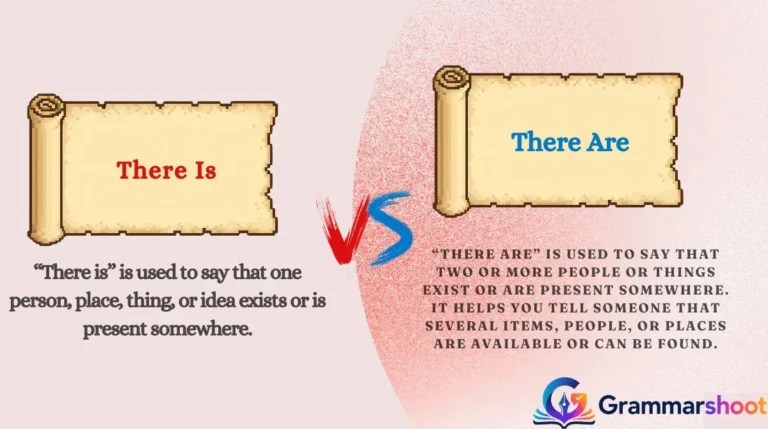
“There is” is used to say that one person, place, thing, or idea exists or is present somewhere.
It is also used with uncountable nouns, which are nouns we do not normally count as separate items.
Think about entering a room and seeing one chair. You could say, “There is a chair near the window.” This sentence tells the listener that a chair is present in that place.
When Should You Use “There Is”?
Use “there is” mainly in these situations:
- When talking about one person or thing.
- When describing something in a particular place.
- When introducing something for the first time.
- When talking about an uncountable noun, such as water, milk, information, or furniture.
The basic grammar rule is:
There is + a singular countable noun or an uncountable noun.
A singular countable noun refers to one item. It often uses “a” or “an,” such as a phone, an apple, or a student.
An uncountable noun refers to something that we do not usually count as individual units. For example, we generally say “some water,” not “a water,” when talking about water as a substance.
Examples of “There Is”
- There is a cat under the bed.
- There is an apple in my bag.
- There is a new student in our class.
- There is some milk in the fridge.
- There is a beautiful park near my house.
- There is enough time to finish the work.
- There is a problem with my computer.
- There is too much noise outside.
Notice that the nouns in these examples are either singular or uncountable. That is why “there is” is the correct choice.
For instance, “a cat” refers to one cat, while “some milk” refers to an amount of milk rather than a number of separate items.
“There Is” in Everyday English
Imagine that your friend visits your home and asks whether you have something to drink. You might reply, “There is some juice in the fridge.”
Or suppose a classmate asks why you look worried. You could say, “There is a problem with my homework.”
In both situations, the expression introduces something that exists or is available.
In casual speech, “there is” is often shortened to “there’s.” For example:
- There’s a shop near my school.
- There’s some food in the kitchen.
- There’s a message for you.
These shortened forms are common in everyday conversation. They have the same basic meaning as “there is.”
One important point is that “there’s” is generally followed by a singular noun or an uncountable noun in standard grammar. Although people sometimes use it before plural nouns in casual speech, beginners should learn to use “there are” with plural nouns.
What Does “There Are” Mean?
“There are” is used to say that two or more people or things exist or are present somewhere. It helps you tell someone that several items, people, or places are available or can be found.
Imagine that you walk into a classroom and see five students waiting for the teacher. You could say, “There are five students in the classroom.”
The sentence is correct because “five students” refers to more than one student.
When Should You Use “There Are”?
Use “there are” mainly when:
- Talking about two or more people or things.
- Describing several objects in a place.
- Introducing plural nouns.
- Talking about amounts expressed with plural countable nouns.
The basic grammar rule is:
There are + a plural countable noun.
Plural nouns often end in “-s” or “-es,” such as books, boxes, students, and classes. However, some plural nouns have irregular forms. Examples include children, men, women, and people.
The same rule applies to these irregular plurals.
Examples of “There Are”
- There are three books on my desk.
- There are many students in the library.
- There are two dogs in the garden.
- There are several shops on this street.
- There are five apples in the basket.
- There are some clean plates in the kitchen.
- There are many people at the bus stop.
- There are four chairs around the table.
Each sentence describes more than one person or thing.
For example, “three books” is plural, and “many students” also refers to more than one student. Therefore, “there are” is the correct form.
“There Are” in Everyday English
Imagine that you are helping your mother prepare dinner. You open a cupboard and notice several plates. You might say, “There are six plates in the cupboard.”
Or perhaps your friend asks about the shops near your home. You could answer, “There are two supermarkets near my house.”
These sentences give useful information about the number of things or places available.
Remember that the noun after “there are” does not always need to end in “-s.” Words such as “children,” “people,” and “men” are already plural, so they also take “there are.”
For example:
- There are many children in the park.
- There are ten people in the meeting.
- There are two men outside the office.
The important point is not the spelling of the noun. It is whether the noun refers to one item or more than one.
Difference Between “There Is” and “There Are” (Detailed)
The main difference is the number of people or things being described. “There is” usually introduces one countable thing or an uncountable noun, while “there are” introduces plural countable nouns.
Compare these two sentences:
- There is a student in the classroom.
- There are students in the classroom.
The first sentence refers to one student. The second sentence refers to more than one student, although it does not tell us the exact number.
Comparison Table
| Grammar point | There is | There are |
|---|---|---|
| Main use | One thing or an uncountable noun | Two or more countable things |
| Singular noun | Yes | No, not in the usual pattern |
| Plural noun | No, not in the usual pattern | Yes |
| Uncountable noun | Yes | Usually no |
| Example | There is a pen here. | There are two pens here. |
| Negative form | There isn’t a pen here. | There aren’t any pens here. |
| Question form | Is there a pen here? | Are there any pens here? |
1. Usage Difference
Use “there is” when you are talking about one countable item.
For example:
“There is a car outside.”
This sentence tells us that one car is outside. It does not say who owns the car or who put it there. It simply tells us that the car is present.
Now consider this sentence:
“There are three cars outside.”
Here, the noun “cars” is plural, and the number “three” makes it clear that more than one car is present.
The same difference applies to people, rooms, books, shops, and many other countable nouns.
2. The Grammar Logic
English sentences usually need a verb that agrees with the subject in number. In these expressions, the form of “be” changes according to the noun that follows.
The word “is” is a present-tense form of “be” used with singular subjects and certain other subjects. The word “are” is used with plural subjects and with “you.”
In existential sentences, the noun phrase after “there is” or “there are” identifies what exists.
For example:
- There is a problem.
- There are two problems.
The first sentence uses “is” because “a problem” is singular. The second uses “are” because “two problems” is plural.
This is the key idea: look at the noun phrase that follows the expression, not just at the word “there.”
3. Sentence Structure Difference
The basic structure for a statement is:
There + is/are + noun phrase + place or extra information.
Examples:
- There is a book on the shelf.
- There are books on the shelf.
- There is some rice in the pot.
- There are several bowls on the table.
You can also use these expressions without adding a place at the end.
For example:
- There is a problem.
- There are many reasons.
The sentence is still complete because the expression tells us that something exists.
4. Meaning Comparison
Both expressions often have the same general meaning: something exists, is present, or is available. The difference is the number and type of noun being described.
Consider these examples:
“There is some water in the bottle.”
This tells us that water is present. Water is uncountable in this meaning, so we use “there is.”
“There are two bottles of water in the fridge.”
This tells us that two bottles are present. The noun being counted is “bottles,” which is plural.
Notice how the noun changes the verb. You can count bottles, glasses, and cups, even though the liquid inside them is uncountable when discussed as a substance.
5. What About “Some,” “Any,” and “A Lot Of”?
These words can appear with either form. The noun that follows them helps you choose the correct expression.
- There is some bread on the table.
- There are some sandwiches on the table.
- There is a lot of traffic today.
- There are a lot of cars on the road.
“Some” can be used with uncountable nouns and plural countable nouns. “A lot of” can also be used with both types.
Do not choose “is” or “are” based only on words such as “some” or “a lot of.” Look at the noun phrase and decide whether it is singular, plural, or uncountable.
Grammar Rules You Must Remember
Learning a few simple rules will help you use these expressions correctly in speaking and writing.
Rule 1: Use “There Is” With Singular Countable Nouns
When you are talking about one person or thing, use “there is.”
Examples:
- There is a pencil in my bag.
- There is a child at the door.
- There is an empty seat near the window.
The words “a,” “an,” and numbers such as “one” can help you recognize a singular noun.
For example, “There is one apple on the plate” is correct because only one apple is being described.
Rule 2: Use “There Are” With Plural Countable Nouns
When you are talking about more than one countable item, use “there are.”
Examples:
- There are six pencils in my bag.
- There are three children at the door.
- There are two empty seats near the window.
Words such as “many,” “several,” “few,” and numbers greater than one often appear with plural nouns.
For example, “There are several questions on the test” is correct because “questions” is plural.
Rule 3: Use “There Is” With Uncountable Nouns
Uncountable nouns usually take a singular verb in this structure.
Examples:
- There is some sugar in the bowl.
- There is enough information in the report.
- There is a little water in the glass.
- There is too much work to do today.
Common uncountable nouns include water, milk, rice, sugar, money, advice, information, furniture, and homework.
You would normally say “There is some advice for you,” not “There are some advice for you.”
If you want to count an uncountable substance, use a countable unit or container.
For example:
- There is some milk in the fridge.
- There are two bottles of milk in the fridge.
In the second sentence, “bottles” is the plural noun that controls the choice.
Rule 4: Change the Word Order to Make Questions
To ask whether something exists or is available, place “is” or “are” before “there.”
Examples:
- Is there a bank near here?
- Is there any food left?
- Are there any clean cups?
- Are there enough seats for everyone?
Use “is there” with singular countable and uncountable nouns. Use “are there” with plural countable nouns.
These questions are common in everyday situations. You might ask whether there is a bathroom nearby, or whether there are any tickets left for a show.
Common Mistakes Students Make
Even learners who know the main rule can make mistakes when speaking quickly. Most errors happen because people focus on the first word they see instead of checking the noun that follows.
Here are some common mistakes and simple ways to correct them.
Mistake 1: Using “There Is” With a Plural Noun
Incorrect: There is three books on the desk.
Correct: There are three books on the desk.
Why? The phrase “three books” is plural. The verb must match the plural noun phrase.
Correction tip: If you see a number greater than one followed by a countable noun, check whether “there are” is needed.
Mistake 2: Using “There Are” With an Uncountable Noun
Incorrect: There are some water in the bottle.
Correct: There is some water in the bottle.
Why? “Water” is uncountable when it refers to the liquid itself. The word “some” does not make it plural.
Correction tip: Learn common uncountable nouns and remember that they usually take “is” in this structure.
Mistake 3: Making Questions With the Wrong Word Order
Incorrect: There is a shop nearby?
Correct: Is there a shop nearby?
Why? In a standard yes-or-no question, “is” moves before “there.”
The first sentence can occur in conversation with rising intonation, especially when a speaker is surprised or checking information. However, “Is there a shop nearby?” is the usual question form learners should use.
Mistake 4: Forgetting “Any” in Negative Sentences
Incorrect: There aren’t books in the cupboard.
More natural in most everyday contexts: There aren’t any books in the cupboard.
Why? “Any” is commonly used in negative sentences when referring to an unspecified amount or number.
For example:
- There isn’t any milk left.
- There aren’t any clean towels.
A sentence such as “There aren’t books on the table” can be grammatical in some contexts, but it often sounds less natural when you simply mean that no books are present.
Mistake 5: Using “There Is” With “People”
Incorrect: There is many people at the station.
Correct: There are many people at the station.
Why? “People” is plural in this meaning, even though it does not end in “-s.”
The same rule applies to irregular plural nouns such as “children” and “men.”
Mistake 6: Choosing the Verb From the Nearest Word
Consider this sentence:
“There is a box of pencils on the floor.”
This is correct because the main noun phrase begins with the singular noun “a box.” The plural word “pencils” is part of the phrase “of pencils.”
Now compare:
“There are two boxes of pencils on the floor.”
Here, “two boxes” is plural, so “there are” is correct.
Correction tip: Look at the complete noun phrase. Do not let a noun inside an “of” phrase confuse you.
Easy Trick to Remember the Difference
Here is a simple trick: one means “is,” and more than one means “are.”
Imagine that you are counting objects in your room.
If you see one chair, say:
“There is one chair.”
If you see four chairs, say:
“There are four chairs.”
You can use the same trick with books, students, phones, windows, and many other countable nouns.
For uncountable nouns, remember that they usually use “there is.”
For example:
- There is some rice.
- There is some water.
- There is some money.
You may not count rice or water as individual items in these sentences, but you can count containers or units:
- There are three bags of rice.
- There are two bottles of water.
- There are five coins in my pocket.
Another useful method is to ask yourself one quick question before speaking: “What noun comes after this expression, and is it singular, plural, or uncountable?”
With a little practice, you will start making the correct choice without stopping to think about the rule.
Daily Life Examples (Very Important)
The best way to learn grammar is to use it in situations you already know. These examples show how people use the two expressions at home, at school, while shopping, and during everyday conversations.
1. At Home
Ali: Is there anything to eat?
Sara: Yes, there is some food in the fridge.
Here, “food” is used as an uncountable noun, so “there is” is correct.
2. In the Classroom
Teacher: Are there enough chairs for everyone?
Student: Yes, there are twenty chairs in the room.
The noun “chairs” is plural, so the student uses “there are.”
3. At a Shop
Customer: Is there any bread left?
Shopkeeper: Yes, there is some fresh bread near the counter.
“Bread” is uncountable in this sentence, so “there is” is used.
4. Looking for a Bus
Passenger: Are there any buses to the city center?
Driver: Yes, there are several buses every hour.
“Buses” is plural, so “there are” is the correct choice.
5. Talking About the Weather
Friend A: Why are you carrying an umbrella?
Friend B: There is a lot of rain today.
“Rain” is uncountable in this sentence, so we use “there is.”
6. At the Office
Worker A: Is there a meeting this afternoon?
Worker B: Yes, there is a meeting at three o’clock.
The noun “meeting” is singular, so “there is” is correct.
7. Planning a Birthday Party
Mina: Are there enough plates for the guests?
Hina: Yes, there are thirty plates on the table.
The noun “plates” is plural, so the sentence uses “there are.”
8. At the Library
Student A: Is there a dictionary I can use?
Student B: Yes, there is one on the front desk.
The word “dictionary” is singular, so “there is” is correct.
9. Talking About a Neighborhood
Friend A: Are there any parks near your house?
Friend B: Yes, there are two parks within walking distance.
The noun “parks” is plural, so “there are” is used.
10. Asking for Help
Student: There is a problem with my computer. Can you help me?
Teacher: Of course. Let’s take a look.
The noun “problem” is singular, so the first sentence correctly uses “there is.”
These short conversations show that the correct expression depends on the noun phrase, not on the place or situation.
Practice Section: Test Your Knowledge
Choose the correct option in each sentence. Read the complete sentence before answering. Pay attention to whether the noun is singular, plural, or uncountable.
- _____ a dog outside the house.
(There is / There are) - _____ five students in the classroom.
(There is / There are) - _____ some milk in the fridge.
(There is / There are) - _____ any clean glasses in the cupboard?
(Is there / Are there) - _____ too much traffic on this road.
(There is / There are)
Answers and Explanations
- There is a dog outside the house.
“A dog” is singular. - There are five students in the classroom.
“Five students” is plural. - There is some milk in the fridge.
“Milk” is uncountable. - Are there any clean glasses in the cupboard?
“Glasses” is plural, so the question begins with “Are there.” - There is too much traffic on this road.
“Traffic” is uncountable in this meaning.
If you answered all five correctly, you understand the main rule well. If you missed one, review the noun in that sentence and decide whether it is singular, plural, or uncountable.
FAQs
1. What is the difference between “there is” and “there are”?
“There is” is used with singular countable nouns and uncountable nouns. “There are” is used with plural countable nouns. For example, say “There is a book on the table” but “There are two books on the table.” The noun phrase helps you choose the correct form.
2. Can we use “there is” in questions?
Yes. Put “is” before “there” to form a standard yes-or-no question. For example, “Is there a hospital nearby?” or “Is there any water left?” Use this form with singular countable and uncountable nouns. For plural nouns, use “Are there?”
3. Is “there is” formal or informal?
“There is” is correct in both formal and informal English. In everyday conversation, people often shorten it to “there’s.” For example, “There’s a problem” is common in speech. In formal writing, choose the full form when it suits the style, and always keep the noun agreement correct.
4. Can we say “there’s” with plural nouns?
In casual conversation, you may hear people say “there’s” before plural nouns, such as “There’s two people outside.” However, the standard form in careful English is “There are two people outside.” For learning and formal writing, use “there are” with plural countable nouns.
5. Do we say “there is some money” or “there are some money”?
Say “There is some money.” In this sentence, “money” is an uncountable noun, so it takes “is.” If you count separate coins, notes, or other units, the noun changes: “There are five coins on the table.” The choice depends on the noun being described.
6. Should we use “there is” or “there are” with “a lot of”?
Both forms are possible. Use “there is a lot of” with an uncountable noun, as in “There is a lot of work to do.” Use “there are a lot of” with a plural countable noun, as in “There are a lot of books on the shelf.” Always check the noun that follows “of.”
Conclusion
The difference between “there is” and “there are” becomes much easier when you focus on the noun in the sentence. Use “there is” for one countable person or thing and for uncountable nouns. Use “there are” when you are talking about two or more countable people or things.
For example, “There is a chair in the room” is correct because “chair” is singular. “There are four chairs in the room” is correct because “chairs” is plural. Similarly, we say “There is some water in the bottle” because “water” is uncountable in that sentence.
Remember to apply the same rule when making questions and negative statements. Say “Is there a problem?” and “Are there any problems?” With regular practice, these forms will begin to feel natural.
Try using them when describing your home, classroom, neighborhood, or daily activities. Notice the nouns around you and make simple sentences about them. A few minutes of practice each day can make a real difference. Keep learning, keep speaking, and do not worry about making small mistakes along the way.

Evan Rellmont is a writer who turns thoughtful ideas into meaningful words, creating stories and reflections that connect, inspire, and leave a lasting impression.