
The words berth and birth look and sound almost the same, but they have very different meanings.
One is commonly used when talking about ships, trains, beds, and parking spaces. The other is connected to being born and the beginning of a person’s life.
For English learners, this is an important difference to understand because using the wrong word can change the meaning of a sentence completely.
English has many words that look or sound similar but have completely different meanings. Berth and birth are good examples. They differ by just one letter, so it is easy to mix them up when writing, reading, or sending a message.
Imagine you are booking a train ticket. You might say, “I need a berth for the night.” Here, you are talking about a place to sleep during your journey. Now imagine telling a friend, “The birth of my baby sister was the happiest day of our lives.” In this sentence, you are talking about someone coming into the world.
Both words are correct English words, but they cannot replace each other. A small spelling mistake can make your sentence confusing or even funny.
Understanding the difference is useful for students, travelers, writers, and anyone learning English as a second language. You may see these words in travel bookings, news reports, family conversations, and school assignments.
The good news is that you do not need to learn complicated grammar rules to use them correctly. Once you understand what each word means and remember a few simple examples, choosing the right one becomes much easier.
By the end of this guide, you will know the meanings of both words, how to use them in sentences, the grammar rules to remember, and the common mistakes to avoid. You will also get everyday examples and a short practice test to check your understanding.
What Does “Berth” Mean?
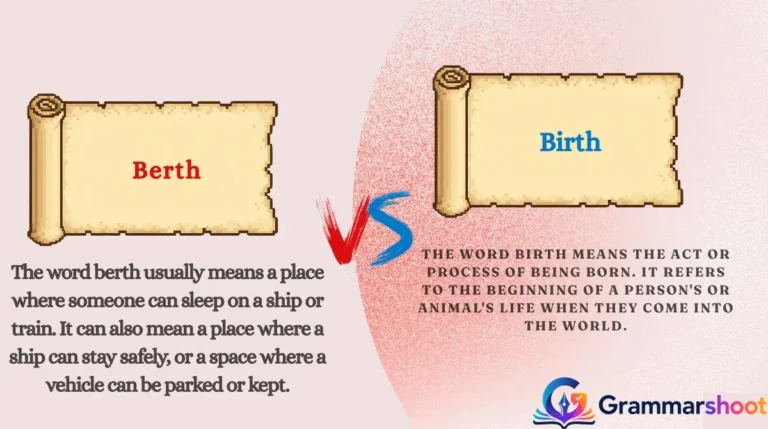
The word berth usually means a place where someone can sleep on a ship or train. It can also mean a place where a ship can stay safely, or a space where a vehicle can be parked or kept.
The exact meaning depends on the situation. However, all these meanings are connected to a place or space set aside for a particular purpose.
1. Berth as a Place to Sleep
On a train or ship, a berth is a sleeping place. It may be a small bed, a bunk, or a sleeping space provided for a passenger or crew member.
For example, when you travel overnight by train, you may book a berth so you can lie down and sleep during the journey.
Examples:
- I booked a lower berth on the train.
- My brother slept in the upper berth.
- We need two berths for our overnight journey.
- The passenger kept his bag under the berth.
- She prefers a lower berth because it is easier to reach.
- Our train ticket includes a sleeping berth.
- The sailor returned to his berth after dinner.
In these sentences, berth refers to a place to sleep.
2. Berth as a Place for a Ship
A berth can also be a place in a port or harbor where a ship stops. The ship stays there while passengers get on or off, cargo is loaded or unloaded, or other work is done.
For example, a large ship may need a special space at a port before workers can unload its containers.
Examples:
- The ship reached its berth early in the morning.
- The harbor has a berth for large cargo ships.
- The captain guided the boat into its berth.
- Workers unloaded the goods after the ship reached its berth.
Here, the word refers to a place where a ship can stay.
3. Berth as a Parking or Storage Space
In some situations, berth can refer to a designated space for a vehicle, such as a boat or, in certain contexts, a bus or other large vehicle.
For example, a marina may provide a berth for a private boat. The owner pays to keep the boat in that space.
Examples:
- The marina has a berth for our small boat.
- The boat was moved to a different berth.
- The company needs more berths for its vessels.
Grammar Rules for “Berth”
Berth is commonly used as a noun. A noun names a person, place, thing, or idea. In its usual meanings, the word names a sleeping space or a place for a ship or boat.
It can be used with articles such as a and the:
- We booked a berth.
- The ship reached the berth.
It can also be used in the plural form berths:
- The train has twenty sleeping berths.
- The port provides several berths for cargo ships.
The word can also be used as a verb, especially in maritime contexts. To berth a ship means to bring it into a berth or assign it a place to stay.
For example:
- The crew berthed the ship safely.
- The vessel was berthed near the harbor entrance.
The past tense and past participle are generally berthed.
Common Learner Confusion About “Berth”
Many learners confuse berth with birth because the words sound alike in many English accents. They may also assume that berth only refers to a bed.
Remember that its meaning is wider than that. It can describe a sleeping place on a train or ship, a ship’s place in a port, or a designated space for a boat.
If the sentence is about a journey, sleeping space, ship, harbor, or boat parking space, berth may be the correct choice.
What Does “Birth” Mean?
The word birth means the act or process of being born. It refers to the beginning of a person’s or animal’s life when they come into the world.
It is also used in expressions about the beginning or creation of something new. For example, the birth of a new idea means that the idea has started to develop or exist.
Unlike berth, which usually names a place, birth names an event, process, or beginning.
1. Birth as the Beginning of Life
The most common meaning of birth is the moment when a baby or animal is born.
For example, when a baby comes into the world, we call this event the baby’s birth. The word can be used when talking about family, hospitals, dates, and personal history.
Examples:
- The birth of their daughter brought them great happiness.
- My birthday is the anniversary of my birth.
- The doctor helped during the birth of the baby.
- The family celebrated the birth of their first child.
- The baby weighed three kilograms at birth.
- Her birth was recorded at the local office.
- The mother received excellent care before the birth.
- The kitten was very small at birth.
In these examples, birth refers to the beginning of life.
2. Birth as a Starting Point
The word is not limited to people and animals. It can also describe the beginning of an idea, movement, organization, or important event.
For instance, if a group of people develops a plan that later becomes a successful business, someone might describe that moment as the birth of the company.
This is a figurative use. It does not mean that a person or animal has been born. Instead, it means that something new has begun.
Examples:
- The meeting marked the birth of a new project.
- The invention led to the birth of a new industry.
- The event celebrated the birth of a local tradition.
- Her experience inspired the birth of a powerful idea.
3. Birth in Common Expressions
You will often find birth in everyday expressions. Learning these expressions can help you understand English more naturally.
Date of birth: The day, month, and year when someone was born.
Example: Please enter your date of birth on the form.
Place of birth: The town, city, or country where someone was born.
Example: Lahore is his place of birth.
Give birth: To deliver a baby.
Example: My aunt gave birth to a healthy baby boy.
By birth: Used to describe someone’s origin or background in certain expressions.
Example: She is Pakistani by birth.
These phrases appear in official documents, conversations, school forms, and news stories.
Grammar Rules for “Birth”
Birth is mainly used as a noun. It can be a countable noun when referring to a particular birth event, but it is often used as an uncountable noun when discussing birth as a general process or condition.
For example:
- The birth of their son was a special occasion.
- Medical care is important during childbirth and birth.
When referring to a particular event, we commonly use a or the:
- It was a difficult birth.
- The birth took place in a hospital.
The plural form is births, as in:
– The hospital records hundreds of births each month.
The word birth is also found in compound words such as birthday, birthplace, birth certificate, and birth rate.
Remember that birth is the noun, while born is usually the form used in sentences describing someone’s arrival into the world.
For example:
- The birth of the baby was announced yesterday.
- The baby was born yesterday.
These sentences are related in meaning, but their grammar is different.
Common Learner Confusion About “Birth”
Some students use birth when they mean a sleeping place because they remember the sound but forget the spelling. Others mix it up with born.
A useful rule is to ask yourself whether you are talking about an event or a place. If you mean the beginning of life, use birth. If you mean a sleeping space on a train or ship, use berth.
Also remember that we normally say “The baby was born,” not “The baby was birth.”
Difference Between Berth and Birth (Detailed)
The main difference is simple: berth refers to a place or space, while birth refers to the beginning of life or the start of something new.
Although the spelling differs by only one letter, the words belong to different meanings and are used in different situations. Understanding this distinction will help you avoid spelling errors and write clearer sentences.
Comparison Table
| Feature | Berth | Birth |
|---|---|---|
| Main meaning | A sleeping place or designated space | The beginning of life |
| Part of speech | Mainly a noun; also a verb | Mainly a noun |
| Common situations | Trains, ships, ports, boats | Babies, animals, life events |
| Example phrase | A lower berth | A baby’s birth |
| Plural form | Berths | Births |
| Verb form | Berth, berthed, berthing | Not normally used as a verb |
| Related word | Bunk | Born |
| Common expression | Book a berth | Give birth |
1. Difference in Meaning
A berth is a place where someone can sleep or where a vessel can stay. Think about a train passenger booking a sleeping space or a ship stopping at a port.
A birth is an event connected to the beginning of life. It can also describe the start of something new, such as a business, idea, or movement.
Compare these sentences:
- We booked a berth on the overnight train.
- We celebrated the birth of our baby.
The first sentence is about a place to sleep. The second is about a life event.
2. Difference in Usage
Use berth when the situation involves a sleeping space, a ship’s assigned place, or a designated space for a boat.
Use birth when discussing a baby being born, someone’s date or place of birth, or the beginning of something.
For example:
- The sailor returned to his berth.
- The sailor celebrated the birth of his daughter.
Both sentences mention a sailor, but the words have different jobs. The first identifies where he sleeps. The second identifies an important event in his family.
3. Difference in Grammar
Both words are commonly used as nouns, but berth can also function as a verb.
Examples:
- The train has several berths. (noun)
- The crew berthed the ship safely. (verb)
- The birth was announced in the newspaper. (noun)
You cannot normally use birth as a verb to mean that a baby came into the world. Instead, English uses be born or give birth.
Correct: The child was born in June.
Correct: She gave birth to a baby in June.
Incorrect: The child was birthed in June, if you are using it as an ordinary substitute for “was born.” Although birth has specialized verb uses, such as in computing and technical contexts, this is not the normal expression for a baby’s arrival.
4. Difference in Sentence Structure
The words often appear in different sentence patterns.
With berth, you might use:
- book a berth
- sleep in a berth
- reach a berth
- berth a ship
With birth, you might use:
- give birth to a baby
- celebrate a birth
- record a birth
- date of birth
Compare:
- I need to book a berth for my journey.
- I need to record the birth of my child.
Both sentences are grammatically correct, but the words cannot be exchanged.
5. Difference in Pronunciation
In many English accents, berth and birth have the same or very similar pronunciation. Both contain the sound represented by th, as in think.
The vowel sound may vary slightly by accent, but the main difference in writing is the letter e in berth and i in birth.
Because they can sound alike, it is especially important to learn their meanings and check their spelling when writing.
Grammar Rules You Must Remember
Four simple rules can help you choose the correct word whenever you are unsure.
Rule 1: Use “Berth” for a Sleeping Space
When you talk about a sleeping place on a train or ship, use berth.
Correct: I reserved a berth for my overnight journey.
Incorrect: I reserved a birth for my overnight journey.
Why? A passenger books a place to sleep, not the beginning of life. Remember that berth is often connected with travel and sleeping arrangements.
Rule 2: Use “Birth” for the Beginning of Life
When talking about a baby or animal coming into the world, use birth.
Correct: The birth of their son was a joyful event.
Incorrect: The berth of their son was a joyful event.
Why? The sentence describes a life event, not a sleeping space. The same rule applies to phrases such as date of birth, place of birth, and birth certificate.
Rule 3: Learn Common Word Partnerships
Some words naturally appear together. Learning these combinations makes the correct spelling easier to remember.
Common combinations with berth include:
- book a berth
- lower berth
- upper berth
- sleeping berth
- ship’s berth
Common combinations with birth include:
- date of birth
- place of birth
- birth certificate
- give birth
- birth rate
For example, you would write, “Please enter your date of birth,” not “Please enter your date of berth.”
Rule 4: Check the Meaning Before Checking the Spelling
If you are unsure which word to write, pause and ask yourself what the sentence means.
Correct: The ship entered its berth.
Correct: The baby was healthy at birth.
The first sentence refers to a place for a ship. The second refers to the time when a baby came into the world.
Easy check: If you can replace the word with “sleeping space,” choose berth. If you can replace it with “the beginning of life,” choose birth.
Common Mistakes Students Make
Many learners make mistakes with these words because they look almost identical. In fast speech, their pronunciation may not help much either. The best solution is to connect each spelling with its meaning.
Mistake 1: Writing “Birth” for a Train Sleeping Place
Incorrect: I booked a birth on the train.
Correct: I booked a berth on the train.
Why it happens: The writer knows that the word refers to a place on a train but remembers the more familiar spelling birth.
How to fix it: Remember that a berth is a space where you can lie down and sleep during a journey.
Mistake 2: Writing “Berth” for a Baby’s Arrival
Incorrect: We were happy about the berth of our daughter.
Correct: We were happy about the birth of our daughter.
Why it happens: The writer remembers the sound but does not focus on the meaning.
How to fix it: Connect birth with baby, born, and birthday. These words all relate to the beginning of life or the anniversary of that event.
Mistake 3: Confusing “Birth” With “Born”
Incorrect: The baby was birth yesterday.
Correct: The baby was born yesterday.
Why it happens: Learners may know that birth and born are related but use the noun where a different grammatical form is needed.
How to fix it: Use born in patterns such as “was born” or “were born.” Use birth as a noun, as in “the birth of the baby.”
Mistake 4: Using the Wrong Word in Official Forms
Incorrect: Please write your date of berth on the form.
Correct: Please write your date of birth on the form.
Why it happens: A spelling error can go unnoticed when someone types quickly or relies only on sound.
How to fix it: Memorize the expression date of birth. It is common on applications, school records, identity documents, and registration forms.
Mistake 5: Assuming the Words Mean the Same Thing
Incorrect: The ship reached its birth at noon.
Correct: The ship reached its berth at noon.
Why it happens: The learner treats similar-looking words as interchangeable.
How to fix it: Never choose a word only because it looks right. Read the whole sentence and decide whether it describes a place or an event.
A helpful habit is to review the full sentence after writing it. A quick meaning check can prevent many spelling mistakes.
Easy Trick to Remember the Difference
Here is a simple memory trick you can use whenever these words confuse you.
Berth = Bed or Boat Space
Think of the letter e in berth as a reminder of a place where you can rest. You might book a berth on a train or find a berth for a boat in a marina.
For example:
- I booked a berth so I could sleep on the train.
- The boat has a berth at the harbor.
Birth = Baby or Beginning
Think of the letter i in birth as a reminder of life. The word is closely connected with a baby being born and the beginning of a person’s life.
For example:
- The birth of the baby made the family happy.
- My date of birth is written on my school form.
You can also remember this short sentence:
“A berth is a place; a birth is a beginning.”
Say this sentence a few times when you practise your English. It connects the spelling with the meaning, making it easier to remember both words.
Another useful trick is to picture two situations. Imagine a passenger lying on a train bed for berth. Then imagine a family welcoming a newborn baby for birth. These mental pictures help you remember which word belongs in each sentence.
Daily Life Examples of Berth and Birth
The best way to learn confusing words is to see them in everyday situations. Here are ten simple examples that show how people might use these words in conversation.
Example 1: Booking a Train Ticket
Ali: Have you booked your ticket for tonight?
Hamza: Yes, I have booked a lower berth.
Explanation: Hamza is talking about a sleeping place on the train, so berth is correct.
Example 2: Asking About a Sleeping Place
Passenger: Is this my berth?
Attendant: Yes, your berth is number 24.
Explanation: The passenger wants to know which sleeping space belongs to them.
Example 3: Talking About a New Baby
Sara: Why is your family celebrating today?
Ayesha: My sister gave birth to a baby girl this morning.
Explanation: The conversation is about a baby arriving into the world, so the word birth is used.
Example 4: Filling Out a Form
Teacher: Please complete this form before class.
Student: Should I write my date of birth here?
Teacher: Yes, please write it in the correct box.
Explanation: The date of birth is the day, month, and year when the student was born.
Example 5: Talking About a Ship
Worker: Where is the ship now?
Captain: It is waiting for a berth at the port.
Explanation: The ship needs a place where it can stop safely.
Example 6: Sharing Family News
Friend 1: I heard your brother has become a father.
Friend 2: Yes! The birth of his son has made everyone very happy.
Explanation: The word birth describes the arrival of the baby.
Example 7: Travelling Overnight
Passenger: Can I change my upper berth to a lower one?
Staff member: I will check whether another berth is available.
Explanation: Both uses refer to sleeping spaces on a train.
Example 8: Discussing an Important Idea
Friend 1: How did your new business begin?
Friend 2: A simple idea led to the birth of the business.
Explanation: Here, birth is used figuratively to describe the beginning of something new.
Example 9: Visiting a Harbor
Tourist: Where should we leave our boat?
Guide: The marina has a berth available near the entrance.
Explanation: The berth is a designated space for the boat.
Example 10: Talking About a Birthday
Friend 1: Why do you celebrate your birthday every year?
Friend 2: Because it marks the anniversary of my birth.
Explanation: A birthday is the yearly anniversary of the day someone was born. The two words are related, but they have different meanings.
Practice Section: Test Your Understanding
Now it is your turn. Choose berth or birth to complete each sentence. Think about the meaning before looking at the answers.
1. I booked a lower _____ for my overnight train journey.berthbirth
2. The _____ of their first child was a happy occasion.berthbirth
3. Please enter your date of _____ on this form.berthbirth
4. The ship moved into its assigned _____ at the port.berthbirth
5. The family celebrated the _____ of a new baby.berthbirth
Check answers
FAQs
1. What is the difference between berth and birth?
Berth usually means a sleeping place on a train or ship, or a designated place for a vessel in a port. Birth means the beginning of life or the arrival of a baby into the world. The two words look and sound similar, but their meanings are different.
2. Are berth and birth pronounced the same?
In many English accents, these words are pronounced the same or very similarly. Their vowel sounds can vary depending on the accent. Because pronunciation may not clearly separate them, learning their meanings and spellings is important.
3. Can berth be used as a verb?
Yes. Berth can be used as a verb, especially when talking about ships. It means to bring a ship into a designated place or assign it a place to stay. For example, “The crew berthed the ship safely.”
4. Is birth a noun or a verb?
Birth is mainly used as a noun. It refers to the beginning of life or the start of something new. In everyday English, we usually say “The baby was born” or “She gave birth,” rather than using birth as a verb to describe a baby’s arrival.
5. Which word is correct: date of berth or date of birth?
The correct phrase is date of birth. It refers to the day, month, and year when a person was born. You will commonly see this phrase on official forms, school records, and registration documents.
6. What is an easy way to remember berth and birth?
Remember this sentence: “A berth is a place; a birth is a beginning.” Use berth when talking about a sleeping space or a place for a ship. Use birth when talking about a baby, the beginning of life, or the start of something new.
Conclusion
Understanding the difference between berth and birth is easier than it may seem. Although these words look and sound similar, they have different meanings and uses.
A berth is usually a sleeping place on a train or ship. It can also mean a place where a ship or boat stays. You might book a berth for an overnight journey or find a berth for your boat at a marina.
A birth, on the other hand, refers to the beginning of life. You use it when talking about a baby being born, someone’s date of birth, or even the beginning of a new idea or business.
The easiest way to remember the difference is this: a berth is a place, while a birth is a beginning.
Try using both words in your own sentences. For example, write one sentence about booking a train berth and another about the birth of a baby. Practising with real-life situations will help you remember the correct spelling.
Keep learning, keep practising, and do not worry about small mistakes. Every new word you understand makes your English a little stronger.

Evan Rellmont is a writer who turns thoughtful ideas into meaningful words, creating stories and reflections that connect, inspire, and leave a lasting impression.