
Have you ever wondered whether you should say “see a bird,” “look at a bird,” or “watch a bird”? These sentences may sound similar, but they do not always mean the same thing.
Many English learners confuse these three words because all of them are connected to using our eyes.
The good news is that the difference is easier to understand than you might think. You do not need to learn difficult grammar rules or remember long definitions.
You only need to understand what happens when you use each word.
We use these words every day. We see people on the street, look at pictures on our phones, and watch videos after school or work.
We also use them when giving directions, asking questions, and talking with friends.
Choosing the correct word can make your English sound more natural. For example, “I watched a movie” is correct because watching a movie usually involves paying attention to something for a period of time.
However, “I saw a movie” can also be correct when you mean that you experienced or viewed a movie, perhaps at the cinema. The meaning depends on the situation.
By the end of this guide, you will understand the meaning of each word, the grammar rules behind it, and the situations in which you should use it.
You will also learn common mistakes, everyday conversation examples, and simple tricks to help you remember the difference.
What Does “See” Mean?
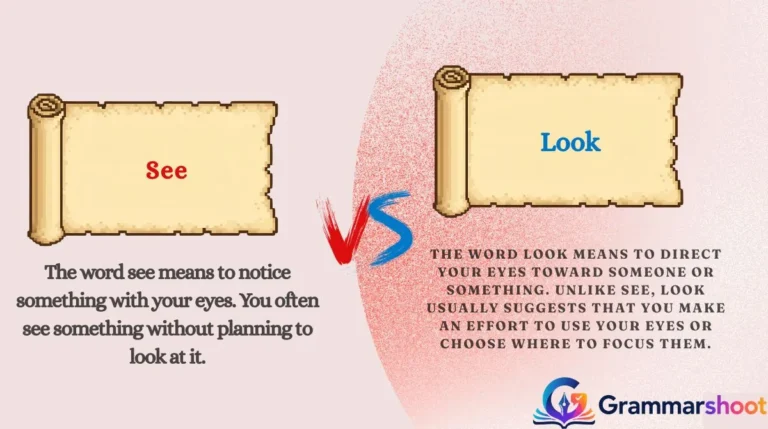
The word see means to notice something with your eyes. You often see something without planning to look at it. In other words, seeing usually happens naturally when your eyes are open and the object is within your view.
For example, imagine that you are walking to school. You notice a dog sitting beside the road. You did not plan to find the dog, but your eyes noticed it. You can say, “I saw a dog on my way to school.”
See is also used when talking about meeting people, visiting a doctor, understanding something, or experiencing an event. Its meaning changes slightly depending on the situation.
When Should You Use “See”?
Use see when you want to talk about noticing something, having a visual experience, or meeting someone.
Here are some common situations.
1. When you notice something naturally
You do not always make an effort to see something. Sometimes it simply comes into your view.
Examples:
- I can see a bird in the tree.
- She saw a rainbow after the rain.
- We saw a beautiful house on our way home.
- He saw his friend across the street.
- Can you see the moon tonight?
- I saw a strange light in the sky.
- They saw a deer near the forest.
In these sentences, the speakers are talking about things they noticed or were able to notice.
2. When you talk about meeting someone
See can also mean to meet or visit a person, especially when the meeting is planned or understood from the situation.
Examples:
- I will see my cousin tomorrow.
- She needs to see a doctor.
- We saw our teacher at the shopping mall.
- I am going to see my friend this evening.
Here, see does not simply mean using your eyes. It refers to meeting or visiting someone.
3. When you talk about understanding
In everyday English, see can mean understand.
Examples:
- Oh, I see what you mean.
- I see why you are upset.
- Now I see the problem.
- Do you see my point?
The speaker is not talking about physical eyesight. They mean that they understand an idea or situation.
Grammar Rules for “See”
See is an irregular verb. Its main forms are:
- Base form: see
- Past simple: saw
- Past participle: seen
- Present participle: seeing
Use these forms according to the tense and sentence structure.
Examples:
- I see a plane in the sky.
- I saw a plane yesterday.
- I have seen that plane before.
- She is seeing a doctor this afternoon.
Notice that we usually use see + object when naming what someone notices.
For example, “I saw a cat” is correct. However, when the object is a person or thing that receives attention, the meaning may depend on the context.
The phrase “see a movie” is also common. It often means to go and experience a movie, especially at a cinema, rather than focusing on the act of watching it.
What Does “Look” Mean?
The word look means to direct your eyes toward someone or something. Unlike see, look usually suggests that you make an effort to use your eyes or choose where to focus them.
Imagine that your friend says, “Look at that beautiful bird!” You turn your head and direct your eyes toward the bird. You are now looking at it.
The important point is that looking is usually a deliberate action. You choose to direct your attention toward something.
When Should You Use “Look”?
Use look when you want to describe directing your eyes toward something, checking something visually, or asking someone to pay attention to a particular thing.
1. When you direct your eyes toward something
Examples:
- Look at the sky.
- She looked at the picture.
- He is looking at the map.
- Look at that beautiful flower!
- I looked out of the window.
- The child looked at his mother.
- Please look at the board.
These examples show that someone is directing their eyes toward a person, object, or place.
2. When you give someone an instruction
Look is very common in commands. You may use it to tell someone where to direct their eyes.
Examples:
- Look at me when I am speaking.
- Look at this picture.
- Look over there!
- Please look at the question again.
In these sentences, look tells someone to perform an action.
3. When you describe appearance
Look can also mean to appear or seem a certain way.
Examples:
- You look happy today.
- This food looks delicious.
- He looks tired.
- The sky looks dark.
- Your new dress looks beautiful.
In this use, look is often followed by an adjective. You do not need the word “at” before the adjective.
Compare these sentences:
- Look at the baby.
- The baby looks sleepy.
The first sentence tells someone to direct their eyes toward the baby. The second describes the baby’s appearance.
Grammar Rules for “Look”
The main forms of the verb are:
- Base form: look
- Past simple: looked
- Past participle: looked
- Present participle: looking
A very important pattern is:
Look + at + person or thing
Examples:
- Look at the board.
- She looked at me.
- They are looking at the stars.
When you want to say that someone directs their eyes toward something, look is normally followed by at before the object.
However, at is not always necessary. It depends on the expression.
Examples:
- Look outside.
- Look up.
- Look down.
- Look around.
- Look carefully.
These expressions are correct because the words after look tell us where or how someone directs their eyes.
Another useful pattern is:
Look + adjective
Examples:
- You look worried.
- The room looks clean.
- This cake looks tasty.
Do not add “at” before an adjective in these sentences. “You look at worried” is incorrect when you mean that someone appears worried.
What Does “Watch” Mean?
The word watch means to look at something carefully, usually for a period of time. It often involves paying attention to an activity, movement, or change.
For example, you watch a football match because the players move around, pass the ball, and try to score. You keep your attention on the game to see what happens next.
You may also watch a child playing, a bird flying, or clouds moving across the sky.
The main idea is that watching usually involves continued attention. It is not just a quick look.
When Should You Use “Watch”?
Use watch when you focus your attention on something that continues, moves, changes, or develops over time.
1. When you watch entertainment
Examples:
- I watch television every evening.
- We watched a movie last night.
- She is watching a funny video.
- They watched a football match together.
- My brother watches cartoons after school.
- I watched a documentary about animals.
These sentences describe giving attention to a program, video, or event.
2. When you pay attention to movement
Examples:
- Watch the ball!
- We watched the birds flying over the lake.
- She watched the children playing in the park.
- He watched the train leave the station.
- I watched the leaves moving in the wind.
- The teacher watched the students during the test.
In each example, the person pays attention to an action or something happening over time.
3. When you warn someone to be careful
Watch can also be used to warn someone about possible danger.
Examples:
- Watch your step!
- Watch out for that car!
- Watch your head.
- Watch the road while driving.
These expressions are common in spoken English. “Watch out!” is especially useful when you want someone to notice danger quickly.
Grammar Rules for “Watch”
The main forms of the verb are:
- Base form: watch
- Past simple: watched
- Past participle: watched
- Present participle: watching
A common pattern is:
Watch + object
Examples:
- I watch movies.
- She watched the children.
- We are watching the match.
- He watches the birds in the garden.
Unlike the usual pattern with look, you do not normally need “at” after watch when naming the thing receiving your attention.
For example:
- Correct: I watched the game.
- Incorrect in standard usage: I watched at the game.
However, watch can take different forms in other expressions, such as “watch out for something.”
Difference Between See, Look, and Watch
Although these words are related, they describe different ways of using your eyes. The easiest way to understand them is to think about whether you notice something naturally, direct your eyes toward it, or pay attention to it over time.
Comparison Table
| Feature | See | Look | Watch |
|---|---|---|---|
| Main meaning | Notice with your eyes | Direct your eyes | Observe with attention |
| Usually deliberate? | Often not | Usually yes | Usually yes |
| Focus | Noticing or visual experience | Direction of your eyes | Continued attention |
| Common pattern | See something | Look at something | Watch something |
| Typical example | I saw a bird. | I looked at the bird. | I watched the bird fly. |
| Common activities | Seeing a sign, seeing a friend | Looking at a photo, looking outside | Watching TV, watching a game |
1. Difference in Meaning
The main difference is the type of attention involved.
See is about noticing something or having a visual experience. You may see a person without planning to do so.
Example: “I saw my teacher at the supermarket.”
Look is about directing your eyes toward something. You may need to turn your head or focus your eyes.
Example: “I looked at my teacher and smiled.”
Watch is about paying attention to something, often while it moves or changes.
Example: “I watched my teacher walk into the classroom.”
These three sentences describe different parts of a possible situation. First, you notice your teacher. Then you direct your eyes toward them. Finally, you follow their movement.
2. Difference in Grammar
The grammar patterns are also important.
With see, you can usually place the object directly after the verb:
- I see a bird.
- She saw the sign.
- We have seen this place before.
With look, use “at” before a person or thing when you mean directing your eyes toward it:
- I looked at the bird.
- She is looking at the sign.
- We looked at the painting.
With watch, you usually place the object directly after the verb:
- I watched the bird.
- She is watching the game.
- We watched the performance.
Remember that English has special expressions and exceptions. For example, “look for” means try to find something, while “look after” means take care of someone or something.
3. Difference in Time and Movement
Watch often suggests that an activity continues for some time. See and look do not always carry this meaning.
Compare:
- I saw the bus.
- I looked at the bus.
- I watched the bus move away.
In the first sentence, you noticed the bus. In the second, you directed your eyes toward it. In the third, you paid attention to its movement as it moved away.
However, watching does not always require obvious movement. You can watch a person sitting quietly or watch a sleeping baby. The key idea is continued attention, not movement alone.
4. Can These Words Be Used for the Same Thing?
Yes. Sometimes all three words can be used in a similar situation, but the meaning changes.
Imagine that a new movie is playing at the cinema.
- I saw the movie last night.
- I looked at the movie poster.
- I watched the movie last night.
The first and third sentences can both be correct. “Saw the movie” often emphasizes the experience of seeing it, while “watched the movie” emphasizes the activity of viewing it.
The second sentence means you directed your eyes toward the poster, not that you watched the movie itself.
This is why you should consider the full sentence instead of choosing a word only because it is connected to eyesight.
Grammar Rules You Must Remember
Rule 1: Use “See” for Noticing Something
When something comes into your view and you notice it, see is usually the natural choice.
Example: “I saw a cat outside my house.”
You are reporting that you noticed the cat. You are not necessarily saying that you were trying to find it.
Rule 2: Use “Look At” to Direct Your Eyes
When you tell someone to focus their eyes on a person or object, use look at.
Example: “Please look at the first question.”
The word “at” is important in this pattern because it connects look with the object receiving your visual attention.
Rule 3: Use “Watch” for Continued Attention
When you pay attention to an activity or something happening over time, watch is often the best choice.
Example: “We watched the children play in the garden.”
You are paying attention to what the children are doing, rather than simply noticing them once.
Rule 4: Remember That “Look” Can Describe Appearance
When you describe how someone or something appears, use look followed by an adjective.
Example: “You look tired today.”
This does not mean that you are directing your eyes toward tiredness. It means the person appears tired.
Other examples include “The sky looks blue” and “Your idea looks interesting.”
Common Mistakes Students Make
Many learners make mistakes with these words because their meanings overlap. Some languages also use one common verb for several actions that English expresses with different words.
The best way to improve is to learn each word in a complete sentence.
Mistake 1: Using “Look” Without “At”
Incorrect: “Look the picture.”
Correct: “Look at the picture.”
When you use look to direct someone’s eyes toward an object, remember the pattern “look at.”
A useful correction tip is to ask yourself whether you mean “direct your eyes toward something.” If the answer is yes and you name the object, you will usually need at.
Mistake 2: Using “Watch” for Every Visual Action
Incorrect for the usual intended meaning: “I watched a sign on the road and learned the speed limit.”
More natural: “I saw a sign on the road and learned the speed limit.”
A sign is often something you notice rather than an activity you follow over time. However, “watch the sign” can be correct in a special situation where you are monitoring it.
Correction tip: Ask yourself whether you are simply noticing an object or paying attention to something happening.
Mistake 3: Saying “See at”
Incorrect: “I saw at a beautiful bird.”
Correct: “I saw a beautiful bird.”
See normally takes a direct object without at when you mean noticing something with your eyes.
Compare it with look: “I looked at a beautiful bird.”
Correction tip: Learn “see something” and “look at something” as separate patterns.
Mistake 4: Confusing “Look” and “Watch”
Incorrect for a movie-viewing activity: “We looked a movie last night.”
Correct: “We watched a movie last night.”
You can also say, “We saw a movie last night.” But look is not used this way without a suitable object or phrase.
Correction tip: For films, television programs, sports matches, and similar activities, watch is usually a safe choice.
Mistake 5: Forgetting the Different Verb Forms
Incorrect: “Yesterday, I seen a rainbow.”
Correct: “Yesterday, I saw a rainbow.”
Seen is the past participle of see, so it normally appears with a helping verb such as have, has, or had.
Examples:
- I saw the rainbow yesterday.
- I have seen that rainbow before.
- She had seen the picture earlier.
Correction tip: Remember the sequence see – saw – seen.
Easy Trick to Remember the Difference
Here is a simple trick that works well for beginners:
- See = notice
- Look = direct your eyes
- Watch = pay attention
Imagine that you are sitting in your living room and a bird flies past your window.
First, you see the bird because it enters your view.
Next, you look at the bird because you turn toward the window.
Then, you watch the bird as it flies from one tree to another.
The three actions are connected, but they do not mean exactly the same thing.
You can use the same trick in many situations. When a friend enters a room, you may see your friend. When you turn toward your friend, you look at them. When you follow your friend’s movements as they walk across the room, you watch them.
One more helpful clue is to think about time. Seeing may happen in a moment. Looking means directing your eyes somewhere. Watching often continues for a while.
These are useful general rules, not strict rules for every sentence. English speakers sometimes use see and watch in overlapping ways, especially when talking about movies, performances, and events.
Daily Life Examples
Everyday conversations are one of the best ways to understand these words. Read the following examples aloud and notice why each word is used.
Example 1: Talking About a Bird
Ali: Did you see that bird?
Sara: Yes! Look at its beautiful wings.
Ali: Let’s watch it build its nest.
Here, see means notice, look at directs Sara’s eyes toward the bird, and watch means pay attention to the bird’s activity.
Example 2: Watching Television
Mother: What are you doing?
Son: I’m watching TV.
Mother: Okay, but look at the clock. It’s almost nine.
The son is viewing a program. His mother tells him to direct his eyes toward the clock.
Example 3: At School
Teacher: Look at the board, please.
Student: I can see the answer now.
Teacher: Good. Watch how I solve the next question.
The teacher asks the student to direct their eyes toward the board. The student notices the answer. The teacher then asks the student to pay attention to a process.
Example 4: At the Bus Stop
Friend A: Did you see the bus?
Friend B: Yes, I saw it near the traffic lights.
Friend A: Watch the road. Another bus is coming!
The first question asks whether the person noticed the bus. The warning asks the other person to pay attention to what is happening on the road.
Example 5: Talking About a Movie
Ayesha: Have you seen the new movie?
Mina: Yes, I watched it last weekend.
Ayesha: Did you like it?
Both see and watch can be used naturally here. Seeing a movie can refer to the experience of viewing it, while watching describes the activity.
Example 6: Looking at Photos
Hamza: Look at this photo of my family.
Bilal: I can see your brother in the back.
Hamza: Yes, watch him in the next video. He’s doing a funny dance!
The photo is something to look at. The brother is visible in the photo, and his movements in the video are something to watch.
Example 7: In the Garden
Mother: Can you see the flowers from here?
Daughter: Yes, but I want to look at them more closely.
Mother: Be careful when you watch the bees around them.
The daughter notices the flowers, directs her eyes toward them more carefully, and then pays attention to the bees’ activity.
Example 8: Meeting a Doctor
Receptionist: Do you need to see the doctor today?
Patient: Yes, please.
Receptionist: Look at the screen to check your appointment time.
In the first sentence, see means meet or visit. In the second, look means direct your eyes toward the screen.
Example 9: At a Football Match
Father: Can you see the players from your seat?
Son: Yes! Look at the goalkeeper.
Father: Watch the ball. The player is about to kick it.
The examples show the difference between noticing the players, directing your eyes toward the goalkeeper, and following the ball’s movement.
Example 10: On a Rainy Day
Nadia: I can see dark clouds outside.
Hira: Look at the window. It’s starting to rain.
Nadia: Let’s watch the rain from here.
See describes noticing the clouds, look tells someone where to direct their eyes, and watch describes observing the rain as it falls.
Practice Section: Choose the Correct Word
Test your understanding by choosing see, look, or watch in each sentence. Pay attention to the meaning and the grammar pattern.
- Please _____ at the picture on page five.
- I _____ a rainbow on my way home yesterday.
- We usually _____ a movie together on Saturday night.
- Can you _____ the mountains from your bedroom window?
- _____ out! There is a car coming.
Answers and Explanations
- Look — “Look at” is used when directing your eyes toward an object.
- Saw — This is the past form of see, used for something noticed yesterday.
- Watch — Watch is natural for the activity of viewing a movie.
- See — The question asks whether the mountains are visible from the window.
- Watch — “Watch out!” is a common warning used when someone needs to be careful.
If you made a mistake, read the explanation and try the sentence again. Understanding why an answer is correct is more useful than memorizing the answer alone.
FAQs
1. What is the difference between see, look, and watch?
See usually means to notice something with your eyes. Look means to direct your eyes toward something. Watch means to pay attention to something, often for a period of time. The correct choice depends on what you want to express.
2. Can we use “see” in questions?
Yes. See is common in both questions and statements.
Examples include “Can you see the board?” and “Did you see my keys?” You can also use it to ask about meeting someone, as in “When will you see your doctor?”
3. Is “look” formal or informal?
Look is used in both formal and informal English. You can say “Please look at the document” in a work meeting or “Look at that dog!” when speaking with a friend. The level of formality depends on the sentence and situation.
4. Why do we say “look at” but “watch a movie”?
Look commonly uses at before the object when you mean directing your eyes toward it. Watch usually takes its object directly. Therefore, you say “look at the screen” and “watch a movie.” These are common English grammar patterns.
5. Is “I saw a movie” correct, or should I say “I watched a movie”?
Both sentences are correct. “I watched a movie” focuses on the activity of viewing it. “I saw a movie” often refers to the experience of seeing it, such as going to the cinema. The best choice depends on the context.
6. Can “look” mean something other than using your eyes?
Yes. Look can describe appearance, as in “You look happy,” or searching, as in “I’m looking for my phone.” It also appears in expressions such as “look after,” which means take care of someone or something. Learning these expressions helps you understand natural English.
Conclusion
Understanding the difference between see, look, and watch can make your everyday English much clearer. Although all three words are connected to eyesight, each one has its own common use.
Use see when you notice something, recognize something visually, or talk about meeting someone. Use look when you direct your eyes toward a person or object.
Remember the common pattern “look at something.” Use watch when you pay attention to an activity, movement, or event, such as a football match or a movie.
Keep the simple memory trick in mind: see means notice, look means direct your eyes, and watch means pay attention.
These meanings overlap in some situations, so always think about the message you want to communicate.
To improve, try making three sentences about things you see, look at, and watch during your day. You can practice while walking outside, studying at school, or relaxing at home.
With regular practice, these words will become easier to choose, and your English will sound more natural and confident.

Evan Rellmont is a writer who turns thoughtful ideas into meaningful words, creating stories and reflections that connect, inspire, and leave a lasting impression.