
Have you ever wondered whether to say “my elder brother” or “my older brother”? Both expressions talk about age, and both can sound correct in many situations.
However, there are some important differences between elder and older that every English learner should understand.
These two words are often confusing because they have almost the same basic meaning. Both can describe someone who is more advanced in age than another person.
However, they do not always fit into the same sentences. For example, we usually say “my elder sister” or “my older sister,” but we do not normally say “She is elder than me.” In that sentence, “older” is the correct choice.
The confusion becomes even greater when learners hear different forms of English.
In some places, especially in South Asian English, people commonly use “elder brother” and “elder sister.” In everyday British and American English, “older brother” and “older sister” are also very common.
So, how do you know which word to choose?
The good news is that the difference is easy to learn once you understand a few simple rules. You will learn what each word means, how to use it in sentences, which grammar rules matter, and what mistakes to avoid.
You will also see examples from family conversations, school, work, and daily life.
By the end, you will know when to use “elder,” when to use “older,” and how to sound more natural when talking about age in English.
What Does “Elder” Mean?
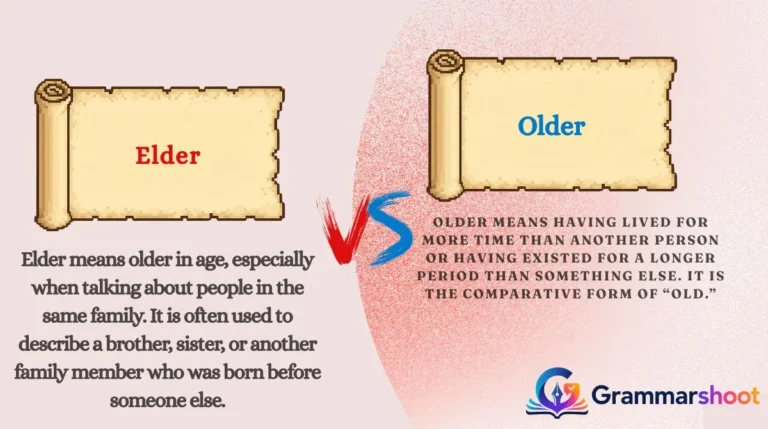
Elder means older in age, especially when talking about people in the same family. It is often used to describe a brother, sister, or another family member who was born before someone else.
For example:
- My elder brother lives in Lahore.
- Her elder sister is a doctor.
- I have an elder son and a younger daughter.
In these sentences, “elder” tells us that one family member is older than another.
When Should You Use Elder?
The word “elder” is most commonly used before a noun. This means it usually comes directly before the name of a person or a family relationship.
Common examples include:
- Elder brother
- Elder sister
- Elder son
- Elder daughter
- Elder child
You may also hear expressions such as “elder members of the family” or “elder people in the community.” In these cases, the word can refer to people who are older and may be respected for their age or experience.
However, when you simply want to compare the ages of two people in a sentence, “older” is usually the better choice.
For example:
- Correct: My elder brother is a teacher.
- Correct: My brother is older than me.
- Incorrect in standard everyday English: My brother is elder than me.
Notice that “elder” works naturally before “brother,” but it does not normally take “than” to make a direct comparison.
Grammar Rule for Elder
The most useful rule is this:
Use “elder” mainly before a family relationship or another noun referring to a person. Do not normally use it with “than” in everyday English comparisons.
The structure is:
Elder + noun
Examples:
- My elder sister is married.
- His elder brother works abroad.
- Their elder son studies medicine.
- She is the elder child in the family.
In the last example, “elder” identifies the older child within the family. The word is not being used in the usual “older than someone” structure.
Example Sentences Using Elder
Here are eight simple examples to help you understand the word.
- My elder brother helps me with my homework.
- Sara often visits her elder sister on weekends.
- His elder son wants to become a doctor.
- My elder daughter is learning to drive.
- Their elder child goes to university.
- I always ask my elder brother for advice.
- Her elder sister taught her how to cook.
- The elder members of our family met at the wedding.
Each sentence uses “elder” to describe a person in relation to someone else or to identify an older person within a group.
Common Confusion About Elder
Many students think “elder” is simply a more formal version of “older.” Although the words overlap in meaning, their grammar is different.
For example, both of these sentences are correct:
- My elder brother lives in Karachi.
- My older brother lives in Karachi.
However, this sentence is not the normal choice in standard modern English:
- My brother is elder than me.
The natural version is:
- My brother is older than me.
Remember that “elder” is especially common in family expressions. It can also be used as a noun, as in “respect your elders,” meaning older people, particularly those who deserve respect because of their age or position.
What Does “Older” Mean?
Older means having lived for more time than another person or having existed for a longer period than something else. It is the comparative form of “old.”
For example:
- My brother is older than me.
- This building is older than that one.
- She looks older than her age.
Unlike “elder,” the word “older” can be used in many different situations. You can use it when comparing family members, friends, buildings, cars, traditions, objects, and many other things.
It is the more flexible and widely useful choice for everyday English.
When Should You Use Older?
Use “older” whenever you want to compare age or the length of time something has existed.
You can use it in three common ways.
1. Before a noun
In this structure, “older” describes a person or thing.
Examples:
- My older brother is very friendly.
- She bought an older car.
- We live in an older house.
2. With “than”
This is one of the most common ways to compare two people or things.
Examples:
- Ali is older than Ahmed.
- This building is older than our school.
- My sister is two years older than me.
3. In questions and negative sentences
You can also use “older” when asking about age or explaining that someone is not as old as another person.
Examples:
- Is your brother older than you?
- My cousin is not older than me.
- Which building is older?
These structures make “older” useful in everyday conversations.
Grammar Rule for Older
The basic structure for comparing age is:
Person or thing + be verb + older + than + comparison
Examples:
- I am older than my cousin.
- She is older than her husband.
- This house is older than that house.
You can also add a number to show the difference in age.
Examples:
- My brother is three years older than me.
- Her daughter is five months older than my son.
- This bridge is more than a hundred years older than the nearby road.
In these sentences, “older” tells us which person or thing has existed for a longer time.
Example Sentences Using Older
Here are eight more examples.
- My sister is older than I am.
- Ahmed is two years older than his best friend.
- This book is older than the one on my desk.
- Our school building is older than the hospital.
- Is your cousin older than you?
- My parents live in an older house.
- The blue car is older than the red car.
- I am not much older than my younger brother.
These examples show that “older” works with people and things. It can also appear before a noun or after a linking verb such as “is,” “am,” or “are.”
Common Confusion About Older
Some learners believe that “older” should only be used for objects or people outside the family, while “elder” should always be used for family members.
That is not correct.
You can say both:
- My elder sister is a teacher.
- My older sister is a teacher.
Both sentences are correct in standard English. However, “older sister” is especially natural in everyday British and American English, while “elder sister” is also widely understood and used.
Another common mistake is thinking that “older” is only about people. In fact, it can describe almost anything whose age or history can be compared.
For example, you can have an older phone, an older building, an older tradition, or an older version of a computer program.
This wider use is one reason why “older” is usually the safer word when you are unsure.
Difference Between Elder and Older (Detailed)
The main difference is not their basic meaning. Both words relate to age. The real difference is how they are used in a sentence and what they describe.
“Elder” is mainly used for people, especially family members. “Older” is much more flexible and can describe people, animals, objects, buildings, and things that have existed for a longer time.
Elder vs Older: Comparison Table
| Feature | Elder | Older |
|---|---|---|
| Basic meaning | Greater age, often within a family | Greater age or longer existence |
| Common use | Family relationships | People and things |
| Before a noun | Yes | Yes |
| Used with “than” | Not normally in standard everyday English | Yes |
| Used for objects | Uncommon in ordinary use | Very common |
| Everyday flexibility | More limited | More flexible |
| Example | My elder brother is kind. | My brother is older than me. |
| Natural question | Is he your elder brother? | Is he older than you? |
This table shows that the words are similar but do not follow exactly the same patterns.
1. Difference in Meaning
In many sentences, both words refer to someone who has lived longer than another person.
For example:
- My elder brother is a lawyer.
- My older brother is a lawyer.
Both sentences tell us that the speaker has a brother who is older than them.
However, “elder” can sometimes carry a stronger connection with family relationships, seniority, or respect. In expressions such as “respect your elders,” it refers to older people, often with an idea of respect for their age or experience.
“Older” is more neutral. It simply compares age and does not automatically suggest authority or respect.
For example:
- My older colleague has more experience.
- We should respect our elders.
The first sentence compares age. The second uses a familiar expression about respecting older people.
2. Difference in Usage
The word “elder” is most natural before a family noun.
Examples:
- My elder brother is a pilot.
- Her elder sister lives in London.
- Their elder son is at university.
The word “older” can be used in the same position, but it also works in other sentence structures.
Examples:
- My brother is older than me.
- This car is older than mine.
- Which of these buildings is older?
This means you have more freedom when using “older.” If you are talking about a comparison and are unsure which word to choose, “older” will usually be correct.
3. Difference in Grammar
The most important grammar difference appears when you use “than.”
With “older,” the comparative structure is normal:
- She is older than her sister.
- I am older than my friend.
- This book is older than that book.
With “elder,” this structure is generally avoided in standard modern English:
- Unnatural in standard everyday English: She is elder than her sister.
- Natural: She is older than her sister.
The same rule applies to questions:
- Natural: Is your brother older than you?
- Unnatural in standard everyday English: Is your brother elder than you?
You do not need to memorize many complicated rules. Just remember that “older than” is the normal expression for direct comparisons.
4. Difference in Sentence Structure
Both words can appear before a noun, but “older” has more possible sentence patterns.
Compare these examples:
Before a noun
- My elder brother is a doctor.
- My older brother is a doctor.
After a linking verb
- My brother is older than me.
- My sister is older than her husband.
The second pattern is especially useful because it allows you to compare two people directly.
You can also use “older” with a number:
- She is four years older than I am.
- He is six months older than his cousin.
The same pattern is not normally used with “elder.”
5. Difference in Use for People and Things
“Elder” mainly refers to people, particularly family members or respected older people.
For example:
- Her elder brother works in Dubai.
- We should listen to our elders.
“Older” can refer to both living beings and objects.
For example:
- My older dog needs special care.
- This laptop is older than my new one.
- Their house is older than ours.
- The older version of the app had fewer features.
You would not normally describe a laptop as “elder.” This is a clear example of why “older” is more widely useful.
Grammar Rules You Must Remember
Learning a few basic rules will help you avoid most mistakes with these words.
Rule 1: Use Elder Mainly Before Family Nouns
“Elder” is commonly used before words such as brother, sister, son, daughter, or child.
Examples:
- My elder brother is a teacher.
- Her elder sister lives nearby.
- Their elder son is married.
You can often replace “elder” with “older” in these sentences without changing the main meaning.
Remember: “Elder brother” and “older brother” are both correct.
Rule #2: Use Older Than for Direct Comparisons
When you compare two people or things, use “older than.”
Examples:
- I am older than my cousin.
- My sister is older than her friend.
- This building is older than our house.
Avoid using “elder than” in standard everyday English.
A quick way to check your sentence is to look for the word “than.” If you are comparing ages directly, “older” is normally the right choice.
Rule 3: Use Older for Objects and Other Things
If you are talking about a car, phone, house, building, book, or computer, choose “older.”
Examples:
- My phone is older than yours.
- This house is older than the school.
- That book is older than mine.
“Elder” is not the usual word for these things.
Rule 4: Do Not Confuse Elder with Eldest
“Elder” refers to someone older within a relationship or group. “Eldest” is commonly used for the oldest person in a family.
Examples:
- My elder brother lives abroad.
- My eldest brother is a doctor.
The first sentence identifies a brother who is older than the speaker or another person understood from the context. The second usually identifies the brother who is oldest among the siblings.
For direct age comparisons, however, “older” and “oldest” are also common:
- My brother is older than me.
- She is the oldest child in the family.
Common Mistakes Students Make
Many English learners make mistakes because the two words have similar meanings. They may also learn one expression from family conversations and then use it in every situation.
Here are some common errors and simple ways to correct them.
Mistake 1: Using Elder with Than
Wrong: My sister is elder than me.
Correct: My sister is older than me.
Why does this happen? Students often think “elder” and “older” can replace each other in every sentence. However, “elder than” is not the normal comparative structure in standard modern English.
Easy tip: When you see “than” in a sentence comparing age, choose “older.”
Mistake 2: Thinking Elder Brother Is Incorrect
Incorrect belief: You must always say “older brother.”
Correct: Both “elder brother” and “older brother” are correct.
“Elder brother” is common in many varieties of English, including South Asian English. “Older brother” is also widely used and sounds very natural in everyday conversation.
The choice may depend on your region, writing style, or personal preference.
Easy tip: Do not mark “elder brother” as wrong simply because you usually hear “older brother.”
Mistake 3: Using Elder for Objects
Wrong: This is my elder phone.
Correct: This is my older phone.
“Elder” is mainly used for people. When you talk about the age of an object, “older” is the usual choice.
More examples:
- Wrong: This is an elder building.
- Correct: This is an older building.
Easy tip: If the word describes a thing instead of a person, “older” is usually correct.
Mistake 4: Thinking Elder Always Means More Important
Wrong idea: An elder person must always have more power or authority.
Correct understanding: “Elder” mainly refers to age or a family relationship. It can suggest respect in some expressions, but it does not always mean someone is more important.
For example, your elder sister may be older than you, but that does not automatically mean she makes every decision for you.
Easy tip: Focus on age first. Think about respect or authority only when the context suggests it.
Mistake 5: Confusing Elder with Eldest
Wrong: He is my elder brother of all.
Better: He is my eldest brother.
You can also say, “He is the oldest of my brothers.”
“Elder” is often used for a family relationship, while “eldest” commonly identifies the oldest child or sibling in a family.
Easy tip: Use “eldest” when you mean the oldest among several siblings.
Mistake 6: Using Elder in Every Formal Sentence
Wrong idea: “Elder” is always more correct because it sounds formal.
Correct understanding: The right word depends on the sentence, not simply on how formal it sounds.
For example:
- Natural: This building is older than the library.
- Unnatural: This building is elder than the library.
Even in formal writing, “older” is the normal choice for this comparison.
Easy tip: Do not choose a word just because it sounds more advanced. Choose the word that fits the grammar.
Easy Trick to Remember the Difference
Here is a simple trick that can help you remember the difference without learning long grammar explanations.
Elder = think of family. Older = think of comparison.
When you talk about a family relationship, “elder” may be a good choice.
For example:
- My elder brother is a teacher.
- Her elder sister is very kind.
When you want to compare ages, use “older.”
For example:
- My brother is older than me.
- Sara is older than Ali.
There is one more helpful trick: remember that “older” can describe things as well as people.
You can say:
- An older phone
- An older house
- An older book
- An older version of a website
But “elder phone” or “elder house” would sound unnatural in ordinary English.
Imagine that you are speaking to a friend about your family. You might say, “My elder sister is studying medicine.” If your friend asks whether your sister is older than you, you would answer, “Yes, she is older than me.”
Both words are useful, and there is no need to avoid “elder.” Just remember that “older” works in more situations.
Daily Life Examples
Real conversations are one of the best ways to understand the difference. Read these examples and notice how the words fit naturally into everyday speech.
Example 1: Talking About a Brother
Ali: Do you have any brothers?
Hamza: Yes, I have an elder brother.
Ali: Is he older than you?
Hamza: Yes, he is three years older than me.
Here, “elder brother” identifies a family relationship. “Older than you” compares two people’s ages.
Example 2: Talking About a Sister
Sara: Who taught you how to drive?
Ayesha: My older sister taught me.
Sara: Is she much older than you?
Ayesha: No, she is only two years older.
Both uses of “older” are natural. The word describes the sister and compares her age with Ayesha’s.
Example 3: Talking About a Phone
Ahmed: Why do you want a new phone?
Bilal: My current phone is very old.
Ahmed: Is it older than mine?
Bilal: Yes, I bought it four years before you bought yours.
“Older” works because the speakers are comparing objects and how long they have existed.
Example 4: Talking About Family Advice
Mina: Who helps you when you have a problem?
Hira: I usually talk to my elder brother.
Mina: That’s nice. Does he give you good advice?
Hira: Yes, he always listens to me.
“Elder brother” sounds natural here because the conversation is about a family relationship.
Example 5: Talking About a House
Usman: Is this your new house?
Farhan: No, it belongs to my uncle.
Usman: It looks older than our house.
Farhan: It is. My uncle’s house was built many years ago.
“Older” is the right choice when comparing buildings.
Example 6: Talking About School
Teacher: Is your sister in the same class as you?
Student: No, she is older than me.
Teacher: What class is she in?
Student: She is in the ninth grade.
The student uses “older than me” to compare ages.
Example 7: Talking About a Family Gathering
Nadia: Who is the oldest child in your family?
Sana: My elder sister is the oldest.
Nadia: How many siblings do you have?
Sana: We are four children.
This conversation uses “elder sister” for the family relationship and “oldest” to identify the child with the greatest age.
Example 8: Talking About a Computer
Hamza: Why is your computer so slow?
Raza: It is an older model.
Hamza: Is it older than mine?
Raza: Yes, I bought it six years ago.
The word “older” is suitable for products and devices.
Example 9: Talking About a Cousin
Amina: Is your cousin the same age as you?
Maryam: No, she is a little older than me.
Amina: Do you go to the same school?
Maryam: Yes, but she is in a higher class.
The phrase “older than me” makes the age comparison clear.
Example 10: Talking About Respect
Father: You should listen carefully when older people share their experience.
Son: I understand, Dad.
Father: We should also respect our elders.
The word “older” describes people by age. In the expression “respect our elders,” the word “elders” refers to older people who are often treated with respect.
Practice Section
Now it is your turn. Choose the correct word in each sentence. In some sentences, both words may be grammatically possible, so look carefully at the structure.
Choose the Correct Answer
1. My ______ brother lives in Islamabad.
a) elder
b) older
2. My sister is three years ______ than me.
a) elder
b) older
3. This building is ______ than the school.
a) elder
b) older
4. Is your brother ______ than you?
a) elder
b) older
5. We should respect our ______.
a) elders
b) olders
Answers and Explanations
1. a) elder — or b) older
Both “elder brother” and “older brother” are correct. “Elder” is especially common in family expressions, but “older” is also natural.
2. b) older
Use “older than” when comparing two people’s ages. “Elder than” is not the normal form in standard everyday English.
3. b) older
“Older” is used for objects and buildings. “Elder” is not normally used this way.
4. b) older
The correct question uses “older than you.” This is the normal way to compare ages.
5. a) elders
“Elders” is the correct plural noun. It refers to older people, often people who are respected because of their age or experience. “Olders” is not the standard form.
FAQs
1. What is the difference between elder and older?
Both words relate to age, but they are used differently. “Elder” is mainly used before family nouns, such as “elder brother” and “elder sister.” “Older” is more flexible and can describe people, objects, buildings, and other things. It is also the normal choice for direct comparisons using “than.”
2. Can we use elder in questions?
Yes, you can use “elder” in questions when it comes before a noun or appears in a suitable expression. For example, “Is he your elder brother?” is correct. However, when comparing ages directly, say, “Is he older than you?” rather than “Is he elder than you?”
3. Is elder formal or informal?
“Elder” can sound somewhat formal in some contexts, but it is also common in everyday family expressions in several varieties of English. Phrases such as “elder brother” and “elder sister” are widely understood. The word “older” is also correct and is often more natural in casual British and American English.
4. Is older brother correct English?
Yes, “older brother” is completely correct. You can also say “elder brother.” Both expressions refer to a brother who is older than another person, usually the speaker or another family member understood from the context. “Older brother” is particularly common in everyday conversation.
5. Can we use older for things?
Yes. “Older” can describe people, animals, buildings, cars, phones, books, and many other things. For example, “This car is older than mine” and “We live in an older house” are both correct. “Elder” is generally not used for objects in ordinary English.
6. What is the difference between elder, older, and eldest?
“Elder” is often used before family nouns, as in “my elder sister.” “Older” is the comparative form used to compare ages, as in “my sister is older than me.” “Eldest” commonly identifies the oldest child or sibling in a family, as in “She is the eldest daughter.” You can also use “oldest” in that final example.
Conclusion
Understanding the difference between “elder” and “older” is easier than it may seem. Both words relate to age, and both can be used to talk about family members. The main difference is how they work in a sentence.
Use “elder” mainly before family nouns, such as “elder brother,” “elder sister,” and “elder son.” It can also be used as a noun in expressions such as “respect your elders.”
Use “older” when comparing two people or things. It is the natural choice in sentences such as “My brother is older than me” and “This house is older than ours.” It can describe almost anything that has existed for a longer time.
The most useful rule to remember is simple: “elder brother” is correct, but “older than me” is the normal form for direct comparisons.
Do not worry if you have mixed up these words before. Many English learners do the same. Read the examples, practise making your own sentences, and pay attention to how people use these words in real conversations.
With a little practice, you will be able to choose the right word naturally and speak English with greater confidence.

Evan Rellmont is a writer who turns thoughtful ideas into meaningful words, creating stories and reflections that connect, inspire, and leave a lasting impression.