
Have you ever stopped while writing an English sentence because you could not decide whether to use relation or relationship? You are not alone.
Many English learners find these two words confusing because they have similar meanings. Both can describe a connection between people, things, ideas, or events.
However, these words are not always used in the same way. For example, you might say, “I have a close relationship with my brother,” when talking about your family bond.
But when discussing two scientific ideas, you might say, “There is a relation between sleep and memory.” Both sentences describe a connection, yet each word fits a different situation more naturally.
The confusion becomes even greater when you hear phrases such as family relations, business relationship, international relations, and in relation to.
These expressions may sound similar, but English uses them in different contexts.
The good news is that you do not need to memorize difficult grammar rules to understand the difference.
A few simple guidelines and some everyday examples can help you choose the correct word with confidence.
Here, you will learn what each word means, how to use it in a sentence, and which common mistakes to avoid.
You will also explore the difference between personal connections and connections between ideas, practice natural spoken English, and test your understanding with short exercises.
By the end, you should feel more comfortable using both words in conversations, schoolwork, professional writing, and everyday communication.
What Does “Relation” Mean?
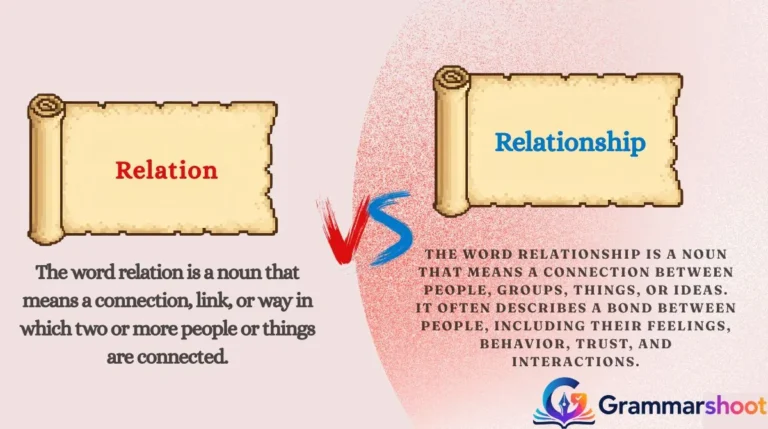
The word relation is a noun that means a connection, link, or way in which two or more people or things are connected.
It is often used when discussing facts, ideas, events, subjects, or the way one thing is connected to another. It can also describe dealings between countries or groups, especially in its plural form, relations.
For example:
- There is a relation between exercise and good health.
- The teacher explained the relation between the two ideas.
- Our country has friendly relations with its neighbors.
In some situations, relation can also mean a family member or relative. For example, “She is a distant relation of mine” means that she is a relative, although not a close one.
When Should You Use Relation?
Use relation when you want to talk about how one thing connects to, affects, or relates to another. It is especially common in formal writing, academic discussions, scientific explanations, and certain fixed expressions.
Consider a student studying the effects of sleep on school performance. The student might write, “Researchers are examining the relation between sleep and memory.” Here, the focus is on the connection between two subjects.
The word also appears in expressions such as in relation to, in this relation, and relations between countries. Of these, in relation to is especially common and means “about,” “connected with,” or “when compared with.”
For example, “I have a question in relation to your homework” means “I have a question about your homework.” In everyday conversation, the simpler word about will often sound more natural.
Grammar Rules for Relation
Relation is a countable noun in its ordinary connection-related meaning. Its singular form is relation, and its plural form is relations.
You can use it with articles and describing words:
- a relation
- the relation
- a close relation
- an important relation
- several relations
However, the natural choice depends on the meaning. When discussing how two people treat each other, English speakers usually prefer relationship in the singular.
Compare these sentences:
- Less natural in everyday English: “I have a good relation with my manager.”
- More natural: “I have a good relationship with my manager.”
The plural form relations is more natural in expressions such as “relations between the two companies” or “friendly relations between the countries.”
Examples of Relation in Sentences
Here are eight examples showing how the word works in different situations.
- There is a clear relation between regular exercise and better health.
- The teacher explained the relation between these two words.
- The report discusses the relation between education and income.
- Our school wants to improve its relations with the local community.
- The two countries have maintained peaceful relations for many years.
- In relation to your request, we will send an answer tomorrow.
- The price of this phone is high in relation to its features.
- My aunt is a distant relation of the family.
Notice that each example describes a connection, an association, dealings between groups, or a family link. The exact meaning depends on the context.
Common Confusion About Relation
One common mistake is believing that relation is always the correct word whenever two people are connected.
Although the words can overlap, the singular relation is not usually the best choice for describing a personal bond. If you want to explain how well you get along with your friend, partner, teacher, or family member, relationship will usually sound more natural.
Another source of confusion is the word relative. A relative is a family member, while relation can also mean a family member in certain expressions. For example, “My relatives live abroad” is a natural everyday sentence. “My relations live abroad” is also possible, especially in British English, but may sound less common to some speakers.
What Does “Relationship” Mean?
The word relationship is a noun that means a connection between people, groups, things, or ideas. It often describes a bond between people, including their feelings, behavior, trust, and interactions.
For example, when you say, “I have a strong relationship with my sister,” you are talking about your personal connection with her.
The word is also used for connections that do not involve personal feelings. You can talk about the relationship between price and quality, the relationship between sleep and health, or the relationship between two events.
This is an important point: relationship is not limited to romantic love or friendship. It can describe many kinds of connections.
When Should You Use Relationship?
Use relationship when you want to describe the connection itself, especially a personal, social, family, romantic, or professional bond.
For instance, a manager might say, “Building a good relationship with customers is important.” The sentence focuses on trust, communication, and the way the customers and business interact.
You can also use it in academic or technical writing. A science teacher might say, “The study explores the relationship between temperature and plant growth.” Here, the word refers to how two things are connected, not to a personal bond.
In short, the word works well when you want to describe an existing connection and, often, its nature or quality.
Grammar Rules for Relationship
Relationship is a countable noun. Its singular form is relationship, and its plural form is relationships.
You can use it in several common structures:
- A relationship with someone
- A relationship between two people or things
- The relationship of one thing to another
- A close relationship
- A healthy relationship
- A professional relationship
For example:
- I have a close relationship with my mother.
- The relationship between the two teams is improving.
- She wants to build a healthy relationship with her colleagues.
- There are several relationships between the characters in this story.
Pay attention to the prepositions. When talking about your own connection with a person, relationship with is very common. When comparing or describing a connection between two or more people or things, relationship between is often suitable.
Examples of Relationship in Sentences
Here are eight examples that show how to use the word naturally.
- I have a close relationship with my younger brother.
- Good communication helps build a healthy relationship.
- Their relationship became stronger after they solved the problem.
- She has a professional relationship with her clients.
- The relationship between parents and children can change over time.
- Scientists are studying the relationship between stress and sleep.
- There is a strong relationship between price and quality in this market.
- The two organizations have developed a positive working relationship.
These examples show that the word can describe emotional bonds, family connections, professional connections, and links between ideas or facts.
Common Confusion About Relationship
Some learners think that relationship can only refer to romantic involvement. That is not correct.
A relationship can be between friends, classmates, parents and children, teachers and students, coworkers, customers and businesses, or even scientific variables.
For example, “She has a good relationship with her teacher” does not suggest a romantic connection. It simply means that they communicate well and treat each other positively.
Another common misunderstanding is that relationship cannot be used for things. In fact, expressions such as “the relationship between diet and health” are completely natural.
The key is to look at the type of connection you are describing rather than assuming that the word has only one meaning.
Difference Between Relation and Relationship (Detailed)
Both words can describe a connection, so the difference is sometimes small. However, they have different patterns of use, and choosing the more natural word can make your English clearer.
The main difference is that relation often emphasizes a link, association, or relevance, while relationship commonly emphasizes the connection itself, especially when describing people or a lasting bond.
Neither word belongs exclusively to one type of sentence. For example, both can appear when discussing scientific ideas. Context helps you decide which sounds more natural.
Comparison Table
| Point | Relation | Relationship |
|---|---|---|
| Basic meaning | A connection or link | A connection or bond |
| Common use | Links, associations, relevance, and group dealings | Personal, family, social, professional, and other connections |
| Personal connections | Less common in the singular for everyday personal bonds | Very common |
| Academic writing | Common in formal or technical contexts | Also common in academic and technical contexts |
| Plural form | Relations | Relationships |
| Common expression | In relation to | In a relationship with |
| Country or group connections | International relations | Relationship between countries or groups |
| Family meaning | Can mean a relative | Can describe a family bond |
1. Difference in Usage
The word relation is often used to describe how facts, subjects, or events connect. You might hear a teacher say, “There is a relation between practice and progress.”
The word relationship is often used when the connection is treated as a bond or an ongoing association. For example, “There is a strong relationship between the teacher and her students.”
Still, these are general patterns rather than absolute rules. A writer may use relationship for two scientific factors or relations for the way two groups deal with each other.
2. Difference in Grammar
Both words are nouns, and both can work as subjects or objects in a sentence.
For example:
- Relation as a subject: The relation between the two measurements is important.
- Relationship as a subject: Their relationship has improved.
- Relation as an object: We studied the relation between the events.
- Relationship as an object: She values her relationship with her parents.
Both words can follow an article, an adjective, or a preposition. The grammar around them is often similar. The main difference is usually the meaning and the expression that sounds natural in a particular situation.
3. Difference in Sentence Structure
The two words often share the same sentence structures.
Relation between + two things
Example: “The report examines the relation between income and education.”
Relationship between + two people or things
Example: “The report examines the relationship between income and education.”
Both sentences can be correct. The second is often the more natural general choice when discussing the connection between two factors, though relation is also common in formal and technical contexts.
With personal connections, the choice is clearer:
- Natural: “He has a close relationship with his father.”
- Usually less natural: “He has a close relation with his father.”
If you are describing how two people feel about each other or treat each other, choose relationship in most everyday situations.
4. Difference in Meaning
Think about what you want to emphasize.
If you are discussing whether two facts are connected, relation may fit well. If you want to describe the nature or quality of a personal bond, relationship is usually the better choice.
Compare:
- “The relation between the two numbers is easy to calculate.”
- “Their relationship is built on trust.”
The first sentence focuses on a link between numbers. The second focuses on a personal bond.
For more guidance on this distinction, Cambridge Grammar Today explains that the singular relationship is preferred when talking about how people feel and behave toward one another. It also notes that plural relations can be used for connections between groups or countries. You can read its guidance in Cambridge Grammar Today.
Grammar Rules You Must Remember
Rule 1: Use Relationship for Personal Bonds
When describing the way people feel about or treat each other, relationship is normally the best choice.
Example: “I have a good relationship with my classmates.”
The sentence describes the personal connection between the speaker and the classmates. Using relationship makes the meaning clear and natural.
Rule 2: Use Relation for Links and Relevance
When discussing how one fact, subject, or event connects to another, relation is often suitable.
Example: “The study explains the relation between diet and health.”
You could also use relationship in this sentence. The choice depends on the style and the point you want to emphasize.
Rule 3: Remember the Plural Form Relations
The plural relations often describes dealings between countries, departments, companies, or other groups.
Example: “The two companies have friendly relations.”
You may also say, “The two companies have a good working relationship.” The first emphasizes their dealings; the second can emphasize the ongoing connection between them.
Rule 4: Learn Common Expressions as Complete Phrases
Some expressions are easier to learn as whole phrases instead of translating them word by word.
For example:
- In relation to = concerning or connected with
- International relations = dealings among countries
- A close relationship = a strong personal bond
- A working relationship = a professional connection
- A distant relation = a person who is related to you but not closely
Learning these expressions will help you speak and write more naturally.
Common Mistakes Students Make
Even learners who understand the basic meanings can make mistakes when using these words. Most errors happen because the words overlap or because students translate directly from their first language.
Mistake 1: Using Relation for Every Personal Bond
Incorrect or less natural: “I have a close relation with my best friend.”
Better: “I have a close relationship with my best friend.”
The problem is not that relation can never refer to people. It can. However, English speakers normally use relationship to describe the quality of a personal bond.
Correction tip: When describing friendship, love, trust, family bonds, or how you get along with someone, start with relationship.
Mistake 2: Thinking Relationship Only Means Romance
Incorrect idea: “Teachers and students cannot have a relationship because they are not a couple.”
Correct: “Teachers and students need a respectful relationship.”
A relationship can be personal, professional, social, or connected to ideas and events. It does not have to be romantic.
Correction tip: Remember that relationship means a connection, not automatically a romantic connection.
Mistake 3: Replacing Relation and Relationship Everywhere
Less natural: “Please tell me about your relation with your parents.”
More natural: “Please tell me about your relationship with your parents.”
In this context, the speaker wants to know about the family bond, feelings, and interactions. Relationship is the normal choice.
However, some sentences allow both words:
- “There is a relation between exercise and health.”
- “There is a relationship between exercise and health.”
Both are possible. Do not assume that one word is always right and the other is always wrong.
Correction tip: Look at the meaning and the context before making your choice.
Mistake 4: Forgetting Common Expressions
Awkward: “I have a question in relationship to your application.”
More natural: “I have a question in relation to your application.”
An even simpler everyday version is, “I have a question about your application.”
In relation to is a common expression that means “concerning” or “connected with.” It is useful in formal English, but about often sounds more direct in conversation.
Correction tip: Learn common phrases as complete units instead of changing one word without checking the expression.
Mistake 5: Confusing Relations With Relationships
Sentence: “The two countries are trying to improve their relations.”
This is correct because relations commonly refers to dealings between countries or groups.
Sentence: “The two countries have a growing relationship.”
This can also be correct, but it may emphasize their broader or ongoing connection.
Correction tip: Use relations when focusing on dealings between groups, especially in established phrases such as diplomatic relations and international relations.
Easy Trick to Remember the Difference
Here is a simple memory trick:
Relation = link. Relationship = bond or connection.
Think of two ideas in a school lesson. They may have a relation because one idea connects to the other. Now think about two friends who trust and support each other. They have a relationship because they share a personal bond.
This trick is helpful, but remember that it is not a strict grammar law. A relationship can also describe the connection between ideas, and relation can describe a connection involving people.
Try asking yourself one question before choosing a word: Am I describing a personal bond, or am I focusing on a link or association?
If you are describing trust, feelings, friendship, family life, or the way two people treat each other, relationship is usually the best choice.
If you are discussing how facts connect, whether something is relevant to another subject, or how two countries deal with each other, relation or relations may be more suitable.
For example, you would normally say, “My relationship with my brother is strong.” But you might write, “The report examines the relation between age and income.”
With practice, these choices will start to feel natural.
Daily Life Examples of Relation and Relationship
Everyday conversations are one of the best ways to learn the difference. Read these short dialogues and notice which word sounds natural in each situation.
Example 1: Talking About Family
Ali: Do you get along with your sister?
Hamza: Yes, we have a very close relationship.
Here, relationship describes how the two family members feel about and treat each other.
Example 2: Talking About Friends
Sara: Why do you trust your best friend so much?
Ayesha: We have built a strong relationship over the years.
The word refers to a bond that has grown through time, support, and shared experiences.
Example 3: Talking About School
Student: I do not understand how these two ideas are connected.
Teacher: There is a relation between them. One idea helps explain the other.
Here, relation highlights the link between two ideas. Relationship could also be used.
Example 4: Talking About Work
Manager: How are things going with our new client?
Employee: We have developed a positive working relationship.
The phrase working relationship is a natural way to describe a professional connection.
Example 5: Talking About Countries
Reporter: Are the two countries working together now?
Official: Yes, they are trying to improve diplomatic relations.
Relations is the usual expression for dealings between countries.
Example 6: Asking About a Document
Employee: I have a question in relation to the new policy.
Manager: Please tell me what you need to know.
Here, in relation to means “about” or “concerning.” In an informal conversation, the employee could simply say, “I have a question about the new policy.”
Example 7: Discussing Health
Doctor: Why are you asking about your sleeping habits?
Patient: I read that there is a relationship between sleep and health.
The word describes a connection between two factors rather than a personal bond.
Example 8: Talking About Family Members
Mina: Who is that man at the family gathering?
Nida: He is a distant relation of ours.
In this sentence, relation means a relative or family member.
Example 9: Discussing Prices
Customer: Why is this laptop more expensive than the other one?
Salesperson: Its price is high in relation to its features.
The phrase means the price is being considered in comparison with the features.
These examples show that word choice depends on the meaning of the sentence. Do not focus only on whether people or things are involved. Think about the kind of connection you want to describe.
Practice Section: Choose the Correct Word
Test your understanding by choosing relation or relationship to complete each sentence. In some real-life contexts, both words may be possible, but choose the most natural answer for the meaning given.
- I have a wonderful ______ with my parents.
- The scientist studied the ______ between temperature and plant growth.
- The two countries want to improve their diplomatic ______.
- I am writing in ______ to your recent email.
- Good communication is important in every healthy ______.
Answers and Explanations
- Relationship — It describes a personal bond with parents.
- Relation or relationship — Both can be correct when discussing two scientific factors. Relationship is a common general choice.
- Relations — This is the standard plural expression for dealings between countries.
- Relation — In relation to is a fixed expression meaning “concerning.”
- Relationship — The sentence refers to an ongoing connection between people.
If you missed any answers, read the grammar rules again and make your own sentences. Creating examples from your daily life is a useful way to remember word differences.
FAQs About Relation vs Relationship
1. What is the difference between relation and relationship?
Both words can mean a connection between people, things, or ideas. Relation often focuses on a link, association, or relevance, while relationship commonly describes a bond or an ongoing connection. For personal bonds, relationship is usually the more natural choice.
2. Can we use relation in a sentence about people?
Yes. Relation can refer to a family member, and relations commonly describes dealings between people, countries, or groups. However, when talking about how people feel about and behave toward each other, the singular relationship is usually preferred.
3. Is relationship formal or informal?
Relationship is used in both formal and informal English. You can use it while talking about friends or family, writing a school assignment, or discussing business. Expressions such as personal relationship, working relationship, and professional relationship are all common.
4. Is relation the same as relative?
Not exactly. Relation can mean a family member, but it also means a connection or link between things. Relative is the more direct everyday word for a family member. For example, “My relatives live in another city” is a natural way to talk about your family.
5. Can we say relationship between two things?
Yes. You can use relationship between to describe a connection between two or more things, ideas, events, or factors. For example, “Scientists are studying the relationship between diet and health.” The word is not limited to connections between people.
6. Which is correct: relation with or relationship with?
Both expressions can occur, but they are not equally natural in every situation. For an everyday personal bond, say, “I have a good relationship with my teacher.” The phrase relation with may appear in other contexts, but relationship with is generally the safer choice when describing personal connections.
Conclusion
Understanding the difference between relation and relationship becomes easier when you focus on the kind of connection you are describing.
Both words can refer to links between people, things, or ideas, but they often fit different situations.
Use relationship when talking about personal bonds, family connections, friendships, professional ties, or the way people treat one another.
It also works naturally when discussing connections between ideas and facts.
Use relation when referring to a link, association, or relevance, and remember that relations is common when discussing dealings between countries or groups. Expressions such as in relation to and distant relation have their own useful meanings.
Do not worry if the distinction feels confusing at first. English has many words that share meanings but follow different usage patterns. Reading examples, listening to everyday conversations, and writing your own sentences will help you learn these patterns over time.
Most importantly, do not try to memorize every sentence. Understand the meaning behind each word, practice a little every day, and use the expression that sounds natural for your situation. With regular practice, choosing between these two words will become much easier.

Evan Rellmont is a writer who turns thoughtful ideas into meaningful words, creating stories and reflections that connect, inspire, and leave a lasting impression.