
English has many words that look almost the same but have very different meanings.
Sometimes, a single letter or a small change in a word can affect the meaning of an entire sentence. Unexceptionable and unexceptional are two good examples of this problem.
Both words are adjectives, and both begin with the prefix un-. They also share the word exception.
Because of these similarities, many English learners think they mean the same thing. However, they describe two different ideas.
Unexceptionable means acceptable, proper, or free from anything that deserves criticism. For example, an unexceptionable answer is one that nobody can reasonably object to.
Unexceptional, on the other hand, means ordinary, common, or not special.
For example, an unexceptional answer may be correct, but it does not stand out as especially interesting or impressive.
The difference matters in schoolwork, professional writing, daily conversations, and English exams. Using the wrong word can change the message you want to share.
You might mean that someone’s behavior was perfectly acceptable, but your sentence could suggest that the behavior was merely ordinary.
The good news is that these words become easy to understand once you learn their meanings and see them in real sentences.
You will also learn how to remember the difference, avoid common mistakes, and choose the right word when speaking or writing English.
What Does “Unexceptionable” Mean?
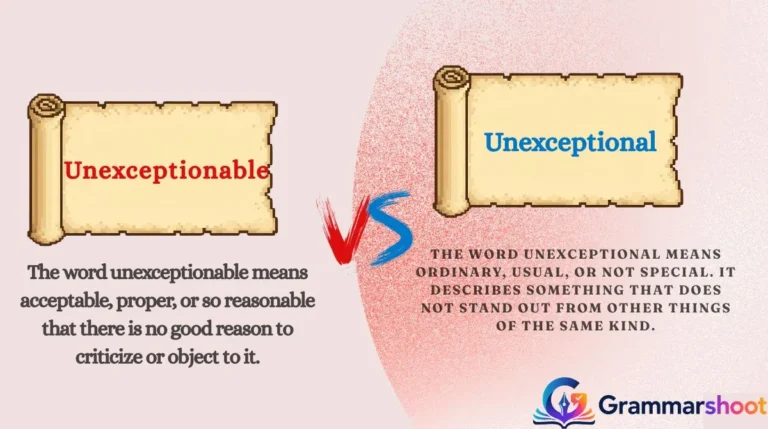
The word unexceptionable means acceptable, proper, or so reasonable that there is no good reason to criticize or object to it. It describes something that meets the expected standard of behavior, quality, or fairness.
When something is unexceptionable, it does not give people a strong reason to complain. It may be correct, fair, polite, or suitable for a particular situation.
For example, imagine that a student answers a teacher’s question clearly and correctly. The answer follows the rules and contains no obvious errors. You could describe it as unexceptionable.
This word is often used in formal English, especially when discussing decisions, behavior, arguments, manners, and professional conduct.
When Should You Use Unexceptionable?
Use this word when you want to say that something is acceptable or cannot reasonably be criticized.
Here are some common situations:
- Behavior: Someone acts politely and follows the rules.
- Decisions: A decision is fair and reasonable.
- Arguments: An argument is logical and difficult to challenge.
- Manners: A person’s manners are proper and respectful.
- Conduct: Someone behaves in a way that meets accepted standards.
For instance, if a manager gives every worker an equal chance to apply for a promotion, you might call the process unexceptionable. It follows a fair approach, so there is little reason to object to it.
However, the word does not necessarily mean that something is wonderful or outstanding. It mainly means that it is acceptable and free from serious grounds for criticism.
Grammar Rule for Unexceptionable
Unexceptionable is an adjective. It describes a noun, such as a decision, explanation, reason, or action.
You can use it before a noun:
- The judge made an unexceptionable decision.
- She gave an unexceptionable explanation.
You can also use it after linking verbs such as is, seems, appears, and was:
- His behavior was unexceptionable.
- The proposal seems unexceptionable.
The word is usually more formal than everyday alternatives such as acceptable, proper, and reasonable.
8 Example Sentences with Unexceptionable
- The teacher gave an unexceptionable answer to the student’s question.
- Her behavior during the meeting was completely unexceptionable.
- The manager made an unexceptionable decision after listening to both sides.
- His reasons for leaving the job were unexceptionable.
- The lawyer presented an unexceptionable argument in court.
- She wore an unexceptionable outfit to the formal event.
- The company followed an unexceptionable process when selecting new employees.
- His manners were unexceptionable throughout the dinner.
Notice that each sentence focuses on something acceptable, proper, or difficult to criticize. The word does not suggest that the person or thing is especially exciting.
Common Learner Confusion
Many learners see unexceptionable and think it means “not exceptional.” This is understandable because the words look similar.
However, unexceptionable is connected to the idea of an objection or criticism. It tells us that something is acceptable.
A useful example is a job interview. If a candidate answers every question politely and correctly, their answers might be unexceptionable. This does not mean the answers are ordinary or boring. It means there is nothing wrong with them that deserves criticism.
Remember this important point: unexceptionable is about acceptability, not about being ordinary.
What Does “Unexceptional” Mean?
The word unexceptional means ordinary, usual, or not special. It describes something that does not stand out from other things of the same kind.
An unexceptional person, event, performance, or result may be perfectly normal. It does not have to be bad or incorrect. It simply lacks something unusual, remarkable, or impressive.
Imagine that you visit a small restaurant. The food is fine, the service is normal, and the prices are reasonable. You enjoy your meal, but nothing makes the experience memorable. You could describe the restaurant as unexceptional.
This word is useful when you want to describe something that is neither particularly impressive nor unusual.
When Should You Use Unexceptional?
Use unexceptional when something is ordinary or does not attract special attention.
Common situations include:
- Performances: A performance is acceptable but not impressive.
- Results: A result is normal rather than remarkable.
- Experiences: An experience is ordinary and not memorable.
- People: Someone does not stand out from others in a particular way.
- Objects: Something has no special features or qualities.
For example, a student may receive an unexceptional score on a test. The score might be close to the class average. It is not necessarily a failure, but it is not outstanding either.
Similarly, an unexceptional day is a normal day without anything especially exciting or unusual happening.
Grammar Rule for Unexceptional
Like unexceptionable, unexceptional is an adjective. It describes nouns and can appear before a noun or after a linking verb.
Before a noun:
- We watched an unexceptional film.
- He gave an unexceptional performance.
After a linking verb:
- The meal was unexceptional.
- Her exam results seemed unexceptional.
It can also be modified by words such as fairly, quite, rather, and completely:
- It was a fairly unexceptional day.
- The hotel was rather unexceptional.
- His performance was quite unexceptional.
In everyday English, simpler words such as ordinary, average, and nothing special often express the same idea.
8 Example Sentences with Unexceptional
- The film was unexceptional, but I enjoyed watching it.
- We had an unexceptional lunch at a nearby restaurant.
- His performance was unexceptional compared with the other players.
- It was an unexceptional day at school.
- The hotel room was clean but otherwise unexceptional.
- She received an unexceptional score on her English test.
- The book tells an unexceptional story about everyday life.
- Their first meeting was pleasant but unexceptional.
Each sentence describes something that is ordinary or not particularly remarkable. Notice that several examples are positive in some ways. A clean hotel room or an enjoyable film can still be unexceptional if it does not stand out.
Common Learner Confusion
The biggest mistake is assuming that unexceptional means unacceptable or poor.
It does not.
Something can be unexceptional and still be good enough. An unexceptional meal may taste fine, and an unexceptional student may pass every exam. The word simply tells us that the thing is not special or remarkable.
For example, imagine that your friend asks about a new café.
You might say, “The café was unexceptional.”
This means it was ordinary. It does not automatically mean the café was dirty, badly managed, or unpleasant.
If you want to say that something is unacceptable, use words such as unacceptable, improper, or unreasonable, depending on the situation.
Difference Between Unexceptionable and Unexceptional (Detailed)
The main difference is simple: unexceptionable means acceptable, while unexceptional means ordinary.
Both words are adjectives, and both can describe the same type of noun. However, they focus on different qualities.
An unexceptionable decision is a decision that is fair or reasonable and difficult to criticize. An unexceptional decision is a decision that is ordinary and does not stand out as special.
Comparison Table
| Feature | Unexceptionable | Unexceptional |
|---|---|---|
| Main meaning | Acceptable or proper | Ordinary or not special |
| Main idea | No reasonable grounds for objection | Nothing remarkable or unusual |
| Focus | Correctness, fairness, or suitability | Normality or lack of distinction |
| Common synonyms | Acceptable, proper, reasonable | Ordinary, average, commonplace |
| Common contexts | Decisions, conduct, arguments, manners | Results, experiences, performances, events |
| Formality | Usually formal | Neutral to formal |
| Positive or negative? | Usually favorable | Often neutral, sometimes mildly negative |
| Does it mean “bad”? | No | No |
| Does it mean “outstanding”? | No | No |
1. Difference in Meaning
The first word focuses on whether something can reasonably be criticized. The second focuses on whether something is unusual or impressive.
Compare these sentences:
- Her conduct was unexceptionable.
- Her conduct was unexceptional.
The first sentence suggests that she behaved properly and gave others little reason to complain.
The second sentence suggests that her behavior was ordinary. It did not stand out in any special way.
Both sentences can be correct, but they communicate different ideas.
2. Difference in Usage
Unexceptionable is especially useful when discussing standards, rules, fairness, and proper behavior.
For example:
“The committee followed an unexceptionable selection process.”
This means the process was reasonable and could not easily be criticized.
Unexceptional is more useful when describing the quality or character of an experience, event, or performance.
For example:
“The committee’s presentation was unexceptional.”
This means the presentation was ordinary. It may have been clear and correct, but it was not especially impressive.
3. Difference in Grammar
There is no major difference in their basic grammar. Both words are adjectives, so they can appear before nouns or after linking verbs.
Before a noun:
- An unexceptionable explanation
- An unexceptional explanation
After a linking verb:
- The explanation was unexceptionable.
- The explanation was unexceptional.
The grammatical structure stays the same. The meaning changes because the adjectives express different ideas.
4. Difference in Sentence Structure
Both words can be used in positive statements, negative statements, and questions.
Examples:
- Her decision was unexceptionable.
- Her decision was unexceptional.
- Was his performance unexceptionable?
- Was his performance unexceptional?
The question about the decision asks whether it was reasonable and free from grounds for objection. The question about the performance asks whether it was ordinary rather than remarkable.
You do not need to change the sentence structure to use one word instead of the other. You need to choose the word that matches your intended meaning.
5. Can Something Be Both Unexceptionable and Unexceptional?
Yes. Something can be both acceptable and ordinary.
Imagine that a student writes a short email to a teacher. The email is polite, grammatically correct, and suitable for the situation. It contains no reason for criticism, but it is not especially creative or memorable.
You could describe the email as both unexceptionable and unexceptional.
The two words are not opposites. They describe different qualities of the same thing.
This is an important point because learners sometimes think they must choose between the words as if one means good and the other means bad. That is not how they work.
6. Simple Meaning Comparison
Consider these examples:
Example A: “The employee’s conduct was unexceptionable.”
Meaning: The employee behaved properly and followed the expected standards.
Example B: “The employee’s performance was unexceptional.”
Meaning: The employee’s work was ordinary and did not stand out.
The employee might behave perfectly well while doing average work. Therefore, both statements could be true at the same time.
Grammar Rules You Must Remember
Learning a few simple rules will help you choose the correct adjective without getting confused.
Rule 1: Use Unexceptionable for Something Acceptable
Choose unexceptionable when you want to say that something is proper, fair, or reasonable.
Correct: The teacher’s decision was unexceptionable.
This sentence suggests that the decision was reasonable and did not give students a strong reason to object.
Incorrect meaning: The teacher’s decision was unexceptionable because it was ordinary and boring.
If you only mean that the decision was not special, unexceptional is the better choice.
Rule 2: Use Unexceptional for Something Ordinary
Choose unexceptional when something is common, usual, or not remarkable.
Correct: The team gave an unexceptional performance.
This means the performance was not particularly impressive. It does not necessarily mean that the team played badly.
If the team followed every rule and behaved properly, you could describe its conduct as unexceptionable instead.
Rule 3: Both Words Are Adjectives
You can use either adjective before a noun or after a linking verb.
Before a noun:
- She made an unexceptionable choice.
- She watched an unexceptional film.
After a linking verb:
- Her choice was unexceptionable.
- The film was unexceptional.
Do not treat either word as a verb or an adverb. For example, “He unexceptionable answered” is incorrect. You could write, “His answer was unexceptionable.”
Rule 4: Check the Meaning Before You Choose
Do not select a word only because it looks familiar. Ask yourself what you want to say.
If you mean “acceptable” or “not open to reasonable criticism,” choose unexceptionable.
If you mean “ordinary” or “not special,” choose unexceptional.
For example:
- The report was unexceptionable because it followed all the required standards.
- The report was unexceptional because it offered nothing new.
Both sentences are grammatically correct, but the reasons for using each adjective are different.
Common Mistakes Students Make
Even students with good English skills sometimes mix up these adjectives. The reason is simple: the words look similar, share the same root, and both describe qualities of people or things.
The easiest way to avoid mistakes is to focus on the meaning of the complete sentence rather than the spelling alone.
Mistake 1: Using Unexceptionable to Mean Ordinary
Incorrect: The movie was unexceptionable because it was not very interesting.
Correct: The movie was unexceptional because it was not very interesting.
Why? The speaker is talking about a movie that does not stand out. The intended meaning is “ordinary,” so unexceptional is the right word.
Mistake 2: Using Unexceptional to Mean Acceptable
Incorrect: The manager’s decision was unexceptional because nobody could reasonably criticize it.
Correct: The manager’s decision was unexceptionable because nobody could reasonably criticize it.
Why? The sentence focuses on the lack of a good reason to object. That is the meaning of unexceptionable.
Mistake 3: Thinking Unexceptional Means Terrible
Incorrect idea: “The restaurant was unexceptional, so the food must have been awful.”
Better understanding: The restaurant was ordinary and did not offer anything special.
The word does not automatically describe something bad. A restaurant can serve fresh food, have friendly staff, and provide good service while still being unexceptional.
Mistake 4: Thinking Unexceptionable Means Perfect
Incorrect idea: “If a decision is unexceptionable, it must be the best possible decision.”
Better understanding: An unexceptionable decision is acceptable and difficult to criticize. It does not have to be the best or most creative choice.
For example, a company might choose a fair and reasonable plan that works well enough. Another plan could be more innovative, but the first plan may still be unexceptionable.
Mistake 5: Changing the Word Without Checking the Message
Incorrect: His manners were unexceptional, so nobody had any reason to complain about them.
This sentence is not impossible, but unexceptional does not directly express the reason for the lack of complaints.
Clearer: His manners were unexceptionable, so nobody had any reason to complain about them.
Use the word that communicates your main point most clearly.
Easy Correction Tips
Before using either word, ask yourself these two questions:
- Am I describing something that is acceptable or free from reasonable criticism? Use unexceptionable.
- Am I describing something that is ordinary or not particularly special? Use unexceptional.
If you are still unsure, replace the adjective with a simple phrase. Try “perfectly acceptable” for unexceptionable or “nothing special” for unexceptional. If the sentence keeps its intended meaning, you have probably chosen correctly.
Easy Trick to Remember the Difference
Here is a simple memory trick that works well for English learners.
Unexceptionable = Acceptable
Think of an objection. If people have no reasonable objection to something, it may be unexceptionable.
Example: The teacher’s rules were fair and unexceptionable.
Unexceptional = Ordinary
Think of something that does not stand out from the crowd. If it is not special or remarkable, it may be unexceptional.
Example: The school assembly was pleasant but unexceptional.
You can also remember the difference by focusing on the endings.
- -able often means “capable of being” or “suitable for.” In unexceptionable, the idea is that something is not reasonably open to objection.
- -al often forms adjectives that describe a quality or characteristic. In unexceptional, the word describes something that lacks an exceptional quality.
This is a helpful memory aid, not a rule that works for every English word.
Use Real-Life Logic
Imagine that you are buying a pair of shoes.
The shoes are comfortable, fit properly, and have no obvious defects. You could describe them as unexceptionable if you mean they are acceptable and have no clear problems.
However, they are a basic design that looks like many other pairs of shoes. You could describe them as unexceptional because they are ordinary and not especially distinctive.
The same shoes can be both. One word describes their acceptability, while the other describes how ordinary they are.
Daily Life Examples: Unexceptionable vs Unexceptional
The following examples show how these words can appear in everyday conversations. Although both words are more formal than some common alternatives, they are useful in writing and thoughtful speech.
1. Talking About a School Assignment
A: What did you think of Sara’s essay?
B: It was unexceptional. The writing was clear, but the ideas were quite common.
Here, unexceptional means the essay was ordinary and did not offer anything especially new.
2. Discussing a Teacher’s Decision
A: Do you think the teacher was unfair?
B: No. Her decision was unexceptionable because she followed the same rules for everyone.
The word describes a decision that is fair and difficult to criticize.
3. Talking About a Job Interview
A: How was your interview?
B: I think it went well. My answers were unexceptionable, although I could have made them more interesting.
The speaker believes the answers were acceptable but could have been more memorable.
4. Discussing a Restaurant
A: How was the new restaurant downtown?
B: It was unexceptional. The food was fine, but nothing really impressed me.
The restaurant was ordinary, not necessarily bad.
5. Talking About Someone’s Behavior
A: Did your new colleague behave politely?
B: Yes, his conduct was unexceptionable throughout the meeting.
The speaker is saying that the colleague behaved properly.
6. Discussing a Football Match
A: Was yesterday’s match exciting?
B: Not really. It was an unexceptional game with very few surprising moments.
The match lacked anything remarkable.
7. Talking About a Business Proposal
A: Can we approve this proposal?
B: The proposal seems unexceptionable, and it meets all the requirements.
The proposal appears acceptable and does not raise obvious objections.
8. Discussing a Holiday
A: How was your weekend trip?
B: It was pleasant but unexceptional. We visited a few places and came home.
The trip was enjoyable enough, but it was not especially memorable.
9. Talking About a Student’s Results
A: Did Hamza get good marks?
B: His results were unexceptional. He passed, but his scores were close to average.
The results were ordinary, not outstanding.
10. Discussing a Formal Event
A: Was the speaker’s behavior appropriate?
B: Yes, everything about his conduct was unexceptionable.
The speaker behaved in a proper and acceptable way.
These examples show that the right adjective depends on what you want to emphasize. A person, decision, event, or experience can be ordinary without being unacceptable, and it can be acceptable without being remarkable.
Practice Section: Choose the Correct Word
Test your understanding by choosing unexceptionable or unexceptional for each sentence.
- The movie was enjoyable, but its story was quite __________.
- The judge made a fair decision that was difficult to criticize. It was __________.
- Her test results were average and did not stand out. They were __________.
- The manager treated everyone fairly, and his conduct was __________.
- The hotel was clean and comfortable, but there was nothing special about it. It was __________.
Answers and Explanations
- Unexceptional — The movie’s story was ordinary and not especially original.
- Unexceptionable — The decision was fair and difficult to criticize.
- Unexceptional — The results were average rather than remarkable.
- Unexceptionable — The manager’s conduct was proper and acceptable.
- Unexceptional — The hotel was fine but did not stand out.
If you answered all five correctly, you understand the main difference. If you made a mistake, review the memory trick and ask yourself whether the sentence is about acceptability or ordinariness.
FAQs
1. What is the difference between unexceptionable and unexceptional?
Unexceptionable means acceptable, proper, or free from reasonable criticism. Unexceptional means ordinary or not particularly special. For example, a fair decision may be unexceptionable, while an average performance may be unexceptional.
2. Can unexceptionable and unexceptional be used interchangeably?
No, they are not usually interchangeable because their meanings are different. One describes acceptability, while the other describes how ordinary something is. However, the same thing can be both acceptable and ordinary, depending on the context.
3. Is unexceptionable a formal or informal word?
Unexceptionable is mainly used in formal or carefully written English. It often appears in discussions about decisions, arguments, manners, and professional behavior. In everyday conversation, people may use acceptable, fair, or reasonable instead.
4. Is unexceptional a negative word?
Not always. Unexceptional usually means ordinary or not remarkable. It can sound mildly negative when someone expects something impressive, but it does not automatically mean bad, poor, or unacceptable.
5. Can I use unexceptionable in a question?
Yes. You can use it in questions just like other adjectives.
For example: “Was the manager’s decision unexceptionable?”
This asks whether the decision was acceptable and difficult to criticize. You can also ask, “Was the performance unexceptional?” when you want to know whether it was ordinary rather than remarkable.
6. What are the easiest synonyms for these two words?
For unexceptionable, try acceptable, proper, fair, or reasonable. For unexceptional, try ordinary, average, commonplace, or nothing special. These synonyms are useful for understanding the difference, although the best choice depends on the sentence.
Conclusion
Understanding the difference between unexceptionable and unexceptional is easier than it first appears. Both words look similar, but they describe different qualities.
Unexceptionable means acceptable, proper, or difficult to criticize. You can use it when talking about fair decisions, good manners, reasonable arguments, or suitable behavior.
Unexceptional means ordinary, common, or not especially remarkable. It is useful when describing average results, everyday experiences, ordinary performances, or things that do not stand out.
Remember that unexceptional does not automatically mean bad, and unexceptionable does not necessarily mean perfect. Something can be acceptable without being outstanding, and it can be ordinary without having any serious faults.
The best way to learn these words is to practice using them in your own sentences. When you are unsure which one to choose, ask yourself whether you mean “acceptable” or “nothing special.” That simple question will usually lead you to the correct answer.
Keep practicing, read examples carefully, and do not worry if you confuse these words at first. With regular use, choosing the right adjective will become much more natural.

Evan Rellmont is a writer who turns thoughtful ideas into meaningful words, creating stories and reflections that connect, inspire, and leave a lasting impression.