
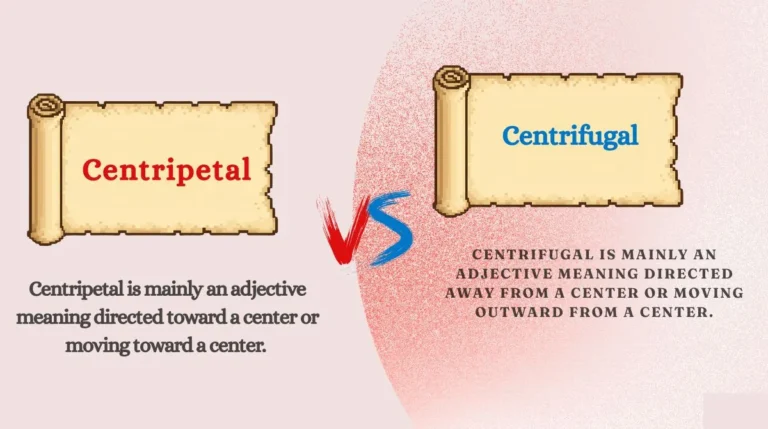
“Centrifugal” and “centripetal” are two words that are easy to mix up. They look almost the same, they are often taught in the same physics lesson, and both describe motion around a center.
For English learners, the small spelling difference can be frustrating.
The easiest way to separate them is to focus on direction. Centripetal means toward the center, while centrifugal means away from the center.
Cambridge describes centripetal as relating to a turning object moving toward the point around which it turns. Collins defines centrifugal as acting, moving, or tending to move away from a center.
These words are not limited to physics textbooks. They are useful in science classes and other technical subjects, and you may also hear them when people talk about cars, wheels, washing machines, and spinning rides.
There is one important science detail. In the usual inertial-frame description of circular motion, the net force needed to keep an object on its curved path points inward and is called centripetal force.
Centrifugal force is used as an apparent or inertial force when motion is described from a rotating reference frame.
Once you understand both the English meaning and this basic physics idea, the pair becomes much easier to remember and use correctly.
What Does “Centripetal” Mean?
Centripetal is mainly an adjective meaning directed toward a center or moving toward a center. In physics, it is especially connected with circular motion. Cambridge defines it as describing a turning object that moves toward the point around which it is turning.
You will often see it before words such as force, acceleration, and motion. Examples include centripetal force and centripetal acceleration.
When should you use “centripetal”?
Use centripetal when something is directed inward, toward a center.
For example, when a car travels around a curve, its direction keeps changing. A net force toward the center of the curve is needed for that curved motion. That inward role is called centripetal. Depending on the situation, friction, tension, gravity, or another physical force can provide it.
Grammar rule for “centripetal”
Centripetal is an adjective. It usually describes a noun.
Common patterns are:
- centripetal + noun → centripetal force
- be + centripetal → The motion is centripetal.
- centripetally → an adverb meaning toward a center
Do not normally use it as a regular verb. For a beginner, the safest pattern is to keep it next to the noun it describes.
Examples of “centripetal”
- The car needs centripetal force to follow the curve.
- The rope provides the centripetal force on the ball.
- Earth’s gravity provides the inward force for the Moon’s orbit.
- The object has centripetal acceleration as its direction changes.
- The force points toward the center, so it is centripetal.
- The students measured the centripetal motion of the object.
- The object moves centripetally toward the center.
- Friction can act as the centripetal force when a car turns.
Common learner confusion about “centripetal”
A common mistake is to think that centripetal force is one special force, like gravity or magnetism. It is better to think of centripetal as describing the direction or role of the net force in circular motion. The actual physical force can be friction, tension, gravity, or something else.
So ask yourself: Is the force needed toward the center? If yes, centripetal is the word you need.
What Does “Centrifugal” Mean?
Centrifugal is mainly an adjective meaning directed away from a center or moving outward from a center. Collins gives this as its basic meaning, and Dictionary.com also describes it as moving or directed outward from the center.
Common expressions include centrifugal force, centrifugal pump, and centrifugal effect.
When should you use “centrifugal”?
Use centrifugal when the idea is outward from the center.
You may hear people say they feel a centrifugal force when a vehicle turns or a spinning ride moves. There is an important physics qualification, though. In an ordinary inertial frame, the circular motion is explained by an inward net force. In a rotating reference frame, a centrifugal force can be introduced as an apparent inertial force acting outward.
This distinction matters because everyday speech and technical physics do not always describe the same viewpoint.
Grammar rule for “centrifugal”
Centrifugal is also an adjective. It normally modifies a noun.
Common patterns are:
- centrifugal + noun → centrifugal force
- centrifugal + noun → centrifugal pump
- be + centrifugal → The effect is centrifugal.
- centrifugally → an adverb meaning outward from a center
Some dictionaries also record centrifugal as a noun for certain machines or devices, but that use is less important for beginners.
Examples of “centrifugal”
- The machine uses centrifugal force in its operation.
- The liquid moves outward during the rapid rotation.
- The washer creates a strong centrifugal effect as it spins.
- The engineer studied the centrifugal motion of the liquid.
- The particles moved centrifugally from the center.
- The factory uses a centrifugal pump.
- The outward pattern is described as centrifugal.
- The rider felt an outward effect during the turn.
Common learner confusion about “centrifugal”
Students sometimes hear “centrifugal force pushes objects outward” and conclude that an outward force is always what keeps a body moving in a circle. That is not the usual inertial-frame explanation.
If the inward force keeping an object on its curved path disappears, the object does not simply move straight outward from the center. It continues along the tangent to the circle at that point.
Difference Between Centripetal and Centrifugal
The main difference is very simple:
Centripetal = toward the center.
Centrifugal = away from the center.
Their word histories make the contrast even easier to remember. Centripetal comes from a form related to Latin petere, meaning “to seek,” while centrifugal comes from fugere, meaning “to flee.”
Comparison table
| Point | Centripetal | Centrifugal |
|---|---|---|
| Basic meaning | Toward the center | Away from the center |
| Direction | Inward | Outward |
| Main physics idea | Inward net force for circular motion | Apparent outward inertial force in a rotating frame |
| Common phrase | Centripetal force | Centrifugal force |
| Word class | Mainly adjective | Mainly adjective |
| Memory idea | Center-seeking | Center-fleeing |
| Simple example | Force keeping a car on a curve | Outward effect felt in a turn |
Usage difference
When you see centripetal, look for an inward idea:
The centripetal force points toward the center.
When you see centrifugal, look for an outward idea:
The rotating system has a centrifugal effect.
Grammar logic
Both words are adjectives, so they often follow the same grammar pattern:
adjective + noun
- centripetal force
- centripetal acceleration
- centrifugal force
- centrifugal pump
They can also come after a linking verb:
- The force is centripetal.
- The effect is centrifugal.
Sentence structure difference
Because both terms usually work as adjectives, the sentence structure is almost identical.
Pattern 1: Adjective + noun
Centripetal force keeps the object on the curved path.
Centrifugal force is used as an apparent force in a rotating frame.
Pattern 2: Subject + be + adjective
The force is centripetal.
The effect is centrifugal.
A simple car example
Imagine a car turning left.
The car itself must experience a net force toward the center of the turn so that its direction changes. That is the centripetal part of the motion.
At the same time, a passenger may feel as if their body is moving toward the right side of the car. In a rotating-frame description, that experience can be represented using a centrifugal force. In an inertial-frame description, the body is tending to continue its previous straight-line motion while the car changes direction.
So both words can come up in the same event, but they are not synonyms.
Grammar Rules You Must Remember
Rule 1: Both words are mainly adjectives
Use them to describe a noun.
Correct: The car needs centripetal force.
Correct: The system shows a centrifugal effect.
For beginners, keep the words beside a noun such as force, motion, acceleration, or effect.
Rule 2: Use direction to choose the word
Ask: inward or outward?
Toward the center → centripetal
Away from the center → centrifugal
Example:
The inward force is centripetal.
The apparent outward force in a rotating frame is centrifugal.
Rule 3: Centripetal force is not one separate kind of force
A centripetal force can be provided by different physical forces. Gravity can provide it for an orbit, tension can provide it for a ball on a string, and friction can provide it for a turning car. What matters is the inward net-force direction.
Rule 4: Be careful with “centrifugal force”
In simple everyday English, people often use the phrase to mean an outward feeling or effect. In physics, the careful definition is frame-dependent: centrifugal force is an apparent inertial force used in a rotating reference frame, while the usual inertial-frame analysis of circular motion uses an inward net force.
Common Mistakes Students Make
Mistake 1: Reversing the meanings
Wrong: Centripetal means away from the center.
Correct: Centripetal means toward the center.
Wrong: Centrifugal means toward the center.
Correct: Centrifugal means away from the center.
The quickest fix is to memorize center in / center out.
Mistake 2: Treating centripetal as a special physical force
Wrong: “Centripetal” is the name of a force that always exists.
Correct: Centripetal force describes the inward net force involved in circular motion. Different real forces can supply it.
Mistake 3: Assuming centrifugal force always pushes an object straight outward
That picture is misleading. In the inertial frame, if the inward force disappears, a moving object follows the tangent to the circular path rather than shooting directly away from the center.
Mistake 4: Using the words without a noun
For everyday learners, centripetal and centrifugal are usually clearer when attached to a noun.
Better: centripetal force
Better: centrifugal effect
Mistake 5: Thinking “force” is always necessary after the adjective
Not every sentence needs the word force.
You can correctly say:
The motion is centripetal.
The pattern is centrifugal.
The pump uses centrifugal action.
The word you choose depends on the noun or idea you are describing.
Easy Trick to Remember the Difference
Try this simple memory trick:
Centripetal = seeks the center.
Centrifugal = flees the center.
The word histories make this trick meaningful. The pet part is related to Latin petere, “to seek,” while fug comes from fugere, “to flee.”
Now picture a ball tied to a rope.
The rope pulls the ball toward the hand. That inward direction is centripetal.
If the rope breaks, the ball does not suddenly travel straight away from the center. In an inertial frame, it moves along the tangent to the circle.
For quick revision, remember:
Centripetal = center in.
Centrifugal = center out.
Say the pair aloud a few times. When you see either word in a question, think of the direction before you think about the spelling.
Daily Life Examples
1. Talking about a car
“Why did I feel as if I moved sideways when the driver turned?”
“That feeling is related to the car’s change in direction and the rotating-frame description of the motion.”
2. Talking about a spinning ride
“Why do I feel pushed toward the outside?”
“People often describe that outward sensation as a centrifugal effect.”
3. Talking about a ball on a string
“What keeps the ball going around in a circle?”
“The tension in the string provides the inward, or centripetal, force.”
4. Talking about a washing machine
“Why does the machine spin so fast?”
“Rapid rotation helps remove water from the clothes, and the motion is commonly explained using centrifugal effects.”
5. Talking about the Moon
“What keeps the Moon in orbit?”
“Earth’s gravity provides the inward force needed for its curved orbital motion.”
6. Talking about a road curve
“What happens if a car takes the curve faster?”
“The required centripetal acceleration becomes larger as speed increases for the same radius.”
7. Talking about a laboratory
“What does a centrifuge do?”
“It uses rapid rotation to help separate materials in a sample.”
8. Talking about vocabulary
“Which word means toward the center?”
“Centripetal.”
“Which means away from the center?”
“Centrifugal.”
9. Talking about a science lesson
“Are centripetal and centrifugal the same?”
“No. They describe opposite directions, and centrifugal force has a special meaning in a rotating frame.”
10. Talking about spelling
“Why do I always mix these words up?”
“Because they share the beginning centri- and differ in the part that gives the directional idea.”
Practice Section
Choose the correct option.
1.
The force directed toward the center is ______.
centripetal / centrifugal
2.
The apparent outward force used in a rotating frame is ______.
centripetal / centrifugal
3.
The rope provides the ______ force that keeps the ball moving in a circle.
centripetal / centrifugal
4.
The word describing movement away from a center is ______.
centripetal / centrifugal
5.
The word connected with “seeking the center” is ______.
centripetal / centrifugal
Answers
- centripetal
- centrifugal
- centripetal
- centrifugal
- centripetal
When you check your answers, do not only memorize the letters. Ask the direction question: inward or outward?
FAQs
What is the difference between centripetal and centrifugal?
Centripetal means toward the center, while centrifugal means away from the center. In basic circular-motion physics, centripetal force is the inward net force; centrifugal force is an apparent inertial force in a rotating reference frame.
Can we use centripetal and centrifugal in questions?
Yes. They are common in science questions.
For example: “What provides the centripetal force?” or “What is the direction of the centrifugal force in a rotating frame?” Both words can be used naturally in questions.
Are centripetal and centrifugal formal or informal?
They are mainly formal, technical vocabulary, especially in physics. You may hear centrifugal force in ordinary conversation, but its detailed meaning becomes clearer when you understand the reference frame. Cambridge labels centripetal as specialized physics vocabulary.
Is centrifugal force real or imaginary?
The careful scientific answer is that centrifugal force is an apparent or inertial force in a rotating reference frame. It is useful in that frame. In an inertial frame, circular motion is explained using the inward net force rather than an outward interaction force.
Which one means toward the center: centripetal or centrifugal?
Centripetal means toward the center.
A useful memory sentence is “centripetal seeks the center.” Centrifugal is associated with outward movement or an outward apparent force in a rotating frame.
Why are centripetal and centrifugal so confusing?
They share the same centri- beginning and are often taught together. Their different endings point to opposite ideas: centripetal is linked with seeking the center, while centrifugal is linked with fleeing from the center.
Conclusion
Centripetal and centrifugal look almost identical, but they do not mean the same thing. Centripetal means toward the center, while centrifugal means away from the center. In basic circular-motion physics, centripetal force describes the inward net force that keeps an object following a curved path. Centrifugal force is commonly used as an apparent inertial force when the motion is described from a rotating reference frame.
For English learners, the easiest memory trick is “centripetal = center in; centrifugal = center out.” Both words are mainly adjectives, so they usually appear before nouns such as force, motion, acceleration, or effect.
The next time you meet either word, do not guess from the spelling alone. Stop and ask one simple question: Is the idea moving toward the center or away from it? That small habit will help you choose the right word and understand the science at the same time.

Evan Rellmont is a writer who turns thoughtful ideas into meaningful words, creating stories and reflections that connect, inspire, and leave a lasting impression.