
Have you ever seen both defence and defense and wondered which one is correct? You are not alone.
This is a very common spelling question, especially for English learners who read British and American English at the same time.
The good news is that the difference is much easier than it first appears. Defence and defense have the same meaning and are pronounced the same way.
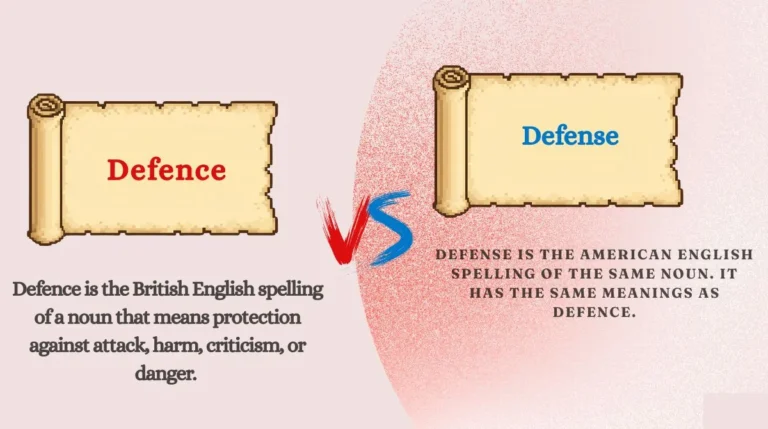
The main difference is the variety of English being used. Defence is the standard British spelling, while defense is the standard American spelling.
Cambridge and Oxford dictionaries both identify these as regional spelling forms of the same word.
So, this is not a case where one word means one thing and the other means something different. The meaning stays the same. What changes is the spelling.
Understanding this difference is useful when writing school assignments, emails, articles, applications, or professional documents.
It can also help you understand words such as self-defence/self-defense, defence policy/defense policy, and phrases used in sports and law.
By the end, you will know exactly when to use defence, when to use defense, why both forms exist, and how to avoid mixing British and American spelling in the same piece of writing.
What Does “Defence” Mean?
Defence is the British English spelling of a noun that means protection against attack, harm, criticism, or danger. It can also refer to a country’s military forces, an argument used to support someone or something, or the part of a sports team that tries to stop the other team from scoring.
For example, when you protect yourself from an attack, you are acting in defence of yourself. When a country uses soldiers and military equipment to protect itself, that is part of its national defence.
The word can also be used in a less physical way. You might speak in defence of a friend who is being unfairly criticized. In law, the defence can mean the person or legal team trying to prove that an accused person is not guilty. In sports, defence describes the players or actions that stop an opponent from scoring.
When should you use “defence”?
Use defence when you are writing in British English or another variety of English that follows the British spelling system.
For example, British-style writing commonly uses:
- national defence
- defence spending
- air defence
- self-defence
- a lawyer for the defence
- a strong football defence
The spelling is especially important when you are following the language style used by a particular school, employer, publication, or country.
Grammar rule for “defence”
Defence is a noun. It can be used as a singular or uncountable noun depending on the sentence. It can refer to the act of protecting, a system of protection, a legal argument, a military organization, or a sports unit.
Here are some simple examples:
- The country has increased its defence budget.
- The walls were built for the defence of the city.
- She spoke in defence of her friend.
- The lawyer prepared a strong defence for his client.
- Our team has a very strong defence.
- The soldiers stood in defence of the border.
- The vaccine helps the body’s natural defences against infection.
- He learned self-defence at school.
A common confusion with “defence”
Many learners think defence and defense have different meanings because they look different. They do not.
The extra c in defence does not create a new meaning. It is simply the normal spelling used in British English.
Think of it this way:
British English → defence
The pronunciation remains essentially the same, so you will usually hear no difference when someone says the two forms aloud. Cambridge lists the same pronunciation for the British and American forms.
What Does “Defense” Mean?
Defense is the American English spelling of the same noun. It has the same meanings as defence.
It can mean protection from attack or danger, a country’s military organization, an argument supporting someone or something, a legal argument in court, or the players whose job is to stop an opponent from scoring.
The easiest way to remember it is:
American English → defense
The meaning does not change just because the spelling changes.
When should you use “defense”?
Use defense when you are writing in American English.
For example:
- national defense
- defense spending
- air defense
- self-defense
- the defense lawyer
- play defense
Oxford notes that American English uses forms such as Department of Defense, while British English uses Ministry of Defence.
This is a good real-world example because official names often follow the spelling conventions of their country.
Grammar rule for “defense”
Like defence, defense is a noun.
It can appear as the subject or object of a sentence, after prepositions, and in common fixed expressions.
Here are eight examples:
- The country needs a stronger defense system.
- He acted in defense of his brother.
- The castle was built for defense against attacks.
- Her lawyer prepared a strong defense.
- The team played excellent defense.
- The army improved its air defense.
- She teaches children basic self-defense.
- The government announced changes to its defense policy.
A common confusion with “defense”
The biggest mistake is not using defense itself. The real problem is mixing spelling systems.
For example, an American writer may normally use color, center, and organize. In that style, defense fits naturally.
A British writer may use colour, centre, and organise. In that style, defence fits naturally.
Neither regional spelling is automatically more correct. The important thing is to know which style you are following and stay consistent.
Difference Between Defence and Defense
The simplest answer is this:
There is no difference in meaning. The difference is spelling and regional English usage.
Defence is the standard British spelling, while defense is the standard American spelling. Cambridge directly describes defense as the US spelling of defence, and it describes defence as the UK spelling of defense.
| Feature | Defence | Defense |
|---|---|---|
| Main variety | British English | American English |
| Meaning | Protection, support, military protection, legal argument, sports protection | Same |
| Pronunciation | Same | Same |
| Part of speech | Noun | Noun |
| Example | national defence | national defense |
| Common related form | self-defence | self-defense |
| Sports phrase | play defence / in defence | play defense / on defense |
| Legal use | the defence | the defense |
Usage difference
The main difference is where the spelling is normally used.
A British newspaper might write:
The country increased its defence spending.
An American newspaper might write:
The country increased its defense spending.
Both sentences communicate exactly the same idea.
Grammar logic
There is no special grammar rule that changes between the two forms.
Both are nouns. Both can be singular or plural where appropriate. Both can be used with articles, possessives, prepositions, and other nouns.
For example:
- The defence was strong.
- The defense was strong.
And:
- Her defence was successful.
- Her defense was successful.
The sentence structure stays the same. Only the spelling changes.
Sentence structure difference
There is no sentence structure difference caused by the spelling.
You do not need to change the verb just because you use defence instead of defense.
Compare:
The team’s defence was excellent.
The team’s defense was excellent.
The grammar is identical.
You can also use both with the same common structures:
in defence of / in defense of
defence against / defense against
self-defence / self-defense
national defence / national defense
Oxford lists these meanings and common uses for both regional forms.
Meaning comparison
The meaning is the same in everyday uses.
For example:
British English:
The lawyer prepared a strong defence.
American English:
The lawyer prepared a strong defense.
Both mean that the lawyer prepared arguments to support the accused person in court.
The same thing happens in sports:
British English:
Their defence was excellent.
American English:
Their defense was excellent.
Again, there is no meaning change.
Grammar Rules You Must Remember
Rule 1: Defence is mainly British English
When you are following British English spelling, use defence.
This is the form you are likely to see in British dictionaries, British newspapers, and British-style educational writing.
Example:
The government is reviewing its defence policy.
Cambridge identifies defence as the UK spelling.
Rule 2: Defense is American English
When you are following American English spelling, use defense.
This includes common American forms such as Department of Defense and self-defense.
Example:
The government announced a new defense policy.
Rule 3: Do not change the meaning
Never assume that defence means one kind of protection while defense means another.
They are spelling variants of the same word.
Example:
She spoke in defence of her friend.
She spoke in defense of her friend.
The meaning is the same.
Rule 4: Keep your spelling consistent
This is one of the most useful rules for students and writers.
If your document follows British English, use defence along with the other British spellings you have chosen.
If your document follows American English, use defense.
Consistency makes your writing look clean and professional.
British style:
The football team improved its defence and organisation.
American style:
The football team improved its defense and organization.
The important point is not that one system is better. The point is to avoid switching between regional spelling styles without a reason.
Common Mistakes Students Make
Students often make mistakes with this word because they learn English from many different sources. A learner may read a British textbook in the morning, watch an American video in the afternoon, and then write a school assignment using a mixture of both spelling systems.
That is completely understandable.
Mistake 1: Thinking one spelling is wrong
A learner may see defense in an American article and think it is a spelling mistake.
It is not.
Wrong idea:
“Defense is incorrect. It should always be defence.”
Better understanding:
Defence is standard British spelling, and defense is standard American spelling.
Mistake 2: Mixing both forms in the same paragraph
For example:
The country increased its defence budget, but the new defense policy will begin next year.
This is not necessarily impossible to understand, but it creates an inconsistent spelling style when both words are being used in the same general context.
For normal writing, choose the regional form that fits your style.
Better British version:
The country increased its defence budget, but the new defence policy will begin next year.
Better American version:
The country increased its defense budget, but the new defense policy will begin next year.
Mistake 3: Adding or removing letters randomly
Some learners write forms such as defencee, defensee, or other invented spellings because they are unsure of the ending.
Remember the two standard forms:
defence
defense
There is no extra e at the end.
Mistake 4: Thinking the pronunciation is completely different
The two spellings look different, but they are pronounced alike in standard British and American usage. Cambridge gives the same basic pronunciation for both forms.
So, when listening, you usually cannot depend on pronunciation to tell which spelling was used.
Easy correction tip
When you are unsure, ask yourself one simple question:
“Am I writing British English or American English?”
British → defence
American → defense
That one question solves most problems.
Easy Trick to Remember the Difference
Here is a simple memory trick:
C for British, S for American
Think:
defenCe → British
defenSe → American
The C and S can help you remember the regional spelling.
Another useful trick is to connect each spelling to a familiar country or institution.
Think of:
Ministry of Defence → British English
Department of Defense → American English
You can also remember that the British spelling often keeps -ce, while the American spelling uses -se in this word.
Do not let the different letter fool you into thinking the words have different meanings. Imagine them as two spellings wearing different regional “clothes.” The word underneath is still the same.
This same kind of British-American spelling difference appears in other words too, such as:
- offence / offense
- licence / license in certain noun/verb conventions
- pretence / pretense
That means learning defence vs defense can help you recognize a wider spelling pattern.
Daily Life Examples
Seeing the word in normal conversations makes the difference much easier to remember.
Example 1: Talking about a country
A: Why is the country spending more money on the military?
B: The government says it needs to improve national defence.
In American English, the same sentence would use defense.
Example 2: Talking about a friend
A: Why did you argue with Tom?
B: He was criticizing Sara, so I spoke in her defence.
American English:
I spoke in her defense.
Example 3: Talking about sports
A: How did your team win?
B: Our defence was fantastic.
American sports writing commonly uses defense instead. Oxford notes these regional sports usages, including “in defence” in British English and “on defense” in North American English.
Example 4: Talking about law
A: Did the lawyer present the case well?
B: Yes. The defence was very strong.
American English:
The defense was very strong.
Example 5: Talking about self-protection
A: Why are you taking that class?
B: I want to learn self-defence.
American English:
I want to learn self-defense.
Example 6: Talking about a building
A: Why were those walls built?
B: They were built for the defence of the town.
The American spelling would be defense.
Example 7: Talking about criticism
A: Why did Maria explain his actions?
B: She was speaking in his defence.
Again, American English uses defense.
Example 8: Talking about sports positions
A: What position do you play?
B: I play in defence.
North American English commonly uses:
I play on defense.
Example 9: Talking about health
A: Why is the body able to fight some infections?
B: It has natural defences.
American English:
It has natural defenses.
Oxford and Cambridge both include protection against infection among the uses of the word.
Example 10: Talking about government
A: Which department is responsible for the country’s military system?
B: In the United States, it is the Department of Defense.
In Britain, the government organization is called the Ministry of Defence.
Practice Section
Choose the correct spelling for each sentence. Remember that the answer may depend on the English variety being used.
1. British English
The country increased its national ______ spending.
a) defense
b) defence
2. American English
She learned self-______ after feeling unsafe.
a) defence
b) defense
3. British English
The lawyer presented a strong ______ in court.
a) defence
b) defense
4. American English
Our basketball team needs better ______.
a) defence
b) defense
5. General spelling question
Which statement is correct?
a) Defence and defense have different meanings.
b) Defence is British English, while defense is American English.
c) Defense is always incorrect.
d) Defence is only used in sports.
Answers
1. b) defence
British English normally uses defence.
2. b) defense
American English normally uses defense.
3. a) defence
The British spelling is defence.
4. b) defense
American English uses defense.
5. b) Defence is British English, while defense is American English.
The two forms have the same basic meaning; the spelling changes according to regional English.
FAQs
What is the difference between defence and defense?
Defence and defense mean the same thing. The main difference is spelling: defence is the standard British form, while defense is the standard American form. They are pronounced the same way in normal usage.
Is defence British or American English?
Defence is the standard spelling in British English. It is used for meanings such as protection, military protection, legal arguments, and sports. American English normally uses defense instead.
Is defense correct English?
Yes. Defense is completely correct English in American English. It is not a misspelling. For example, Department of Defense and self-defense are standard American forms.
Can I use defence and defense in the same sentence?
You can, but normally there is no good reason to switch between the two spellings when the same style of English is being used. For polished writing, choose British or American spelling and remain consistent throughout the document.
Is defence more formal than defense?
No. The spelling does not decide whether the word is formal or informal. Defence is a standard British spelling, and defense is a standard American spelling. Both can appear in formal, academic, professional, and everyday writing.
Which spelling should I use: defence or defense?
Use the spelling that matches your chosen English variety. Choose defence for British English and defense for American English. Also check the style guide used by your school, employer, publisher, or website when one is provided.
Conclusion
The difference between defence and defense is simple once you know the rule. Both words have the same meaning, the same basic pronunciation, and the same grammatical role. The main difference is regional spelling.
Use defence when you are following British English. Use defense when you are following American English.
You may see these spellings in many areas of English, including everyday conversation, sports, law, government, and writing about protection or security. The most important habit is consistency. Do not spend time worrying that one form is “wrong.” Instead, decide which English style you are using and keep that style throughout your writing.
A small spelling difference can feel confusing at first, but after seeing a few examples, it becomes easy. Keep practicing with real sentences, and soon defence vs defense will be one of those grammar questions you can answer without thinking twice.

Evan Rellmont is a writer who turns thoughtful ideas into meaningful words, creating stories and reflections that connect, inspire, and leave a lasting impression.