
Altogether and all together look almost the same, so it is easy to mix them up. They sound alike when spoken, but they do not always mean the same thing.
The difference is small in spelling, yet it can change the meaning of a sentence.
This confusion is common for English learners because both forms contain the words all and together.
For example, you might see “We worked all together” and “There were ten students altogether.” Both are correct, but they express different ideas.
The good news is that the difference becomes simple once you look at the meaning of the whole sentence. Altogether is normally one word when it means in total, completely, or on the whole.
All together is two words when all describes the people or things, and together tells us that they are united, gathered, or doing something at the same time.
This distinction matters in school writing, emails, conversations, and everyday English.
A small spelling mistake can sometimes make your sentence sound confusing or change what you mean.
By the end, you will know when to write altogether and when to use all together, how their grammar works, and how to avoid the mistakes that many learners make.
What Does “Altogether” Mean?
Altogether is an adverb. It is usually written as one word.
It has several common meanings, but the most useful ones for everyday English are:
- In total
- Completely
- On the whole or generally
The exact meaning depends on the sentence.
Altogether meaning “in total”
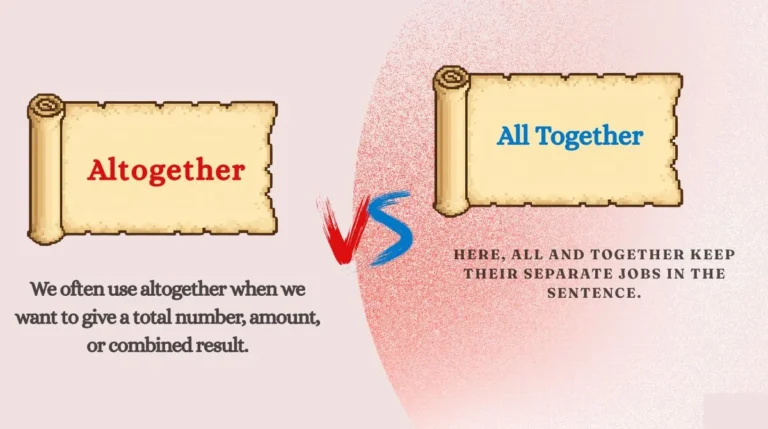
We often use altogether when we want to give a total number, amount, or combined result.
For example:
- There are thirty students altogether.
- We spent $200 altogether.
- Altogether, five people joined the meeting.
In these sentences, altogether means in total.
Think of it as adding separate parts together and looking at the final total.
Suppose one class has 15 students and another class has 12 students. You could say:
There are 27 students altogether.
You are not saying the students are physically standing in one place. You are simply giving the total.
Altogether meaning “completely”
Altogether can also mean completely or entirely.
Examples include:
- The situation is altogether different now.
- That is an altogether new problem.
- Her approach was altogether unexpected.
- The two ideas are altogether different.
Here, altogether does not mean a total number. It adds the idea of complete difference, complete change, or complete quality.
Altogether meaning “on the whole”
In some sentences, altogether means when everything is considered or on the whole.
For example:
- Altogether, the trip was a great experience.
- The plan was not altogether bad.
- Altogether, I think we made the right choice.
This use is slightly more formal, but it is still common in written English.
When should you use “altogether”?
Use altogether when you could replace it with:
- in total
- completely
- entirely
- on the whole
Try replacing the word in your sentence. If the meaning still works, altogether is probably the right choice.
For example:
We have 50 books altogether.
Change it to:
We have 50 books in total.
The meaning stays the same, so altogether is correct.
8 examples of “altogether”
- There were twelve guests altogether.
- We collected $500 altogether.
- Altogether, the repair took three days.
- The new system is altogether different.
- His explanation was not altogether clear.
- Altogether, I enjoyed the movie.
- The company has four offices altogether.
- The result was altogether unexpected.
Common learner confusion
The biggest mistake is thinking that altogether means that people or objects are physically together.
For example:
There were twenty students altogether.
This means there were 20 students in total. It does not tell us whether they were sitting together, standing together, or even in the same room.
That is an important clue.
When the idea is total amount, think altogether.
When the idea is people or things being together, think all together.
What Does “All Together” Mean?
All together is a two-word phrase.
Here, all and together keep their separate jobs in the sentence.
- All refers to everyone or everything in a group.
- Together means in one place, as a group, or at the same time.
For example:
The children stood all together near the door.
Here, all refers to the children, while together tells us how they stood.
All together for people in one group
We commonly use all together when people or things are gathered in one place.
Examples:
- The family was all together for dinner.
- Please sit all together.
- The players stood all together before the match.
- We were all together in the same room.
The key idea is that the members of the group are united or gathered.
All together for doing something at the same time
All together can also mean that everyone does something at the same moment.
For example:
- Say the answer all together.
- Sing all together.
- The students shouted all together.
- On three, everyone jumped all together.
Here, the phrase describes a group action.
The grammar of “all together”
Because all and together are separate words, you may move other words around them depending on the sentence.
Compare:
We were all together.
and:
We were all working together.
In the second sentence, all refers to we, while together describes the way we were working.
You can also say:
They all went home together.
This does not use all together as one fixed phrase. Instead, all modifies they, and together tells us that they went home as a group.
That distinction is useful because learners sometimes assume that every sentence containing all and together should use the phrase all together.
When should you use “all together”?
Use all together when you mean:
- everyone or everything is together
- everyone is gathered
- people are acting together
- people are doing something at the same time
A simple question can help:
Are the people or things together as a group?
If yes, all together may be the correct choice.
8 examples of “all together”
- The children sat all together on the floor.
- We were all together at the wedding.
- The singers performed all together.
- Please stand all together for the photo.
- The family had dinner all together.
- The students answered all together.
- The birds flew all together across the sky.
- They danced all together at the party.
Common learner confusion
Learners often choose all together when they are talking about a total.
For example:
❌ There are 100 pages all together.
When the intended meaning is 100 pages in total, the standard form is:
✅ There are 100 pages altogether.
However, English can sometimes allow different wording depending on the intended meaning. The safest approach is to focus on what you are trying to say.
Total = altogether
Grouped or united = all together
Difference Between Altogether and All Together
The easiest way to understand the difference is to focus on meaning, not pronunciation.
Both forms are pronounced very similarly, but their grammatical roles are different.
| Feature | Altogether | All Together |
|---|---|---|
| Spelling | One word | Two words |
| Main meaning | In total, completely, on the whole | All members or things together |
| Grammar | Adverb | All + adverb together |
| Common question answered | How much? How many in total? To what extent? | Where? In what group? At what time together? |
| Example | We have ten books altogether. | The books are all together on the shelf. |
| Main idea | Total or completeness | Unity, gathering, or simultaneous action |
Usage difference
Consider these two sentences:
There were 25 people altogether.
The 25 people were all together.
The first sentence tells us the total number.
The second sentence tells us that the people were together as a group.
The number is the same, but the message is different.
Grammar logic
Altogether works as a single adverb.
It can describe the total amount or the overall degree of something:
We spent $300 altogether.
The plan was altogether different.
Altogether, the event was successful.
By contrast, all together contains two separate words.
In:
The students stood all together.
All refers to the students, and together describes how they stood.
This is why the space matters.
Sentence structure difference
Look at these patterns:
Number + altogether
- There were 40 guests altogether.
- We sold 75 tickets altogether.
Subject + be + all together
- The guests were all together.
- The children were all together.
Subject + verb + all together
- The players shouted all together.
- The students sang all together.
You may also see all and together separated:
They all worked together.
This sentence is important because it shows that the two words do not always need to appear side by side.
Meaning comparison
Compare the following:
We ate ten pizzas altogether.
Meaning: We ate ten pizzas in total.
We ate all together.
Meaning: Everyone ate as a group or at the same time.
The first sentence answers how many.
The second sentence answers how or with whom.
Another pair:
There are six rooms altogether.
There are six rooms in total.
The guests are all together in the living room.
The guests are gathered in one place.
Once you separate these two meanings in your mind, the spelling becomes much easier.
Grammar Rules You Must Remember
Rule 1: Use “altogether” for a total
When you mean in total, use the one-word form altogether.
✅ We have ten chairs altogether.
You could also say:
✅ We have ten chairs in total.
The two expressions have the same basic meaning.
Rule 2: Use “all together” when people or things are gathered
When all members of a group are together, use all together.
✅ The students were all together in the library.
Here, the sentence is about the students being gathered in one place.
It is not about the total number of students.
Rule 3: Use “altogether” to mean completely
When the meaning is completely or entirely, use altogether.
✅ That is an altogether different issue.
This means it is completely different.
Another example:
✅ The answer is not altogether wrong.
Here, altogether means completely.
Rule 4: Remember that “all” can be separated from “together”
Do not assume that every use of all and together creates the fixed phrase all together.
For example:
✅ They all worked together.
In this sentence, all modifies they, while together describes how they worked.
You could also say:
✅ They worked all together.
Both structures can be grammatical, but the first is often more natural in everyday speech.
The important point is that all together and altogether are not simply spelling variations of the same word.
Common Mistakes Students Make
These words are confusing because English pronunciation does not always give us a clear clue. When people speak quickly, the two forms can sound almost identical.
Mistake 1: Using “all together” for a total
❌ There were 50 students all together.
When the intended meaning is 50 students in total, write:
✅ There were 50 students altogether.
The problem is not the number 50. The problem is the meaning.
Ask yourself: Am I giving a total?
If yes, use altogether.
Mistake 2: Using “altogether” for people gathered in one place
❌ The whole family was altogether in the kitchen.
When you mean that the family members were gathered in one place, the natural form is:
✅ The whole family was all together in the kitchen.
This sentence is about physical or social togetherness, not a total.
Mistake 3: Confusing “completely” with “together”
Compare:
✅ The two designs are altogether different.
This means they are completely different.
But:
✅ The two designers worked all together.
This means they worked as a group.
The meanings are completely different, even though the words look very similar.
Mistake 4: Forgetting that context controls the meaning
A sentence such as:
There were ten people together.
does not automatically mean ten people altogether.
“Together” tells us something about being in the same group or place.
“Altogether” can tell us the total.
Compare:
Ten people were together at the station.
This tells us they were gathered there.
There were ten people altogether at the station.
This tells us the total number was ten.
Both can be correct. They simply emphasize different information.
Easy correction tip
Before choosing the spelling, replace the word with another expression.
Try:
altogether → in total
or
altogether → completely
If it works, choose altogether.
For the other form, try:
all together → as a group
or
all together → everyone together
If that makes sense, all together is likely correct.
Easy Trick to Remember the Difference
Here is a simple classroom trick:
Think: “One word = one total”
Altogether is one word.
When you see it, think:
“What is the total?”
Example:
We spent $80 altogether.
Think:
$80 in total.
That makes the one-word form easy to remember.
Think: “Two words = a group”
All together has two words.
Think:
all the people + together
Example:
The children were all together.
You can mentally separate it:
All the children → together
That is a group idea.
Use the replacement test
This is probably the fastest trick of all.
If you can replace the word with in total, use:
altogether
If you can replace it with everyone together, use:
all together
For example:
We have 30 tickets altogether.
→ We have 30 tickets in total.
So altogether is correct.
The players stood all together.
→ The players stood everyone together / as a group.
So all together fits the meaning.
Remember these two short lines:
Total = altogether
Group = all together
That simple rule will solve most everyday cases.
Daily Life Examples
Here are some natural examples you might hear or use in everyday English.
1. At school
Teacher: How many students are in your class?
Student: There are 32 students altogether.
Here, altogether means in total.
2. At a family dinner
We were all together for dinner last night.
The focus is on the family being gathered as a group.
3. Talking about money
The three items cost $75 altogether.
This means the total price was $75.
4. Taking a photograph
Come closer, everyone. Stand all together for the photo.
The speaker wants everyone in one group.
5. Talking about a change
The new design looks altogether different.
This means it looks completely different.
6. At a concert
The crowd started singing all together.
Everyone sang at the same time.
7. Counting people
Altogether, 150 guests attended the event.
The sentence gives the total number of guests.
8. Talking about friends
We all went to the café together.
Here, all means every person in the group, and together means as a group.
Notice that this is not the same structure as all together.
9. Planning a trip
There are eight of us altogether.
This means the total number of people is eight.
10. Talking about a family reunion
It was the first time in years that everyone was all together.
The important idea is that everyone was gathered in the same place.
These examples show why context matters more than sound. Listening alone may not tell you which form to write, but the meaning usually does.
Practice Section
Choose the correct option: altogether or all together.
1.
There were forty guests __________ at the wedding.
2.
The children stood __________ for the group photo.
3.
We spent $120 __________.
4.
The two plans are __________ different.
5.
Everyone sang __________ when the music started.
Answers
1. altogether — The sentence gives the total number of guests.
2. all together — The children were gathered as a group.
3. altogether — It means $120 in total.
4. altogether — It means completely different.
5. all together — Everyone sang at the same time.
A useful habit is to explain the reason after choosing the answer. Do not just memorize the spelling. Ask what the sentence means.
FAQs
What is the difference between altogether and all together?
Altogether is one word and usually means in total, completely, or on the whole.
All together is two words and refers to people or things being together as a group or doing something at the same time.
The meaning of the sentence tells you which form to use.
Can “altogether” be used in questions?
Yes. Altogether can be used in questions when asking about a total.
For example:
How many people were there altogether?
This means:
How many people were there in total?
It is very common in everyday conversation.
Is “all together” the same as “together”?
Not always. All together emphasizes that everyone or everything in the group is together.
For example:
The children were all together.
The word all shows that every child in the group was together.
However, together alone can also describe two or more people doing something as a group.
Is “altogether” formal or informal?
Altogether is used in both everyday English and formal writing. It is not limited to one style.
For example, you can say:
We paid $100 altogether.
You can also see it in more formal writing:
The proposal was altogether unsuitable.
The meaning and grammar stay the same.
Can “all together” be used for things, not just people?
Yes. All together can describe objects or other things that are gathered or arranged as a group.
For example:
Put all the books together.
You can also say:
The books are all together on the top shelf.
The phrase is about the items being grouped or kept in the same place.
Which is correct: “altogether” or “all together” when counting?
When you are giving a total, altogether is normally the correct choice.
For example:
There are 25 students altogether.
Here, the word means 25 students in total.
Use all together when the meaning is that all members of a group are gathered, such as:
The 25 students were all together in the classroom.
Conclusion
The difference between altogether and all together is easier than it first appears. The key is to focus on the meaning of the sentence rather than the similar sound.
Use altogether as one word when you mean in total, completely, or on the whole. For example, “We have 20 books altogether” means we have 20 books in total.
Use all together as two words when you mean that everyone or everything is together as a group. For example, “The children were all together in the garden” tells us that the children were gathered in one place.
Whenever you feel unsure, use the simple memory rule:
Total = altogether.
Group = all together.
Keep practicing with short sentences from daily life, and this small spelling difference will soon feel natural. Once you connect the spelling to the meaning, choosing the right form becomes much easier.

Evan Rellmont is a writer who turns thoughtful ideas into meaningful words, creating stories and reflections that connect, inspire, and leave a lasting impression.